It has been a few weeks since I focused on the resource part of this blog. I have spent the last few weeks sharing my big transition into full-time self-employment, and while I love having this creative outlet to process my own thoughts, I want to make sure I am striking the right balance for you. A blog full of dry, boring articles is a snooze-fest, but too much personal stuff starts to look like MySpace circa 2009. My goal is to provide you with value while we stay connected.
I’ve been thinking about this post for a while. I want to discuss hormones and our influence over them. I want to be clear that I am not a doctor or a hormone specialist, but through my certifications and schooling, and working with clients, I have gained a lot of knowledge. As a coach, I can help you navigate this in a way that makes sense with your life and with your medical team’s recommendations. I want to help you look more closely at what is happening in your body and the influence we have (and don’t have), while working on the mindset needed for best results.
Why Your Mindset is the First Hormone Trigger
The way we hear about hormones in the media often feels like a mystery or something that gets damaged beyond repair, working against us. Between the mixed messages and the scare tactics online, it is easy to feel overwhelmed or defeated. I want to return to common sense, starting with how you think about your body.
If you believe your hormones are permanently messed up and nothing you do matters, you are going to have a much harder time than the person who says, "Hey, I can tell something is off. Let me look at what is in my control and what I need to discuss with my doctor."
The belief in our ability to change, grow, and figure things out is the very basis of behavior change. As soon as you decide you are screwed, change becomes much harder. Stay open to the possibility of improvement and hope, then take action. Consult trusted professionals (not social media influencers). That mindset gets you most of the way there.
What’s in Your Control
We cause ourselves a lot of misery by spending emotional energy on things we cannot change. It's human nature. When it comes to hormones, there is a lot we can’t control, like our genetics or our age. And then there are things we have various levels of control over (like our job, where we live, what we eat, etc.).
But if you start gaining weight in your 50s and blame hormones, getting emotional about the passing of time isn't helpful. It is better to channel that energy into your behaviors, your environment, and conversations with your medical provider.
Often, when faced with a health disruption, people first look for an external fix. I am not against supplements; I take them myself, but they work best when the major lifestyle factors are already addressed. If you have not slept more than five hours a night for five months, no amount of ashwagandha will lower your cortisol alone. Scrolling on your phone until midnight, eating heavy meals, and drinking alcohol, then slapping an over-the-counter sleeping pill on top of it isn't ever going to be the answer. We control what we can first, our daily actions and our mindset. Think of supplements as optimizers once you’ve already addressed your lifestyle factors.
Hormones are Chemical Messengers
Your hormones are the chemical messengers, and your body is waiting for instructions. The problem is that sometimes our habits and environment are giving the wrong orders.
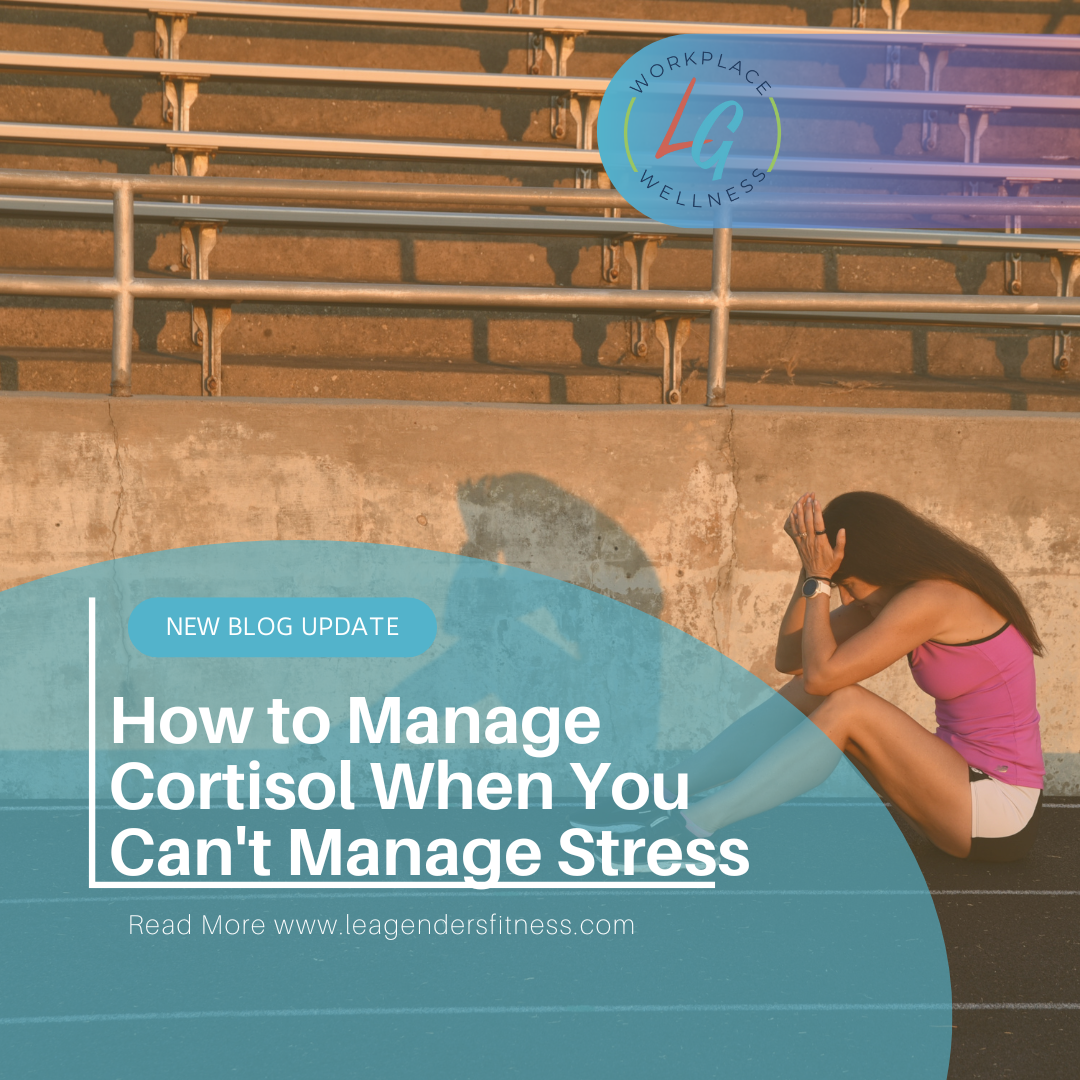
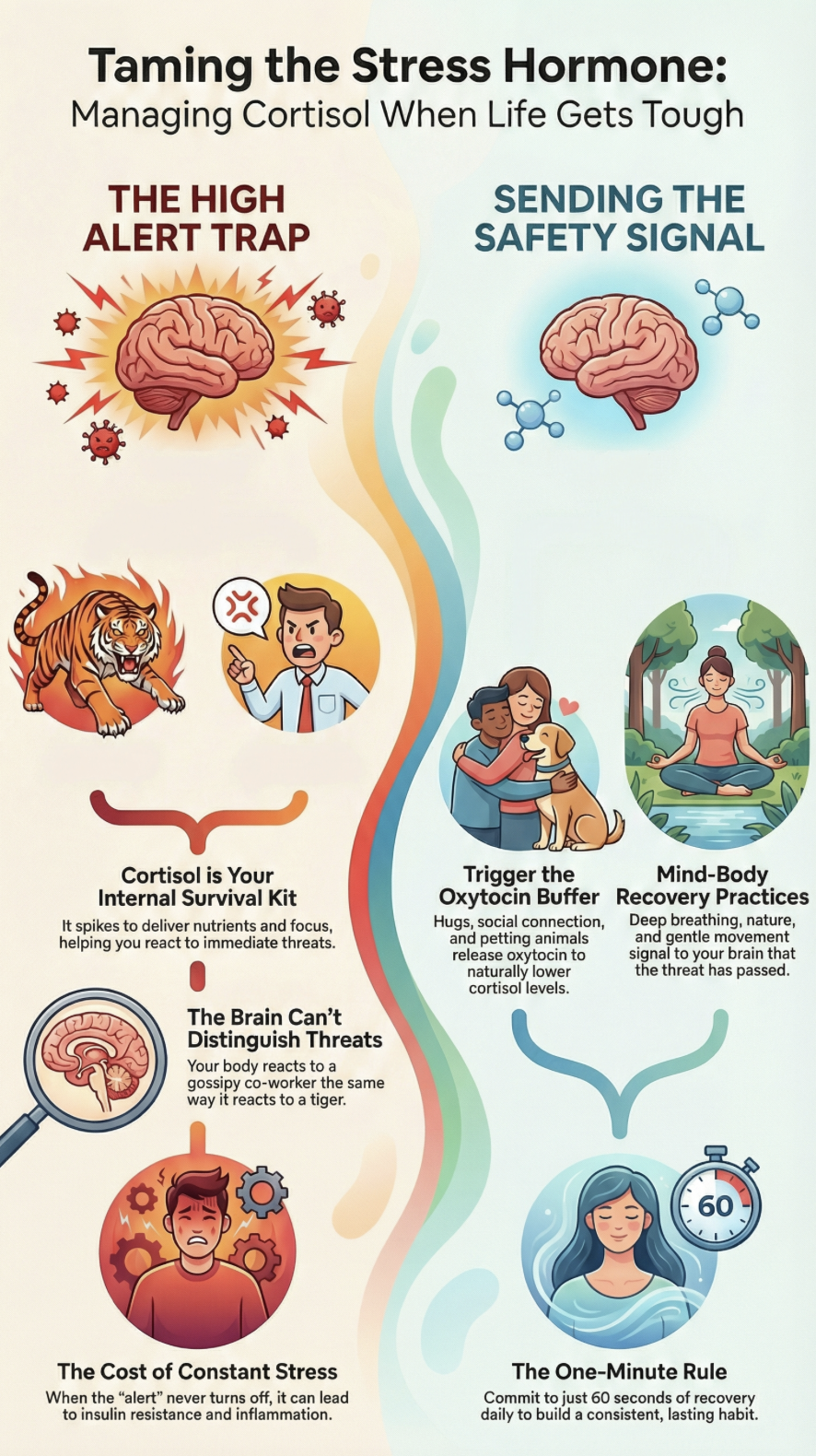
Let’s talk about stress. It’s part of modern life (and historical life)! We hear a lot about the hormone cortisol, and it has a bad reputation as the stress hormone, but it is an important part of your daily energy cycle and your body’s internal survival kit. In a healthy state, it rises in the morning to help you wake up and is at its lowest in the evenings so you can sleep. It spikes to help you focus and have the energy you need to face challenges by rapidly delivering nutrients to your brain and body, so you are ready to react to a threat.
Now we understand that cortisol is good for us, makes us more resilient, and basically keeps us alive (thank you, cortisol!) It’s intended to be a short-term solution. Your body gets the cortisol it needs to survive the stressful event, you return to a calm state, cortisol naturally lowers, and you come back stronger.
But what if those threats are a gossipy co-worker, fear of losing your job, worrying about a relationship, or simply too much work and not enough rest? Even some everyday “normal” activities like caffeine on an empty stomach, drinking alcohol, low nutrient intake (i.e. restrictive dieting) or even dehydration can send that high alert signal. Your body doesn't know the difference between needing to run from a tiger in the wilderness and Susan in accounting dropping the ball (again!). Your brain releases cortisol in response to threats, real and perceived.
When the High Alert Never Turns Off
When the high alert is on for too long without recovery, you start to feel the consequences.
To fuel the fight-or-flight response, cortisol increases blood sugar levels. This is great for short-term energy needs, but it can become a health issue if there's no use for that fuel, and it stays constant. It can lead to insulin resistance, in which your cells become “numb” to the effects of insulin, which naturally lowers blood sugar.
Even our immune system can be stimulated by stress and it doesn’t need a virus to trigger inflammation. Your brain signals your immune system to prime itself for a potential damage, which causes your body to increase inflammation as a protective measure, basically treating your thoughts and worries as if they were an actual virus or injury.
Sending the Safety Signal
Back to what we can control, because Lord knows it’s not your spouse (amiright?). We can start by taking actions that signal to your body that the threat has passed. We can't always control our circumstances or other people, so it’s not helpful to just say "reduce your stress” or “just relax.” Instead, look at it as a balancing act between unavoidable stressors and intentional recovery practices.
Start thinking about what kinds of recovery actions might fill your tank when life stressors drain it. Mind and body practices like deep breathing, meditation, prayer, gentle movement, creative pursuits, and getting outside in nature all help send the signal that the threat has passed.
Meaningful social interactions, hugs, petting your dog or cat, and deep conversations with loved ones can release the hormone oxytocin which is involved in naturally lowing cortisol levels.
Having a winding-down routine before sleep, dimming the light, light stretching, or breathing exercises can be a restorative practice that lowers the stress response and allows you to sleep more deeply and recover more effectively. Remember, stress is not bad in itself, as long as we recover it makes us stronger. Instead of feeling helpless about stressors we can’t control, we can start to focus on that recovery.
TAKE ACTION: THE MOST IMPORTANT STEP
Often, when faced with new habits or practices in our day, we have big ideas that never materialize into lasting behavior change, simply because we start too big. Starting a meditation practice or light stretching for 15 minutes every day sounds reasonable until you remember you have kids and a spouse (like anyone would leave you alone for 15 minutes at a time, ha!). My invitation to you is to pick one recovery practice. One. Then commit to it for one minute a day. That’s it. Purposely make your new goal so simple that you wouldn’t possibly have a reason not to do it. Now, you’re thinking, “But Lea, what's the point? What is one minute a day going to do?” It builds the habit and consistent action, which are the most important parts when you are starting out. The idea is you can always do more, but never let a day go by without at least doing your minute.
And see what happens.
Questions? I’d love to help.
Lea
There is no greater compliment than a referral!
Have I helped you? Leave a Google Review here

Lea Genders is a board-certified health coach, personal trainer, and workplace wellness consultant based in Fort Worth, TX. She offers corporate wellness programs for employee health and productivity, as well as in-person and virtual training / coaching for individuals worldwide. Her blog shares expert guidance on strength training, running, and sustainable nutrition @fortworth_trainer




Meal prep sounds so Type A, but here’s how a self-proclaimed queen-of-good-enough does it: protein, veggies, and dinner without the Sunday prepping marathon, plus why the best meal prep food is the kind you’ll still want to eat on Wednesday.