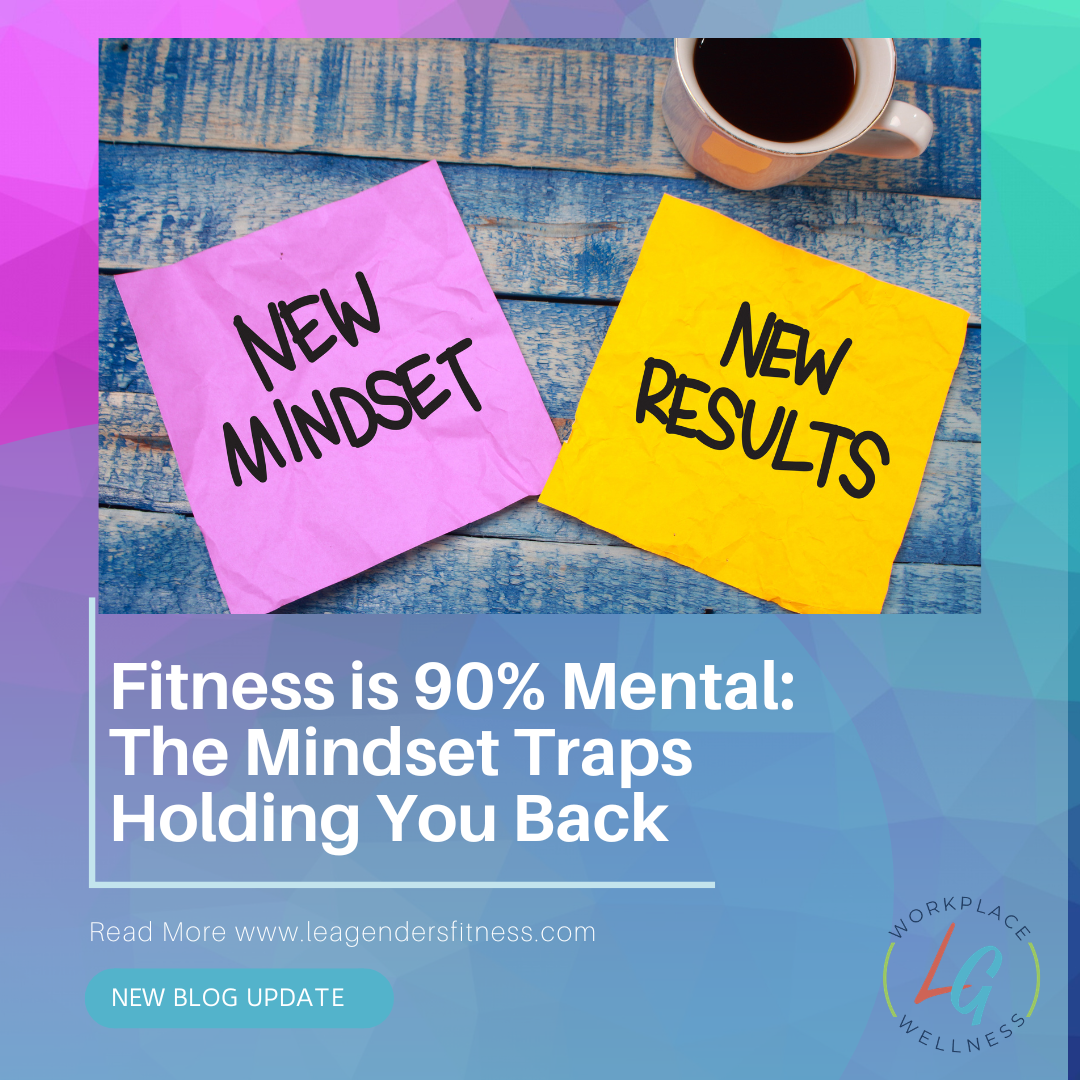
The more I coach and grow personally, the more I realize that health and fitness is 90% mental. We often think we are held back by genetics, a busy schedule, or even age, but what usually keeps us stuck are poor mental practices. Once you decide to get healthier, you have to think about how you think and examine old mindsets that don't serve you anymore. Sometimes we have hidden beliefs or outdated ideas that we don't even realize are holding us back. I can speak about these confidently because I’ve fallen for each of them during my own journey, and I see them everyday all around me.
1. The Perspective Trap: We are Unreliable Narrators
I recently found a picture of myself from my 20s. I specifically remember feeling out of shape when it was taken. Thirty years later, looking back, I realize I looked cute and fit. I have no idea what I was seeing then, but I was clearly wrong.
It happens with performance, too. Six years ago, I could run a considerable sub-2-hour half-marathon with ease. Lately, that has been a struggle. If I only compare myself to those easy years, I am constantly frustrated. But if I am grateful for what I can do today, which is still a lot, I can appreciate the journey for what it is.
The connection here is that we often struggle with perspective in the present. If I couldn't see the truth in my 20s, why would I trust my harsh judgment now? My finishing times were never the problem, it's how I'm judging myself.
We do this with others, too. We look at someone else and assume it is just easier for them. We compare our reality to their Instagram highlight reel.
We are unreliable narrators of our own lives. We often judge ourselves too harshly and others too simply. Our perspective is usually skewed. It takes practice to step outside ourselves and see the bigger picture. It’s also why working with a coach can be helpful. It’s hard to be objective about our own lives. When we accept that we might not be seeing everything clearly all the time, it’s easier to enjoy the process.
2. The Fixed Mindset Trap
When I started barbell training, I struggled. I had a coach who taught me the movements and encouraged me to lift heavier than I ever imagined I could, but more than a few times, I left the gym almost in tears, thinking, "Maybe this just isn’t for me." I had to actively remind myself that it could be for me if I wanted it to be, but it wouldn't be if I wasn’t willing to keep trying. That realization is what kept me showing up.
A fixed mindset is the belief that your abilities are set. Statements like "I’m just not a strong person" or "I’ve never been athletic" treat fitness like a talent you're born with rather than a skill you practice. The thoughts, “I’m too old.” or “I’m too out of shape.” hold more people back than their actual abilities.
When we are beginners, a fixed mindset tells us that because we aren't good at something immediately, we just aren't built for it. A growth mindset allows us to add "yet" to the end of that sentence: "I’m not good at it yet."
I’m so grateful I didn’t give up when it got hard. By working through those struggles, I came out on the other side stronger, more confident, and more resilient than I ever thought possible. I try to remember this when I try something new (like entrepreneurship!).
3. The Identity Trap
This is about the labels we give ourselves. "I'm a busy professional," "I'm a mom," or "I'm the person everyone else leans on." We often use these roles as reasons fitness doesn't fit into our lives. We decide that people like us are too busy or too tired to be a fitness person.
A client once told me that when she was in school, she felt she had to choose between being the smart one or the athletic one. She chose smart. It wasn't until she was an adult that she realized she could be both smart and athletic. It is a perfect example of how even our positive traits, like being smart and successful, can sabotage us if we think they don't leave room for anything else.
Even a label like "I’m a runner" can be a trap. I spent so many years identifying strictly as a runner that I didn’t see how strength training could fit into that identity. I told people I didn’t like lifting; I just wanted to run. But the truth is, I never gave it a fair chance. I lifted weights a few times, got sore, couldn’t stand up from the toilet for three days, and decided I wasn’t the kind of person who lifts weights.
Well, friends, I was flat wrong. When I started lifting with a coach and stayed consistent long enough for that debilitating soreness to stop, I realized it made me healthier, stronger, and even a better runner. It changed how I saw myself. Now, I don’t identify as just a runner anymore. I am a trainer, a coach, and someone who loves fitness. That kind of identity is what keeps me active and consistent even when life gets busy.
4. The All-or-Nothing Trap
This is my favorite story to tell because it is the whole reason I became a coach in the first place. I spent more years than I care to recount bouncing up and down in weight because of the all-or-nothing trap. It’s the mistaken idea that if you can’t do everything perfectly, you might as well do nothing. If I can’t do a full hour at the gym, I might as well stay on the couch. If I eat one cookie, I might as well just finish the whole box and start over tomorrow (or Monday). I’d white-knuckle my way through a strict diet or an extreme exercise plans only to go equally extreme in the other direction when the program ended.
All-or-nothing usually leads to nothing. By trying to be perfect, I’d swing wildly from one end of the spectrum to the other, never finding a middle ground. It was only when I realized ten minutes of movement is better than an hour that I never did, and that one sugar-filled treat didn’t mean I failed, that I was finally able to stay consistent long enough to see sustainable results. Once I started accepting the "good enough" efforts, I was able to keep the weight off for good.
5. The Self-Compassion Trap
Do you ever wonder why you walk into the kitchen and can’t remember what you went in for, but you can sing every lyric to the theme song for The Fresh Prince of Bel-Air? (What? Just me?)
It’s because your brain loves repetition. The more a neural pathway is used, the stronger and more automatic it becomes (so maybe I watched too much TV in the 90s). This is how your brain saves energy; it turns frequent thoughts or behaviors into a "groove" so it doesn't have to work as hard to recall them.
The thoughts you have and the way you talk to yourself have the same effect as an old song. It just plays automatically in the background. You’re not trying to remember the lyrics; you just know them. If you constantly tell yourself that things are too hard, that you aren't good at this, or that you’re lazy, weak, or unfit, then that becomes the story and the song that plays on autopilot sabotaging you from behind the scenes.
But when you teach yourself a new song, you can rewire your brain. You can choose a song of resilience, one that says you can do anything you put your mind to. You can remind yourself that you are smart and capable and that you have done plenty of hard things before. When you start playing that new song in the background, everything begins to look different. It takes work including self-awareness, observation, and a willingness to change.
If a song you hated was playing on loop, you’d change the station. Yet we let a negative self-talk internal voice tell us we aren't doing enough. Self-compassion is just changing the track. It’s learning to treat ourselves at least as kindly as we do the other people we love.
6. The No-Pain No-Gain Trap
Sometimes high-achieving people think a workout doesn't count unless it leaves you sweaty and exhausted. I blame the internet. It’s the no-pain-no-gain trap.
There are a few reasons this fails us. One is that extremely hard workouts are physically and mentally demanding. When something is hard mentally, it makes it harder to start because our brains are trying to protect us. The more friction there is to overcome at the start, the more likely it is that we never get started at all.
Secondly, more is not always better. More without recovery can lead to injury and burnout. You can’t get fitter if you’re hurt. It’s not to say you shouldn’t push yourself or have high-intensity sessions, it’s just that you need those a lot less often than you need to just move your body regularly. Hit the high-intensity class once a week, slowly build up the strength over time, and keep showing up.
For busy people, sometimes the most productive thing you can do is a walk, a mobility session, or a 20-minute strength-building session. More intensity or longer gym sessions aren't always the answer. More sweat or more soreness does not mean you had a better workout or that you will get better results.
What you can do consistently is more important than what you do occasionally.
7. Outcome Obsession TRAP
The outcome obsession is a trap because it sets us up for disappointment. If the scale doesn't move one week, we feel like we failed, even if we feel better or slept better. Clients often come to me and say they want to lose weight. Okay, fine. My job is to help get them what they want and a dose of what they need (mindset work, strength, health, longevity).
The people who learn to enjoy the process and celebrate the wins along the way, in whatever form they take, are the most successful. You know why? Because those who are too outcome-focused often quit after four or eight weeks when they don’t see dramatic physical results (again, I blame the internet for unrealistic expectations).
Sure, we celebrate fat loss around here, but you know what else we celebrate? Realizing we’re the “strong” friend in the group. Being able to lift heavy objects around the house without help. Not needing the clerk's help carrying the 30-lb dog food bag to the car. Putting our own bag in the overhead compartment. Simply noticing tasks around the house are a little bit easier. Sleeping better. Having more energy. Feeling more confident. If the number on the scale is your whole focus, or your obsession, the stress of holding that tightly can sabotage you in itself.
When we let go of what we can’t fully control, like the number on the scale or how fast we run, and focus instead on our behaviors and habits, we’re focusing on what we can mostly control. Over time, with patience and consistency, everything starts to fall into place. I like to say fat loss is a side-effect of a healthy lifestyle, not the whole point. We can’t force outcomes.
When we recognize and celebrate every small win along the way, it gives us the fuel to keep going.
Now What?
Do any of these feel familiar? Is there a mindset you want to work to improve? If you can change one thought it can be the start of a whole new way of thinking about your health and fitness.
The same mindsets I mastered in my health journey, I have to relearn as I run my business. I continue to work through mindsets, question my own thoughts, look at the bigger picture, give myself grace, and realize I am always learning and growing. And then I don’t. I mess up, and that’s part of it. I’d love to hear your perspective.
Lea
There is no greater compliment than a referral!
Have I helped you? Leave a Google Review here

Lea Genders is a board-certified health coach, personal trainer, and workplace wellness consultant based in Fort Worth, TX. She offers corporate wellness programs for employee health and productivity, as well as in-person and virtual training / coaching for individuals worldwide. Her blog shares expert guidance on strength training, running, and sustainable nutrition @fortworth_trainer






Meal prep sounds so Type A, but here’s how a self-proclaimed queen-of-good-enough does it: protein, veggies, and dinner without the Sunday prepping marathon, plus why the best meal prep food is the kind you’ll still want to eat on Wednesday.