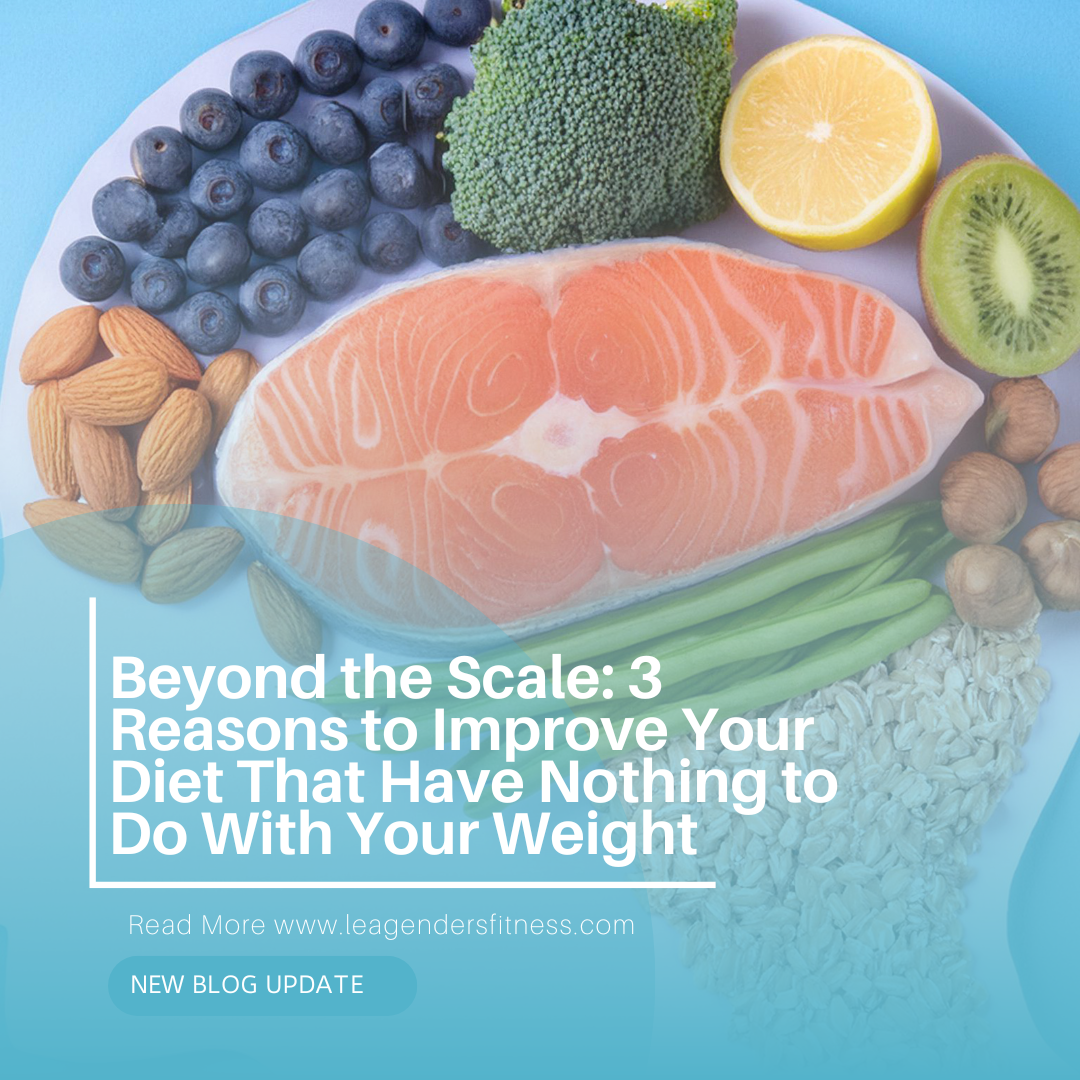
Most people only think about nutrition or changing their diets when they want to lose weight. What we often miss is that how we eat is a resource that can improve life in many meaningful ways, even if the number on the scale never moves. There are so many things in this world we can't control, but for most adults who buy their own food, nutrition is a tool we have in our toolbelt to make a difference in how we feel, move, and look. The beautiful part is that we don’t have to be perfect; we don’t need any heavy restrictions, and we can even eat the foods we enjoy while making meaningful changes right away that improve the quality of our lives. Here are three reasons to improve your diet that have nothing to do with weight loss.
Stabilize Your Mood and Manage Stress
If you’ve ever felt Hangry (getting so hungry you feel angry), you already understand the relationship between low blood sugar and mood. Low blood sugar triggers a direct stress response. When your brain senses you are low on energy, it perceives it as a threat and releases stress hormones. This causes your liver to pump stored glucose into your bloodstream for that quick energy you might need to run away from a wild animal.
Your brain doesn’t know the difference between physical danger and perceived stress. If you are just sitting in your chair, this internal reaction can make you feel unnecessarily anxious or irritable during a work meeting. By eating regular, nutrient-dense foods, you can directly lower that stress response and keep your mood steady. Small changes in your nutrition can change how you are showing up at work, for your family, and in your life.
Fuel Your Movement and Recovery
You’ve probably heard things like, “Food is fuel!” And that sounds good, but I don't really like that saying because it ignores the idea that food is also cultural, emotional, fosters connection, and can be a show of love. Looking at food as only fuel can feel a bit stiff and take the joy out of it.
If someone says, "I could never diet because I love food too much," it helps me better understand their relationship with food. Eating shouldn’t be an experience equated to fueling up your car at the gas station. Food is something to enjoy, to nourish our bodies, and make us feel good.
All that being said, calories are literally energy. Feeling sluggish? Think about the quality of food you recently consumed. When you eat nutrient-dense food, it gives you the energy to do the activities in your life that you enjoy, whether that is walking with your family, dancing, swimming, hiking, camping, or pogo-stick competitions. (hah)
When we talk about recovery from exercise, food also plays a huge role. Recovery is more than sitting on the couch for a Netflix marathon; physical recovery literally means replacing the fluids you sweat and the glucose your muscles used. You need nutrients (and sleep!) to rebuild damaged tissues. Without this recovery, it can lead to additional stress on the body, burnout, or injury.
Improve the Quality of Your Sleep
Have you ever made the connection between what you eat and how you sleep? I don’t just mean when a six-ounce steak and a glass of wine at 8 PM keep you up too late. Of course, heavy meals and alcohol can disrupt sleep processes.
But it also works in another way. Too low a calorie intake, or even a low nutrient intake, signals a stress response in the body. This includes being overfed and undernourished (plenty of calories but lacking vitamins and minerals). That cortisol release at night, when it naturally should lower, can disrupt your circadian rhythm. This makes it harder to fall asleep and reduces the quality of your rest.
Eating a regular-portioned, nutrient-balanced meal at least three hours before bed can directly improve your sleep.
Why There Is No One-Size-Fits-All Approach to Nutrition
If you're thinking this all sounds great, but you still don’t know what to eat, I invite you to start experimenting with a few ideas in mind. We are all different in the sense that we have varying preferences, experiences, values, and tolerances.
I had a client once who complained that whenever she put spinach in her smoothie, she got an upset stomach. She asked her doctor, and her doctor said bluntly, “It’s not the spinach.” But when she drank the smoothie without the spinach, she was fine. For her, leafy green spinach was not healthy because it did not make her feel well. There is no one-size-fits-all approach to nutrition. Just because something is "healthy" doesn't mean you have to eat it, especially if you don’t like it or it doesn’t make you feel good.
Conversely, just because something is "unhealthy" doesn’t mean you never get to eat it. A healthy body and mind are flexible. If you are getting the nutrients your body needs, a treat can be positive and healthy.
Rethinking Processed Foods for Convenience and Health
Generally speaking, the closer a food is to its natural state, the healthier it is (poisonous mushrooms notwithstanding). This isn't meant to imply you have to start growing your own vegetables and hunting your own meat, but start to think about prioritizing whole foods: poultry, lean meats, vegetables, eggs, potatoes, fruit…you get the idea.
I am going to say something else that you don’t hear much from health coaches: processed foods are not the devil. Seriously. Processed foods allow us to get many needed nutrients in ways that are inexpensive and convenient. Examples of processed foods that can support your health goals include frozen or microwavable vegetables, canned beans, fiber-rich whole-wheat bread, instant rice, oatmeal, liquid egg whites, and protein powder (among many other foods). They are not perfect in many ways, but don’t let perfect get in the way of good enough for now. You don’t need perfection to improve your health, just “better than before.” Better eating choices start with making decisions in the right direction, not holding yourself to an impossible standard. Start with what feels realistic in the life you are living today.
It’s a better strategy to focus on reducing the ultra-processed foods you consume, which are usually the items in the snack aisle, dessert freezer or deep fried choices. These foods with very low nutrient quality, but high sugar, high sodium, high saturated fats, and high calorie counts are manufactured specifically to make you want to eat more of them. They even tell you in the marketing (Bet you can’t eat just one!). I probably dated myself with that reference.
It’s easier to overeat calories in low-nutrient food than it is in foods that support your health. While this article was never about losing weight, when you start to change your mindset about getting the foods you need to be healthy, weight loss is often a natural side effect.
My favorite example of this is an egg and an Oreo. A medium egg is about 63 calories, which is only ten calories more than a single Oreo. If you eat a whole sleeve of twelve Oreos, you're looking at over 600 calories. To eat as many calories from medium eggs, you’d have to eat ten eggs. Most people could polish off a sleeve of cookies while answering emails without even thinking about it. But almost nobody is accidentally eating ten eggs in one sitting.
It’s not easy, I know. But it is simple. It’s all about building habits and practices, and experimenting with what works best for your body and lifestyle. Leave all the rules (and guilt and shame) behind. Aim to eat a mix of proteins, carbohydrates, and fats in health promoting foods that make you feel good. Try to eat minimally processed foods where it makes sense, but if some processed foods help you get nutrients with less hassle, they can be a good choice too. Don’t forget to eat the foods you enjoy with the people you love.
Questions? I’d love to help.
Lea
There is no greater compliment than a referral!
Have I helped you? Leave a Google Review here

Lea Genders is a board-certified health coach, personal trainer, and workplace wellness consultant based in Fort Worth, TX. She offers corporate wellness programs for employee health and productivity, as well as in-person and virtual training / coaching for individuals worldwide. Her blog shares expert guidance on strength training, running, and sustainable nutrition @fortworth_trainer





Meal prep sounds so Type A, but here’s how a self-proclaimed queen-of-good-enough does it: protein, veggies, and dinner without the Sunday prepping marathon, plus why the best meal prep food is the kind you’ll still want to eat on Wednesday.