
I got such a positive reaction to last week’s post about carbohydrates and fiber I decided to stay on the nutrition path for another week. I titled this post "Dieting Toolkit: Everything You Need to Know to get results." But in the third sentence, I'll tell you that the anti-diet approach works better. Bait and switch? No. This is the toolkit you always needed, but popular culture got it all mixed up.
The Calorie-In-Calorie-Out Confusion
There is a lot of noise out there that says "calories-in-calories-out" doesn't work. But this is the law of thermodynamics. It is literally proven by science: we lose weight by taking in fewer calories than we burn. Gain weight by consuming more than we use.
The mistake we make, and where the confusion comes from, is thinking this is something you can perfectly calculate in an Excel spreadsheet or can totally control. Even those calorie and macro calculators that give you calorie targets for weight loss or muscle gain are estimates, no online algorithm knows exactly what is going on in your body. They are meant to be used as a guide and starting point, to be adjusted based on how your body responds.
If you count the calories you eat and watch the calories you burn on your fitness tracker, and when it seems like you are in a deficit but you're not losing weight, you start to say, "Hey, deficits don't work!"
But they do. The problem is that so many things affect both sides of the calorie in calorie out equation.
Look at "Calories In." Even if you are weighing and measuring every morsel and never forget a single lick, bite, or French fry from your spouse's plate (which most people don't do, including me), the labels themselves are legally allowed to be 20% off in either direction. So that 200-calorie snack could be 240 calories. On top of that, Calories In is affected by things like hormones and sleep, which dictate your appetite and how much food you think you need. Separately, it is also about how much food you are absorbing, the quality of your food, and your satiety. Calorie counting can be helpful for learning portion sizes and awareness but it is far from an exact science.
Then look at the "Calories Out" equation. Your fitness watch is estimating, and likely overestimating. I read that trackers can be off by 27% to 93% depending on the activity (yikes)! Even if you use a heart rate monitor, you are likely not burning as many calories as you think. Plus, we are human. Even health professionals who do this for a living (Guilty!) tend to underestimate what we eat and overestimate what we burn. Calories Out is also influenced by body size, muscle mass, genetics, metabolism, and more. It’s far from a simple calculation.
The biggest mistake is thinking calories in and calories out only have to do with your nutrition and exercise.
All Diets “Work”
Another big mistake people make is thinking there is some magic diet out there. As the saying goes, there is nothing new under the sun. Whatever faux (ok fine, or real) doctor wrote a book about the latest diet, the reality is twofold. All diets work as long as they create a calorie deficit, and as long as you stick to them.
Let’s break this down a bit. Keto works because you cut calories by removing all carbs. Intermittent Fasting works because you restrict the time window you are allowed to eat and therefore eat less calories. Paleo works because you cut out processed foods and dairy. If you can stick to any of these long enough to lose weight, they will work. And if one of these diets works for the way you prefer to eat, that’s great. It it makes you look, feel, and perform your best. Keep going. You found your thing. The problem comes when it doesn’t work for you. You think it "should work," and assume it’s your fault when you can’t keep up with the trendiest way to restrict, and give up altogether.
People fail because they choose extreme diets that cut out entire food groups or extremely limit calories, which just isn't realistic for a lot of people over the long term. A balanced plate that follows the basics will always win because of sustainability. If you eat mostly protein and veggies, choose whole or minimally processed foods when possible, drink plenty of water, and pay attention to portion sizes, you are 90% of the way there. And don't forget that food is for joy and connection, too. Cutting out every morsel of pleasure for the sake of a diet is a recipe for burnout.
The Healthy Eating Trap
This brings us to the trap of mistaking "healthy eating" for fat loss. I hear clients say all the time, "I eat healthy, so I’m not sure why I’m not losing weight."
Lots of foods like nuts, seeds, salmon, and avocados are incredibly healthy, and you should include them in your diet, but they have higher calorie counts. While carbs and protein have 4 calories per gram, fats have 9. Those portions add up quickly, especially if you aren't measuring. The bag of nuts might say 190 calories for 1/4 cup, but if you don't measure, you can easily double or triple that throughout the day without realizing it.
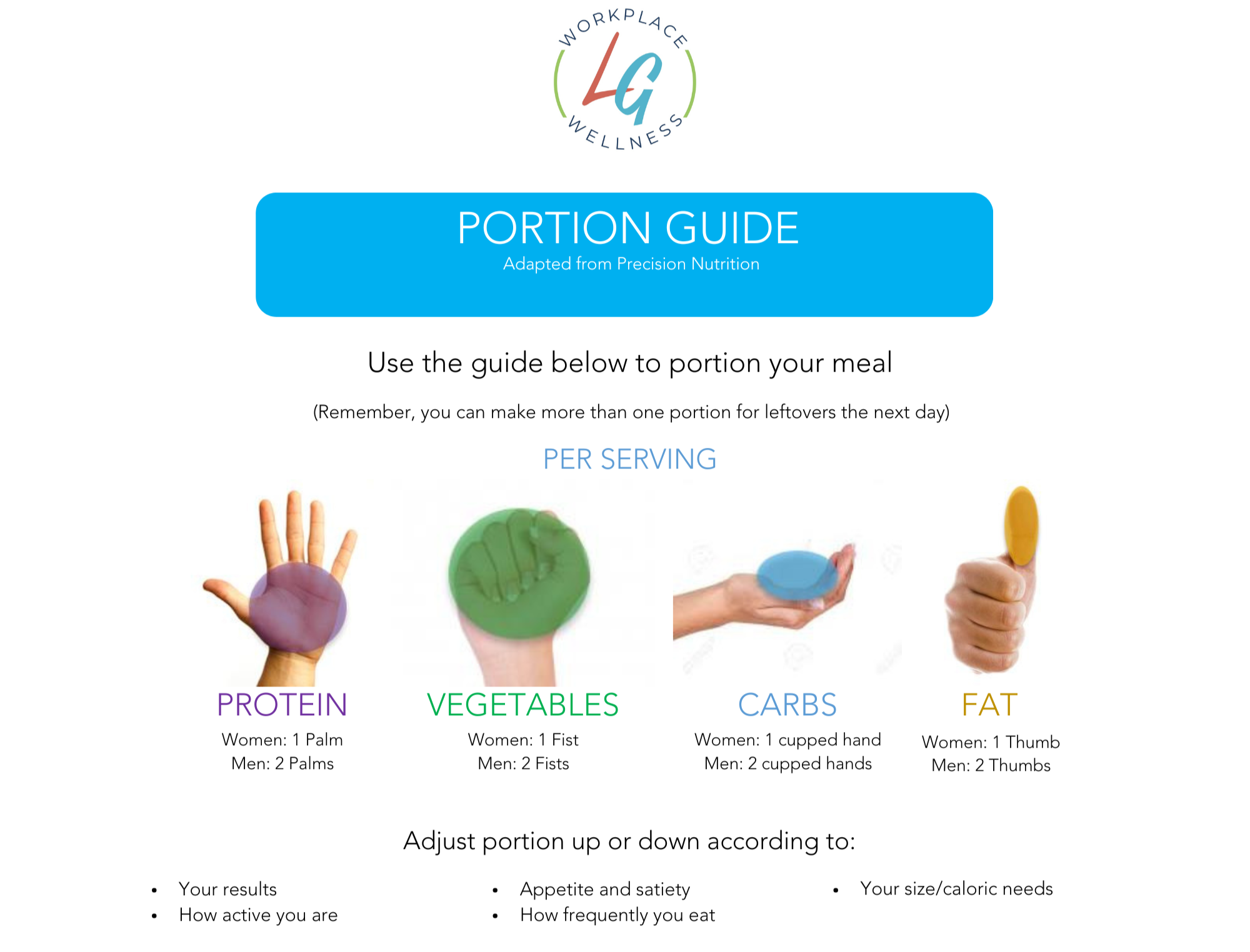
Most people don’t need to count calories, but you do need to pay attention to portion sizes. One easy way to do this for fats is to use your thumb as a guide. Think of a serving size as the size of your thumb when slicing an avocado or eating nuts.
The real driver of fat loss is calories. In theory, you could eat all junk food and lose weight if you were in a calorie deficit, but that wouldn't be healthy for your body. It is also more difficult because processed foods are engineered for palatability (to make you want to eat more). Whereas healthy foods can make you gain weight too if you eat more than your energy needs. The key is to find the balance. Eat the foods you enjoy that make you look, feel, and perform your best while maintaining a slight (not drastic) calorie deficit. That’s it. That’s the big “secret.”
Then, don’t stay in the deficit forever. Give your body room to breathe. Come out of it, eat a little more, and maintain for a while before pushing again.
The Strategy That Works
The strategy that works is to aim to eat a little bit better than before. What does that mean? Micro improvements. What it doesn't mean is trying to completely overhaul your diet in one day. We have all tried that before, right? And it usually doesn't work at all.
But if every time you eat, you think, "How can I make this a little bit better?" you will slowly start making better choices that snowball over time. What constitutes a little better? Maybe a smaller portion, more protein, more fiber, less junk food, or more vegetables.
The reason this works is that it avoids saying, "I will start eating better tomorrow" (when tomorrow never comes) or declaring a last-hoorah meal (oh, you have done it too). And if you are always looking to get a bit better, better keeps improving. It works for someone who is just starting this journey and isn't used to healthy foods at all, as well as for someone who already eats pretty well. We can always get a little better.
This mindset gets us away from all-or-nothing thinking. Instead of thinking that if I can't eat the perfect meal, I might as well eat half a pizza (and feel bad about it the next day), you shift to saying, "My friends ordered pizza, and I want some, so I will limit my slices to two and maybe add chicken for additional protein." See the difference? We work with what we have in front of us without pressure or guilt. Do the best you can. Just do a little better than you would have otherwise.
It works when you are busy, or when you don't have a choice of meals, like at a work function or party. Maybe a little better in this context is to eat really slowly and chew every bite to help with satiety and digestion. It focuses on what you can do immediately to get a win in the moment, no matter what, and removes all the guilt of not being perfect. That is where long-term success and sustainability come from.
No one is perfect, and that is not the goal. The goal is to be a little better, make micro-choices in the right direction, and over time, those small decisions add up to big changes. It’s the true Anti-Diet sustainable approach. The outcome is that instead of heavily restricting for a couple of weeks and then falling off the wagon, you make steady continuous progress that feels doable and leads to real results over time.
Questions? I’d love to help.
Lea
There is no greater compliment than a referral!
Have I helped you? Leave a Google Review here

Lea Genders is a board-certified health coach, personal trainer, and workplace wellness consultant based in Fort Worth, TX. She offers corporate wellness programs for employee health and productivity, as well as in-person and virtual training / coaching for individuals worldwide. Her blog shares expert guidance on strength training, running, and sustainable nutrition @fortworth_trainer








A guy in my neighborhood runs only in the hottest part of the day, in the hottest months of the year. We call him Self-Inflicted-Pain-Guy. I laugh, but lately I’ve been wondering why I’m often Self-Inflicted-Pain-Girl myself. What if I’ve been mistaking discipline for structure?