A long time ago, in a world far, far away, I worked five days a week in a corporate office. At the time, I had a minor elbow strain and was wearing a compression sleeve to work to help accelerate healing. A coworker asked me about it, and I confessed it happened at the gym.
I never forgot what she said next: “You see, that’s why I don’t do any of that gym stuff. All you people I know who go to the gym end up getting hurt.”
The truth of the matter is, when you push your body to perform athletically over the years, chances are that you will experience at least some sort of minor strain or pain along the way, and at worst, a full-blown injury. My coworker was not completely wrong in her observations (only in her conclusions). If I think of everyone I know who has been working out for five years or more, nearly all of them have had to deal with at least some pain or strain along the way. But of course, people who don’t workout get pains and strains too (and usually worse).
I am no exception. Over the past couple of decades, I’ve experienced everything from minor muscle pulls, joint pain, to a full-on boot on my foot. But the fear of pain or injury is not a reason to stop moving your body, challenging your muscles, building your endurance, or working to increase strength.
In the end, a fitter body is more resilient against injury and pain. You can avoid the gym and never pull a hamstring from lifting weights, but you might pull one stepping off a curb. Lifting weights builds muscle, strong bones, and tendons. When you trip, you are more coordinated to catch the fall in the first place, and if you do fall, you are less likely to sustain a major injury. Muscles stabilize joints.
It comes down to risk versus reward. Yes, there is a small amount of controllable risk, but the reward of a fit and resilient body makes that risk completely worth it.
Why Avoiding Strength Training Increases Your Injury Risk
If you or someone you know lets fear get in the way of strength training, the risk of getting seriously injured actually increases, not decreases.
One way to mitigate that fear is to work with a professional. A trainer can help you determine appropriate loads, exercise selection, proper form, and recovery strategies so you aren't guessing. I spend as much time helping clients realize they can do more than they think as I do making sure we don't overshoot their current capacity.
That balance is what it all comes down to: load versus capacity.
When the load placed on the body is greater than its current capacity, we can get hurt. However, that load isn't just about the weight you’re lifting. People assume injury is always acute: "I tried to press too much weight, failed, and hurt myself."
Of course an injury like this can happen, but it is rarely that straightforward. Muscles adapt and develop faster than tendons and ligaments. If we rush progress, our muscles might be strong enough to physically lift the weight, but our connective tissues haven't caught up yet, which can lead to injury over time. This is why progressive overload (increasing weight or volume progressively) must be done slowly and systematically. We can’t rush progress.
Understanding Allostatic Load: How Life Stress Impacts Recovery
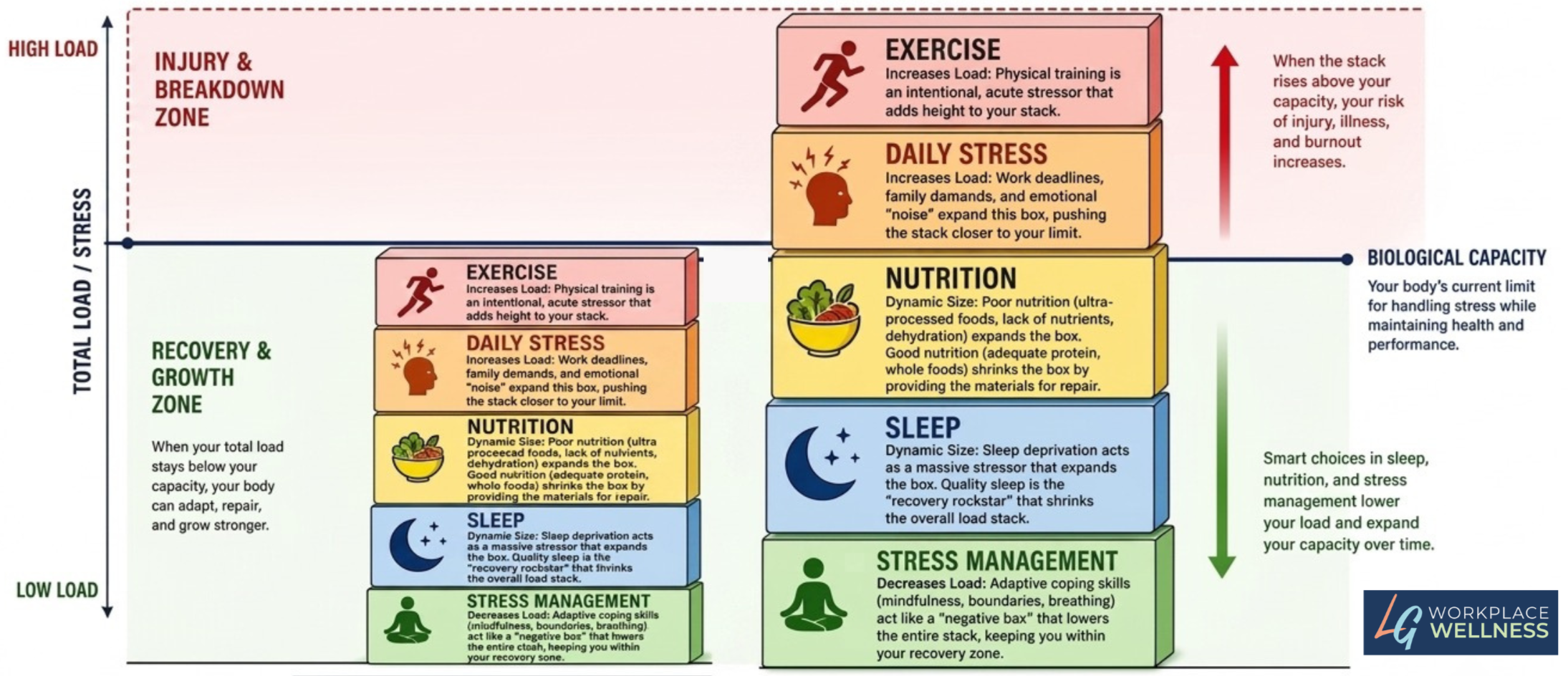
Load is much more than the weight on a barbell or dumbbell. Allostatic load refers to the cumulative stress from all areas of your life. We don’t have one bucket of stress for exercise, another for work, and a third for your child who refuses to eat a vegetable or wear matching socks. It’s all combined. If we aren't recovering properly from all of life’s stressors, we drastically increase the chances of an injury. I wrote a whole blog post on recovery last week in case you missed it. It comes down to load (from all stressors) verses current capacity to recover from it.
People often think of recovery solely as rest days, but it is just as much about proper nutrition, stress management, and quality sleep. Consuming too few calories or lacking key nutrients increases physical stress on the body and inhibits repair. Shortchanging your sleep doesn’t give your body the time it needs to restore. And failing to rest your muscles gives them no chance to rebuild before being broken down again in your next workout. The combination of these can lead to that gym injury. I see this as good news because it gives us a little more control over our aches and pains than we might have thought.
How to ADDRESS Chronic Pain Beyond Exercise
If your lower back hurts, you might rush to the internet to find exercises to stretch or strengthen it. Before doing that, it is worth considering your lifestyle inputs. Are you getting the nutrients, quality sleep, and recovery you need between sessions? Are you managing everyday stress in healthy ways?
If you think about your overall stress load in regards to injury prevention, you can consider if your nutrition is increasing your stress load with ultra-processed foods, alcohol, or dehydration, or lowering it with adequate calories, and proper nutrients. Then, are your sleep habits increasing your stress load or helping reduce it? You can think of non-fitness self-care as like a valve-release for stress. It might look like meditation, reading, dancing, spending time with loved ones, coloring, knitting, or whatever else brings you peace and/or joy. The more you can release some of the stress, the smaller your overall load.
People rarely consider their allostatic load when dealing with pain and injuries, but the higher your overall stress without recovery, the fewer resources your body has to repair itself. We are remarkably resilient, but we must maximize the tools we give our bodies to do the job. It isn't to say that every injury can be healed (or prevented) with relaxation, sleep, and good nutrition, as nice as that would be. However, these are huge factors in how your body manages pain and healing, and most people completely overlook them in search of the quick fix or complicated recovery protocols.
Avoiding strength training altogether when healing is rarely the answer. There is always something we can do to modify, reduce, and start rebuilding from your current capacity. A certain amount of aches and pains are inevitable over time, especially as we age, but we don’t have to live with chronic pain.
Of course, ongoing or severe pain should be evaluated by a medical professional who understands and supports strength training. But for everyday aches and minor pains, remember that improving or finetuning your nutrition, stress management, and sleep can help lower your overall allostatic load to give your body the resources it needs to heal.
If you need help getting started or moving forward, I'd love to chat with you about it.
Lea

Lea Genders is a board-certified health coach, personal trainer, and workplace wellness consultant based in Fort Worth, TX. She offers corporate wellness programs for employee health and productivity, as well as in-person and virtual training / coaching for individuals worldwide. Her blog shares expert guidance on strength training, running, and sustainable nutrition @fortworth_trainer






I’d been calling my runs easy effort all summer. My heart rate disagreed, and the same thing might be happening in other parts of your life. In today’s post I talk about the difference between high tolerance and easy effort, and how that applies to sleep, stress, and recovery.