
I almost titled this post Hill Running for Dummies as a nod to my very first running blog back in 2010. I was several of years into my own running journey, loved writing, and decided to combine the two with a blog: Running For Dummies. The "for Dummies" part was mostly tongue-in-cheek. I eventually changed it when my blog started to grow, and I worried about copyright infringement with the ‘For Dummies’ book people.
That early blog became the catalyst for my entire career as a coach and personal trainer. I originally pursued my certifications to learn more, build authority, and offer better advice to my readers. A blog written by a certified coach stood out in an era when every other runner had a personal blog. The rest, as they say, is history. When I published those first posts, I had no idea it would shape my life’s work.
I have hill training on my mind recently because I started sprinting hill repeats again after a long stretch without any specific speed work. I was partly inspired by a client who wanted to incorporate hill training into her routine. In addition to her regular personal training sessions and solo workouts, we met at a local hill each week so I could coach her through a hill-sprint-repeat workout. Doing that with her reminded me just how fun and rewarding hill work can be.
I know what you might be thinking. “Did she really call hill repeats fun?” Hear me out. You work extra hard, but because you get recovery between efforts, the workout feels manageable both mentally and physically. Then, even after running for over twenty years and coaching for more than a decade, I was still pleasantly surprised by the small but noticeable boost to my everyday base pace after a couple of weeks of dedicated hill training.
Let's look at the core structure of hill training through the classic Five Ws: Who, What, Where, When, and Why (plus a quick hoW).
The Who, What, Where, When, Why (and hoW) of Hill Repeat Training
Who Should Do Hill Repeats
Hill repeats benefit runners of all experience levels, from beginners to seasoned athletes. I would recommend that you have about ten to twelve weeks of consistent, easy-paced running under your belt before adding this kind of intensity. This applies whether you are a brand-new runner, returning after time off, or building back up to a more consistent routine. Give your body time to adapt to the everyday demands of running before you ask it to sprint up an incline repeatedly.
What a Hill Workout Looks Like and How to Adapt It For Yourself
Hill sprint repeats are exactly what they sound like, starting with a short 10-to-15-minute warm-up of brisk walking or easy jogging, sprint up a hill, recover, then repeat. For a concrete example, here is how I program my Garmin watch for a hill session. Keep in mind that my personal setup is just one approach, not a universal template. Based on your goals and experience, it may look different for you.
Before I head out, I program the workout directly into my Garmin app. I set the warm-up step for 'until lap press,' and I usually take about 15 minutes to jog over to my favorite local hill. For the work intervals, I program 10 x 1-minute efforts. On the hill, I run up at roughly a 90% effort, it feels hard, but not like an all-out sprint. I intentionally keep the first repeat or two a little slower so I have enough energy to finish all ten strong.
I set the recovery steps to 'until lap press' as well. Once I reach the top of a hill interval, I walk for a moment to catch my breath, and jog back down. Once I reach the bottom, I walk until I feel ready for the next push, then hit lap again for the next repeat. Using 'until lap press' lets me adjust my recovery time based on my heart rate, not a rigid timer. Early in the workout, I might only need 90 seconds to recover, while near the end I might take close to three minutes as fatigue builds. After I complete all ten repeats, the watch moves to a final 'until lap press' recovery phase while I jog (or walk) home.
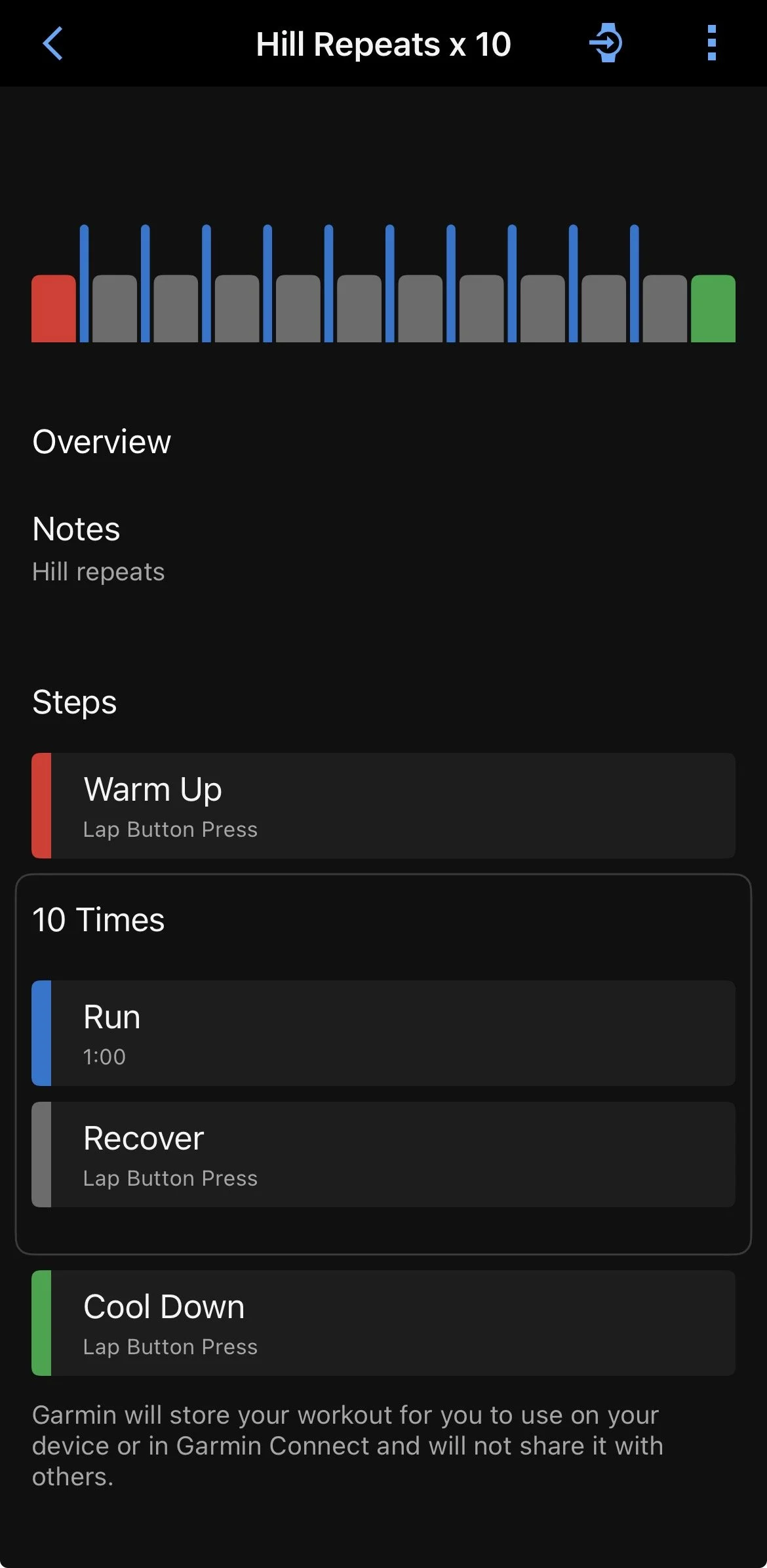
To create a Garmin workout: In the Connect app click the three dots on the bottom right for ‘More,’ then ‘Training and Planning,’ then ‘Workouts,’ then ‘Create a workout.’
What I do isn't necessarily what you should do, and you can easily adjust each variable to fit your current fitness. You can experiment with hill grade, interval length, perceived effort, number of repeats, and recovery time. The goal is to create a workout that feels challenging yet doable.
Time or Distance: You might choose longer or shorter intervals; 20 to 30 seconds of hard effort is incredibly effective. You can also structure repeats by distance, such as a tenth or a quarter of a mile.
Grade: The hill's grade also changes the overall difficulty of the workout.
Effort: If you are entirely new to hill work, you do not even need to sprint; simply running up an incline at your normal pace naturally increases the effort.
Number of Repeats: You can start at four or five intervals and increase the number of intervals over time.
Another thing to keep in mind is that you don’t have to plan or structure anything. Don’t have a watch? No problem! Do a short warm-up to the bottom of the hill, run up to a distance that feels right for you, walk and rest as long as needed, and repeat. You don’t have to plan how many, how fast, or how long in advance if you don’t want to. Do what feels right. Stop when your body tells you, whether that is after three repeats or thirteen. The magic is in the doing. Once you start, you can refine as you go.
Where to Find the Right Incline
I live in Fort Worth, and Texas is famous for being flat, but plenty of our neighborhoods and parks feature great rolling hills. I use a hill near my house because it is convenient, has low traffic, and an incline appropriate for my fitness goals. Look around your neighborhood or local parks to find a stretch that feels safe and achievable.
If your surrounding area is completely flat, you still have options. Some runners use multi-story parking garages during low-traffic, off-peak hours. However, always be mindful of private property rules and car safety. If you have access to a track with sturdy stadium stairs, or long outdoor stairs in other public locations, those make a great substitute. If outdoor space or weather is a limitation, a treadmill can be your new best friend (BRF=Best Running Friend). You can set the incline for your work interval and lower it back to flat for recovery.
When to Add Hills to Your Training Plan
Beyond building a solid base of 10 to 12 weeks of easy running, timing within your overall schedule matters. A rule of thumb for injury prevention is to avoid increasing both volume (weekly distance) and intensity (speed or difficulty) in the same week. If you are adding distance to your weekly long run, hold off on introducing new, high-intensity hill repeats during that same time. Throwing too many new stressors at your body at once makes recovery more difficult and opens the door to injury.
I prefer adding hill work after a strong base-building phase, but before I start ramping up my long-run mileage for an upcoming race. Once my body starts to adapt to the hill efforts, I can maintain them while building my endurance for the race distance.
Your individual recovery needs will vary based on your age, overall stress, nutrition, sleep, and running experience. Learning to tune into your body’s signals is one of the best skills you can develop as a runner. Pushing through severe fatigue without adequate rest doesn't build fitness; Poor recovery usually leads to exhaustion, burnout, or injury.
A little goes a long way, and more is not better when it comes to high intensity work. You get fitter, faster, and stronger after the workout when you are recovering. Working with an experienced coach can help have a second set of eyes on your programming.
Why Hill Running Delivers Big Results
Why are hills such a game-changer? For starters, running uphill forces your glutes, quads, calves, and hamstrings to work harder than on flat ground. You build muscle strength and power on that hill. This doesn’t mean you can skip the gym though, hill repeats complement strength training, but they don't completely replace heavy lifting or progressive overload!
Hill work also improves your running economy, meaning your body uses energy more efficiently. That is why one hill session a week can make your flat, everyday running pace feel noticeably lighter and easier.
Hill work is also gentler on your joints than flat ground sprinting, the impact on your knees and hips is lower. If you have knee issues, be mindful on the way back down the hill by walking or taking controlled steps.
Beyond the physical benefits, hill repeats build mental toughness. Learning to stay focused and relaxed while pushing up a steep hill builds the kind of mental strength you need when things get tough during the final miles of a race. Plus, a hills on a race course at your race pace will feel a lot less daunting when you are accustomed to sprinting them.
How to Maintain Proper Hill Form
Here are a few quick tips for form and technique on those hills. Keep your eyes focused ahead at the crest of the hill rather than staring down at your feet. A coach said this to me twenty years ago, and it stuck: If you can see your shoes, you're looking in the wrong direction.
Lead with your hips and imagine a rope around your waist gently pulling you forward to keep your posture tall. Shorten your stride into quick, light steps rather than overstriding or reaching forward. Always run by effort rather than strict pace, conserving enough energy early so you can finish the workout strong.
Ready to tackle some hills together?
Whether you want to meet up at a hill here in Fort Worth for an in-person coaching block, runner-specific strength training, or you need help structuring your training schedule through online coaching, I would love to support your goals. Reach out anytime, and let's get you running strong!
Lea

Lea Genders is a board-certified health coach, personal trainer, and workplace wellness consultant based in Fort Worth, TX. She offers corporate wellness programs for employee health and productivity, as well as in-person and virtual training / coaching for individuals worldwide. Her blog shares expert guidance on strength training, running, and sustainable nutrition @fortworth_trainer








Meal prep sounds so Type A, but here’s how a self-proclaimed queen-of-good-enough does it: protein, veggies, and dinner without the Sunday prepping marathon, plus why the best meal prep food is the kind you’ll still want to eat on Wednesday.