
The fitness industry loves to keep us confused. Everywhere you look, there’s a new magic workout, miracle diet, or a conflicting expert opinions.
Why We Don’t All Get the Same Results
I remember when my husband and I would start the exact same diet in the same week: he’d drop six pounds, and I’d lose half a pound (or somehow gain one!). It felt so unfair. While "calories in vs. calories out" is the law of thermodynamics, it isn’t always a simple math problem you can just plug into a calculator. There are biological and hormonal differences between us that affect our individual outcomes. We’re all cut from the same cloth, we just don't all get the same results from the same effort.
One of the biggest sources of frustration is the misconception of fat-burning exercises.
You’ve seen the YouTube titles: "Melt belly fat with this one move!" “Try this fat-burning workout!”But that’s not how fat loss works. This oversimplification spreads misinformation and leads to the exact confusion and burnout that keeps people from seeing results.
Spot-Reduction
First, you can never spot-reduce fat. You can build muscle in a specific area, but reducing fat happens kind of like scooping water out of a bowl. If you say, “I want to have less water in the top right curve,” and you scoop out a cup of water, you’ll have less water in the bowl, but not from that specific area. Where you lose the fat first is largely determined by genetics. (I always lose fat in my boobs first, which is last place I’d prefer haha)
So, if you see an advertisement for a “belly fat-reducing exercise,” let that be an immediate red flag. You can build the muscle underneath that area (with progressive resistance training), but you can’t train your body to only burn fat from one specific spot.
And the idea that there is one specific exercise that burns more fat than another is false. The confusion comes from conflating fat oxidation (using fat for fuel) with “burning” stored adipose tissue (fat) for fat loss.
The Fat-Burning Zone: USING FAT FOR FUEL
It is true that low-intensity exercise uses more fat than carbs for fuel. You may have even seen a “fat-burning zone” chart on your cardio equipment. The mistake is assuming that burning fat for fuel equals fat loss from your body. It doesn't. People who try to stay in that “fat-burning zone,” intentionally avoiding higher intensity, probably won’t get the results they are after.
Here is an example:
The Fat-Burning Zone: Low Intensity
In this scenario, Laura is walking at a brisk pace. Her body is relaxed enough to prioritize burning fat stores for fuel. She is staying in the fat burning zone according to the treadmill at the gym.
Duration: 30 minutes
Total Calories Burned: Approx. 200 calories* (example: varies based on the individual)
Source of Fuel: 60% Fat / 40% Carbs
Result: She burned 120 calories from fat, and 200 total calories overall.
The High-Intensity Zone: Vigorous Exercise
In this scenario, Lisa is running or doing a HIIT circuit. her body needs energy fast, so it switches to burning carbohydrates (glucose) because they are a quicker fuel source than fat.
Duration: 30 minutes
Total Calories Burned: Approx. 400 calories (example: varies based on the individual)
Source of Fuel: 30% Fat / 70% Carbs
Result: You burned 120 calories from fat, but 400 total calories overall.
The takeaway here is that even though Laura burned a higher percentage of fat, Lisa burned double the total calories, so she’s much further along in creating the calorie deficit needed for actual fat loss. Does this mean you should go 100% intensity all the time? Absolutely not.
High-intensity work is taxing on your nervous system and joints, especially as we get older. If you try to go with high-intensity activities every day, you'll likely burn out or get injured. Low-intensity is great because you can do a lot of it, it requires almost zero recovery time, and it’s great for your mental health. One is not better, they work together.
*Take those calorie numbers on your watch or treadmill with a grain of salt. Research shows they can be off by anywhere from 3% to 45%. Use them as a general guide, not a scientific fact.
Fasted Cardio
There is also a common misconception that fasted cardio is the magic bullet for fat loss. The logic here is that if we exercise first thing in the morning when our carbohydrate stores (glycogen) are low, our bodies will be forced to use more fat for fuel, and therefore we will lose more weight. While some people may prefer to exercise fasted and that is fine, usually having more carbs in your system while exercising allows you to perform better and have more energy in the session. It’s a personal preference.
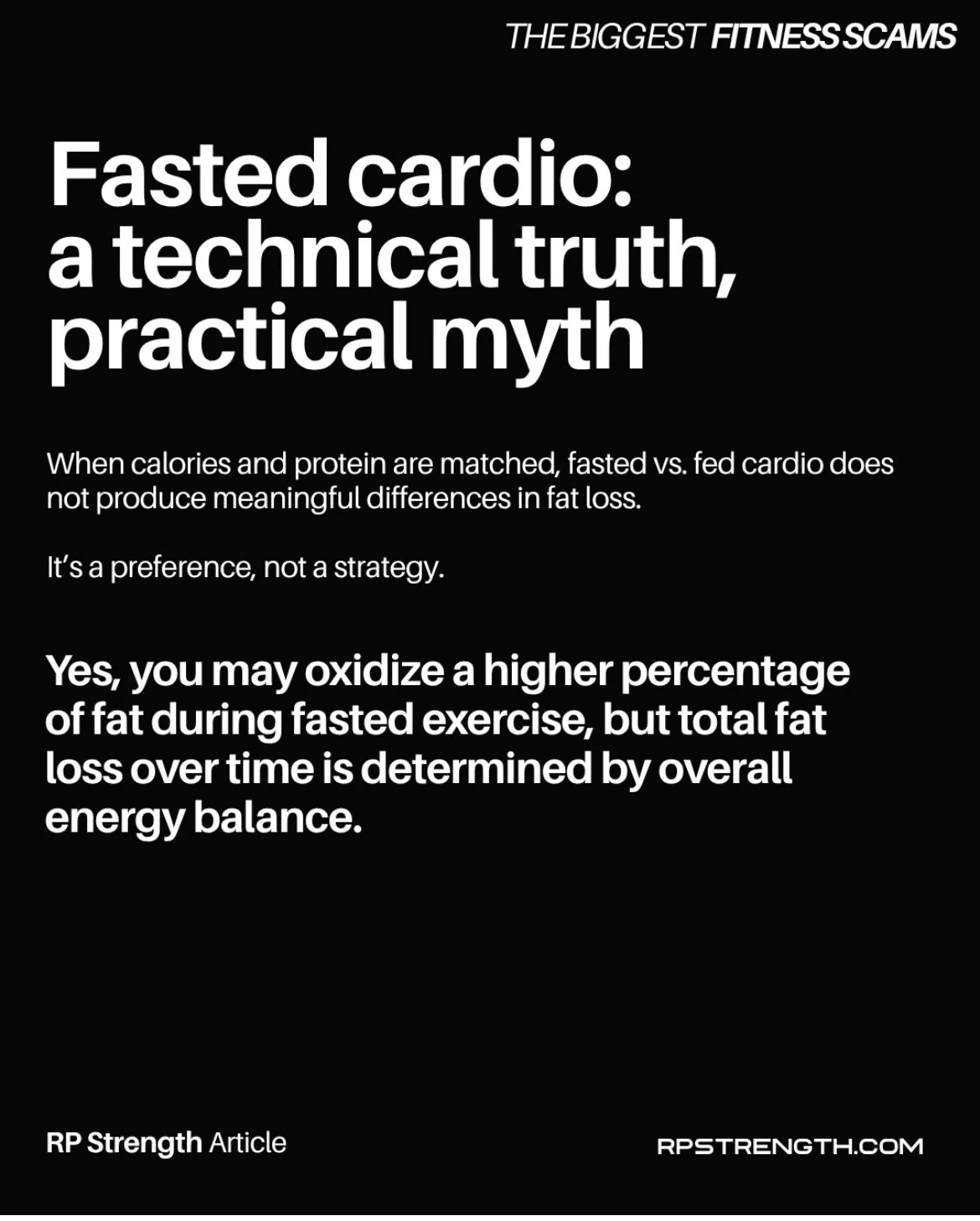
Fat oxidation (using fat for fuel) and fat loss are not the same thing. Fat oxidation is simply the process by which your body releases fatty acids into the bloodstream for energy. If you then eat at maintenance or a surplus in calories, you won’t lose any of the fat you burned. Real reduction in stored adipose tissue comes from a calorie deficit, consuming fewer calories than you need over the course of the day, regardless of whether you exercised on an empty stomach or not.
“Reduction in stored adipose tissue (fat) comes from a calorie deficit, consuming fewer calories than you need over the course of the day or week”
How to Get Results
As we learned in the example above, if you stay in that fat-burning zone, you will likely burn fewer total calories than if you did high-intensity exercise. That’s why it is smart to mix high-intensity and low-intensity activities because burning more calories overall will likely be more effective for getting into a calorie deficit to lose fat.
However, keep in mind that our bodies are adaptive. This is a good thing; it’s the very reason you can train to get stronger, run faster or walk longer, but as your body becomes more efficient at cardio, you burn fewer calories for the same exercise. This is one reason your fat loss might stall if you rely solely on cardio to burn calories for weight loss. As you lose weight, your energy needs decrease slightly; you become more efficient at cardio and burn fewer calories with the same exercise; and fat loss stalls because you are no longer in a deficit.

HA HA! (yes, I think I am funny)
Here is A SUGGESTED PATH FORWARD:
Do cardio because it benefits your heart, body, and mind. There is no need to obsess over staying in a fat-burning zone or manually burning a certain number of calories; just mix up your intensities throughout the week. (Usually one or two days of a higher intensity exercise is enough. More is not better)
Do progressive resistance training twice a week. Muscle requires more energy to simply exist, so you are naturally burning more calories around the clock just by having more muscle on your body. Muscle takes up less space in your body than fat, so when you lose fat and gain muscle, you likely will be a smaller size at the same weight. (If twice a week is out of reach, start with one. Something is always better than nothing. I have clients that got results on one day a week.)
Eat in a slight calorie deficit if fat loss is your goal. (And remember, it is usually much easier to eat 300–500 fewer calories than it is to manually burn 300–500 calories a day!) Again, more is not better. Think of it like this, you don’t bake a cake faster by turning up the temperature in the oven. Too extreme of a calorie deficit will often backfire. Slow and steady wins the race here.
Next time you see a fat-burning exercise, routine, or supplement, you now know it's just marketing. Stick to the basics, and you will see better results than chasing the latest hype. If this feels at all overwhelming or confusing, let's talk! I can help you work out (pun intended) the best exercise and nutrition plan without extremes or heavy restrictions, that makes sense for your goals and lifestyle.
Lea
There is no greater compliment than a referral!

Lea Genders is a board-certified health coach, personal trainer, and workplace wellness consultant based in Fort Worth, TX. She offers corporate wellness programs for employee health and productivity, as well as in-person and virtual training / coaching for individuals worldwide. Her blog shares expert guidance on strength training, running, and sustainable nutrition @fortworth_trainer
Interested in coaching? Apply here.









I’d been calling my runs easy effort all summer. My heart rate disagreed, and the same thing might be happening in other parts of your life. In today’s post I talk about the difference between high tolerance and easy effort, and how that applies to sleep, stress, and recovery.