My Real-World Experiment in Behavior Change
If you know that I am a health and fitness coach, read my blog posts and look at my credentials in behavior change, and assume for one minute that I have figured it all out, or do things perfectly all the time, you would be mistaken. I understand why this happens; it’s easy to look at someone else and assume they have it all together. Especially someone who teaches and coaches on health and fitness. But clutch your pearls, make your shock and dismay face, I am human too. Not a robot, not perfect. I like sushi, ice cream, and chocolate. I miss workouts, sleep in, and eat things I know aren’t good for my health. Shocking! Just kidding.
This shouldn’t be a surprise. I would say the biggest difference between me today and an unhealthier version of me is that I now have a healthier mindset. Instead of spiraling over a couple of missed workouts or a couple of pounds on the scale, I focus on doing the next right thing for ‘future Lea.” Not an overhaul every Monday or every first of the month that will "finally change everything."
When I eat something not great for my health, I try to consider the context: What am I getting out of this? Pleasure? Happiness? Connection with loved ones? Those are all good for my health, too. I’m honest with myself and try not to make excuses, but instead of beating myself up, I look at what I am prioritizing and adjust as needed. This prevents a bad day from turning into a setback that lasts for weeks or months, because I'm always just looking for the next action that supports my health.
This mindset gets me most of the way there. It keeps me consistent; it's a constant "what’s next?" rather than starting over or aiming for perfection.
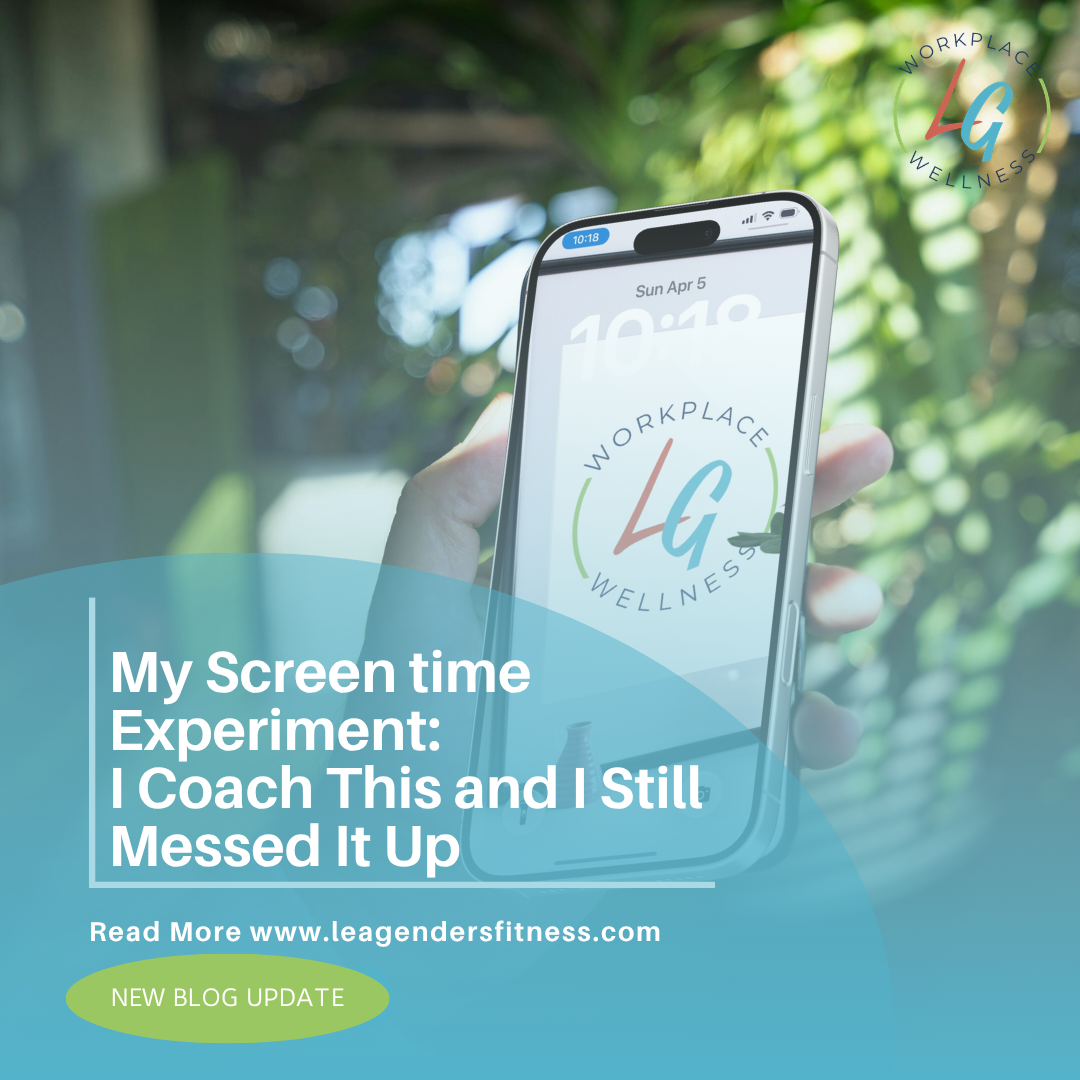
But here is my real experiment in behavior change. Lately, I’ve been making an intentional effort to spend less "screentime" on my phone. You know that weekly message that tells you how many hours you average a day on screens? Yikes. Mine is high, like, almost a full-time job high. (I started to type a disclaimer here, like I am on my screen to track the workout when I am training clients, but really, even outside of that, my use is entirely too high.) I even wrote about digital wellness at the end of last year, so it’s not like I don’t know this is bad for me.
It’s not you, it’s them!
If you’ve seen the news lately, you know that a jury recently found Meta and YouTube liable for intentionally designing their apps to be addictive. They use psychological engineering to keep us scrolling long after we intended to stop. While, of course, we have personal responsibility for our actions, It’s helpful to realize it’s not just a lack of willpower on our part, the algorithms are specifically engineered to keep us hooked.
I was in a coaching meeting a couple weeks ago, and the facilitator challenged us to limit our social media and phone use for the new month. When he asked us to confirm our buy-in, I enthusiastically typed in the chat, “I’m in!” Sound familiar? It’s all fun and dopamine hits until it’s time to execute the plan.
“It’s all fun and dopamine hits until it’s time to execute the plan.”
This perfectly illustrates how, even when you know the behavior change principles (the exact same ones I teach and coach everyday!), You don’t always do them. I made a few classic mistakes right out of the gate. Luckily, I had the self-awareness to catch and correct them without giving up or being hard on myself, but by quickly readjusting.
Mistake #1: Ignoring "Client-Centered" Design (Following Someone Else's RULES)
My first mistake was adopting someone else’s rules without any context for how they would work in my life. Here are the rules he set. These are not bad in themselves; they are highly practical and, if executed, highly effective:
No phone for the first hour upon waking.
No phone the last hour before bed.
No scrolling social media at all.
No phones at meals or when eating.
Posting on social media and replying to comments is permitted (since many of our coaching leads come from social media, we can’t just go dark).
Mute or unfollow distractions and negative voices online.
Rules and guardrails can be helpful, but trying to follow rigid rules that don't take my unique lifestyle into account is a fast track to failure. Lasting change only happens when you are in the driver's seat of your own life. (Hint: this may apply to you and that diet you tried to follow or that latest exercise plan.)
Mistake #2: Forgetting the "Power of Less" (The Whole Life Overall Mistake)
My second mistake was falling into the "let me change my whole life in one day"trap. It sounds good, but the reality of our biology is that too much change, too suddenly, causes our brains to panic and seek the comfort of normalcy. Our brains prefer stability and comfort. We’ve all probably experienced this with New Year’s Resolutions that were too ambitious, which is why the second Friday in January is dubbed ‘National Quitters Day.’
I realize now that I should have taken just one of those rules and started there. No phones for the first hour. That was uncomfortable enough for now! If I mastered that, maybe in a week or two, I could layer on another action. This is the "Power of Less." Research shows that if you assign yourself one new practice, you'll do it consistently about 85% of the time. If you try to take on two, your success drops to 35%. If you try three or more (like my six rules!), Success drops to practically zero. Have you done this? Attempted to start a new exercise plan, diet, and sleep schedule in the same week? There is science behind why this doesn’t work.
Mistake #3: Failing to Shape the Path (The Convenience Factor)
I spent the previous two weeks explaining, in a two-part blog post, how we can "shape the path" to help our logical mind guide our emotional mind. Part of that is to make bad habits less convenient. So what did I do to make it easier not to check my phone ten thousand times a day? Nothing. Turning it off and putting it in a drawer might have helped. But I didn’t do that. I just left it right next to me and expected myself to rely on willpower. No wonder it didn’t work.
Here is how the experiment went.
Day One: Starting off STRONG (AND the knowing-doing DISCONNECT)
No phone, one hour from waking: It went fine until I had about ten minutes left, and I was literally watching the clock. No phone an hour before bed, easy. I plugged my phone into the charger in another room and read my book. I did ok at not scrolling during the day, but I definitely got caught up in responding to and talking to people online (which technically wasn't against the rules).
No phone at meals felt weird! I usually play Wordle while I eat breakfast. But as a health coach, I know that slowing down and paying attention to your food helps you digest better, tune into hunger and fullness signals, and feel more satisfied. Here is a prime example of the disconnect between knowing and doing. Just because my logical brain knows information doesn't mean my emotional brain wants to do it. We don’t always jump easily from knowing to doing; it's simply part of being human. Which is why one of the most common phrases I hear as a health and fitness coach is “I know what to do, but I can’t seem to do it.”
“I know what to do, but I can’t seem to do it”
Day Two: coasting along with a few minor slips
Again, success for that first hour. Got distracted and ended up going a little longer than an hour. Same with nighttime, easy to put the phone away and read. No phone at meals, but I scrolled a bit during the day, less than normal but more than the guidelines dictated (which was zero). I’m feeling like I am doing pretty well on day two!
Day Three: The Late-Night Text (How disruptions derail us)
No phones for the first 45 minutes. Then I decided that sitting at my computer checking emails was technically not my phone, so I did that, and I let myself off the hook. Not the end of the world, I still delayed 45 minutes, which I am counting as a win. Scrolled more than the rules allowed during the day (again), but successfully avoided phones at meals. But here at the end of day three, everything started to fall apart.
My husband plays drums in a rock band, and he had a show in Dallas. He usually texts me when he is loading up to come home, so I couldn’t put my phone away because I wanted to watch for his text (which would come after I would usually be sleeping). This disruption in routine had me scrolling at night, waiting for his text. I was up later waiting for him to get home, so I went to bed much later than usual.
Day Four: pouring rain (SEEKING COMFORT OF old habits)
Still had to get up relatively early for clients. Tired. Pouring rain. No dog walk, that’s usually an easy twenty minutes without my phone. I made breakfast without my phone, but within thirty minutes of waking, I was checking messages for client cancellations. My poor sleep and the bad weather disrupted my morning routine, making it harder to resist that first hour.
When life gets stressful (worried about my husband driving across town at midnight) or routines change (bad weather = no walk), our brains actively seek out the comfort of old habits for a quick dopamine hit. I caught myself scrolling, mistaking it for relaxing. But scrolling isn't actually relaxing for your brain the way reading or an artistic practice is.
By now, I am back to my old normal levels of scrolling, completely disregarding the plans I set for myself. What happened to my enthusiastic “I’m In!”? The reality of my life happened. This is what happens when you start a strict diet on Monday and end up scavenging for snacks in the back of your cabinets by Thursday.
I did successfully put my phone away an hour before bed. But by the end of day four I realized…
The Real LessonS:
I didn't flawlessly execute the six rules. But instead of beating myself up for failing on day four, I practiced self-compassion. And that is backed by science! Studies show that self-compassion is significantly more effective than self-criticism for self-improvement. When we are kind to ourselves after a setback, we are more willing to learn from our mistakes, spot the missteps, and try again.
It would have been a very normal, human reaction, to think, “Oh I failed. That didn’t work for me.” and go back to my old behavior. Maybe try again in a few months when I remember this is still an issue.
But I didn't spiral or quit. I just collected the data, adjusted my expectations, and focused on the next right action. I treated everything I did as an experiment and learned what doesn’t work for me. I learned (or relearned!) some valuable lessons.
First, I need more guardrails around my regular social media use to successfully "shape my path," rather than just relying on willpower. I didn’t do it and I just wrote a blog series on this exact subject. It just goes to show unless you intentionally sit down and think through these things, just knowing you “should” set your environment up for success is not helpful.
Second, when I decided to adopt all these rules, I didn’t think ahead about what I would do if my routine changed. If I had planned for needing to be near my phone for a late-night text or for pouring rain in the morning, I could have had a backup plan ready. If it rains and I can't walk the dog, then I will do X instead of scrolling. I’ll keep my phone close with the volume on while I read my book while waiting for my husband’s text. Seems so obvious now, but without a plan, that’s not what I did. By anticipating obstacles up front, we are much less likely to be thrown off track by them.
Finally, I applied what I learned without judgment. If a new plan doesn’t work, that’s data. The next step is to learn from that and make the goal even smaller. Going forward, my only rule for myself is no phone for the first hour of the day. Once I successfully and consistently execute that, I can layer on the next level.
Step 1: Have a realistic, compassionate view of how change works (aka don’t expect sweeping change to be easy or frictonless)
Step 2: Attempt to do the thing (make it as small as necessary to feel confident you can execute)
Step 3: If you don’t do the thing you intended to do, make it smaller and try again
Step 3b: If still not successful, make it smaller yet.
Step 4: If successful, celebrate yourself in a healthy way (no matter how small). Message me, I’ll celebrate with you.
Step 5: Once consistent, build on, layer on, or test, the next stage.
That is how behavior change works (in a nutshell).
“If a new plan doesn’t work, that’s data. The next step is to learn from that and make the goal even smaller.”
IT’S NOT WHAT YOU KNOW: IT’S WHAT YOU DO
I tell you this story to remind you that behavior change is hard, even for those of us who study and coach it. As my experiment proved, it’s especially hard to be objective about your own habits. That’s why coaching can be helpful, even if (especially if) you already know what to do. Do I know too much screen time is bad for my brain? Do I know it can inhibit my creativity? Yes, of course. Did that knowledge alone help me immediately and swiftly change my behavior? No.
We have to take it step by step, be kind to ourselves, and be open to changing plans or direction to get to our desired result.
I am walking right here next to you. And if you ever want some help discovering what your own 'next right action' could be, let’s chat! A coach can help guide you so you don’t have to figure it out all alone.
Lea
There is no greater compliment than a referral!
Have I helped you? Leave a Google Review here

Lea Genders is a board-certified health coach, personal trainer, and workplace wellness consultant based in Fort Worth, TX. She offers corporate wellness programs for employee health and productivity, as well as in-person and virtual training / coaching for individuals worldwide. Her blog shares expert guidance on strength training, running, and sustainable nutrition @fortworth_trainer
Interested in coaching? Apply here.







Meal prep sounds so Type A, but here’s how a self-proclaimed queen-of-good-enough does it: protein, veggies, and dinner without the Sunday prepping marathon, plus why the best meal prep food is the kind you’ll still want to eat on Wednesday.