
Welcome to the latest edition of workout Wednesday when each week I share a new running or strength training for runners workout.
If you want to increase your natural running pace to run faster with less effort, you will need to train your body to run at a faster pace. You can do this by running intervals at accelerated speeds, followed by recovery periods.
This workout is an advanced beginner or intermediate level. It is best if you are running consistently for a couple of months before attempting this interval workout.
After you warm-up at a comfortable pace, this workout begins with your 5K pace—your hard-effort pace for racing 3.1 miles. It should feel challenging, but a pace you could hold for the distance. If you have a recent 5K finish time, this is the pace you should apply for the start of this workout.
Note this is your racing pace, not the speed you run for three miles leisurely around your neighborhood. Pushing slightly outside of what is comfortable, like you would in a race, will yield the best results.

speed-building ladder treadmill workout
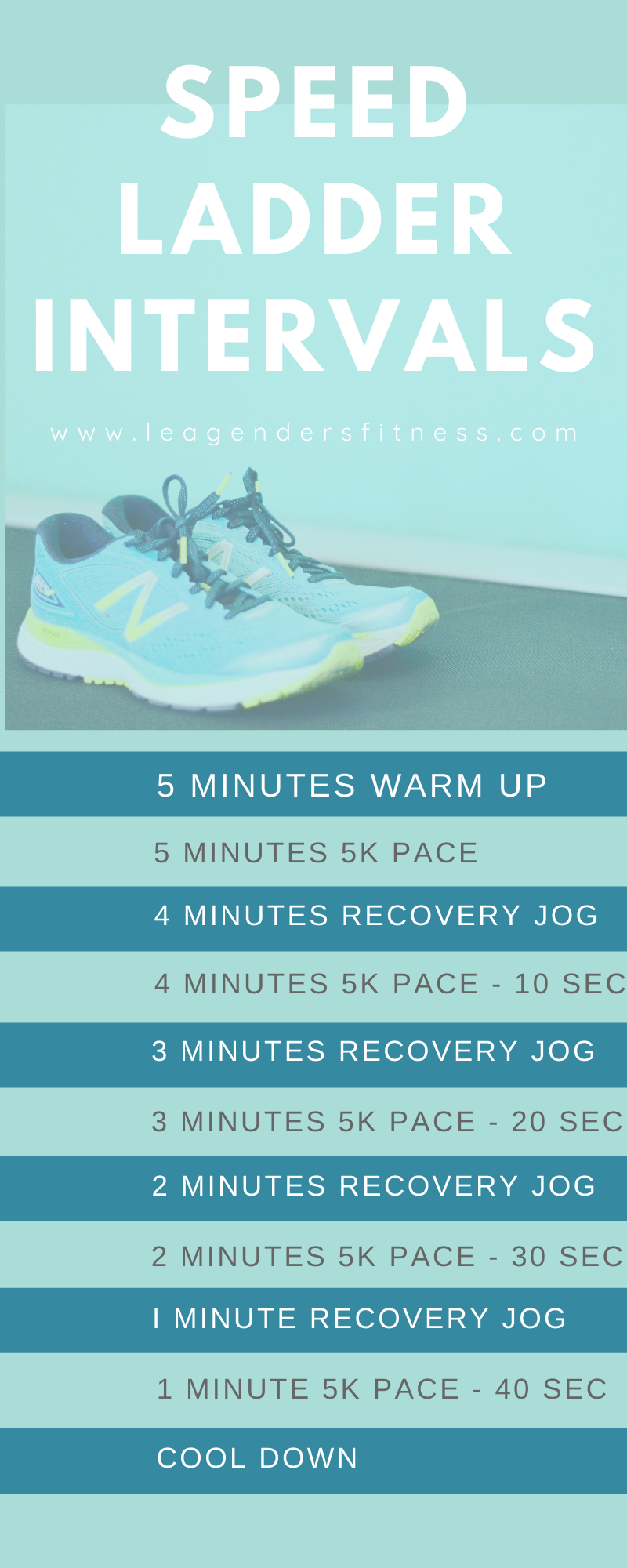
Speed-Building Ladder Treadmill Workout
Five minutes warm-up
Five minutes at 5k pace
Four minutes at recovery pace
Four minutes at 5k pace minus 10 seconds (increase speed by 10 seconds per mile)
Three minutes at recovery pace
Three minutes at 5K pace minus 20 seconds (increase speed by another 10 seconds per mile)
Two minutes at recovery pace
Two minutes at 5K pace minus 30 seconds (increase speed by another 10 seconds per mile)
One minute at recovery pace
One minute at 5k pace minus 40 seconds (increase speed by 10 another seconds per mile)
Walk to cool down until heart-rate returns to normal
I will use a pace as an example, but please apply your 5k results to this workout. It can be dangerous to attempt to follow arbitrary speeds from workouts on the internet. Always work at your current fitness level. The beauty of this workout is that if you are consistent with training and adequate recovery, you will increase your running speed over time.
As an example, if your 5K personal record is 27 minutes, that is an 8.41 per mile pace. You would start your first speed interval at 8.41.
All recovery paces should be a jog or a walk to bring the heart-rate and intensity down between hard intervals.
It is a ladder because your pace climbs a ladder and gets faster as you move through the workout. Each work interval gets 10 seconds faster, as the length of the interval decreases. Using the 5K pace in my original example, perform the first work interval at 8.31 pace, then 8.21 pace, then 8.11 pace, then 8.01 pace. We drop 10 seconds off the speed at each new work interval.
As your fitness increases, and your 5k time decreases, you will need to adjust the paces accordingly to continue to progress. You will continue to see new results from this workout as long as you make adjustments to the speed intervals as your 5k time improves.
Hop on the treadmill and give it a try, let me know how it goes!
Did you like this post? Do you know someone who might benefit? It helps me when you share with your friends and followers on Facebook, Twitter or Pinterest.

Questions? I’d love to help.










Meal prep sounds so Type A, but here’s how a self-proclaimed queen-of-good-enough does it: protein, veggies, and dinner without the Sunday prepping marathon, plus why the best meal prep food is the kind you’ll still want to eat on Wednesday.