Interval Track Workout to Increase Speed

Welcome to another edition of Workout Wednesday! A few weeks ago I wrote a post called types of running workouts to increase speed and I received some feedback that while it was interesting to learn about the types of workouts, people were looking for the specific workouts they could do to increase speed. 

It is hard to provide general interval training plans for people that I don't know. As a running coach, I develop training plans based on my client's current abilities, while keeping in mind their specific goals and limitations. 

It is challenging to assign specific running paces to use for intervals on the internet. One pace would be much too easy for some runners and much too challenging for others. Trying to run at an arbitrary pace because a blog post told you to can lead to injury, overtraining and burnout. AKA don't do it. 

I can get around this limitation by providing paces based on your current 5K pace. This way everyone can work at their own level based on a recently timed race. Have you ran a 5K recently? If not, just map out 3.1 miles on the road and record the time it takes you to complete. Run this 5K as you would an actual 5K race, moderately faster than what is comfortable. It shouldn't be a light easy jog and it shouldn't be an all-out effort run. The sweet spot is somewhere in the middle. Once you have established your current 5K pace, you'll be able to determine the appropriate pace to run each interval. It is important to run based on your current 5K pace, not a 5K race you ran 3 years ago and not the 5K pace you hope to run one day. You should only increase your interval paces when your 5k pace proves to be faster. Got it? 

THE TRACK

Track workouts are often described in meters which can be confusing to those of us who are used to measuring distance in miles. The track makes it very easy to measure distance in meters. You just need to count your laps:

200 meters is 1/2 lap of the track (one straight and one curve). It equals 1/8 mile.

400 meters is one lap around the track. It is equals 1/4 mile.

800 meters is two laps around the track. It equals 1/2 miles.

1600 meters is four laps around the track. It equals 1 mile.

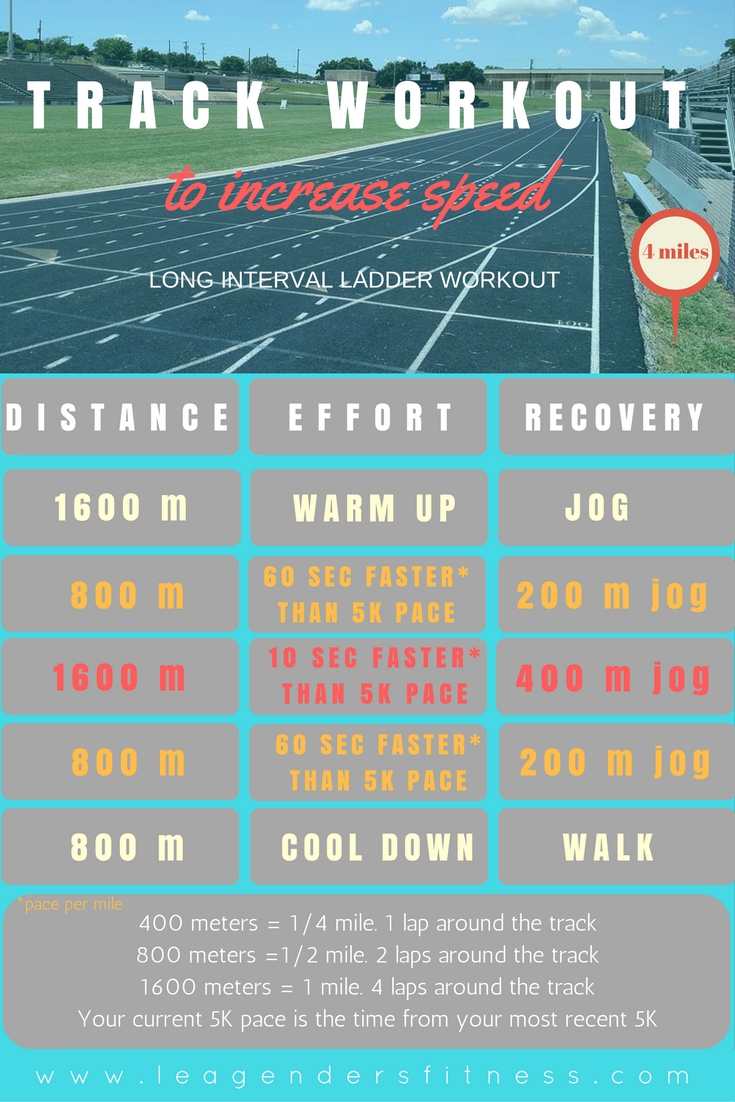
Warm up by jogging for 1600 meters (1 mile / 4 laps around the track).

Once warmed up run 800 meters (1/2 mile / 2 laps around the track) 45-60 seconds faster than 5K pace. If your last 5K was at 10.00 minute mile pace (finished in 31 minutes), you would run this interval at a 9 to 9:15 minute mile (approx 4.5 minutes for 2 laps).

It’s easy. Take your current 5K pace per mile then subtract 45-60 seconds to determine your first interval pace.
— calculating your interval pace


Jog or walk 200 meters (1/8 mile / 1/2 lap around the track) to recover.

Run 1600 meters (1 mile / 4 laps around the track) 10-12 seconds faster than your current 5K pace. If your last 5K was a 10 minute mile (finished in 31 minutes), you would run this interval at 9:48-9:50 per mile

Take your current 5K pace then subtract 10-12 seconds to determine your long interval pace.
— calculating your long interval pace

Jog or walk 400 meters (1/4 mile / 1 lap around the track) to recover.

Run 800 meters (1/2 mile / 2 laps around the track) 45-60 seconds faster than 5K pace. If your last 5K was at 10.00 minute mile pace (finished in 31 minutes), you would run this interval at a 9 to 9:15 minute mile (approx 4.5 minutes for 2 laps).

Jog 400 meters then walk 400 meters to recover and cool down.

That's four miles! You should complete this workout feeling fatigued but also feeling like you could do one more interval if your mean 'ol coach asked you to do it. 

I recommend no more than 2 or 3 speed workouts per week for experienced runners and 1-2 for new runners. Always start with a solid running base of 20 miles per week of easy runs for at least 4-6 weeks before beginning any interval training. Always take a rest day or very easy run the day after a hard interval workout. Run your hard runs hards and your easy runs easy. Remember that adaptation to exercise (i.e. getting stronger/faster) happens during rest, not during the workout. Allow your body the time to recover, rebuild and get faster. Aim for 7-8 hours of sleep each night, fuel your body with mostly foods from nature, eat plenty of protein and carbs and you'll be set up for success.

Wondering about track etiquette? Check out my latest Running A-to-Z post about track etiquette. Don't make these mistakes when running on a track. 

Have questions? Confused? Need clarification? Leave your questions in the comments or be a part of my new series "Ask the Trainer" and have your questions answered in a future blog post.

Like this post? It helps me when you share. 

 

Coach Lea

I am a NASM personal trainer and RRCA adult distance running coach that specializes in strength training for runners. I offer in-person training in the Shredshed, online training and Fit to Run bootcamps. If you are interested in a more in-depth running or strength training plan, please contact me. Have questions? I'd love to help. 

While I am a certified personal trainer, I am not your personal trainer. Since I don't know your exercise abilities, injury background or medical history, please see your doctor before beginning any new exercise program.


Running A-to-Z: T is for Track Etiquette

Welcome to another edition of Running A-to-Z where each week I cover a running-related topic following the order of the alphabet. If you missed any past Running A-to-Z posts you can catch up on letters A-S in the archives. (Only 6 more letters 'til the end of the alphabet! It's been a fun 20 weeks so far!)

This week we are on letter T. T is for track etiquette. The track can be a confusing and intimidating place for new runners, but it doesn't have to be that way. If you just follow a few basic rules of the road...err...track, you'll fit in a like a pro. 

Warm up stretches or non-running exercises should be done off of the track lanes.

Stay off the grass or field in the middle of the track.

Always run counterclockwise.

The inside lanes are for faster runners. The lanes to the right are for the slower runners and walkers. Always move to the right if there are faster runners than you on the track.

Always be aware of runners around you when you are starting and stopping.

It is nice to have a running partner or two, but do not run more than two people abreast (side by side) so you aren’t blocking other runners from getting by.

Move to the right if you hear someone calling out "on your left". This means that a runner is coming up on your left to pass you. Probably best to leave the headphones at home so you can hear someone calling out to you. 

Do not stand, stretch or chat on the track.

Leave your phone at home or in the car. No texting, talking or scrolling while running or walking on the track.

Always be respectful of other runners, the community and the property. Throw away any used water bottles or litter left on the track or surrounding areas (even if it is not yours).

Got it? Good. The track is a great place for speed work, intervals or laps on a flat, spongy, soft surface that is easier on the joints than concrete or asphalt. Once you learn basic track etiquette, you'll fit in with the some of most dedicated runners in your town.

Stay tuned for Workout Wednesday this week where I will share a track workout you can do to increase your speed. 

Have questions? Leave them in the comments or be a part of my new series "Ask the Trainer" and have your questions answered in a future blog post.

Like this post? It helps me when you share.


Coach Lea

I am a NASM personal trainer and RRCA adult distance running coach that specializes in strength training for runners. I offer in-person training in the Shredshed, online training and Fit to Run bootcamps. If you are interested in a more in-depth running or strength training plan, please contact me. Have questions? I'd love to help. 

While I am a certified personal trainer, I am not your personal trainer. Since I don't know your exercise abilities, injury background or medical history, please see your doctor before beginning any new exercise program.


5 REASONS YOU'RE NOT IMPROVING IN RUNNING

If you've been running for a while and it seems like you're not improving I may be able to help you to pinpoint the culprit. There a few reasons that you may not be improving in running.


YOU ONLY RUN

If you've spent any time on this site you know I am a huge proponent of strength training for runners. When you run you only move in one direction - forward, which can lead to muscle imbalances and weaknesses. You don't have to spend hours in the gym, but working in some quick strength and flexibility training in all planes of motion will go a long way in helping you improve and remain injury free. 

YOU'RE NOT RUNNING ENOUGH

If you want to be a better runner, you have to run more. You have to consistently put in the work over time. If you are inconsistent or only running once or twice a week then improvements will come slow or not at all. Commit to a running/training plan and follow through. If you need a coach to guide you through, I'm here to help. 
YOU ONLY RUN AT ONE PACE

If you run at the same pace every day you are training your body to conserve calories and glycogen (carbs) in the muscles. This is good for long distance running because this is why you're able to cross the finish line. However, if you want to improve and run faster you'll need to train to run faster by adding in intervals, fartleks and/or hills into your training. The key is to have a variety of workouts that train the different exergy systems. Slow runs have an important place in your schedule but they should not be the only workouts that you do. 

YOU DON'T REST

I'd argue that rest days are one of the most important parts of your training plan. You body adapts and improves during rest, not during the workout. So if you don't rest, you don't allow your body the recovery it needs to repair and rebuild. You can't beat your body into submission. Work hard, rest hard. Plan one or two full rest days (or more if you need it) in your training schedule each week for best results. 

YOUR LIFESTYLE

Take a look at your lifestyle including your sleeping habits, nutrition and stress. Lack of sleep, poor nutrition, excessive alcohol intake and stress can all be factors in a poor or stagnant performance. Consider your lifestyle outside of running and evaluate if you need to make improvements. A good night sleep and proper nutrition can make a world of difference in your training. 

Take a good hard look at these factors to determine if you should make some adjustments in order to improve in your running. Work hard, rest hard, be consistent. You'll get there.

Like this post? Please consider sharing.

Have questions? I'd love to help! Ask in the comments or join the conversation and "Ask the Trainer" for your question to be featured in a future blog post

Coach Lea

I am a NASM personal trainer and RRCA adult distance running coach that specializes in strength training for runners. I offer in-person training in the Shredshed, online training and Fit to Run bootcamps. If you are interested in a more in-depth running or strength training plan, please contact me. Have questions? I'd love to help. 

While I am a certified personal trainer, I am not your personal trainer. Since I don't know your exercise abilities, injury background or medical history, please see your doctor before beginning any new exercise program.

THE ULTIMATE RESISTANCE BAND TRAVEL WORKOUT

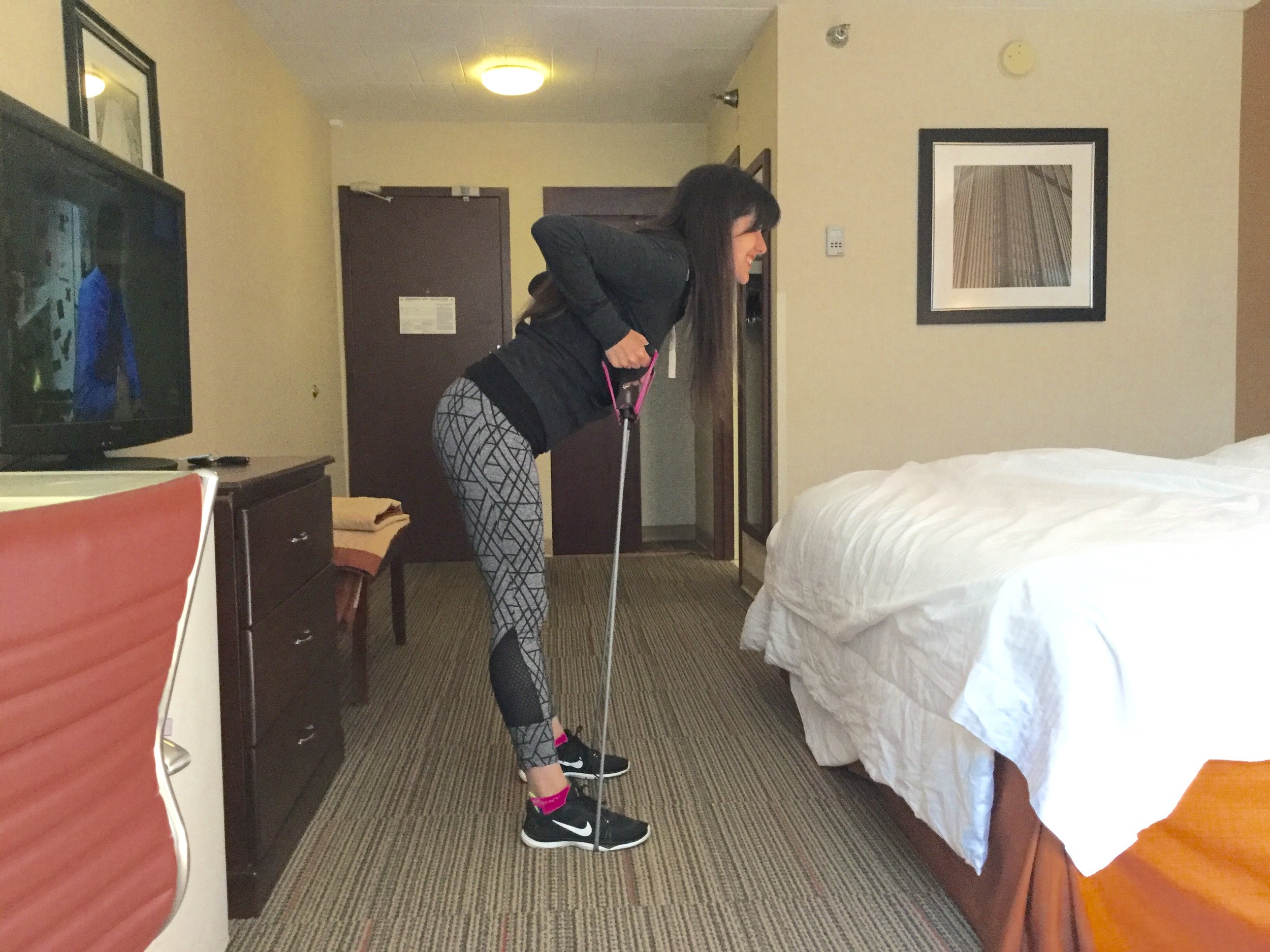
Welcome to another edition of workout Wednesday! Last week hubby and I took a trip to my hometown, Pittsburgh PA to visit family (Go Steelers!). We all know it can be a struggle to fit in a workout when you are traveling, so I brought along my resistance band to show you how easy it can be to get in a quick travel-friendly workout while on the road. With no fancy equipment, just a resistance band and about 15 minutes of free time I was able to squeeze in some strength training while traveling. Add in a hotel treadmill session or a foot tour of a new city and you have a full body strength and cardio workout. 

Five simple resistance band moves for a full body strength workout. Perform 12 reps of each move and repeat 3 times. 

LUNGE & BICEP CURL 

Place your feet about hip width apart with the resistance band under your forward foot. Step into a back lunge while simultaneously curling the resistance band toward your chest making sure you keep your elbows close to your sides. Repeat on other leg. 


BENT OVER ROW

With your feet slightly wider than hip width step on a resistance band with an overhand grip on the handles. Keep your back straight and pull the handles upward in a rowing motion.


GLUTE KICK BACK

On all fours with your shoulders stacked directly over your wrists hold the resistance band on the ground with both hands while looping it around your back foot. Straighten your leg to kick out your back foot. Repeat on other leg,


HIP ABDUCTION

This is a great one for runners. Traveling or not, fit this exercise into your routine. With your feet slightly wider than hip width, pull the resistance bands in an upward motion while moving your leg out laterally. Repeat on other leg.


UPRIGHT ROW

With your feet slightly wider than hip width step on the resistance band. With an overhand grip pull the handles up until your elbows are even with your shoulders. 

Do you workout when you travel? Do you love the Steelers? Tell me in the comments. 

Like this post? it helps me when you share

Have questions? Leave them in the comments or be a part of my new series "Ask the Trainer" and have your questions answered in a future blog post.

Coach Lea

I am a NASM personal trainer and RRCA adult distance running coach that specializes in strength training for runners. I offer in-person training in the Shredshed, online training and Fit to Run bootcamps. If you are interested in a more in-depth running or strength training plan, please contact me. Have questions? I'd love to help. 

While I am a certified personal trainer, I am not your personal trainer. Since I don't know your exercise abilities, injury background or medical history, please see your doctor before beginning any new exercise program.