MOTIVATION

Seven Ways to Improve in Running (That Doesn't Include Running)

In order to become a better runner the number one thing you should be doing is running. The first piece of the puzzle to get into place is consistent running because consistency is foundation of any successful plan. Slowly build a running base until you are running three to four days a week for five to six weeks. Once you build this base, you can start to think about working on speed, strength and adding more milage. Whether you are a beginner or an advanced runner there are ways to improve your running that doesn't include running. 


GET YOUR NUTRITION ON TRACK

Proper nutrition is important for all people to look, feel and perform their best, but for athletes it is even more important. Work to achieve a balance of healthy carbs, fats and proteins from mostly whole food sources to not only fuel your run, but to enhance recovery and feel your best. Follow the 80/20 rule to eat according to your goals 80% of the time and leave 20% open for foods that you enjoy but may not be optimal. I write more about it this in my Running A-to-Z post, D is for Diet.

GET ENOUGH SLEEP

Most of us don't have to choose between sleep and a workout, but if it came down to the choice of a one hour workout or one hour of sleep, how do you think the experts would advise you to spend your time? If you are not getting at least the seven hours a sleep that most people need, the answer is sleep. Going to bed at midnight and setting your alarm for 5am to workout is not doing your body any favors. 

Not getting enough sleep per night can reduce the benefits of healthy eating and exercise. When you don't get enough sleep, your cortisol (stress hormone) levels can rise, which can be associated with fat gain. 

In our busy lifestyles sleep is often is the first thing to get slashed, but knowing how important it is to recovery and improvement it should be given a higher priority, especially for athletes. 

BUILD REST & RECOVERY INTO YOUR WORKOUT SCHEDULE

Resting isn't laziness. Just like sleep, rest and recovery are essential to improving in running. Our bodies adapt, improve, get faster and stronger during rest, not during the workout. We need to allow our bodies the proper time to recover. This includes taking full rest days after hard workouts and alternating hard/easy days throughout the week. 

ADD STRENGTH TRAINING

My favorite topic which is the basis for this blog and my personal training business. Strength training for runners can make you a stronger, faster, less injury-prone runner. You don't have to become a gym rat to reap the benefits of strength training.There are plenty of equipment-free, quick and efficient strength workouts in the archives that you can try at home to get started. 

ADD STRETCHING/FOAM ROLLING

When you run and only run, you sometimes can develop muscle imbalances. You have overactive muscles that are working too hard and compensating for underactive muscles that are not able to do their job. One way to help prevent muscle imbalances is to strengthen the weak muscles (see above) and stretch/foam roll the overactive muscles. I recommend foam rolling before you run and stretching the overactive or tight muscles immediately following your run. Here is a post I wrote on foam rolling that may be helpful if you want to get started. 

GET ON YOUR MENTAL GAME

Running is as much as mental sport as it is a physical one. I am not suggesting that if you visualize yourself running fast that you will magically win your next marathon, but having a strong mental picture of success goes well with your physical training. If you think positive, act positive and ban those negative thoughts, it can make a difference in how you perform. I wrote more on this in a post called Running A-to-Z: M is for metal tricks for running. 

FIND AN ACCOUNTABILITY PARTNER OR RUNNING COACH

We all need support. Whether it is for accountability, emotional support or technical help, I suggest finding a partner or coach to help you stay on course (pun intended). Friends can be a great motivator to exercise. Sometimes we feel more obligated to others than we do to ourselves. We may not think twice about cancelling on ourselves for our daily workout, but if we know we have someone counting on us we are more likely to show up so we don't let them down. If you don't have any friends or family interested in exercise consider finding an accountability partner online, joining an exercise class, running group or hiring a coach. 

Any questions? I'd love to help. Let me know in the comments. 

Like this post? Please consider sharing. 


Coach Lea

I am a NASM personal trainer and RRCA adult distance running coach that specializes in strength training for runners. I offer in-person training in the Shredshed, online training and Fit to Run bootcamps. If you are interested in a more in-depth running or strength training plan, please contact me. Have questions? I'd love to help. 

While I am a certified personal trainer, I am not your personal trainer. Since I don't know your exercise abilities, injury background or medical history, please see your doctor before beginning any new exercise program. This is an opinion blog. No information in this blog is intended to be taken as medical advice or prescription. Please see your doctor and/or registered dietitian for any health concerns.




5 THINGS I WISH I KNEW BEFORE I STARTED RUNNING

One of the great things about running is that you don't need a lot of training, equipment or time commitment to get started. You can just lace up those running-specific shoes, hit the road and TA-DA, you're a runner. That is not to say that you won't learn a lot of lessons along the way. These are five things I wish I knew before I started running so I wouldn't have had to learn the hard way. 


JUST SAY NO TO COTTON

Shirts, shorts and socks that are made of cotton material absorb water (aka sweat). If you run in cotton you'll end up with heavy, wet, sweat-stained clothes or blister-primed feet. Synthetic apparel wicks away moisture so the sweat is pulled away from your body. Look for man-made fabrics with wicking properties for the most comfortable running experience. (Can someone delete those old internet race pictures of me where I looked like I peed my cotton shorts?)

HAVE PATIENCE

Be patient with your progress. In order to avoid injury, burnout or overtraining, slow progression is ok, in fact it is the goal. It is natural for new runners to want to run too much and too fast. If you get injured you'll get knocked out of the game before you ever had a chance to start.

As general rules you should never increase your mileage by more than 10% each week and never increase intensity (speed) and distance (miles) in the same week. Increase your mileage for three weeks in a row then back off the fourth week for recovery. Endurance and speed will come. With time, patience and persistence you can achieve all your running goals, it just doesn't happen overnight.

LEAVE YOUR EGO AT HOME

No one cares about your running pace except you. You probably won't come in first place at any race. You probably won't come in last place either. (If you do, good for you for spending the maximum time on the course and getting the most of your race entry fee.) There will likely always be someone faster and someone slower. Never apologize for being a slow runner or say that you're not a "real" runner. You'll learn pretty quickly that running is a race against yourself and your former self. To "win" at running you mostly just have to overcome your own brain. 

RESTING ISN'T LAZINESS

Your body adapts (aka recovers and grows stronger) during rest, not during the workout. If you never rest, you never allow your body the recovery time it needs to repair and rebuild. Taking scheduled rest days is essential to becoming a successful healthy runner. Listen to your body. I have found as I am getting older (old-lady talk) I need more rest days than I did even five years ago. This is normal. I'd rather take an extra rest day than get injured and not be able to run for weeks or months. 

DON'T JUST RUN

If you've been reading this blog for any length of time you know that I am a huge proponent of strength training for runners. Why? Because for years I was a runner that only ran. I kept getting injured, sidelined and I plateaued in my running progress. I started strength training in addition to my running and became a stronger, less injury-prone, well-rounded athlete. I was a runner first who fell in love with strength training and the benefits much later. Strength training can be a game changer for beginners and advanced runners alike.

What are some things you wish you had known before you started running? Any questions? Need help with a running plan, strength training session or both? Let me know in the comments if I can help and check out my coaching services page.

LIke this post? Please consider sharing.


Coach Lea

I am a NASM personal trainer and RRCA adult distance running coach that specializes in strength training for runners. I offer in-person training in the Shredshed, online training and Fit to Run bootcamps. If you are interested in a more in-depth running or strength training plan, please contact me. Have questions? I'd love to help. 

While I am a certified personal trainer, I am not your personal trainer. Since I don't know your exercise abilities, injury background or medical history, please see your doctor before beginning any new exercise program. This is an opinion blog. No information in this blog is intended to be taken as medical advice or prescription. Please see your doctor and/or registered dietitian for any health concerns.
 

5 KINDS OF JUNK FOODS DISGUISED AS HEALTH FOODS

One of the most challenging parts of living a healthy lifestyle is sorting through all the information and misinformation out there. Some say the "magic formula" for successful weight loss is to exercise regularly and eat healthy foods in a calorie-deficit. But what exactly does "eat healthy foods" mean? It can be confusing with all the mixed messages and misleading food marketing labels.

The most important thing to understand is that food marketing labels are sometimes intentionally deceiving. Many foods are marketed as healthful choices when in reality they are quite the opposite. 

This isn't intended to be a post about what you should or should not eat. Each person needs to make those choices for themselves, possibly under the direction of their doctor or registered dietitian (RD). This is a post about being aware of what you are eating, so that you can make the best decisions for yourself, your health and your family, based on reality, and not on misleading food packaging marketing.

5 KINDS OF JUNK FOODS DISGUISED AT HEALTH FOODS

1. YOGURT

Yogurt is one of the worst offenders of misleading marketing, often advertised as a diet food. Most flavored yogurts are very high in sugar and often have artificial sweeteners and/or high-fructose corn syrup. They can have as much sugar as a cup of ice cream, but people eat them and think they are making a good choice for their body. 

Try buying plain Greek yogurt, which is higher is protein and lower in sugar than traditional yogurt and then add fresh fruit or berries for flavor. If it is not as sweet as the yogurt you are used to, it is because it has a lot less sugar.

2. PROTEIN BARS

Protein bars are often advertised in health and fitness magazines by models with six-pack abs. Everyone knows protein is important for building and maintaining muscle, right? Right. But A lot of these packaged protein bars are nothing more than glorified candy bars with added protein. Check the ingredient list, sugar content and calorie content. They are often high in calories, sugar and are highly processed. I think they are OK in moderation but generally should not be consumed as a health food. I enjoy some protein bars, but consider them an occasional treat, not a healthy staple.

Try to get most of your protein from whole food sources like lean meats, beans, nuts and leafy greens.

3. FROZEN DIET DINNERS

Frozen diet dinners are often too high in sodium and processed ingredients and too low in nutrients to be considered a healthy food, but with labels like "Healthy Choice" and "Weight Watchers" we can be misled into thinking that they are a good choice for our body. 

Try meal prepping for the week with these mason jar salads for a quick, fresh lunch on the go. 

4. FAT FREE FOODS

Let me let you in on a little secret. If the food label boasts claims of Fat Free or Low Fat, it is often a red-flag that the food is not healthy at all. You see they take out the fat, but then add more sugar and processed ingredients so it still tastes good. Read the nutritional and ingredient label to be sure what you're eating.

Our bodies need healthy fats. Reducing intake of healthy fats does not necessarily equate to reduced body fat. You need a healthy balance of protein, carbs and fat in your diet.

5. ORGANIC, GLUTEN-FREE OR LOW-CARB PACKAGED FOODS

Watch out for buzz words on packaged foods like organic, gluten-free, and low-carb. While natural foods that are organic, gluten-free and low-carb are obviously just fine, processed foods with these labels are not any healthier than their counterparts. Organic junk foods are not any better for you than regular junk food. A gluten-free cupcake is still a processed low-nutrient food. Low-carb cookies are still cookies. When it comes to packaged foods, these types are labels are generally marketing labels designed to mislead you. (Obviously if you have celiac disease or a gluten intolerance a gluten-free label is helpful, but for the rest of the population it doesn't mean much in terms of the the health status of a food.)

Honorable mentions of junk foods disguised as health foods are dried fruits, trail mix, processed meats, veggie chips, sports drinks and cereal. Most of these have either too much added sugar or sodium to be considered healthy. Always look for the most natural alternative. 

I encourage you to ignore package marketing all together, read the nutrition label, take note of the calories per serving and number of servings in the package. Pay attention to the sugar content per serving and most importantly, the ingredient list. 

If you want to eat junk food then it's always OK to enjoy an occasional treat. It is actually healthy for us to have a balanced approached to nutrition (no one can eat 100% perfectly all the time). The idea is to learn to decipher between health foods and junk food, so that you don't eat junk food that you think is healthy. Eat healthful foods from nature most of the time and when you want to enjoy an indulgent treat, do it with your eyes open.

For any serious nutritional concerns please see a registered dietitian. Have questions? Leave them in the comments or be a part of my new series "Ask the Trainer" and have your questions answered in a future blog post.

Like this post? It helps me when you share.


Coach Lea

I am a NASM personal trainer and RRCA adult distance running coach that specializes in strength training for runners. I offer in-person training in the Shredshed, online training and Fit to Run bootcamps. If you are interested in a more in-depth running or strength training plan, please contact me. Have questions? I'd love to help. 

While I am a certified personal trainer, I am not your personal trainer. Since I don't know your exercise abilities, injury background or medical history, please see your doctor before beginning any new exercise program. This is an opinion blog. No information in this blog is intended to be taken as medical advice or prescription. Please see your doctor and/or registered dietitian for any health concerns.


10 Healthy Habits for the Office-Dweller

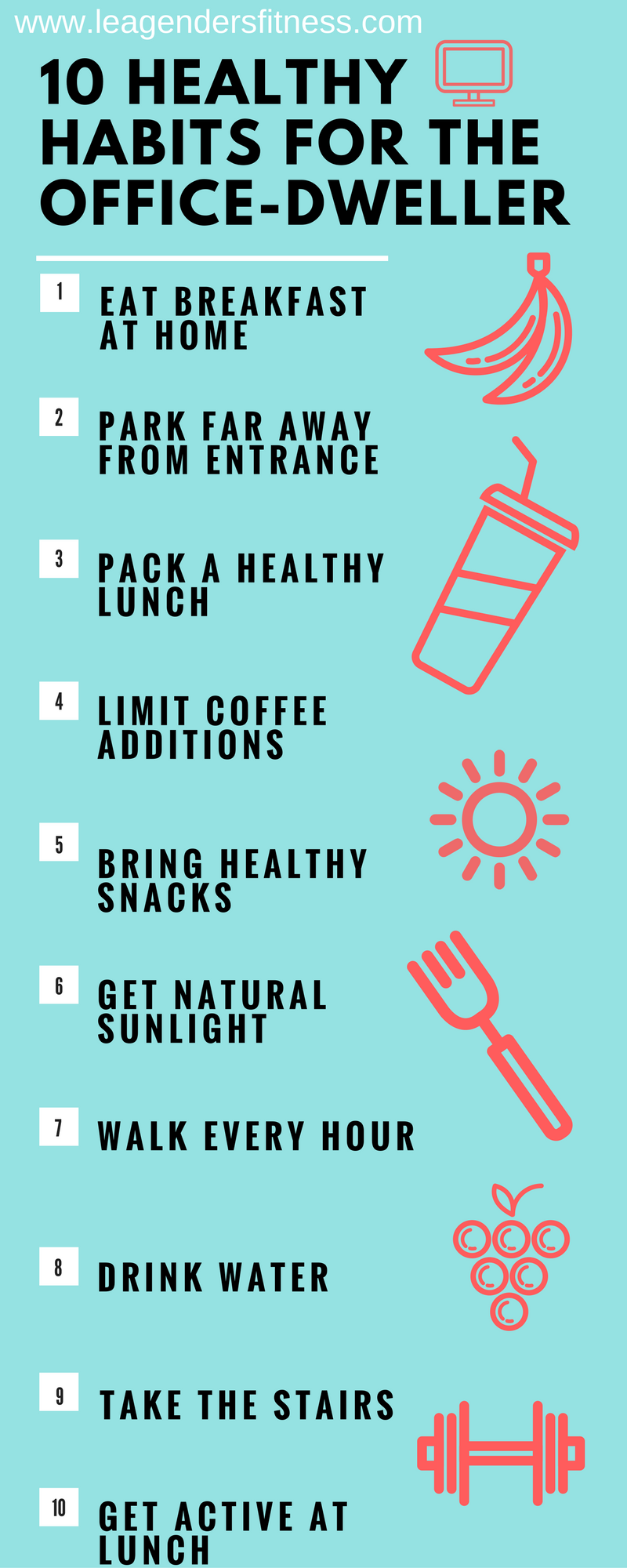
Working 8-5? It can feel hard to stay healthy and active when you live in cubicle-land for eight hours a day but these easy tips will help you build healthy habits while at the office. Try tackling just one or two at a time at first. Once you've established a healthy habit then build on it with something new. Before you know it all these healthy habits will be second nature. 

10 HEALTHY HABITS FOR THE OFFICE-DWELLER

EAT BREAKFAST AT HOME

Starting your day off on the right foot often starts with your first meal of the day. Eating a healthful breakfast at home before leaving for work can help limit the temptation of a drive-through breakfast or office donuts. I like to eat eggs and a banana each morning, so when my co-workers start texting on their drive in "Anyone want anything from McDonald's?" It is always easy for me to say "no, thank you." If you don't have time to eat breakfast at home, try making it at home and bringing it to the office to eat later. 

PARK FAR AWAY FROM THE ENTRANCE

Start your healthy habits at the beginning of your work day by parking your car as far away from the entrance as reasonably possible. Getting a few extra steps in the morning (and throughout the day) starts your day off on the right foot. Pun intended.

PACK A HEALTHY LUNCH

I make and pack a salad from home every day. It is healthy, portion-controlled and delicious. I know that no matter what else I end up eating that day, at least I had a big healthy salad packed with vegetables and protein (usually chicken) for lunch. It helps eliminate temptation of high calorie or unhealthy lunches, saves money and establishes a healthy routine. 

LIMIT THE COFFEE ADDITIONS

Be aware of the additions to your morning coffee. You may feel a boost from the caffeine, but adding sugar, creamers and/or flavor shots add empty calories often uncounted calories to your meal. I like my coffee like I like my clothing, black. 

BRING HEALTHY SNACKS TO AVOID THE VENDING MACHINE

Visiting the vending machine can be a bad habit. If you pack healthy snack alternatives, you may never have to visit the vending machine again. Almonds, Pistachios, cheese, grapes, carrots, hummus, low sugar yogurt, cottage cheese, berries, oranges, apples and natural peanut butter are all good healthy snack options for the office. 

GET NATURAL SUNLIGHT 

Are you under the florescent lights all day? Get up and walk outside at least once a day, more if possible. I'm not suggesting you hang out there all day (unless your boss gives the thumbs up), just try to get a couple of quick doses of natural sunlight throughout the day. 

GET UP EVERY HOUR FOR A QUICK WALK

Every hour on the hour I try to get up a take a quick lap around the office. I multi-task by going to see co-workers in their office instead of emailing or calling them. Get up and move around as much as possible. It's good for your mind, body and overall well-being. 

REFILL A WATER BOTTLE

I fill my water bottle in the morning and I'll inevitably have to get up again and use the bathroom. I refill and the cycle continues. Use a restroom on another floor to get moving around a little more than usual. Refill throughout the day to stay hydrated. 

TAKE THE STAIRS

Whenever possible, take the stairs instead of the elevator. Every step counts. I'm pun-tastic today.

GET ACTIVE AT LUNCH

Ever heard of a RUNch? It is run on your lunch break. If you can't run, then walk. If you can't walk, then stretch. Take advantage of your limited free time and get active for at least part of your lunch break. Try to recruit co-workers to get active with you.

I know from my own office experiences that sometimes stress, deadlines, pressure and heavy workloads can make some days fly by in a blur, but if you establish healthy habits in your day it can help you manage stress, think more clearly and improve productivity.

Are you working on establishing healthy habits at the office? Can I help? What works for you? Any questions? Let me know in the comments!

PIN ME

PIN ME

Like this post? It helps me when you share!
 

Coach Lea

I am a NASM personal trainer and RRCA adult distance running coach that specializes in strength training for runners. I offer in-person training in the Shredshed, online training and Fit to Run bootcamps. If you are interested in a more in-depth running or strength training plan, please contact me. Have questions? I'd love to help. 

While I am a certified personal trainer, I am not your personal trainer. Since I don't know your exercise abilities, injury background or medical history, please see your doctor before beginning any new exercise program.