
When I first became a coach more than a decade ago, I used to panic when my clients got upset because the scale wasn’t moving. Oh no! They aren’t getting the results they want! It would cause me so much stress.
But growing as a coach means learning that helping people overcome these obstacles, both physically and mentally, is the entire point of coaching. Coaching isn't telling someone what to do, then celebrating when they get results from following the rules. Real coaches help people adapt new behaviors to their everyday lives and work through the barriers they face. When everything goes perfectly, that’s not coaching. When the scale doesn’t budge, that’s where I can really help, that’s my job.
I often talk to my clients about adopting a ‘beginner’s mindset.’ It doesn’t mean you are a beginner or that you don’t know anything; it just means you keep an open mind, with a willingness to learn and try new strategies. As a coach, it’s important that I work to do this too.
I was personally reminded of this when I recently decided to put myself in a slight calorie deficit. I haven't stepped on a scale in a really long time. I had gotten a little lax with my food, and while I was generally consistent with my workouts, both my cardio and my strength volume had dropped a bit. Lo and behold, because I wasn’t really paying attention, I stepped on the scale and realized I'd gained six pounds. And based on the tighter pants that prompted me to step on the scale in the first place, I knew it wasn’t muscle gain.
Before you roll your eyes at me, I know this is no cause for panic. I just need to refocus for a while, find my rhythm again, and get back to normal. Once I reset my healthy habits, I know from experience I will be able to do it intuitively again. But for now? Back to tracking.
I probably haven’t weighed myself regularly or intentionally eaten in a deficit in five years or more, and it is eye-opening how going through it feels. I’m used to coaching people through the ups and downs, but I forgot what it actually feels like in real time. This experience has been particularly helpful for me as a coach. It was my turn to adopt that beginner’s mindset.
Before this, I was eating generally healthy by preparing meals at home, but I wasn't skipping any treats and I was pretty much snacking nonstop all day. When I tightened things up by tracking my calories in my app, cutting out the between-meal snacking, and increasing my workout volume and step count, I kind of assumed I’d see an immediate drop on the scale, you know, at least a pound.
The Reality
The scale, however, had other plans. It barely budged, even after a few weeks.
Even though I coach people on the scale almost weekly, reminding them that it is just one small measure of progress, that fluctuations are normal, and that slow weight drops are usually a sign you are preserving muscle mass while losing fat, I still had that emotional moment of, “Seriously?!?”
It was such a good reminder that even when we know better, that scale can still mess with our heads. I mean, I knew other people got upset when the scale dropped slowly (or not at all), but I’m a health coach and a fitness professional. I know the science.
Turns out, I am human too. Hah.
To add insult to injury, my husband also tightened up his diet and lost nine pounds over three weeks. Me? 1.25. lol. (It’s worthy to note that not only do men have different hormone profiles, he also has more to lose than me. It obviously gets harder the less fat you have to lose.)
Luckily, because I do know better, I was able to talk myself off the ledge pretty quickly. Let’s review why.
Why Slower Is Better
The mental reframe we need around the scale is that a slower drop is actually a good result, arguably a better result than a larger decrease in weight. When your weight goes down by more than a couple of pounds a week, you are likely losing water and fat, but also muscle. Precious muscle that fuels your metabolism, your ability to move through life with ease, and your longevity.
I work really hard for my lean muscle, so it’s important to me that it stays right where it is. I’d like to drop six pounds, but not if that means six pounds of muscle. The truth is, my husband's rapid drop over three weeks was likely a combination of fat, water, and muscle. That glacier-slow decrease in scale weight while I am maintaining or growing my strength in the gym is a great sign that my muscle is safe.
This is why doing resistance training while you aim to lose fat is a priority. It allows you to maintain that precious muscle that shapes your body and helps you function optimally, all while prioritizing true fat loss.
The reframe here is simple: slow loss is the best result because it likely mostly fat loss.
When the Scale Doesn't Move at All
We also have to keep in mind that if you lose body fat and gain muscle in the same period, you’ve hit the jackpot of fat loss, the best result you can hope for (and some people completely miss it).
In this scenario, the number on the scale wouldn’t change at all, but your body composition would, sometimes dramatically. Muscle tissue is denser than fat, meaning a pound of muscle takes up significantly less space than a pound of fat. Your pants size might be smaller, and you might look tighter, but if you lived and died by the number on the scale, you’d be upset that it’s not going down.
Fat Loss Isn’t Linear
When the scale doesn’t move for two weeks, please know that is not a plateau. If often just means you just have to give the process more time. The biggest disservice of the fitness industry is setting us up with unrealistic expectations. People vastly overestimate what they can achieve in one to three months, and completely underestimate what they can do with a year of focused habits.
It’s much more useful to look at fat loss in four-week blocks. When you look at the big monthly picture rather than day-to-day or even week-to-week, it removes the frustrating noise of short-term fluctuations and lets you focus on the overall trend. This also sets the stage for a longer, slower process, rather than quick fixes that are rarely sustainable in the longterm.
Speaking of normal fluctuations, let’s talk about some of the factors that can affect the number on the scale that have absolutely nothing to do with whether you lost or gained fat:
Water retention and salt intake
Carbohydrate consumption (glycogen storage, this is a good thing)
Women’s menstrual cycles
Inflammation from exercise (muscle repair)
Bowel movements
Creatine supplementation
These are normal, day-to-day variables that can cause your weight to rise or drop by one to three pounds overnight. I can’t get mad that my body pulled extra water into my muscles after a tough workout to help speed up recovery; that's just my body doing its job.
Consider this your reminder that approximately a half-pound of fat loss a week for women in midlife is incredibly normal (of course, results will vary based on how much you have to lose). But that doesn’t mean it will happen as a half-pound every single week in a straight line. Keep looking at the big-picture trends and make decisions based on those long-term results.
The key to success here is to adopt habits and behaviors that are sustainable for a long time, because if you are suffering week to week, chances are you won’t be able to hold on long enough to see real changes.
Better Ways to Measure Success
The scale tells us our relationship with gravity. This sounds like a perfectly reasonable sentence until you are standing naked in your bathroom wanting to throw the thing out the window because it says you only dropped .21 pounds after a solid week of consistency. (oddly specific? hah).
This is why, even if you choose to use a scale, we must rely on other ways to gauge how our program is working:
Waist Measurements: If your waist measurement is shrinking but the scale is staying the same, that’s a beautiful sign you are losing fat while holding on to your muscle.
How Your Clothes Fit: Again, if your clothes fit better even when the scale is static, it’s a sign of fat loss.
Progress Pictures: Take these in a swimsuit or shorts, and a sports bra (women). You can look in the bathroom mirror all day, but we don’t see ourselves objectively. Photos help you spot changes you might otherwise miss.
Strength in the Gym: If you are maintaining your strength or increasing your weights in the gym, that's a strong sign you are preserving or gaining muscle.
Biofeedback: Energy levels, sleep quality, and overall mood are all meaningful measures of success, no matter what the scale says. On the flip side if these metrics are getting worse, it may be a sign you need to increase your calories or reduce your activity, as these are signs you may not be recovering properly.
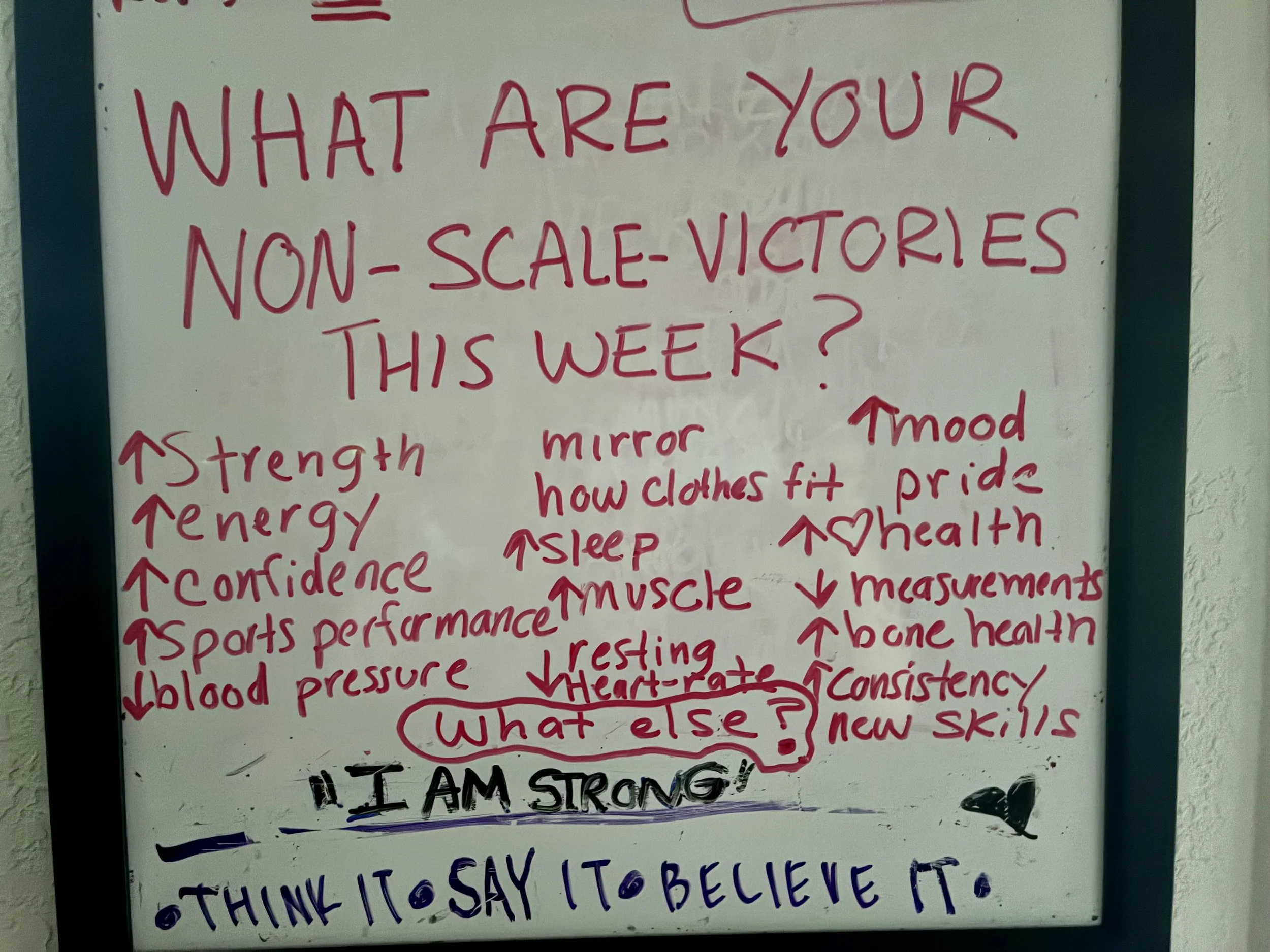
This is from the white board in my gym. I often write these things more for me than for my clients. hah.
The Big Picture
In the end, this has been a really healthy exercise for me to go through again. It was more than 15 years ago that I first lost the 40 pounds that kicked off my fitness journey, and it’s easy to forget what the middle of the process feels like. Stepping into my clients' shoes allows me to truly understand their day-to-day struggles so I can coach with deeper empathy. I’ll be over here celebrating all my small wins along the way (and yours too)!
I’m here to remind you that extreme measures are not required or advised. More often than not, the path forward involves an open mind, some fine-tuning, sustainable healthy habits, and a little self-compassion. When we learn to enjoy the process rather than hyper-focusing on the scale, the real results of a life well-lived naturally follow.
Lea
There is no greater compliment than a referral!
Have I helped you? Leave a Google Review here

Lea Genders is a board-certified health coach, personal trainer, and workplace wellness consultant based in Fort Worth, TX. She offers corporate wellness programs for employee health and productivity, as well as in-person and virtual training / coaching for individuals worldwide. Her blog shares expert guidance on strength training, running, and sustainable nutrition @fortworth_trainer
Interested in coaching? Apply here.








A guy in my neighborhood runs only in the hottest part of the day, in the hottest months of the year. We call him Self-Inflicted-Pain-Guy. I laugh, but lately I’ve been wondering why I’m often Self-Inflicted-Pain-Girl myself. What if I’ve been mistaking discipline for structure?