The Courage to Show Up

I walked into a large meeting room in the convention center which was already buzzing with my fellow fitness professionals preparing for a seminar on partner workouts. My heart started racing, I felt nervous and intimidated. I looked around the room and there were already more than 50 people and everyone seemed paired off. We were going to learn and perform partner programming. Who would be my partner? Would he/she be fitter than me? Could I keep up? My fight or flight response kicked in and I really wanted to run. What was I thinking? Why did I sign up for this? There were a lot of people in the room. Would I embarrass myself? How would I measure up against other fitness professionals? It felt downright scary. 

Then it hit me. This is how the new people that show up at my bootcamp must feel. I teach a beginner bootcamp on Tuesday nights. When a new person walks in that door for the first time, I can sometimes sense the apprehension. I go out of my way to make them feel welcome and encourage them that we are going to have a great class. But I somehow forgot what it was like to feel that fear because I already know the Tuesday night workout will be fun and we'll maybe even have a few laughs. I know for a fact they'll be able to keep up (we do modifications, if necessary). I know they'll push themselves more than usual and it will feel hard, but I also know that they will likely walk out of those studio doors feeling like they accomplished something great. It was easy for me to forget the courage it takes to just show up, how much they might have had to overcome just to walk through those doors. 

I know it can be a challenge to pick yourself up off the couch after a long day at work or school when a glass of wine or a Netflix marathon seems more enticing. It takes strength to ignore those butterflies in your stomach as you enter the new studio address into your GPS, avoiding the feeling of wanting to turn around at the next red light. It takes a certain level of determination to join a group of strangers in a room to sweat together. I forgot about the fear that other people might be judging or critiquing you. 

But it all came back. That day in the conference room, I remembered it all. And it all felt real scary. Then a friendly girl tapped me on the shoulder and asked me to be her partner. The instructor began his lesson/workout and the next hour and a half flew by. All my fears were unfounded. The workouts were challenging and fun. I finished the session with some fresh ideas and a sense of accomplishment for learning something new and not letting a feeling of uncertainty stop me from trying something great.

The lesson I learned at that seminar was less about partner programming and more about understanding and having compassion for my new students in class. 

I get that it is hard. It can be scary and intimidating, but most of the time the hardest part is just showing up (except burpees. hah). Just get yourself out there with the expectation of having fun. Have the courage to show up and see what happens. You may be rewarded with new friends, a sense of community, and a kick-ass workout (not to mention healthy body & mind). 

Like this post? Please consider sharing. 


Workout Wednesday: Plank Workout

Welcome to another edition of Workout Wednesday! Each week I put together a quick and effective workout that you can try at home. Runners always tell me they don't have time for strength training. I suggest you work through this core circuit after you complete your run. If you complete 10 minutes of strength training after each run this week, you could squeeze in a full body workout! 

I love planks. They are effective for building core strength, which is essential for runners! I like to do at least one to two minute low plank every day. #plankaday. If I miss a day, the @Plankpolice come after me. (No. I'm not kidding.)

Let's get planking!

HI PLANK

In a high plank position place your shoulders directly over your wrists. Your body should form a straight line from your head to your heels. Engage your abs and breathe normally. Hold for one minute.

MARCHING PLANK

In a marching plank you will transition from a high plank to a low plank position. Lower your right arm, then your left arm until you are in an elbow plank position. When transiting multiple times, like you will during this circuit, be sure to alternate the arm you first use to push up. Push back up to high plank starting with the right arm, but on the next rep, pushup to plank by starting with the left arm to minimize pressure on the shoulders. This is challenging! Work to complete one minute.

LOW PLANK

Position your elbows on the floor with your shoulders directly over your elbows. Your body should be in a straight line parallel to the floor. Engage your core, pulling your belly button into your spine while breathing normally. Squeeze your glutes. Be careful not to sink your hips or raise your butt in the air. Do not clasp hands. Hold for one minute. If you need to rest, break it up into 15 or 30 second increments. 

LOW PLANK SPIDERMAN

While in the low plank position, bring your knee out to side and bring as close to your elbow as your flexibility will allow. Be careful not to sink your hips low or raise your butt in the air. Alternate sides for one minute. 

SIDE PLANK

With a straight arm lift yourself up into a side plank position. Your shoulders should be directly over your wrists. Stack your feet and don't allow your hips to drop. Hold for 30 seconds before switching sides.

If a straight arm side plank is too challenging, start in a side elbow side plank and break it up into 10 or 15 seconds increments. Repeat on other side.

I recommend doing the circuit two to three times a week while continually challenging yourself. In order to keep progressing and getting stronger, you'll want to continuously make the circuit more difficult, either by adding more time, sets or progressing the exercises.

Like this post? Please consider sharing!
 

Coach Lea

I am a NASM personal trainer that specializes in strength training for runners. I offer in-person training in the Shredshed, as well as online training. If you are interested in a more in-depth strength training plan for runners, please contact me. Have questions? I'd love to help. 

While I am a certified personal trainer, I am not your personal trainer. Since I don't know your exercise abilities, injury background or medical history, please see your doctor before beginning any new exercise program.


Running A-Z: K is for Knee Pain Prevention for Runners

Hi, friends. Welcome to the latest edition of Running A-Z. Each week I cover a new running related topic following the order of the alphabet. Have you been following along? You can catch up on letters A-J in the archives

I could write a whole other blog post on things that you should never say to a runner: Did you win your marathon? (After you ran a 5k) What was your place? (It was 574th, thank you very much) Isn't running bad for your knees? (As a matter of fact, it's not). 

It's not that running is bad for your knees, it is just that when you run (and only run) you can form muscle imbalances (have muscle tightness and weaknesses). This is where knee pain can occur, sometimes called runner's knee.

When you run you strengthen the hamstrings (back of the leg muscles) more than the quadriceps (front of thigh). Tight hamstrings and weak quads is an imbalance that can cause pressure on the knee. Knee pain can also be rooted in instability issues from lack of hip strength. The solution could be to work on strengthening your quadriceps and hips and stretching your hamstrings and calves. 

It's important to note that if you already have knee pain, please see your doctor. Never run through pain. Pain is a signal from your body that something is wrong. Work with a professional to figure it out. It won't get better by ignoring it or reading blogs, you'll likely just end up with a full-blown injury. 

I am going to talk about knee pain prevention, the actions you can take to avoid knee pain the first place. 

Foam Rolling and Stretching

Foam rolling only takes a few minutes and can make an incredible improvement in muscle tightness and improved flexibility. Before you run take five minutes to go through a foam rolling routine, focusing on overactive or tight muscles. Foam rolling, also called self-myofascial release, is a technique that uses pressure to break up the knots within the muscle to help release tension and tightness. See my foam rolling for runners post for more detailed instructions.

Strengthening

Focus on hip and quad strengthening exercises. Even if you don't do any other strength training, these will go a long way in injury prevention. You don't need to spend hours in the gym, just 15 minutes a day three times a week. Check out my post on injury prevention for runners for some simple and effective hip strengthening exercises.

Resting

Sometimes pain is caused by overtraining and can be diminished or eliminated simply by resting. Be sure you are building in proper rest days into your training schedule. Too much too soon combined with not enough rest can lead to overuse injuries.

Active injury prevention

You should be proactive in injury prevention. Review my runner's injury prevention checklist to ensure that you are taking all the correct actions to avoid running injuries. I outline them in this blog post and you can download a PDF version to print. 

Like this post? Please consider sharing. 
Coach Lea

I am a NASM personal trainer that specializes in strength training for runners. I offer in-person training sessions in Fort Worth in the Shredshed, as well as online training. If you are interested in a more in-depth strength training plan for runners, please contact me. Have questions? I'd love to help. 

While I am a certified personal trainer, I am not your personal trainer. Since I don't know your exercise history, injury background or medical history, please see your doctor if you have pain or before beginning any new exercise program.


The Runner's Injury Prevention Checklist

Attention runners! Are you taking all the necessary precautions to avoid injuries? Use this checklist to make sure you are on the right track to continue running injury-free well into the future. 

download the injury prevention checklist

download the injury prevention checklist

Do you properly warm up and cool down?

Take 5-10 minutes before each run to warm up. I recommend a mix of foam rolling and dynamic stretches. Dynamic stretching is when you move the joint through the full range of motion. It is an active stretch, unlike a static stretch that you would hold for 30 seconds. Great dynamic stretches before running are leg swings, walking lunges and squats. 

After your run take 5 minutes for static stretching (hold each stretch for 30 seconds). 

Do you wear running-specific shoes and replace them every 500 miles?

A good pair of running shoes will provide the support you need to run safety and help prevent injury. If you are putting in significant miles each week, like someone who is training for a marathon, I would recommend having two pair of running shoes and rotating the shoes every other run. Mark on your calendar (or in your training log) when you buy new shoes and keep track of the milage. Replace every 500 miles.

Do you build distance and intensity gradually, no more than 10% a week? 

One of the big mistakes runners make is doing too much too soon. Listen to your body. Build your milage gradually, never more than 10% increase a week and every fourth week, reduce your milage. Building milage slowly is the best way to prevent injury. You'll hopefully be running long into the future, there is no need to rush anything. 

Do you avoid increasing both distance and intensity in the same week?

If you add additional miles to your training log, don't also add increased intensity speed work. I usually block my training cycles to meet specific goals, I am either training to increase milage (like for a half marathon) or to improve speed, but never both in the same week. 

Do you limit speed work and hard effort sessions to 2-4 times a week?

Most runners need just 2-3 days a week of effort sessions. Effort sessions include anything outside of easy runs, for example, hill repeats, fartleks, speed work and long runs. Doing too much only leads to injury. Listen to your body. 

Do you rest between hard workouts?

Always allow 1-2 rest days or easy run days between hard workouts. Never do hard workouts back to back. Remember that adaptations occurs during rest. If you never rest, you never get stronger or faster. More is not always better. 

Do you fuel properly for running?

Your body literally runs (pun intended) on the fuel you give it. If you don't fuel properly, you'll see it in your results. Runners need carbs and calories for energy, protein for muscle repair, and fat. Eat to perform. Work to include nutrient dense foods in your diet for the best results. 

Do you strength train and/or cross train? 

Ah, my favorite topic. It's so important to me that I built my business around the notion that runners who strength train are stronger faster runners. You don't have to spend hours in the gym, but carving out a little time for strength training and cross training will help reduce your chance of injury from running. 

Do you get 7-8 hours of sleep a night? 

Sleep is so important. Not getting enough sleep, less than seven hours of sleep per night, can reduce the benefits of running. Your body needs the time to recover. Lack of sleep can cause you feel unfocused, hungry and, despite your running efforts, not achieve results. When you don't get enough sleep, your stress hormone levels can rise, which can be associated with fat gain. 

Aim for 7-9 hours a sleep a night to maximize your efforts and reduce the chance of injury.

If you answered yes to all the above questions, congratulations! You are taking the necessary precautions to help avoid injury. Did you fall short anywhere? If so, tackle one point at a time and work to improve gradually until you check yes for all the questions. 

You can download the checklist here in PDF format!

Any questions? I'd love to help! Let me know in the comments. 

Like this post? You can help me out by sharing!


Coach Lea


Shuffle Up Your Workout with a Deck of Cards!

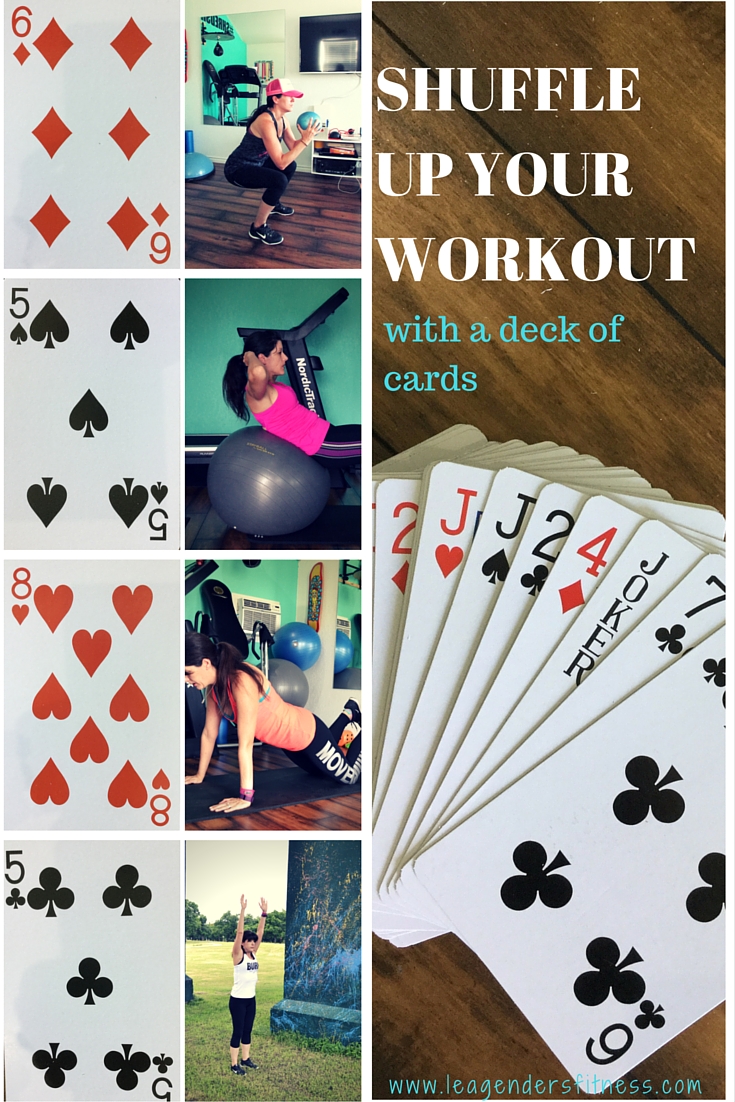
Welcome to Workout Wednesday! No one ever said working out had to be boring. As a bootcamp instructor I am always looking for ways to keep our sessions fun and interesting. There are lots of way to add a game component to your workouts. For this one we are going to use playing cards for a fun full body workout challenge.

Shuffle up your workout with a deck of cards.

Shuffle up your workout with a deck of cards.


What You'll Need

A deck of playingcards

Timer 

52 Pick-up

When I was a young girl one of my boy cousins approached me with a deck of cards and asked me if I wanted to play a game called 52 pick-up. I was excited my much older cousin wanted to play a game with me. When I enthusiastically agreed to play, he threw all the cards on the floor and walked away, "There are 52 cards, now pick them up."  Jerk. That is a trick you only fall for once.

I promise my workout won't be a trick, but I can almost guarantee you'll be working to pick yourself up off the floor after this one. 

How it works

Shuffle the cards, place them face down in a stack, then choose the first card off the top. Set your timer for 20 minutes and complete as many cards as you can in that timeframe. 

Hearts = pushups

Diamonds = squats

Spades = crunches

Clubs = burpees

You perform the number of repetitions on the card. For example, if you flip over a 4 of hearts, you perform 4 pushups. 6 of diamonds means you do 6 squats.

King, Queen, Joker and Jacks = 12 reps each. 

Hearts = Pushups

Start in a high plank position with your hands placed a little wider than your shoulders. Keeping your body in a straight line, while engaging your core slowly lower your chest to the floor. Once in the low position, push back up to the starting position. If this is too challenging, drop to your knees. 

Diamonds = Squats

Starting with your feet hip width apart push your hips back and lower until your thighs are parallel to the floor (like you are sitting back in a chair) or as low as your flexibility allows. In the low position, engage your core, squeeze your glutes and push up to standing. Take a deep breath in as your lower to the squat and breath out as you return up to standing.

Spades = Crunches 

Start by lying on your back with your knees bent at a 90 degree angle. Push the small of your back into the floor. Contract your abs while breathing normally and lift your shoulders and upper back off the floor a few inches. Hold in the top position for 3 counts before lowering back to the floor.
You could also use a stability ball for this exercise, follow the above instructions but positioning a stability ball under your lower back.

Clubs - Burpees

Burpees (Everyone's favorite!)

Burpees (Everyone's favorite!)

Start with your feet hip width apart, lower into a squat position until your hands are flat on the ground in front of you. Jump your legs backwards into a high plank position. Jump both feet forward so you are back in the squat position. Jump up and raise both hands over your head. If this is too challenging, step back and forward from plank position instead of jumping. 


SUCCESS TIPS

Don't be tempted to skip cards. Since there are only four exercises, you may find yourself doing the same exercise several times in a row. That's ok, you are building endurance. 

Work to complete the reps on the cards only resting for as long as it takes you to flip the next card. The goal is to keep moving for the entire 20 minutes. Since the clock is ticking, you want to maximize your time.

All of these exercises can be completed using only your bodyweight, but you can challenge yourself further by adding weights to the exercises.

See how many cards you can get through in twenty minutes. I'd love to know, send me a message on Twitter or leave a note in the comments. 

Partner Challenge

You could make this a partner challenge by competing with a friend to see who can get through the most cards in 20 minutes. Just remember that proper form is always more important than speed. Rushing through the exercises with improper form will make them less effective and you could risk injury. Play smart!

Please remember that while I am a personal trainer, I am not your personal trainer who knows your medical history, exercise background and unique needs. Please consult with your doctor before beginning any new exercise program. 

Any questions? I'd love to help. Let me know in the comments.

Coach Lea

Like this post? You can help me out by sharing!