Running A-Z: J is for Journaling for Runners (Believe Journal Giveaway)

Welcome to the latest edition of Running A-Z where I cover a running-related topic following the order of the alphabet. Missed some posts? You can catch up on letters A-I here

When I started this series, I worried this would happen. I worried I would come upon a letter that did not have an obvious running-related topic. J? Jogging? Jokes? I was sort of lost. Instead of burdening (or delighting) you with my running jokes (I think I'm hilarious) I decided to talk to you about the importance of journaling for runners. 

I am a blogger and a writer at heart, so it is very natural for me to journal my runs and workouts. Journaling your runs includes documenting more than just how many miles you ran and at what pace. When you journal your runs you write about how you felt during your run, what the weather was like, the time of day, how you fueled and how you felt after. But even if you have never journaled before, there are great reasons why you should start a running journal today. 
 

To state your goals

Writing you goals and plans down on paper is the first step in achieving them. So whether you are training for a half marathon, a faster 10k or your first 5K, having a written plan and goal serves as a daily reminder to stay on track and can be a motivator to do the work required to achieve that goal. A journal can hold you accountable to your goals.

To track improvements

Writing about your daily runs help you track improvements. Sometimes improvements may come slowly and you may feel like you are not improving at all. Being able to track your progress from week to week, month to month and year to year show you that while sometimes changes have been slow, they have been occurring.

I tend to forget every summer that the debilitating Texas summer heat slows me down and get mad at myself for my slower pace in 90% humidity. A running journal helps remind me of my paces and conditions from last summer so I can make comparisons based on similar conditions. I can't always count on my brain to remember. 

To monitor and customize your training plan

Journaling helps you monitor how you feel during and after a run and the factors that can affect it. Maybe you notice that you always feel drained with "heavy" legs on early morning runs, but feel fast and efficient in the afternoon. That may mean your body doesn't respond well to running on an empty stomach in the morning. Maybe you notice you have better runs after a moderately high carb dinner. 

Journaling may reveal that too many speed work sessions in one week leaves you feeling drained and overworked. Maybe adding an extra tempo run in a week improves your half marathon pace. It's hard to know what is working or not working until you track and monitor it. 

I noticed that if I ran more than two days in a row, I would experience some hip pain. I backed off running on that third day for rest and the hip pain went away. The journal helped me see that pattern and I changed my training plan to fit my needs. 

A journal can help you experiment with what is working, and not working for you. When you document how you feel, you can see the trends over time and make adjustments as needed.

To document achievements

I am a big fan of self-celebration. Too many things in this world can bring us down, let us remember to celebrate our achievements, both big and small. If I completed every workout on my plan for the week, that is cause for celebration! If I achieved a PR or even crossed a finish line without dying, let's celebrate. A journal helps you document those successes so that on those days that you are dealing with self-doubt or negative feelings you can turn to your journal to remember your past successes. 

Getting started with journaling

All you need to get started is a notebook. Some people may prefer an app like Daily Mile, but call me old fashioned (or just old) but I prefer the pen and paper method. There is something that works for me when sitting down with a pen and notebook to document my experience.

WIN IT

Enter to win a believe training journal giveaway

Enter to win a believe training journal giveaway

All you need to get started is a regular notebook, but If you want to get fancy, I recommend the Believe Journal. It is training log designed by professional runners that is chalk full of motivation and inspiration. Best news? I have one for you to win in a giveaway. There are many ways to earn entries. Just complete one or complete them all for a better chance of winning. Good luck, friends!  

Thanks for tuning in for another edition of running A-Z. Have any suggestions for future topics following the order of the alphabet? What do you want to learn more about? Let me know in the comments! 

Like this post? Please consider sharing!

GIVEAWAY RULES

Giveaway runs from 7/25/16 - 8/2/16

Open to US residents, 18 years old or older

Must have a shipping address in the US

Winner will be notified by email and have three business days to confirm prize

If prize is not confirmed in three days, an alternative winner will be selected

All Rafflecopter entries will be verified. If entry not completed, a new winner will be selected.

All winners will be randomly selected via rafflecopter

No purchase necessary to win



Coach Lea


5 Exercise Excuses Debunked

There are a lot of legitimate reasons not to workout. Maybe your doctor told you not to, maybe you needed your sleep, maybe you have an injury or you're sick. The key is to be honest with yourself so you can determine when you miss a workout if you are making excuses or you legitimately need to rest. As the saying goes, "The only thing standing between you and your goal is the bull$hit story you keep telling yourself as to why you can't achieve it." Maybe a nicer way of saying that is that sometimes we need to get out of our own way. We make these excuses why we can't workout, then we believe them. It all starts in our heads. Believe you can do it first. Then do it. 
 

"I don't have time"

This one is easy to debunk because it really doesn't take a lot of time to fit in exercise in your life. Maybe you legitimately don't have an hour a day to workout but fitting in 20-30 minutes a day is all you need. Try getting up 30 minutes earlier in the morning or squeezing in three separate ten minutes workouts through out the day. Yes, that counts. Take your dog for a walk. Do pushups during commercials of Game of Thrones or lunges while you're waiting for the microwave to ding. It doesn't have to be structured and scheduled. Move your body. Check out my workout archive for plenty of quick workouts that are 4-15 minutes long. Something is always better than nothing. 

"I can't afford a gym membership"

A gym membership may sound like the ideal workout environment with a 24 hour schedule, a pool, sauna and treadmills for all. But a gym can also be crowded, expensive and intimidating. While it may be nice to have the convenience of gym, it simply is not necessary to get in shape. If you can't afford a gym membership you can do workouts at home with DVDs, look up free workouts on You-Tube or follow my workouts every Wednesday for #workoutwednesday. There a ton of free resources on the internet and you can get an effective full body workout with no equipment except your own bodyweight. No gym membership needed.

"I'm too Old or OVERWEIGHT"

I recommend speaking with your doctor before beginning any new exercise program, but using your age or current weight as an excuse not to exercise is just a cop out. Once your doctor gives you clearance to workout this excuse is debunked. A fitness professional can help develop a safe and effective program for any age or fitness level. Not everyone needs to join CrossFit to get in shape, there are plenty of low-impact workout plans that will be effective for you at your current fitness level. If you are not sure where to start, work with a professional to help you reach your goals. 

"I hate to exercise"

Exercise is physical movement with the purpose to improve health and fitness. Maybe you hate running. Maybe someone dragged you to a fitness boot camp once and you almost died (jokes!). That's OK. There are plenty of ways to move your body. The key is to find the thing that you enjoy and stick with it. Some people like walking, some people like tennis. My dog loves to run so I indulge him. There are many paths to fitness. There is no need to follow the traditional route. It may take some experimenting, but try some fitness classes, round up some friends for a hike or jump on a bike with your kids. There is something out there for everyone. 

"I don't have child care." "My kids keep interrupting me." "I have to drive my kids to...."

I get it. No matter what their age, kids keep you busy. Sometimes (OK most of the time) they need your attention. You can barely use the bathroom without them pounding down the door, let alone get away for an hour to workout. But kids can be a great motivator to exercise. You want to be healthy so you can keep up with them and be around for them for years to come. Whether they are 5 or 15, getting them involved in exercise is a great way to lead by example and be a role model for a healthy lifestyle. Maybe it's a family bike ride, hike or tag football in backyard. Teaching your kids that exercise can be fun, is a good way to remind yourself. 

There's one thing that always sticks with me when I catch myself making excuses as to why I can't do something. I think it's human nature, we rationalize our bad decisions. I once told my sister that I can't get myself out of bed to workout in the morning anymore and she said, "It's not that you can't, it's that you choose not to." It's true, if I turn off the alarm and roll over to go back to bed instead of working out, I made a choice. Works towards making the choices that bring you closer to your goals, rather than making excuses that set you further behind.

Like this article? Please consider sharing.

Need help with motivation? Maybe I can help!

Coach Lea


Strength & Cardio Ladder Circuit Workout

Welcome to another edition of Workout Wednesday. Each week I give you a new workout that is quick and effective. If your excuse for not exercising is that you don't have enough time, I have that excuse debunked! Most of the circuit style workouts I share are from 4-15 minutes. You can make time for that, right? 

I am returning from a long weekend at the IDEA World Fitness convention. I had a great time soaking up the knowledge and connecting with my fellow fitness professional and bloggers. It can be hard to squeeze in a workout when you're traveling. This workout is a perfect bodyweight workout that takes up little space and little time. You could knock it out on the floor of your hotel room or whenever you have limited time or space. 

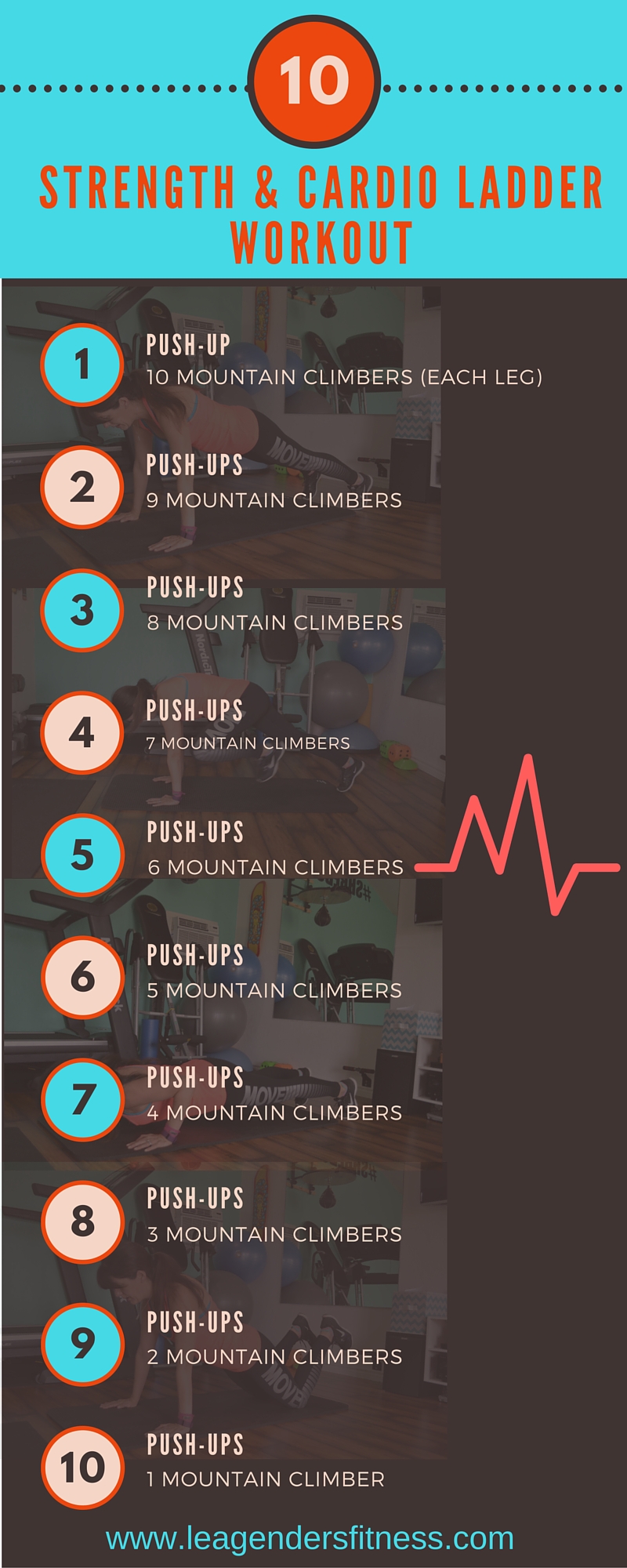
This is a ladder workout that combines a strength move with a cardio move. You count up reps of the strength move from 1-10 and count down on the cardio move from 10-1. For example, in this first circuit, you would complete 1 rep of a pushup and 10 reps (each leg) of a mountain climber. Then you would move on to 2 reps of the pushups and 9 reps (each leg) of a mountain climber. Then 3 push-ups and and 8 mountain climbers and until you worked your way up to 10 reps of the push-up and 1 rep (each leg) of the mountain climber. 

strength & cardio ladder workout

strength & cardio ladder workout

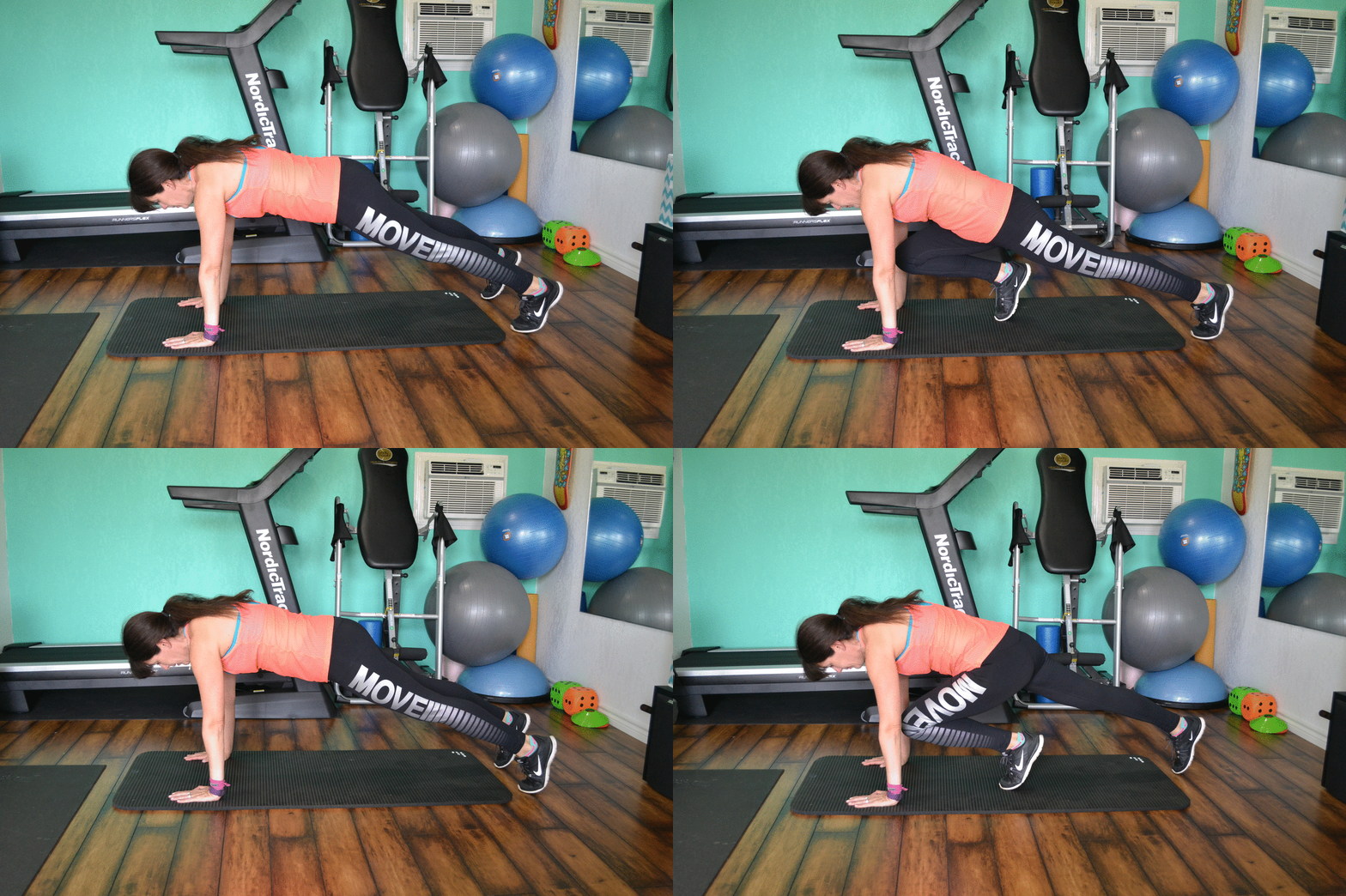
There are just two moves in this circuit. The push-up and the mountain climber.

Push-Up

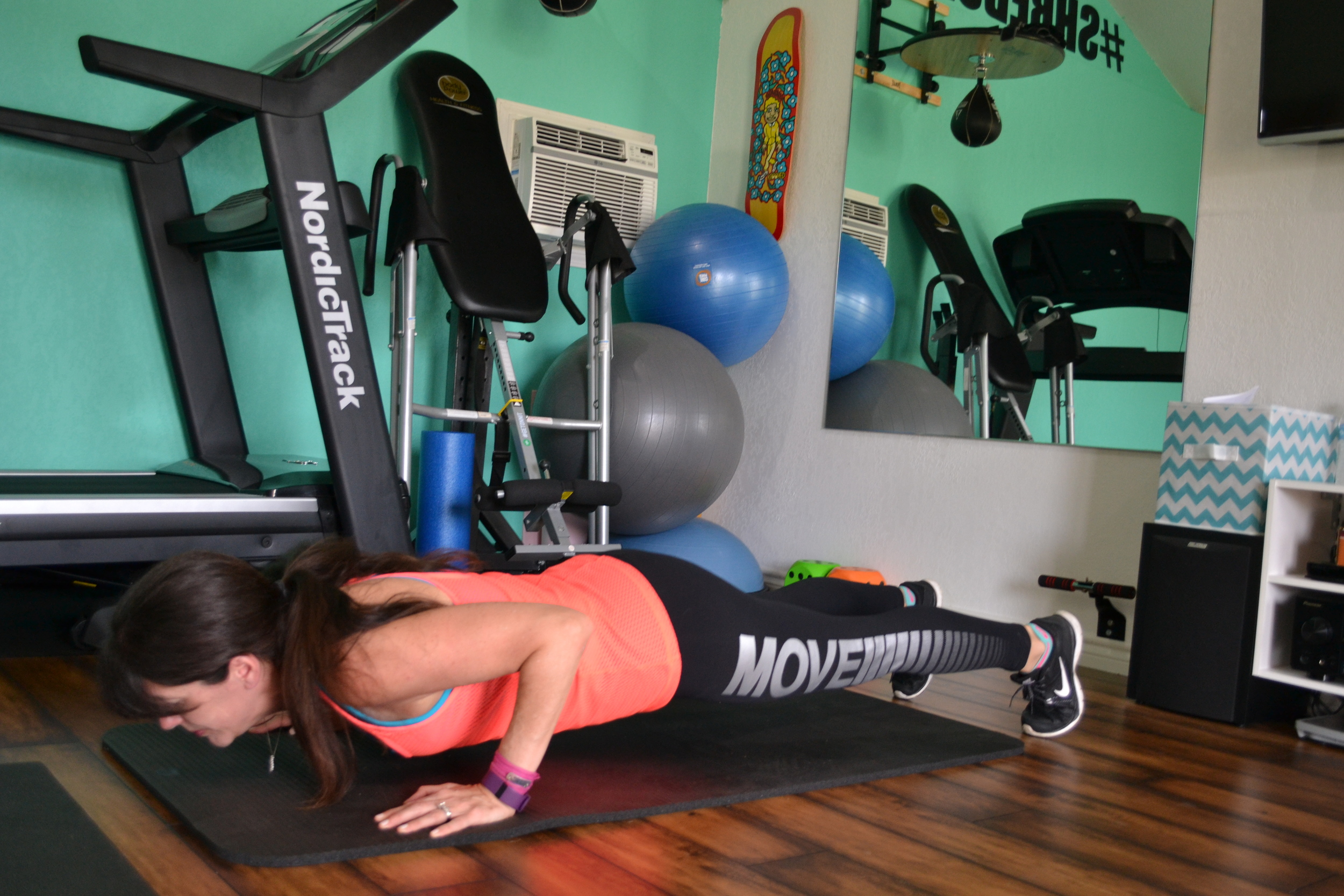
Start in a high plank position with your hands placed a little wider than your shoulders. Keeping your body in a straight line, while engaging your core, bend your elbows slowly to lower your chest to the floor. Once in the low position, push back up to the starting position. If this is too challenging, drop to your knees. 

starting push-up position

starting push-up position

low push-up position

low push-up position

Mountain Climbers

Start in a high straight arm plank position with your wrists directly under your shoulders with your legs wider than hip width for stability. Keep your body in a straight line from your shoulders to ankles while engaging your core. Do not allow your hips to hike up or sag down. Quickly bring your right leg, then your left leg in to touch your elbows. Right then left equals one rep.

This is a great format for strength and cardio in one workout. You could make it a full body workout by completing this circuit then switching up the exercises to a squat and high knees! 

It's important to remember that while I am personal trainer, I am not your personal trainer. Please speak to your doctor before beginning any new exercise program. Have questions? I'd love to help!


Like this post? Please consider sharing. 


Coach Lea


Running A-Z: I is for Injury Prevention for Runners

It's another week of Running A-Z, where I cover a running-related topic following the order of the alphabet. This week is the letter I. We will be talking about exercises for injury prevention. If you missed any of our past editions, you can catch up with letters A-H in the archives.

If you read this blog on a regular basis you know that I am a huge proponent of strength training for runners. In fact, I run my whole business on the notion that runners who strength train are stronger, faster and less prone to injury. But I get it. Runners generally don't enjoy the strength training aspect as much as they love to run. The good news is that you don't need to spend hours in the gym for basic injury prevention exercises. Runners generally need to work on strengthening their hips and abs. I challenge you as a runner to find 15 minutes three times a week to perform these exercises. Our goal is to strengthen those hip muscles to avoid injury.

You'll want to progress the exercises to make them more difficult over time, either by adding an extra set, a few reps, or adding resistance. Begin with two sets of ten reps for each exercise. After a week add an extra set. Once you are doing three sets, start adding additional reps each week until you're at three sets and 20 reps. Then make the exercises more challenging or add resistance. By continually progressing the exercises you will avoid adaptation and will get stronger over time. 

CLAMSHELLS

Lie on your side with your knees slightly bent with your legs and ankles together. You can prop yourself up on your forearm during the exercise. Open and close your knees like a clam by lifting your top knee up. Repeat on the opposite side.

Progress the exercise by adding a resistance band to your thighs.

BIRD DOG

On all fours with your wrists directly underneath your shoulders lift one arm off the floor to shoulder height while lifting the opposite leg in line with the hip. Switch arms/legs after 30 seconds. Squeeze your abs and glutes during the move while breathing normally.

Progress the exercise by extending the time in position.

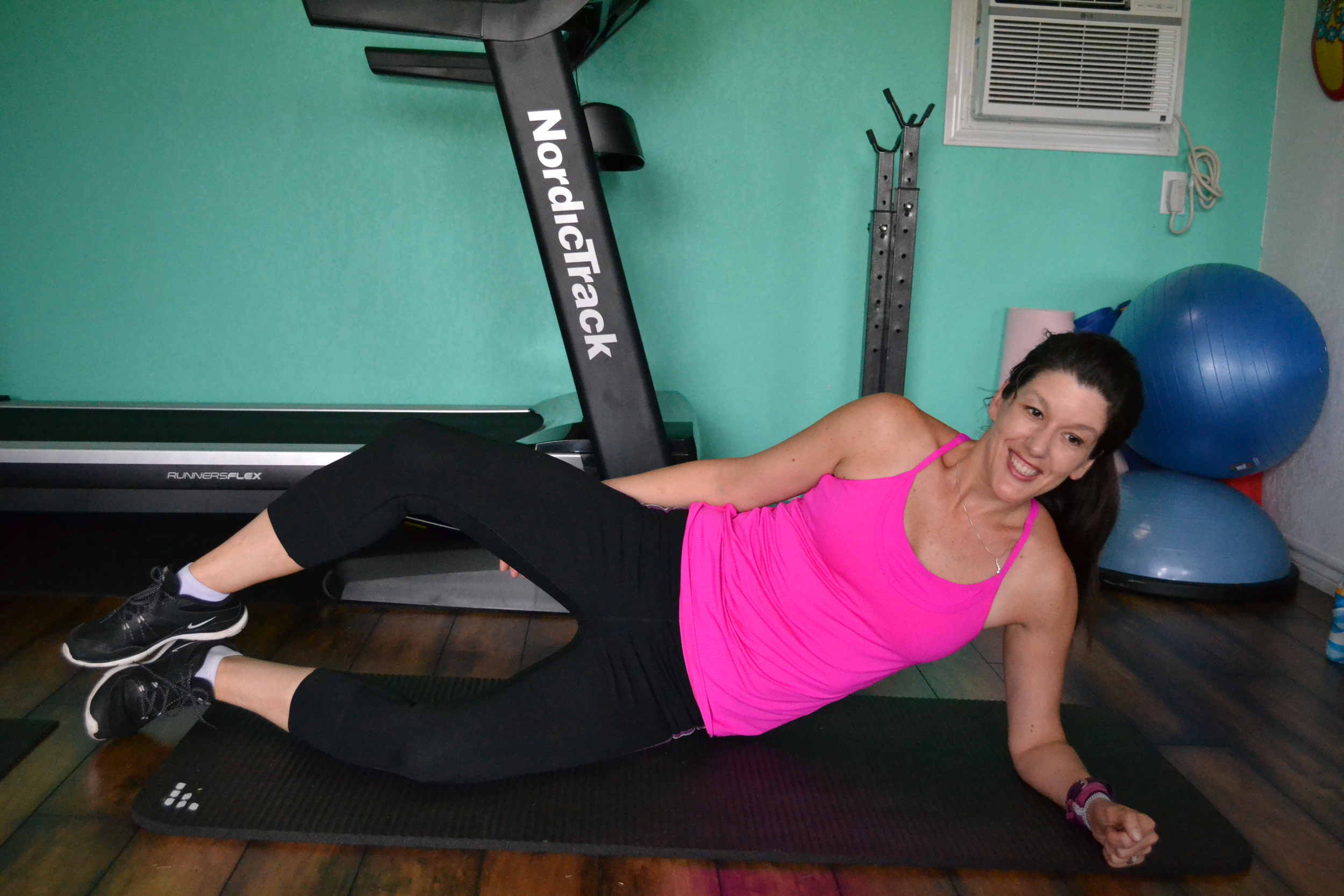
HIP ABDUCTION

Lie on your side with your legs stacked on top of one another. Lift your top leg to about 45 degrees before lowering. Switch sides and repeat.

Progress the hip abduction when you're ready by advancing to the side plank hip abduction.

With a straight arm lift yourself up into a side plank position. Your shoulders should be directly over your wrists. Stack your feet and don't allow your hips to drop. Lift your top leg. Switch sides and repeat.

GLUTE BRIDGE

Lie on your back with your knees bent and lift your hips off the floor while engaging your glutes and abs. Your body should be in a straight line from your knees to your shoulders.  Lower your hips to the floor and repeat. 

Progress the exercise my lifting one leg, then alternating the leg. 

I encourage you to work these four exercises into your weekly routine to build hip strength. It is important to remember that while I am a personal trainer and running coach, I am not your personal trainer and running coach. Please get clearance from a medical professional before beginning any new exercise routine.

Any questions? 

Like this post? Please consider sharing.

7 Fitness Mistakes that Can Kill Your Results

You've been working out and eating healthfully but not seeing the results that you expected. What's going on? It can be frustrating when you've been working hard but feeling like it's not getting you closer to achieving your goals. Are you making one of these seven fitness mistakes?

Rushing the Process 

The truth is that fitness progress takes time. Any program that promises results in nine weeks or 90 days is using a marketing ploy to entice you with a quick fix. Yes, you can make progress in that amount of time, but fitness is a life-long commitment, not a three month challenge. 

A lot of people start a new workout program, remain consistent for three or four weeks and then get frustrated and quit when the results aren't there as quickly as they hoped or expected. It took you much longer to get out of shape, so you can't expect to turn everything around in a few short weeks. The good news is that after three weeks you are on the right track to building a fitness habit. It is a great start. The difference between those who fail and those who succeed is that the successful people don't quit.

Consistency is the key. Put in the work. Give it time. Make it a habit. You will get there. 

Focusing on scale weight

The scale doesn't tell the whole story. It is important to remember that when looking to lose weight, you should be focusing solely on fat loss, not weight loss. 

A scale can show weight loss that is mostly water or muscle (bad) instead of fat, but you still may walk away feeling happy that you "lost" three pounds. Losing three pounds of muscle is not good, but the scale can't tell you that.

On the other hand, the scale may not budge a lot when you are losing fat and gaining muscle because muscle is more dense than fat and takes up less space in your body. That is why your clothes may fit looser but your body weight stays the same.

Focus on non-scale victories. How do you feel? How do your clothes fit? How are your energy levels? A scale is one tool to use in your fitness journey, not the end-all-be-all. Don't give it too much power, as it doesn't tell you the whole story.

Skipping Strength Training

It can be easy to fall into a all-cardio-all-the-time routine when on a mission to lose fat. While cardio plays an important role in fat loss and heart health, it shouldn't be the only thing you do to improve your fitness. 

Strength training or resistance training can be the missing link to successful fat loss. It helps you maintain and build lean muscle. You want to make sure you are preserving your muscle mass while you lose weight. The more muscle you have on your body the more calories you burn, even at rest.

Some women don't want to lift weights because they worry about getting too bulky or masculine looking, but this fear is unfounded. The women that look like that work extremely hard to achieve that look over years of dedicated training for that specific goal. Unless you are specifically training and eating to look like a bodybuilder over a long period of time, you won't look like one. I promise.  

You don't need to spend hours in the gym. Carve out 30 minutes three times a week for strength training to build lean muscle for a well-rounded fitness routine.

Eating too much or too little

Nutrition is tricky. Some people think that because they are working hard at the gym that gives them a free pass to eat whatever they want. While I am a big proponent of balance, eating fast food after your daily workouts isn't going to get you the results that you desire. I limit my indulgence meals to once or twice a week. What you do occasionally does not impact what you do consistently. I make healthy choices most of the time so that when I want to eat pizza, sushi or drink wine, I have room for it in my diet. It's an occasional treat, not an everyday occurrence.

On the other end of the spectrum is the problem of eating too little. We know that in order to lose weight we need to create a calorie deficit, which means to eat fewer calories than we burn. Seems simple enough, eat less to lose weight, eat even less to lose more weight, right? Not so fast. Everyone's calories needs are different so I can't put an exact calorie count on it, but when a very active adult woman is not eating and wondering why she is not getting the results she desires, the answer is probably in her calorie intake. You can't thrive on kale and tuna.

Under eating can sabotage your results as much as over eating. Without proper fuel you won't have the energy to give your workout the intensity you need for results. Under eating can damage your metabolism, cause you to lose muscle, kill your results and put you at risk for malnutrition, resulting in unhealthy weight loss and possible nutrient deficiencies.

A person with an unhealthy obsession with healthy eating may be suffering from a disorder called orthorexia nervosa, a term which means fixation on righteous eating. 

The key is to be like Goldilocks, not too much, not too little. If you need help determining what that means for you, I recommend working with a registered Dietitian for professional guidance. 

Working out too much

Sometimes working out is like make up, less is more. When working out becomes an unhealthy obsession it can be harmful. Some people think that doubling or tripling their time in the gym will double or triple their results, but this is simply not true. Spending needless hours in the gym can increase your chance of injury, cause burnout, fatigue, irritability, possibly raise cortisol levels (the stress hormone) to unhealthy levels and hurt your metabolism. Overtraining causes the benefits of exercise to diminish. 

Moderate amounts of exercise of 30-60 minutes most days of the week is best way to go. Remember Goldilocks? 

Not resting

This goes hand in hand with working out too much, but even when exercising a moderate amount of 30-60 minutes a day, we still need our rest and recovery in between workouts. It is during rest that the body adapts to the stress of exercise and rebuilds. If you never rest, you won't see the results because you never give your muscles a chance to repair. Continuous workouts without rest will make you weaker, not stronger. Allow yourself one or two full rest days a week and never work the same muscle groups two days in a row. 

Not getting enough Sleep

If it came down to the choice of one hour of working out or one hour of sleep, how do you think the experts would advise you to spend your time? If you are not getting the 7-9 hours a sleep that your body needs, the answer would be sleep, every single time. Going to bed at midnight and setting your alarm for 5am to workout is not doing your body any favors. 

Not getting enough sleep, less than seven hours of sleep per night, can reduce the benefits of healthy eating and exercise. Lack of sleep can cause you feel unfocused, hungry and, despite efforts in the gym, not achieve results. When you don't get enough sleep, your cortisol (stress hormone) levels can rise, which can be associated with fat gain. 

Aim for 7-9 hours a sleep a night to maximize your efforts with nutrition and in the gym.

Have you ever made any of these fitness mistakes? I can write with confidence about these, because I personally have made most of them myself. Over the last decade on my fitness journey, I have grown by making a lot of mistakes and then learning from them. My aim is to help you not make the same mistakes I did, so you can be healthy, strong and see amazing results from your fitness efforts. 

Like this post? Please consider sharing.