WORKOUTS

STRENGTH & RUNNING WORKOUT

Welcome to the latest edition of workout Wednesday when each week I share a running or runner-specific strength workout. This week you are getting the best of both worlds because we are combining strength moves with a running interval workout. It's a great way to get in your strength and running in on the same day. This works best in a gym setting when you have access to a treadmill, but you could certainly do the run portion outdoors with a timer.
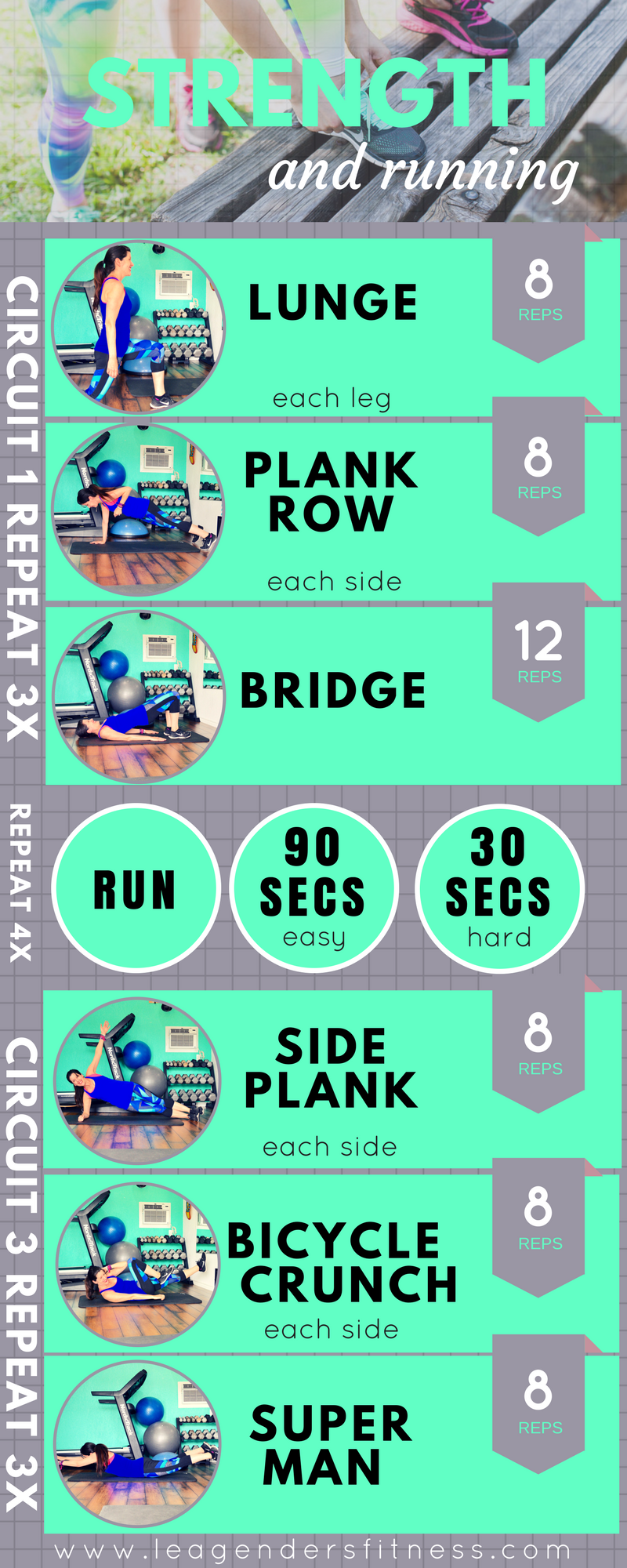
strength and running workout. Free PDF printable download. Save to Pinterest for later

strength and running workout. Free PDF printable download. Save to Pinterest for later

CIRCUIT ONE

There are three exercises in the first circuit. Move through all three exercises with little to no rest. Move swiftly but not so fast that you sacrifice form. Proper form is always more important than speed. After you complete the exercises, take a short rest or water break and repeat two more times.

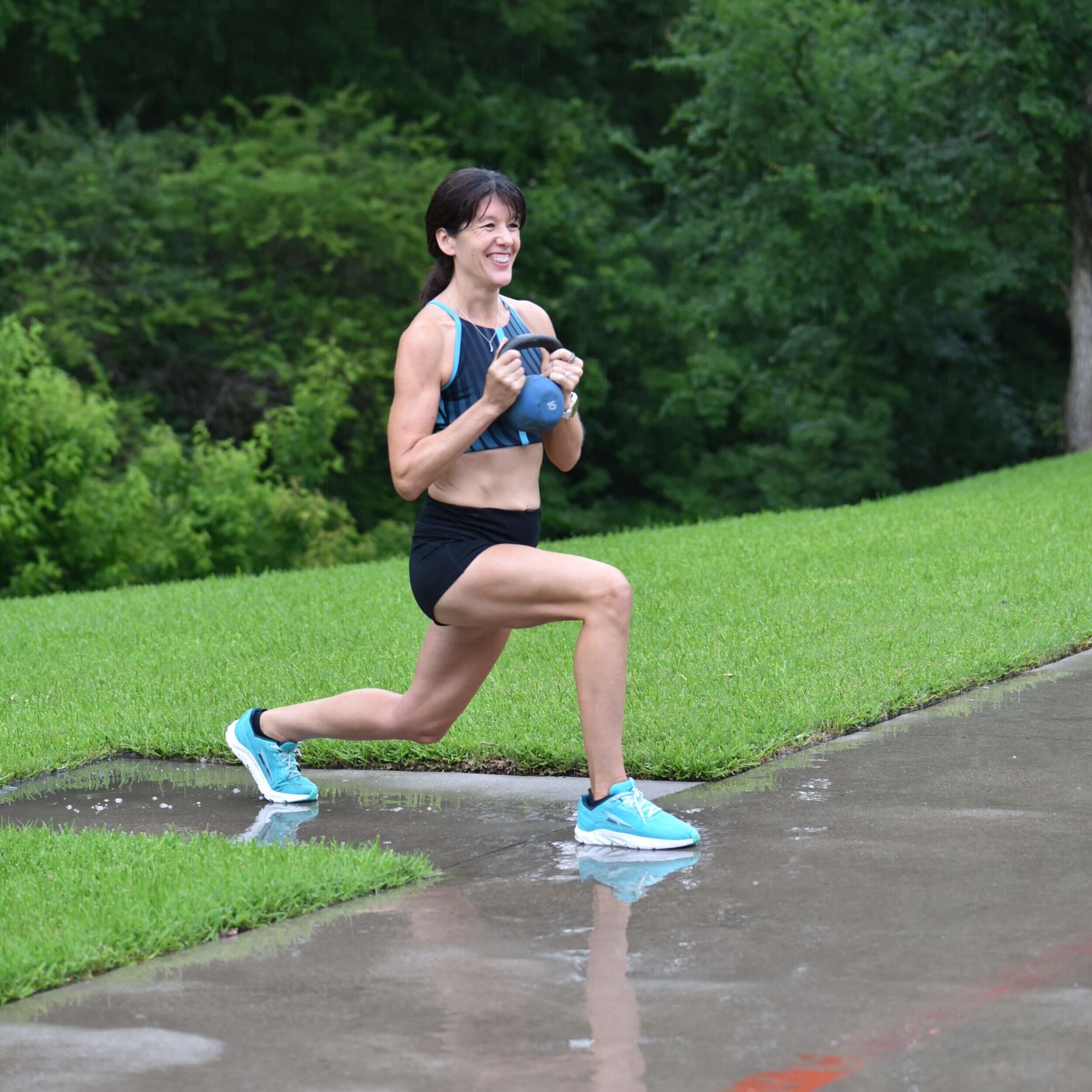
LUNGE

Starting with your feet hip width apart and your toes pointed straight ahead, engage your core and keep your back straight. Take one large step with your right leg to lunge forward until your front knee is lined up over your ankle and your back knee is nearly touching the floor. Once you are in the lunge position push back up to starting position. Perform 8 reps on each leg.

PLANK ROW

Start in a straight-arm high plank position with your wrists directly under your shoulders and your legs slightly wider than hip width for stability. Keep your body in a straight line from your shoulders to ankles while engaging your core. Do not allow your hips to hike up or sag down.

With your core tight and your glutes engaged lift your right elbow to row as you bend your elbow up toward the ceiling. Keep your elbows close to your side, do not allow them to flare out. You can do this exercise with or without weights. Perform eight reps on each side

BRIDGE

Lie on your back with your knees bent and push your hips off the floor so your body is in a straight line from your shoulders to your ankles. Push your shoulders into the mat. Squeeze your glutes and engage your abs. Pause for 1-2 seconds at the top of the the move. Perform 12 reps.

CIRCUIT TWO: RUN

Run for 90 seconds at an easy effort pace, then run for 30 seconds at a hard effort. Your hard effort pace should leave you out of breath. Repeat for a total of 4 cycles. 

CIRCUIT THREE

Move through the three exercises with little to no rest. Complete the circuit three times

ELBOW PLANK TO SIDE PLANK

Position your elbows on the floor with your shoulders directly over your elbows. Your body should be in a straight line parallel to the floor. Engage your core while breathing normally. Squeeze your glutes. Be careful not to sink your hips or raise your butt in the air. Do not clasp hands in front as this throws off your alignment. 

Twist up into an elbow side plank position with your shoulder directly over your elbow. Don't allow your hips to drop. Hold the position for 1-2 seconds in the top position. Alternate sides and perform eight reps.

BICYCLE CRUNCH

Lie flat on the floor with the lower back pressed into the ground. Place your hands on either side of your head, do not lock your fingers or pull on your head. Lift your head and shoulder off the floor and touch your right elbow to the left knee. At the same time, straighten your right leg, keeping it several inches off of the floor. Alternate sides to repeat the motion you'd make while pedaling a bicycle. Perform eight reps on each side. 

SUPERMAN

Lie face down on the floor with your arms extended in front of you, raise your arms, chest and thighs off of the floor (like you are flying like superman) Pause for 1-2 seconds at the top position. Perform eight reps.
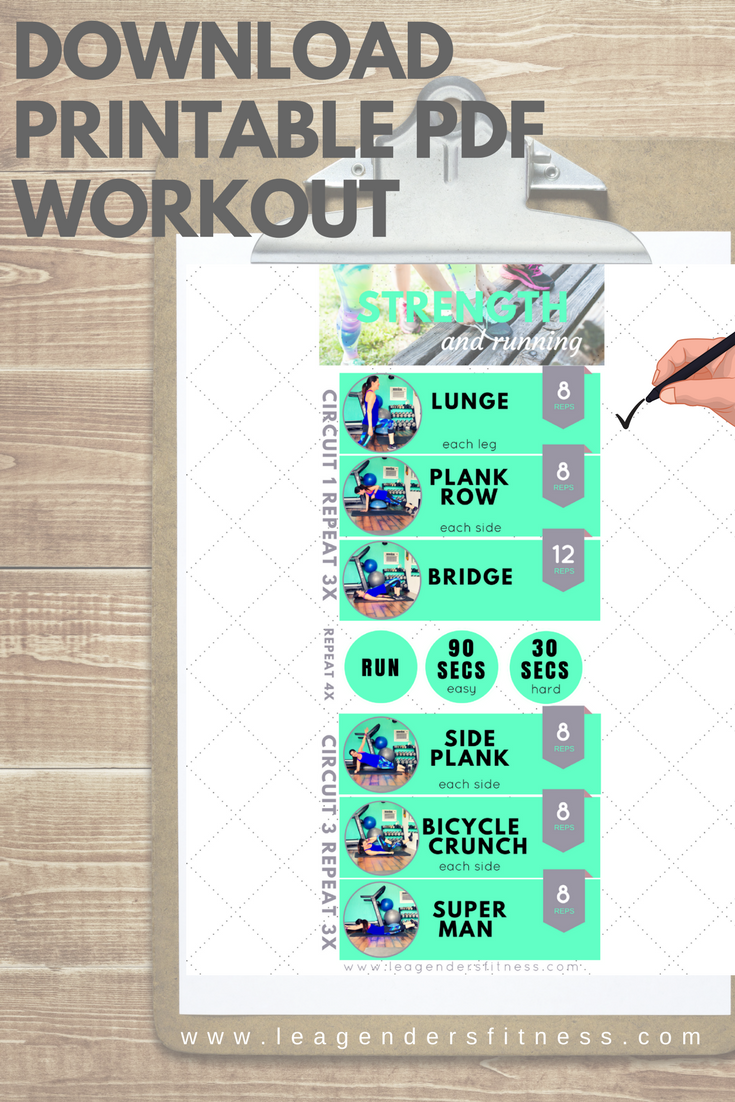
Download a printable version of this workout.

Download a printable version of this workout.

Give it a try and let me know how it goes in the comments, on Instagram or on Twitter

Take a rest day or schedule easy effort paced-runs in the day or two following this workout. Always allow proper recovery after a high intensity workout. Adaptation (getting stronger and faster) happens during the rest period after the workout, not during the workout itself. If you don't allow your body the proper recovery time you won't see the full benefit of your workouts!

Questions? I'd love to help.

Lea signature.jpg

Coach Lea

Like this post? Know someone who would benefit from it? It helps me when you share with your friends and followers.

THE PLAYLIST HIIT RUNNING WORKOUT

I  get most excited and energized by blogging, running and rock music so I am always thrilled when I get the opportunity for a passion trifecta to blog about running and music. 

Welcome to workout Wednesday when each week I share a new running or strength for runners workout. This week we have a fun running workout that takes all the pressure and stress out of your runs and lets you just go with the flow, or the beat of the music. 

The idea is to create a playlist with the beats per minute or BPM in mind. We start with a song with a mid tempo BPM for a moderate pace to warm up and then alternate between higher BPM songs and medium BPM songs until the run is complete. 

We naturally match our stride to the BPM so we may feel motivated to keep up a faster pace in sync with the music. Since most songs are around three minutes long (give or take), a playlist built around BPM can be the perfect high intensity interval workout.

The Playlist HIIT running workout. Save to Pinterest for later.

The Playlist HIIT running workout. Save to Pinterest for later.

Start off with a song with a mid tempo BPM to get started, then make the next song on your playlist an uptempo song with 155-185 BPM. Some say 180 is the perfect BPM for runners as it's been claimed that 180 strides per minute is the most efficient turnover. 

How do you find BPM of popular songs? The site songbpm.com lets you enter any song and it returns the BPM. Spotify also has playlists built around BPM, so you can pick and choose your favorite songs to build you own playlist HIIT workout around the music that you love.

If you like alternative rock like I do, your playlist might look something like mine. With this playlist we are alternating between mid tempo and up tempo songs. I created a playlist on Spotify if you want to hear my song selections. Create your own playlist with the music that you love. 

THE PLAYLIST HIIT WORKOUT


Against Me! Don't Lose Touch 120 bpm

The Yeah Yeah Yeahs Phenomena 157 bpm

Band of Skulls - Sweet Sour 127 bpm

The Hives two-timing touch and broken bones 165 bpm

The Black Keys  Howlin for you 133 bpm

Cake the distance 183 bpm

Young the Giant My Body 130 bpm

Millencolin - Ray 197 bpm

The fratellis - Henrietta 122 bpm

The Kills Sour Cherry 160 bpm

Create your own playlist and see how it feels to run by music bpm. As a running coach I will advise you to not try to run faster than your current fitness level. If you can't keep up with the tempo of the song, it's always better to go at your own pace for safety and sanity.

I'd like to thank hubby, the drummer, for a little bit of music education as I put together this post. 

Like this post? Know someone who might like it too? It helps me when you share with your friends and followers. 
Lea signature.jpg

CORE STABILITY BALL TRAINING

Welcome to the latest edition of workout wednesday when each week I share a new running or runner-specific strength training workout. 

This week we are talking about core stability and strength. As runners, core strength is important to keep proper form, to provide a stable base between the lower and upper body and to power our stride. You don't need to spend hours in the gym or devote your life to strength training to reap the benefits of runner-specific core work. Spend 5-10 minutes on core exercises before you hit the road for your next run. You'll help activate running muscles and core training can be part of your warm up before you hit the road.

This post contains affiliate links. That means if you click on a link and make a purchase, I make a small percentage of the sale with no additional cost to you. No one is getting rich here, it just helps with the cost associated with running (pun intended) this blog. Thanks, as always, for your support. 

EQUIPMENT

STABILITY BALL

You can work to strengthen your stabilization muscles and joints by providing an unstable, but controllable base like a stability ball. Some of the benefits of balance and stabilization training for runners are improved joint stability, increased flexibility, improved posture control, improved balance and coordination. 

Core Stability Ball Training. Save to Pinterest for later. Download a printable PDF of this workout.

Core Stability Ball Training. Save to Pinterest for later. Download a printable PDF of this workout.

CORE STABILITY BALL TRAINING WORKOUT

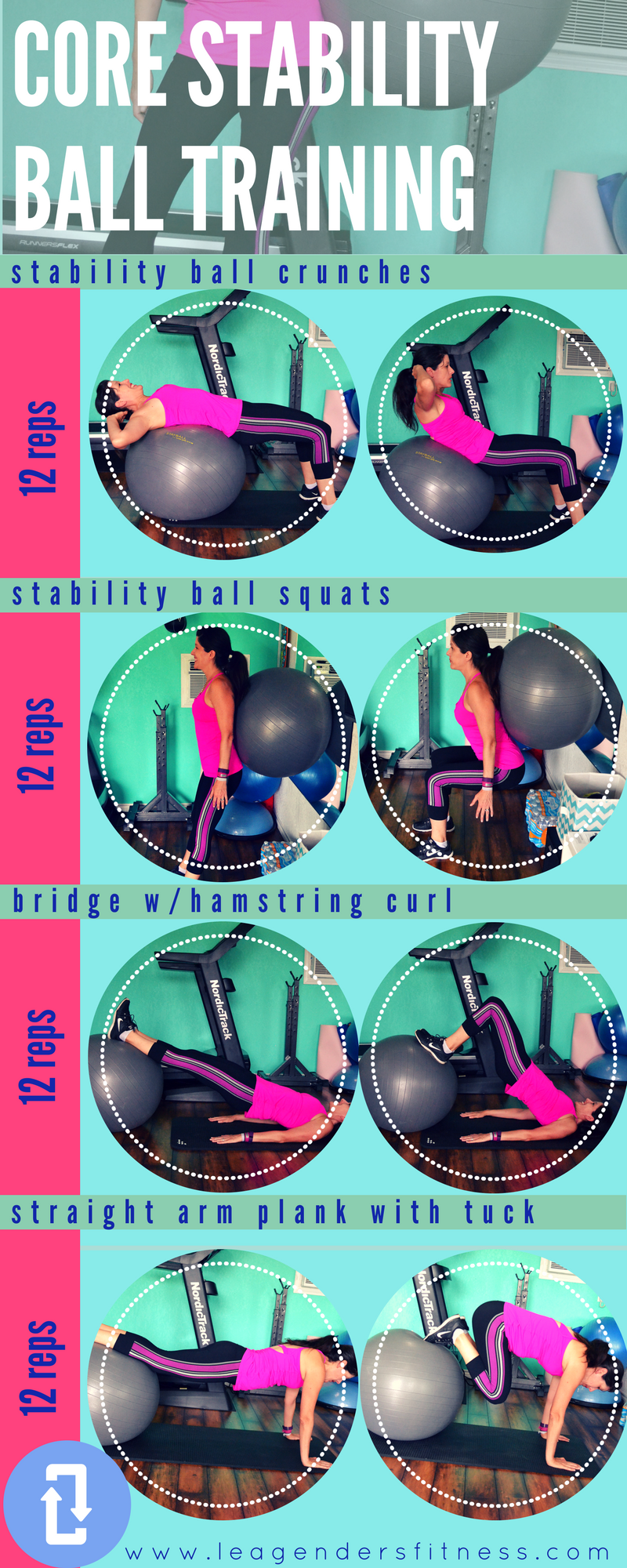
BALL CRUNCH

Position the stability ball under the small of your back. Place your hands behind your head, do not pull on your neck, and lift your shoulders and chest up into a crunch. Engage your abs and hold for 3 seconds in top position. Slowly lower back to the starting position. For an added challenge hold a medicine ball for additional resistance. Perform 12 repetitions before moving onto the next exercise. 

BALL SQUATS

Place the ball against a wall and position the ball in the middle of your back. With your feet about hip width apart and your toes pointing straight ahead, walk your feet forward. Lower yourself into a squat until your thighs are parallel to the floor, like you are sitting in an invisible chair. Be careful not to lean back into the ball, but use it as a guide to lower yourself. Once in the low position, press through the heels and push back up to standing. For an added challenge hold a medicine ball at your chest. Perform 12 reps before moving onto the next exercise.

BRIDGE WITH HAMSTRING CURLS

Lie on your back with the stability ball positioned under your calves. Lift your hips off the ground into the starting bridge position, engage your abs and glutes. Bend your knees and lift your hips to curl the ball towards your body. Straighten your legs back out and perform 12 repetitions without lowering your hips to the ground.

STRAIGHT ARM PLANK WITH TUCK

Position the stability ball under your thighs and walk your hands out until you come into a high plank position with your shoulders directly over your wrists and the ball under your shins. Pull your knees in towards your chest to roll the ball forward, then straighten your legs to return the ball to the starting position. Do not to lower the hips between reps. Perform 12 repetitions, take a one minute break then repeat the circuit one or two more times. 

Do you work in core and stabilization exercises into your running routine? Give this one a try and let me know what you think on Instagram, Twitter or in the comments!

download a printable PDF core stability workout

download a printable PDF core stability workout

Did you like this post? Do you know one person who might benefit from it? It helps me grow when you share with your friends and followers. 

Lea signature.jpg

Core Partner Workout to Try with Your Valentine or BRF

Welcome to the latest edition of workout Wednesday when each week I share a new running or runner-specific strength training workout. It's February and love is in the air so it seemed the right time for my second annual Valentine's Day partner workout.

I love working out with with my partner. My husband is my favorite running buddy and it helps with motivation to have another person working towards similar goals. Hubby motives me to get up early and run, mainly because I know he is counting on me to be there for him. (Also because he pulls off the covers at 5am and turns on all the lights. How's that for motivation?) Sometimes we feel more accountable to another person than we do ourselves. Whether you have a swole-mate, a valentine, a BRF (best running friend) or a gym buddy, grab anyone you can sucker into it and let's have some partner-workout fun!

I recruited my favorite love birds to demonstrate my core-focused partner workout in the ShredShed. Sorry the gig doesn't pay well, but they were good sports. Wish them a happy wedding anniversary, they just celebrated one year!

Happy Anniversary. Now stop it. We have work to do!

Happy Anniversary. Now stop it. We have work to do!

This core-focused partner workout is done in a circuit fashion. Move from one exercise to the next with little or no rest between exercises. Once you complete the circuit, rest for one minute then repeat one or two more times. 

Core-focused partner workout. Try it with your favorite sweaty buddy or save to Pinterest for later.

Core-focused partner workout. Try it with your favorite sweaty buddy or save to Pinterest for later.

Find a workout buddy and try it for yourself. Do you have a favorite fitness friend? At the time of this post, I have openings in the Fort Worth Shredshed for personal training for runners. I help runners get stronger, faster and reduce change of injury with strength training. Team up with a friend for a reduced rate for two in one session.

Like this post? It helps me when you share with your friends and followers!

Lea signature.jpg


THE DOS AND DON'TS OF STRENGTH TRAINING FOR RUNNERS

You're a runner and you heard that strength training is important for runners. You know you should be including strength training, but you've not quite figured out how to make it all work in your training schedule. It's easier to just lace up your shoes and go out for a run than it is to figure out how to add in strength training. You don't exactly have spare time laying around like your husband's socks. If you're going to do this it has to be quick and effective. 

Strength training for runners is important, not only for injury prevention, but for your running performance. Strength training will help you become a strong and faster runner. It can be the difference between a potential injury and new PR.

But strength training for runners is not the same as strength training for muscle growth or strength training for other sports. Runners need running-specific strength. What does that mean? Let's explore the Dos and Don'ts of strength training for runners. 

the Dos and Don'ts of strength training for runners

the Dos and Don'ts of strength training for runners

THE DOs of STRENGTH TRAINING FOR RUNNERS

Do include exercises in all planes of motion 

When we run, we are moving in one plane of motion (the sagittal plane, forward and backward). When we pound out the miles week after week we can develop muscle imbalances because we don't develop strength in the other planes of motion, which can lead to injuries. The best way to injury-proof your running is to include strength exercises that include lateral and rotational exercises to cover the frontal and transverse planes respectively. Try incorporating side lunges, curtsy squats, one leg lift and chop and plank to side plank.

Do full body exercises at least twice a week

For best results, do full body exercises at least twice a week. This can be two 30 minute sessions or four 15 minute sessions. Any less than twice a week, you won't get the full benefit of the strength work (although I will argue that something is always better than nothing). 

Do single leg and balance exercises

Runners benefit greatly from unilateral (single leg) exercises like single leg deadlifts, lunges and single leg lift & chop. When we run we are repeatedly balancing on one leg at a time over the miles. When we build single leg strength and develop strong balance our running performance will improve.

Do multi joint exercises

We want to get the most bang for our strength training buck so we can get it done and get back on the road, right? Multi-joint exercises are more effective and efficient because they work multiple muscles in one exercise. Squats, deadlifts and lunges are all great examples. Skip the bicep curls and the leg extension machine and choose multi joint exercises instead.

Do be consistent

Strength training only works if you do. If you do your exercises one week, but then skip two weeks, you won't see the full benefit of your work. It's more important to be consistent than anything. Even if you can just do 10-15 minutes at a time, work to maintain consistency in your strength training. 

THE DON'TS OF STRENGTH TRAINING FOR RUNNERS

Don't neglect your upper body

It may seem like that as runners we only need to build a strong lower body, but strong arms, back and shoulders power our stride and provide stability for our running form. Push ups, rows and shoulders presses should be included in your strength training for runners plan.

Don't spend hours in the gym

Don't waste any time in the gym. Runners do best to work in a circuit fashion, which means to move from one exercise to the next with little to no rest between exercises. Complete a set of exercises moving between lower body and upper body movements. For example, perform a set of single leg deadlifts, followed by a set of push ups, followed by a set of rows and finish up with lateral lunges. Once you complete all the exercises, take a brief break and repeat the circuit one or two more times. Bodybuilders need long rest periods between sets, runners do not. More quickly, but slow enough to keep proper form. 

Don't do hard running workouts and strength workouts in the same day

If you run hills, intervals or a long run and then attempt a strength workout, your strength workout will suffer and you could end up injured, overtrained or burned out over time. It's better to schedule strength training on days that you are not running, or on easy effort running days. I will do a strength training session in the morning of a day that I have an easy three mile run on the schedule. Never do strength training and running on the same day if the total workout is more than an hour and a half. At that point, the risk for injury starts to become greater than the benefit of the workouts.

Don't ignore pain

No pain no gain is bull crap. Push through discomfort, push through breathing heavily, push through muscle burning, never ever ever push through physical pain during running or strength training. Pain is your body signaling you that something is wrong. Always listen to pain. Learn to tell the difference between feeling pain and feeling discomfort.

Don't neglect rest days

I know it can be challenging to fit everything in: the miles, the strength training and the rest. Always take at least one full rest day a week (sometimes you may need two or even three). If you have to cut something out of the schedule to make it work, never cut out the rest day. We adapt to exercise (get stronger and faster) during the rest periods after the workout, not during the workout itself. If you don't allow your body the proper time to recover you won't see the full benefits of your hard work. I know that sometimes for runners, the rest is the hardest part, but it may just be the most important day of your training schedule. 

Got it? Good. Need more help or individual attention? If you live in Fort Worth, at the time of this post, I have openings for strength training sessions to improve running performance and fat loss. Live outside of Fort Worth? Contact me to learn about how we can work together online. 

Like this post? It helps me when you share with your friends and followers.
 

Questions? I'd love to help. 

COACH LEA