RUNNING

TREADMILL TABATA WORKOUT

Welcome to the latest edition of Workout Wednesday! You may have noticed I am a little obsessed with the Tabata protocol. Tabata is 20 seconds of work, followed by 10 seconds of rest for 8 rounds totaling four minutes. I use them a lot on my Workout Wednesday posts, I use them at my bootcamps (great for group fitness!) and even in my own workouts. 

I must point out that a true Tabata is a near 100% effort for 20 seconds/followed by complete rest for 10 seconds. This is not exactly what we are doing here, so it is more of a play on the Tabata protocol, than an exact Tabata workout. 

If four minutes doesn't seem like enough of a workout for you, try doing burpees (or other intense exercise) during the 20 second work periods and see how you feel after four minutes. Hah. Otherwise, I stack them with a one minute rest period between each four minute Tabata.

This is a treadmill workout using my version of Tabata protocol. You can download a free Tabata timer app for your phone to easily track the intervals or use a (---> affiliate link) GymBoss timer like I do.

I don't like to assign speeds (mph) or paces to workouts published on this blog because everyone is so different. A 6.0 mph speed (10 minute mile pace) on the treadmill may feel like a leisurely jog to one person and be an all-out sprint to another. Always work at your own level. Please don't try to hit some arbitrary pace because a workout on Pinterest told you to. 

This is why I prefer the RPE chart. The RPE chart levels the playing field. Rate of Perceived Exertion allows you to work at the level that is appropriate for your fitness levels based on how you feel and your breathing rate. 

TREADMILL TABATA WORKOUT

MINUTES 1-4

Start by warming up for four steady minutes (no Tabata) at a 2-3 on the RPE chart. This is to get your blood circulating and prepare your body for a more intense workout. 

MINUTES 4-8

We will start to increase the intensity in this four minute Tabata. Choose a speed that will put you at a RPE 4-6. This may be a jog. You should be able to carry on a conversation at this pace. Cycle through the 20 seconds work/10 seconds rest protocol for four minutes. 

*During the rest intervals you can choose to lower the speed on the treadmill to a walking pace but with only 10 seconds to rest it doesn't give you much time for the belt to slow down before you need to speed back up into the work phase. Some people may choose to simply jump to the sides of the treadmill during the 10 second rest phase and let the belt roll. This could be dangerous, we don't want to fall off the back of the treadmill when we hop back on. Try at your own risk. I personally always choose to go with staying on the slowing belt during the rest. Safety first. 

MINUTES 8-9

Active rest at RPE 2-3 for one minute before starting your next cycle. This is usually a walk or very slow jog.

MINUTES 9-13

This cycle we are going to up the intensity a little more to a RPE 7-8 from the above chart. You should be working hard during the 20 second work intervals. 

MINUTES 13-14

Active rest at RPE 2-3 for one minute before starting your next cycle. 

MINUTES 14-18

This is your last high intensity cycle. Work at a RPE 7-8 again during the 20 second work intervals and RPE 2-3 during the 10 second rests. This is your last Tabata. Make it count. 

MINUTES 18-20

Cool down for at least two minutes by walking.

Give it a try! Like this post? Please consider sharing or saving to your favorite Pinterest workout board.

Running Journal Free Printable Download

If you've been following along you may have read that I had the flu. Cue internet sympathy. Wait? No one cares? Oh yeah. hah.

My eyes stared at the blank MacBook Air screen as I lied on the couch covered in my favorite leopard print blanket (aka Alison), but my foggy flu brain wasn't cooperating. I was easily distracted by Facebook, Netflix (Walking Dead marathon) and coughing fits. I just couldn't pull it together enough to write my usual blog posts for the week. Lucky for me I was working on another printable this week before I got sick, this time a run journal. We'll get back to 52 Healthy Habits next Monday (spoil alert: I was sick so no habits were established) so this week I want to share my new printable with you.

It can be beneficial to journal your runs, not only to track your miles (because most of us have watches and apps that do that) but to track how you feel and how you performed.
Since I am a blogger and a writer at heart it is very natural for me to journal my runs. I don't write a novel each time, but I take note of how many miles I ran, how I felt, what the weather was like, how I slept the night before and what I ate surrounding my run. It's amazing to see how those things can affect your run. Once you start to track these details certain trends may start to emerge.
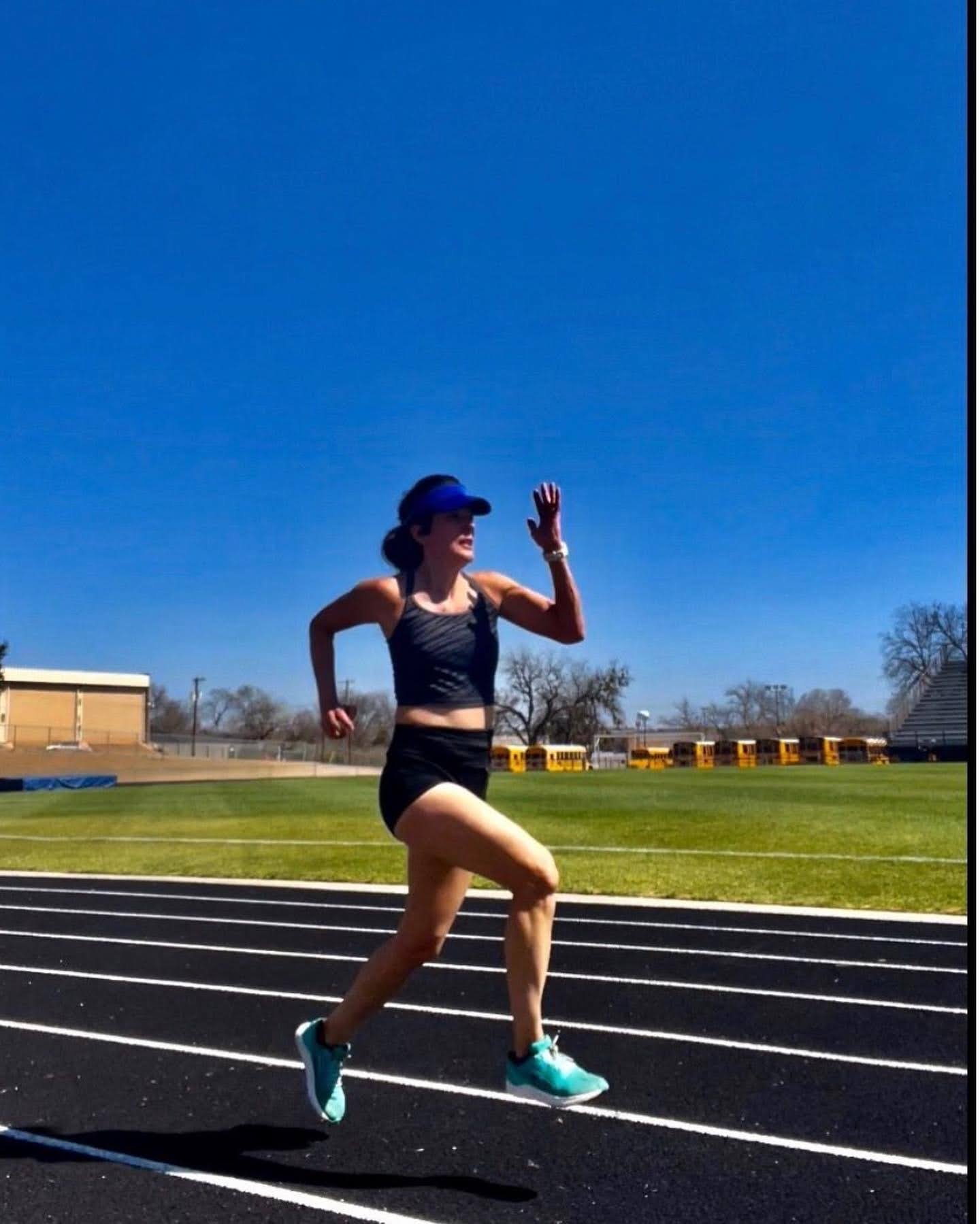
I like to journal so I can look back and see how far I've come. I seem to forget every summer that the brutal Texas heat takes at least a minute off my pace and then I wonder why I am so slow. The weather can make a big difference! When I journal I can look at my runs from last summer to compare rather than runs during the cooler spring temperatures.

I made this weekly journal that you can print out and jot down notes after your run. 

Enter your email below to get the PDF version to print out.

Enter your email below to get the PDF version to print out.

WEEKLY GOAL

It's a good idea to establish a goal for the week. It may be to run three times or a certain number of miles or hit a certain pace, but writing in down and looking over it each day goes a long way on the road to achieving it.

PERSONAL RECORDS

This is a place to record your personal records (your fastest finishing time) for 5K, 10K, 1/2 marathon and full marathon. If you haven't ran these distances you could use this space to record your goal race dates.

DAILY MILES AND PACE

Jot down the number of miles you ran, your pace or how long it took you to complete. At the bottom of the weekly miles there is a space to record your month-to-date and year-to-date miles.

FEEL | WEATHER | FUEL | SLEEP

Just a quick word or two on how you felt during the run, what the weather was like, how you ate and how you slept the night before. 

WEEKLY NOTES

Make any notes here during the week or at the end at the week in reflection.

RUNNING SHOES

I like to rotate between two pairs of shoes which makes it harder to keep track of the miles on each pair. Most people need to replace their running shoes every 300-600 miles, depending on type of use (trail runners may need to replace sooner), your weight and other factors. You usually can tell when you need to replace your shoes by the cushioning and the tread, but it's a good idea to have some awareness of how many miles on your shoes. Use this space to keep a running total of the miles on your shoes. 

REFLECTION

Take a minute and reflect on your best, your longes, your fastest and your hardest run of the week. Take a moment to pat yourself on the back for another successful week. 

Ready? Set? Get it. 

Like this post? Please consider sharing. 


Where Should I Run? The Pros and Cons of Common Running Surfaces

When you ask the question "Where should I run?" you should first evaluate your goals. If your goal is to run a road race, you should mostly be training on the road, likewise with trail races. If you have a track meet coming up, it makes sense to practice in the same environment in which you will be performing. With that being said, there are pros and cons to all running surfaces and barring any immediate event, it makes the most sense to vary your running surfaces to help avoid certain repetitive and overuse injuries.

Cement

Running on sidewalks and urban trails, usually made from cement, can be a safe environment for running that is away from the dangers of traffic. 

However, cement surfaces like sidewalks and urban trails are some of the most inflexible surfaces where you can run and can be hard on the joints. There is no shock absorption to reduce the force of impact when your foot hits the ground. Cement can be as much as 10x harder than asphalt.

While cement surfaces may be harder on your body it doesn't mean that you shouldn't run on them. Just be aware of the potential pitfalls and pay close attention to the signals your body sends. If you feel aches and pains give yourself extra rest days and combine with lower impact activities. 

Ashphalt

Asphalt is softer than cement and therefore easier on your joints, so if it is safe to do so, I usually take my running off the sidewalks onto the street, against traffic on low traffic roads. 

While the surface may be softer you may open yourself up to more risk by running on street, even in low traffic areas. You might have to watch out for cars, animals, potholes and running repetitively on a cambered (sloped) road could eventually lead to certain types of running injuries. 

When training for a road race or if roads are most accessible surface for you, leave the headphones at home, pay close attention to your surroundings, run against traffic and change up your route often! 

Track

The track's soft flat surface is easy on the joints and it makes measuring the distance very simple (as each time around the track is 1/4 mile). It is a safe environment away from traffic and you're often in good company with like-minded runners.

However the track isn't ideal for long distance running and running in the same direction around long curves on the track can be hard on the hips and ankles when done repetitively. 

Use the track for shorter speed or interval sessions and take longer runs to the roads or trails if you prefer. 

Treadmill

The treadmill offers shelter from weather, protection from traffic and you have strict control over your pace. It has a soft surface that is easier on the joints than running on cement or asphalt.

To some people the treadmill can feel repetitive and boring and not everyone has access to a treadmill on a regular basis. 

A treadmill is a great tool if you have access to one. Try these boredom busting treadmill workouts to keep things interesting.

Trails

Nature trails offer a soft forgiving surface to run with usually beautiful scenery that is safe away from traffic. Trail running is quiet and can be used as a form of meditation. Trail running can help improve balance and proprioception. 

Depending on the how technical the trails, you may run on uneven ground with loose rocks or gravel which can be dangerous if you fall or twist your ankle. 

The trails are a wonderful place to run, you may need to run at a slower pace to account for an uneven or changing terrain. Run with a friend for safety if the trails are isolated.

Where is your favorite place to run? Do you prefer on one running surface over another? 

Like this post? It helps me when you share or save to Pinterest.


Hot Tips for Cold Weather Running

I live in Texas so my window of opportunity to write about cold weather running is limited. Last week we had a 30 degree day and a 70 degree day. I pulled out my gloves and hat, only to quickly put them away again. While the weather here is fickle, it does get cold.

I moved to Texas from Pennsylvania largely to get away from the snow and ice. I was 23 at the time and I had just about enough to shoveling the snow out from under my tires, my car locks freezing over and icy road conditions. They don't close the schools and businesses for a drop of snow (or 5 feet) like they do here. You just have to deal with it.

Before I moved here I didn't realize it snowed in Texas. I thought that because it was a southern state, like Florida, that it didn't snow. I was wrong. Obviously we don't get the snow like up north, but it still snows nonetheless. If I would have known it snowed in Texas I may have decided to move somewhere else. Good thing I was fooled because if I didn't move here, I would never have met my husband.

Despite the fact that there is snow in Texas and the temperature can drop quite low, I still want to keep running. I take it indoors on the treadmill all the time, but I prefer to run outdoors, so I try to make it work outside when it is safe to do so.  

1. Dress in Layers

The rule of thumb is to dress for 10-20 degrees warmer than the current temperature, because once you start running, you will warm up considerably. Ideally you would dress in layers. A long sleeve synthetic (aka not cotton) base layer, a warmer zip up on top and if really cold a third layer. You can always remove layers as you go if you get too hot once you start running.

2. Head, Fingers, Knees and Toes

It sounds like a children's song: Head, Fingers, Knees and Toes, but it is a good reminder to cover all exposed skin. We lose heat from our extremities so a hat and gloves go a long way in keeping us warm. For cold and windy days, I like a wear a neck gaiter (either attached to a top or a separate piece) to cover my mouth and nose. 

3. Wear Fitted Clothing

You want to wear clothes that provide both insulation and breathability. Fitted clothing keeps the cold air from creeping in under your clothes. You can layer loose fitting clothes over your first fitted layer.  

4. Avoid cotton socks

Cotton absorbs water and can provide an unfavorable environment for your feet when you sweat. To keep your feet dry and blister free look for socks made from synthetic materials that help wick moisture away from the skin. 

5. Hydrate

It may seem like you don't need to hydrate as much much it is cold but it is just as important as in warm weather running. Hydrate early and often during cold weather runs, just like you would in the heat. 

6. Warm up Indoors

Take five to ten minute and warm up indoors before heading out for a cold weather run. You want to get the blood flowing to your muscles in preparation for your workout. Some jumping jacks, high knees and butt kicks (dynamic stretches) should do the trick. If you like Yoga, also try a few sun salutations to get those muscles warmed up before your run. It may take a little longer to warm up in extremely cold weather so it is important to warm up indoors to prevent injury.

7. Prepare Mentally

Running in cold weather can be uncomfortable, but preparing for it mentally can make it more bearable and make you stronger. I look at it as another opportunity to practice stepping outside my comfort zone. You are building mental toughness (as well as physical toughness) every time you hit the road in uncomfortable situations. Mental toughness is a skill that transcends far beyond your running journey.

Of course, I recommend common sense. In extremely cold, icy or snowy conditions, take your run indoors, schedule a rest day or do some other physical activity inside. Be safe, friends!

Do you run in the cold, take it to the treadmill or take time off until Spring? Will a little preparation, you can run outdoors all winter long! 

Like this post? It helps me when you share or save to Pinterest.

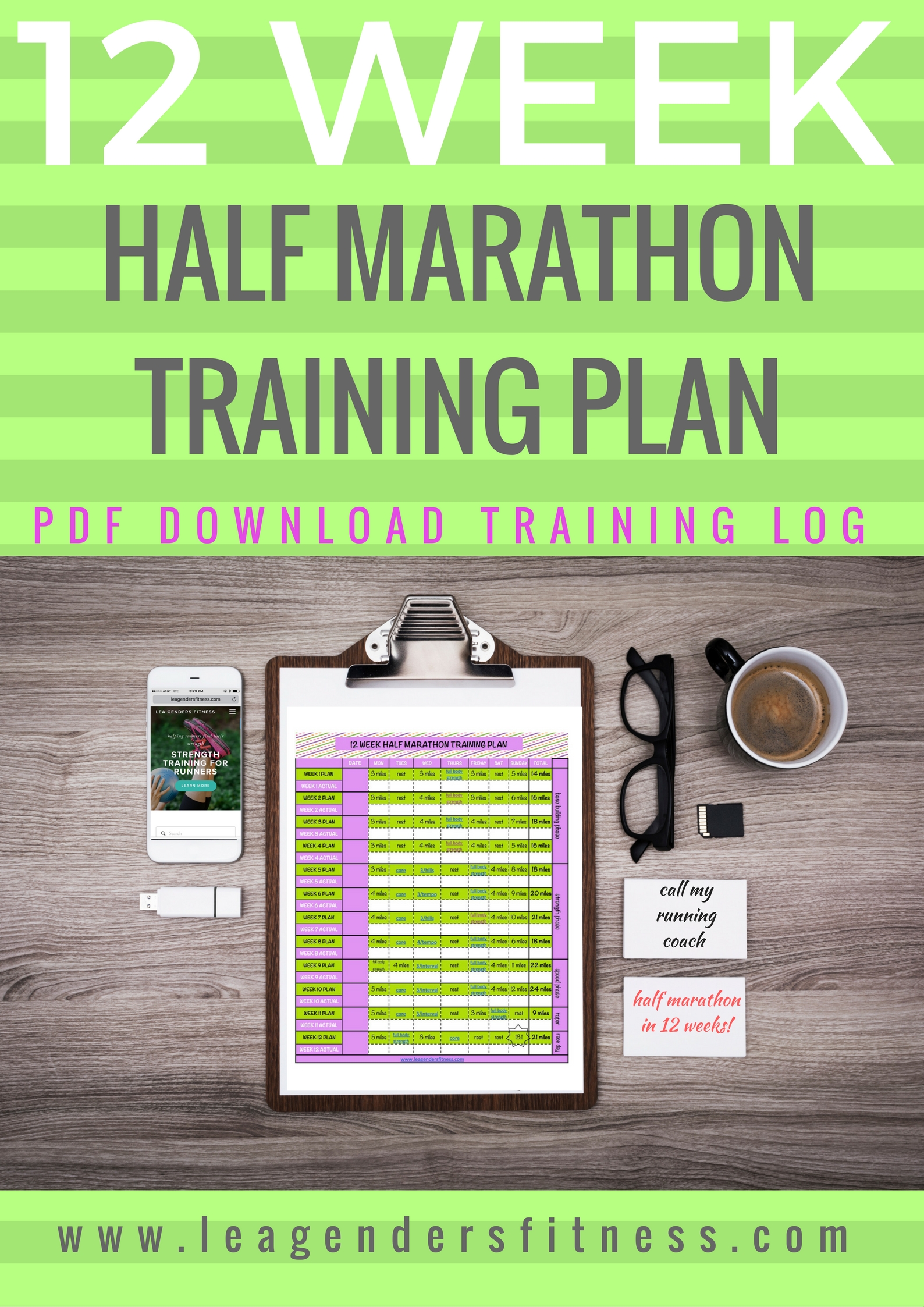
12 Week Half Marathon Training Plan and PDF Download

Hello, friends. I am excited to tell you that I just registered for the Dallas Rock 'n' Roll half marathon in March. If you want to run it with me, I have a discount code (code:LEAGENDERS) from the rock 'n' roll marathon series because I am a 2016 rock 'n' blogger. This code worked for all 2016 races and works for some of the early 2017 races, including Dallas. 

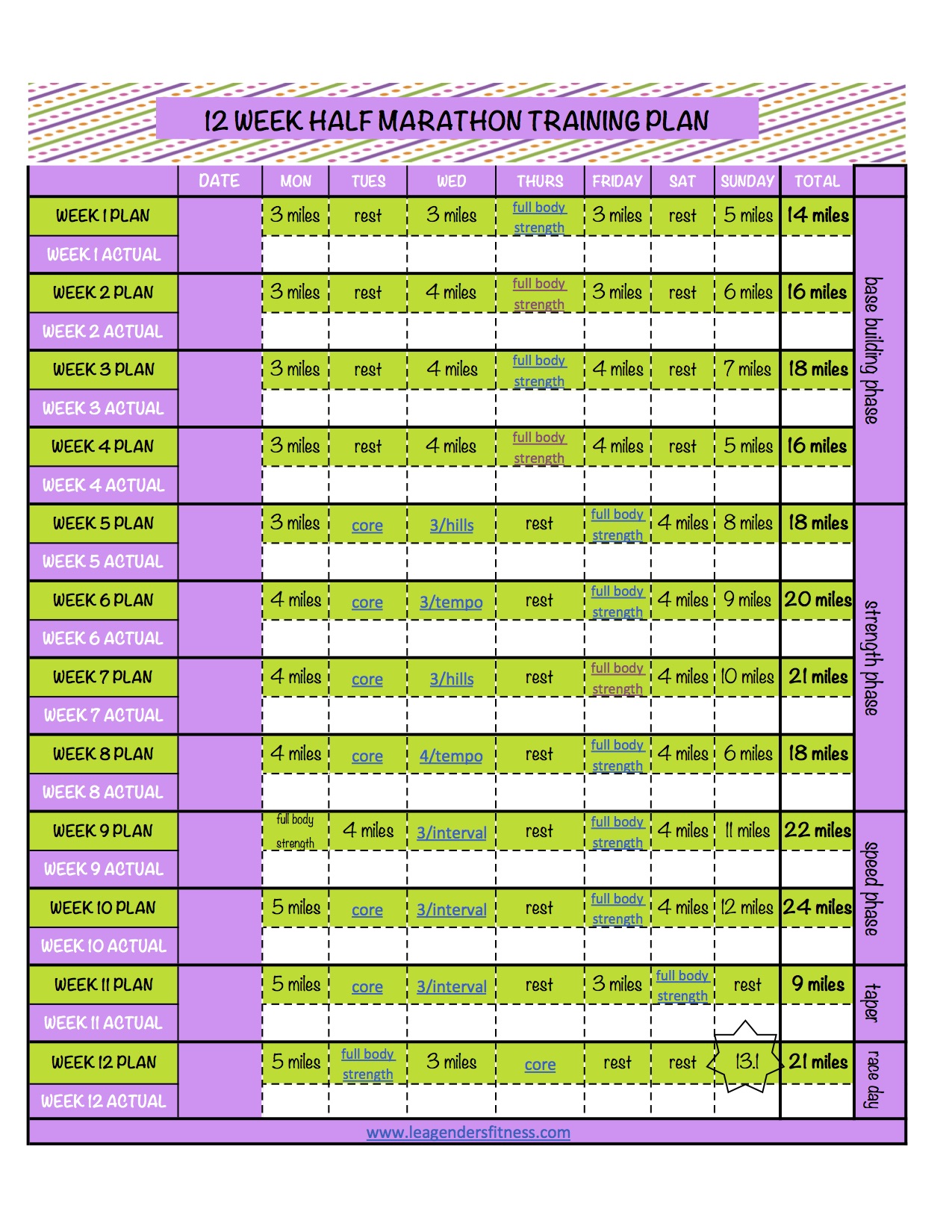
Would you like to train with me? For Workout Wednesday I am thrilled to share my personal 12 week half marathon training plan. 

12 week half marathon training plan.jpg

I haven't been running long distances much this fall/winter so it is time to start training for my half marathon at the end of March 2017. Following a training plan is a great way to stay motivated to exercise well into the new year. 

I starting building a training plan to get myself back up to 13.1 miles. I am happy to share it with you but as always, there are a few caveats. First of all, I am a certified running coach, but I am not your running coach. Since I don't know your exercise abilities, injury background or medical history, please see your doctor before beginning any new exercise program. This program is intended for an advanced beginner or intermediate runner. You should be able to run at a conversational pace (meaning you can hold a full conversation without gasping for breath while running at a slow pace) before starting this program. 

Because I am who I am (the strength training for runners coach), this half marathon training plan may not look like your typical plan. My plan includes strength training days because I think they are really important. While running will be my priority, I will still find a day or two each week for strength training. A full body strength training day and a core day once a week should be sufficient. 

THIS 12 WEEK HALF MARATHON TRAINING PLAN IS BROKEN INTO FOUR PHASES

BASE BUILDING PHASE

Even though I am an experienced runner, it is still a good idea to start any plan with a base building period. Since I haven't been running a lot lately, I gave myself four weeks to build a base. Depending on your current fitness level, you could shorten this phase. All runs in this phase should be done at conversational pace. We will slowly start to build our long run in this phase.

STRENGTH PHASE

When I talk about strength in this context, I am a referring to running strength. We will start to incorporate hills and tempo runs into our workouts. 

SPEED PHASE

The speed phase for half marathon training includes running intervals. I generally recommend no less than 1/2 mile intervals for half marathon speed work. We don't spend a lot of time doing shorter intervals for half marathon training. 

TAPER PHASE

This is when we will back off the milage and long runs to taper in order to prepare for race day.

You may notice that that there are rest days, easy run days and/or core days immediately following high intensity days. We always want to allow low intensity days like core work and conversational pace milage after high intensity days to allow our bodies to properly recover. Remember that our bodies adapt, get stronger and faster during rest, not during the workout. Allowing the proper recovery is an essential part of this half marathon training plan.

I included a PDF printable download at the end of the post so that you can print out the half marathon training plan and fill in your actual mileage each week. Running plans should always be dynamic, meaning that you should be willing to change and adjust as needed along the way. If I was your running coach, we would review your log at the end of the week and based on how you felt and performed, we would make adjustments if necessary. It is important when following a plan from the internet that you don't look at it as a rigid all-or-nothing plan. 

The perfect plan is one that fits into your lifestyle. If you feel you need an extra rest day after a long run, then take it. If you have to swap a running day and a strength training day because you can only get to the gym on certain days, then swap them. If you need to do your long run on Saturday instead of on Sunday, then do it. As a coach, I wouldn't expect you to complete the plan exactly as written for 12 weeks. Life happens, things change. This is not an excuse to blow-off the plan, but rather permission to make appropriate changes as needed. The most important part of the plan is to build the long runs and weekly mileage slowly over time. 

I caution you not skip any rest days or add more mileage to the plan unless you are an experienced runner who has completed many half marathons. The mileage build-up is strategic. Doing too much too soon is one of the biggest mistakes runners make. 

Are you ready to start training? I invite you to download my 12 week half marathon training plan printable PDF so you can log your progress along the way.

Want more personal support? Work with me!

Like this post? Please consider sharing or saving to Pinterest

Coach Lea