MOTIVATION

52 Healthy Habits: Week 4 Morning Pages

Welcome to the latest edition of 52 healthy habits, where each week I tackle a new healthy habit and attempt to build upon these habits week after week. The reason I started this series is because I believe healthy habits are the the cornerstone of goal achievement. Whatever it is that you want to do in life, figure out the actions you need to take every day to get there and start building habits. It's not easy and I am certainly not perfect, but I hope you will follow along on my healthy habits journey as I succeed and fail along the way. 

(this post may contain affiliate links. That means if you click on a link and make a purchase on this site I make a small percentage of the sale with no additional cost to you. No one is getting rich here. It just helps with the running (pun intended) of this site.)

My week one healthy habit was getting up early at 5:30am to work on my blog, business or work out, and while I massively failed that first week, I have improved drastically in weeks two and three. This week we got up early every day, even Saturday and Sunday. While it still feels hard even after a full eight hours of sleep, we are rolling on this habit. Day by day. 

My week two habit was entering my calories into MyFitnessPal every day and I was able to do that (I don't do weekends for sanity sake) with little issues. I wanted to make my week two habit something easy since I was still struggling with the morning thing.

My week three habit was to hit the macros more closely on my macro shred program. While I haven't improved drastically I have set up an action plan for next week. I am starting over the 6 week program on Cori Lefkowith's 6 Week Macro Cycling Shred Program, I am really focusing on hitting the targets this time around.


WEEK 4: Morning Pages

Now we are moving into week four! My healthy habit for next week is Morning Pages. Have you heard about Morning Pages? I listen to a lot of Podcasts and this concept seemed to be coming up over and over again on different shows. Morning Pages are three pages of a handwritten brain dump written shortly after you wake up in the morning. It's not a list, it's definitely not an article or a story. It is a stream of consciousness writing about whatever is on your mind. If you don't know what to write? Just start writing. You can write that you don't know what to write about and it seems useless. It's OK. You're not supposed to reread and certainly not edit what you wrote. It is for your eyes only, so you should really be able to pour your heart into it. Some even suggested having another notebook nearby for ideas or to-dos that might come up during your sessions since you're not supposed to analyze or edit, it is not a great place to store actionable ideas. 

They said that some people may feel inclined to type their morning pages, but to resist the urge. It takes longer to write out by hard and forces you to slow down your thoughts, it's harder to edit (and harder to reread apparently, my handwriting is atrocious). I am committed to writing three handwritten pages everyday about whatever my brain and pen spill out on the paper. Worries, fears, goals, dreams, complaints, gratitude, nothing. Just get it down. Hubby looked at me a little weird when he saw me scribbling in my notebook. "Is that your manifesto?" he asked with a smirk.

It feels sort of like a teenage girl's diary minus the boy bands (unless you count Jack White) but I started several days ago (already missed a day or two) so next week I want to commit to the three pages every day, even on weekends. It takes about 20-25 minutes to finish, so good thing I've been getting up earlier. Depending on what I write, some days I think I will want to ceremoniously light the pages on fire and burn them in my backyard so I am sure no one will ever read them. I don't think that's what the creator had in mind. I have visions of my family going through my things in my home after I'm dead and finding Grandma's old "crazy" notebooks and even though I am already dead in this scenario, I die inside. hah.

So what are the benefits? According to some die-hard practitioners, a clearer mind, more creative thoughts and reduced anxiety. I'll take it. Seems like worth a shot.

I think there is some merit to this and I have faith in the process because once back in 2014 I started a 1000 word a day challenge. It lasted a whopping eight days. I opened a new free blog account and starting typing. It was amazing that after seven days of writing my mind never felt so clear. I wrote about it on that blog and I said that I didn't notice how much noise was going on in my brain until I cleared it all out. Then it felt so quiet in comparison. That was three years ago. It is plenty cluttered again. The reason I said I stopped doing the 1000 words a day is exactly the fact that I was typing and publishing online so I was editing myself. Maybe not saying everything I really thought and felt deep down inside for fear of judgement, criticism or ridicule (or trouble!). WIth morning pages you get it all out there (even if it is not fit for public consumption). I am excited about this new habit. I am excited to remember what that clear mind feeling is like because that is a foreign concept these days. I'll let you know how it goes. Just promise me if I die you won't read them.

You can learn more about Morning Pages in this article, the one I originally referenced in 2014 when I talked about wanting to stop typing my 1000 words a day and start penning them, but somehow I never did. 

What healthy habits are you tackling this week? Have you ever heard of Morning Pages? Willing to give it a shot? I am excited about it. My biggest obstacle will be forgetting to do it with my morning foggy brain, so I'll have to make sure it is on my early morning to-do lists. 

Like this post? It helps me if you share.

Coach Lea


The DOs and DON'Ts of Permanent Fat Loss

I really wanted to call this post 'the secret to permanent fat loss' but that sounds so spammy, right? The truth is it is no secret. It's just not that sexy. It's not the latest "fat-melting" supplement, the magic shake or the latest hard-core exercise program. It's not a secret, it's a lifestyle. 

For years and years I was great at losing fat. I did it so many times, I'd rather not recount how many. I knew exactly how to get the fat off, I just didn't know how to keep it off. The biggest mistake I made was making fat loss a singular focus. It is all I thought about, it is all I cared about. I didn't fit my fat loss goals into my lifestyle, I changed my whole life to fit in my fat loss goals and that wasn't sustainable. Once I lost the weight, I lost the focus and the weight came back on. Here is what I learned from my own fat loss journey and keeping the weight off for good.

DON'T BE GOAL ORIENTED

Say what? It sounds counterintuitive to say you shouldn't be oriented to your goals, but hear me out. It's great to have a fat loss goal, but it shouldn't be a singular focus. It's fine to have a number in the back of your head, but place your focus on the habits you need to build into your life. What are you doing daily to support your goals?

DO BUILD HEALTHY HABITS INTO YOUR LIFESTYLE THAT WILL SUPPORT YOUR GOALS

Focus on the permanent lifestyle changes and habits needed to meet your goal, rather than the goal itself. Focus on the journey, because there is no end. You will find that your goals will continue to change and evolve over time.

DON'T DIET

Seriously. A diet implies a short-term way of eating. You can't be on a diet forever, but you can eat a healthy diet forever. See the difference? Diet as a verb implies something that you do short-term. Forget the low carb or low fat diet. Diets fail. Permanent lifestyle changes win. 

DO CHOOSE WHOLE UNPROCESSED FOODS MOST OF THE TIME

Focus on making healthier choices most of the time. You don't have to be perfect, you just have to make the best choice possible with what you are given. Try to focus on choosing whole unprocessed foods most of the time. Occasional indulgences are OK. Enjoy life, family meals and time with friends without guilt, but learn to make healthy meals at home, pack your lunch and meal prep healthier choices for the week. What you do most of the time matters more than what you do occasionally. When healthy eating becomes just a part of your lifestyle, it ceases being a diet that you can be on or off. 

DON'T PUNISH YOURSELF WITH EXERCISE

Yes, Exercise is important. I think everyone should exercise to build a healthy heart, body and longer life. Exercise is not a punishment for having a body you don't love. Learn to love the body you have while working to improve. Don't exercise to burn off a big meal or to pay penance for an indulgence. It's a mindset. If you view exercise as punishment it's harder to find the joy in movement. No one loves punishment. 

DO MOVE MORE

Move. It doesn't have to be a structured bodybuilding-style workout and you don't have to train to run a marathon. Just move. Do the active things you enjoy. Get outside. Ride bikes with your kids, take a brisk walk with your spouse (or dog), take a Zumba (or bootcamp) class with friends. Try some different fitness activities to discover something you love. Some people love running (like me) some people love weight lifting, but some people hate it. It's OK. Maybe it's Yoga. Maybe it's CrossFit. Maybe it's running with your dog or hiking. Learn how to make exercise a daily habit. Find your thing and just do it, because if you try to force yourself to do something that you hate, it won't last long term. It has to be sustainable. 

DON'T TRY TO LOSE WEIGHT

Losing weight is easy. Stop drinking water (don't do this) and the scale will probably read a couple pounds lighter, but there is a big difference between water weight loss and fat loss. The worst case scenario is muscle loss. You may show a lower number on the scale but if you are losing muscle instead of fat then you are hurting your metabolism, which makes it harder to keep the weight off permanently. 

DO WORK TO LOSE FAT

If you want a lean, fit physique, then your primary focus should be on fat loss instead of weight loss. Eat a healthful diet with plenty of protein, do cardio exercise that elevates your heart-rate and work in some muscle building or maintaining exercises like Yoga, bodyweight exercises, weightlifting or bootcamps. It doesn't have to be 60 minutes a day for 6 days a week, just work in one or two full body resistance training exercises (or 15 minutes a day) to help build and maintain muscle. 

In order to achieve permanent fat loss the goal should be to work on building sustainable lifestyle habits. Make healthier food choices most of the time, fit in some exercise that you enjoy and work on finding that balance between your goals and your lifestyle. If you haven't picked up on it yet, sustainability is the key. Anyone can power through 12 weeks of a hard-core program to quickly lose weight, but if you don't continue those activities after the 12 weeks, the weight will probably creep back on. It is better to lose weight slowly over time so you can maintain it for a lifetime. 

I monitor my weight to keep myself in check and if I find the scale creeping up a bit (like it did over the holidays) I always first examine my habits. What am I doing differently on a daily basis? Did any bad habits slip in? I evaluate and then adjust. I don't freak out about the scale or weight gain, because I know that when I sustain healthy habits, my weight will stabilize to a healthy number. 

Like this post? It helps me when you share. 


Coach Lea


52 Healthy Habits Week 3: Macro Cycling

Happy Monday, Friends! I've been writing each week about my experiments with new healthy habits because I believe habits are the key to success when pursuing any goal. Want to make big changes? Start with small sustainable actions. The more consistent we are, the more likely we will reach our goals. No matter where we are in our health, fitness and wellness journey, there is always something small we can do to improve. I'm a fitness trainer and still always looking to continue to grow and evolve by making small sustainable changes in my lifestyle.

We can learn new habits by practicing them. I've been incorporating a new habit each week while building on the previous week's habit and reporting on them here to keep myself accountable. It's important to note that most of these habits are small and sustainable. The idea is to not make your new habits too lofty, aka run 6 miles 6 days a week, cut out carbs and read one book a week. You would just be setting yourself up to fail. Try instead to set smaller achievable goals like exercise at least 15 minutes a day (OK if more, but at least 15 minutes), add a serving of green veggies to each meal and read for 20 minutes before bed instead of watching TV or scrolling social media. These are all small achievable actions that performed consistently over time can lead to big results and an overall healthier lifestyle.

I don't have any expectations that I will be perfect, do everything right or never mess up. I'm human. We mess up. I'm sure over time some habits will stick, while others will fall away. In fact, I failed on my week one habit of getting up early to work on my business, blog and/or workout, but then pulled it together for week two. It is not about perfection, it's about making small progress each week.

I'm proud to report I did much better my second week of my week one habit. We got up early 6 out of 7 days at 5:30am. It helped a lot that my husband is doing this with me. We leaned on each other to find the strength to get up early when the warm blankets were beckoning us to stay in bed. What did I learn? A support system goes a long way, whether it is a spouse, a friend, a coach, an accountability partner, a FB group or maybe just a dog that is excited to go for a walk. 

Last week my goal was to log my calories every day into the MyfitnessPal app. I've been doing Cori Lefkowith's macro cycling program. It's a six week program that cycles the percentage of calories that come from protein, carbs and fats every two weeks.

For me it is an experiment to see how manipulating macros within my already healthy diet can affect my body composition. I did log every meal for seven days (win), but I didn't do so well on actually hitting the targeted macros. Maybe I'm a little too stuck in my ways, I generally eat the same things for breakfast, lunch and snacks every day and then hubby makes dinner and he decides what he wants to cook each night.

I had a hard time making changes to my usual diet because my usual diet is already healthy. My percentage of calories from fats were high and my percentage of proteins were low compared to the targets (carbs were generally spot on). I made some small changes, removed higher fat nuts & cheese sticks and added cottage cheese and lowfat Greek yogurt to raise protein, but I never quite got there.

MyFitnessPal daily report

MyFitnessPal daily report

I try to learn from these types of experiences to help me better understand my own clients. Part of me wants to say "I can't do it, Cori. I can't hit those numbers." but then I think about how when my clients tell me they can't do something and I ask them if they can't or if they won't. There is a big difference. If I want to give the program a fair shot, I have to follow the parameters of the program, not just do it my way and then declare it didn't work for me. This applies to any fitness or nutrition program in the world: It only works if you do. 

“This applies to any fitness or nutrition program in the world: It only works if you do. ”
— www.leagendersfitness.com

I didn't buy Cori's program for nothing. I bought it because I wanted to see if manipulating macros will affect my body composition, but if I am not willing to make the changes to meet the numbers she targeted, then how will I ever know?

Now there would be nothing wrong with trying a program, making the changes and deciding that I didn't like the way it made me look, feel or perform and then going back to my old way of eating (again, already healthy). But I haven't followed it closely enough to really know. Next week I am going to plan ahead and work harder at achieving the targets, even if it means giving up my beloved morning eggs for a few weeks. (gasp!)

So while my week 2 habit was to log my calories into MyFitnessPal, my week 3 habit is going to take it a step further and work harder to adjust my daily meals to hit the prescribed marcos. Since hubby makes dinner, I will have to log my dinner first with whatever we are having and working backwards the rest of my day to make the numbers work. Let me try it, see how I feel, then decide after completing if it is something I want to continue long term. Who knows? Maybe I will love it and never look back. 

Change is hard for everyone.

I'd love if you will stay tuned next week to see how it all went. If you want to choose your own new small sustainable healthy habit and build on it each week, I'd love if you would join me for accountability.

52 HEALTHY HABITS

WEEK THREE: ADJUSTING MY FOOD INTAKE TO HIT MY MACROS
WEEK TWO: LOG MY CALORIES INTO MYFITNESSPAL
WEEK ONE: EARLY TO RISE

Like this post? It helps me when you share.


Coach Lea


Pain vs. Discomfort: Know the Difference to Avoid Exercise Injury

You hear about pain all the time in fitness.

"No Pain No Gain." 
"Pain is Weakness Leaving the Body"
"Pain is Temporary, Glory is Eternal."
"Pain is temporary, Quitting Lasts Forever."

or my favorite:

"Pain is Temporary, Your Half Marathon Finish Time is on the Internet Forever." (hah.)

Not so fast.

These popular quotes about pain send mixed signals because I believe these quotes are referencing "discomfort" not literal pain. It's just that "No Discomfort, No Pain" doesn't have the same ring. So what's the difference between discomfort and pain? It's important to know. 

I went to the physical therapist for my shoulder a few years ago and I remember the PT telling me to alert her if I felt pain during our exercises. She was very careful to explain the difference between discomfort and pain because a lot of people confuse the two. Discomfort is OK and natural, pain is signalling a larger problem.

When we feel pain it is our body's way of telling us something is wrong. We must not ignore pain signals or try push through them. Pushing through pain could lead to long-term injury, which could leave you sidelined for months on end. 

Pain is usually a sharp or stabbing feeling in a specific area, numbness or radiating. If you experience pain or swelling stop what you are doing immediately and allow your body to rest and recover until the pain subsides. Consider seeing a doctor if the pain persists for more than a week or two even after resting.

Discomfort is feeling that something is difficult or challenging. It can be a burning sensation in your muscles or breathing heavily. It might mean fatigued or heavy legs when running. It might mean mental exhaustion or even muscle soreness in the days following a hard workout. These are all relatively normal reactions to exercise and in most cases you should try to build mental and physical toughness by powering through these uncomfortable feelings. "Discomfort is temporary, Glory is Eternal" Sounds more like it. 

My favorite saying is "If it doesn't challenge you, it doesn't change you." you have to stress the body in order to change it, but feeling pain is not our goal, pushing outside our comfort zone is our goal. We want to challenge ourselves, not kill or hurt ourselves through exercise. It seems like common sense, but like my hubby likes to say "Common sense is not so common."

“Common sense is not so common.”
— Hubby


The fitness industry glorifies hard workouts. Go hard or go home. People want to get crushed every session or they feel like they didn't get a good workout. It's simply not true. We are best served when we alternate between high intensity, low intensity and rest days. Those low intensity days allow our bodies to recover. Yoga, stretching, jogging, walking, flexibility and balance training are all low-intensity workouts that make us stronger overall athletes and should not be ignored or underestimated. A balanced schedule of high and low intensity workouts will keep you feeling strong, healthy and help avoid injuries. One or two high intensity workouts a week should suffice for most athletes. 

Exercise should not cause pain. If you feel pain, it means you should back off and allow your body to recover. If you start a new exercise plan, progress slowly, increasing the duration and intensity over time. Once you adapt to a certain exercise you can continue to progress by making it harder as you get stronger. Sound confusing? Need help putting together a progressive exercise plan to reach your goals? I can help. 

Like this post? Please consider sharing.


52 Healthy Weeks: Week 2 and I FAILED!

I have to eat my words. This is what I said last week when I told you about week 1 of my 52 healthy habits.

“I know that when I write here that I am going to get up at 5:30 and that alarm goes off at the crack of dark thirty, I’ll have some accountability to not turn off my alarm clock and go back to bed, because I really don’t want to write a post next week telling you that I failed. See how that works? I just created some accountability. ”
— http://www.leagendersfitness.com/news/2017/1/16/52-healthy-habits-week-1-early-to-rise

My week 1 goal was to get up at 5:30am to work on my blog, business or to workout. I know getting up at 5:30 is always hard for me in the beginning. In retrospect, I probably should have started week 1 with something easier in order to build confidence before tackling the hard things. Here is how it went. My internal dialogue:

Monday:

Alarm at 5:30. "Ah, I can go back to bed this morning. I have all week to make it happen. Nothing wrong with having to report that I got off to a slow start on Monday and then kicked ass the rest of the week." Back to bed.

Tuesday:

Alarm at 5:30am. "It is still early in the week. I'll get up tomorrow morning for sure." Back to bed.

Wednesday:

I accidently changed my alarm sound on my phone to something softer and much less annoying than the typical iPhone ringtone. I think this helps as not to so abruptly jolt me out of a deep sleep. It was a happy accident.

I had some blog work that I needed to get done and I got up to finish it. Hubby and I took Ollie for a walk early in the morning and I got so much work done towards my goals. When I was driving to work I had that "runner's high" feeling of euphoria, even though I didn't even run. "Getting up early rocks. I am going to do this forever!"

Thursday:

"Ugh. I don't have anything important to do. I can go back to bed today" Back to bed. Totally forgot something important. Unlike yesterday, I didn't have a clear plan on what I was going to work on in the morning

Friday:

"Why start now? I'll start over next week." Back to bed.

Saturday:

I teach bootcamp on Saturday mornings at 8am and I don't like to rush before camp. I want plenty of time to eat breakfast, make sure I have my workouts and equipment in order and drink coffee before I go. I easily got up early because I knew I had to. It wasn't a choice. 

LESSONS LEARNED:

So, I didn't do so well, but I am committed to learning from my mistakes from this past week and improving next week. Here's what I learned from my failure this week.

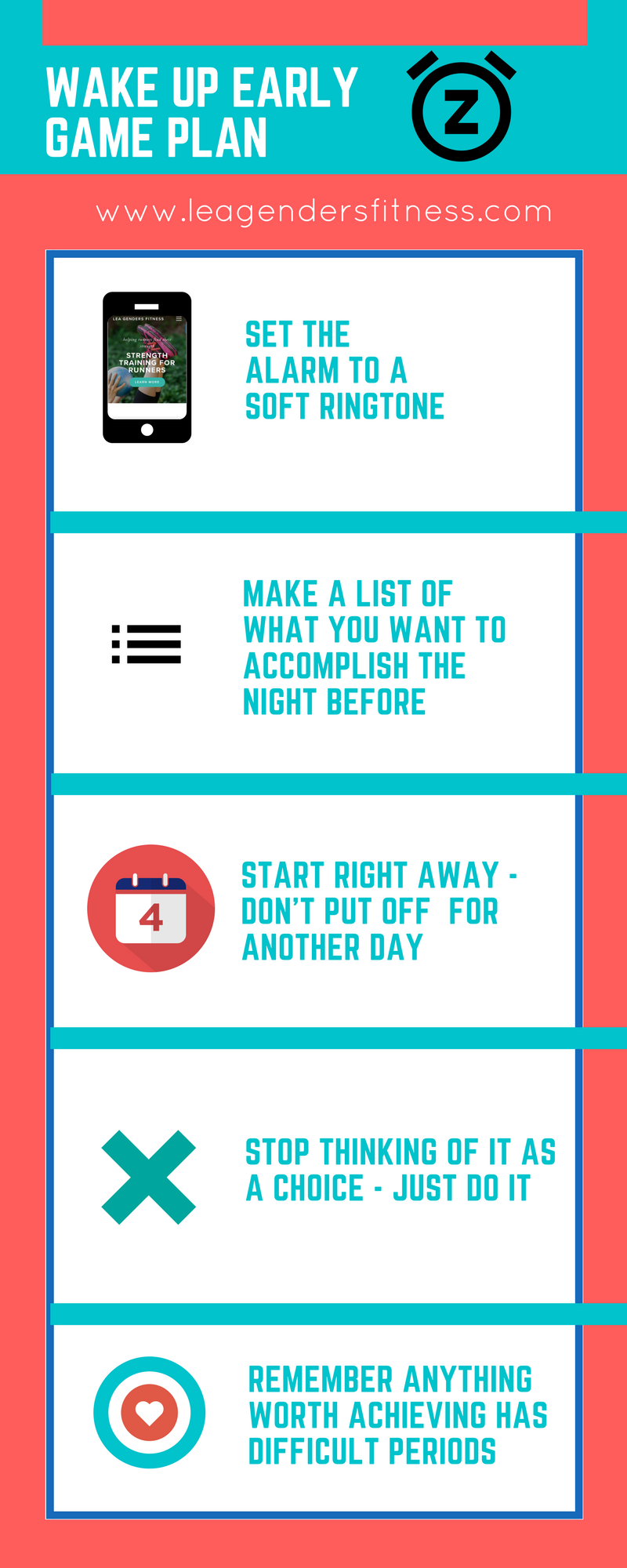
  • Set the alarm to a soft ringtone.
  • Have a clear plan for the morning's work. When I had specific things I wanted to accomplish on Wednesday, I got up to get them done. This week before bed I am going to write myself a to-do list for the work I want to accomplish in the morning.
  • My 'start over Monday' mindset from Friday is always something I warn my clients against. It's a trap. There is always another Monday. With this mindset you can push your goals off forever. Start today. Start now. 
  • View getting up early as something that is not a choice, but something I have to do, like on Saturday. I got up easier because I had things I wanted to accomplish and I knew sleeping in wasn't an option.

It is never fun to tell you that I failed, but it is real life and it happens to everyone, even the trainers and coaches. If you didn't quite accomplish what you wanted to last week, every day is new day to start over. 

TIME TO TAKE MY OWN ADVICE

I went to a wedding last weekend and one of the ladies at my table asked me about my blog. She said, "Oh, I wish I could run." I gave my usual advice: "You can! Most reasonably healthy people can start to learn to run. But here's the catch. It sucks at first. Like really sucks. So you have to commit to being consistent during that early hard phase. When it's hard and you can't breathe and your legs hate you, you have to do it anyway. This phase can last a few months, but if you commit to regular practice, you will eventually get past it and then running becomes enjoyable. Most people who love to run first went through that early hard phase. You just have to stay faithful in the hard times that it will get better."

Then it hit me. My advice on getting through the hard phase in running applies to everything. It applies to getting up early. Fight through the sucky-phase until it becomes a habit. It might take awhile, but I just 'do it anyway' in the beginning and it will be become routine. Time to take my own advice.

I feel prepared to tackle it again next week...and I seriously don't want to type another blog next week about how I didn't make it happen, so let's do this!

WEEK 2: TRACK CALORIES/MACROS IN MYFITNESSPAL

On to week 2. Since my week 1 habit didn't 'stick" and is still a work in progress, I am going to do something relatively easy for me for week 2. Something I know I can accomplish while I continue to work on week one. 

I am going to log my meals into MyFitnessPal. I am not a big believer in tracking every morsel that I eat for the rest of my life. It can become cumbersome and for someone like me who leans towards an 'all-or-nothing' mindset, putting too much emphasis on tracking can throw off my healthy balance if I become too attached to meeting certain numbers. With that being said, I think it is a good idea to track occasionally so I know where I stand. My meals don't drastically change from day to day or week to week, so if I log my calories for a week or two, It gives me a pretty good idea if I am on track. 

I am not looking to lose any weight, but I am experimenting with a macro-cycling program to see how it affects my body composition. For week 2 I will track my meals in MyFitnessPal every day to establish a baseline. 

What are your goals for the week?

Like this post? Please consider sharing.


Coach Lea