5 Ways Your Fitness Tracker Can Sabotage Results

This post contains affiliate links which means if you click on a link and make a purchase I make a small percentage of the sale with no extra cost to you. It helps support the running (pun intended) of this blog.

I love my FitBit. In fact, I am a little obsessed with it. I made a commitment to myself this year to walk or run 10k steps every single day. It's one of my non-negotiable bare-minimum goals for each day. A FitBit can be a great motivator to move but it is easy to make mistakes that can take you farther away from your fitness goals, rather than closer. Your FitBit is supposed to make you healthier, not crazier, Right? 

5 WAYS YOUR FITNESS TRACKER CAN SABOTAGE YOUR RESULTS

FITBIT: WHAT NOT TO DO

LIVE AND DIE BY CALORIES BURNED

The number of calories burned during an activity can vary drastically from person to person. There are a lot of factors that go into it that simply can't be captured 100% accurately on your FitBit. You should consider the calorie burned on your FitBit as a general guide, not as an exact science. It is safe to assume the calorie burned on your FitBit is over-estimated. If you eat to the calories that your FitBit says you burned, you may end up overeating for your activity level.

ONLY FOCUS ON STEPS

Steps are great. They are a way to track how much you are moving, which is important, but there are plenty of important facets of fitness that don't require steps. Lifting weights, stretching, practicing Yoga and foam rolling are all beneficial fitness activities that won't rack up many steps. If you neglect certain fitness activities simply because they won't increase your step count, then your FitBit may be holding you back.

GET TOO COMPETITIVE

Yeah, I like to win too. But if you stay up an extra hour to walk on the treadmill to beat some guy you never met named Jose in your FitBit challenge, you may be taking this competition thing too far. (Resemblance to actual events in my life are purely coincidental. Or not.) Yes, the challenges can help motivate you to move a little more, but they should not take over your life. Damn you Jose (shakes fist in the air at person I never met). 

LOSE COMMON SENSE

I was very proud of myself. In 2016 I took 10K steps every single day from January through October. Then one day I was lifting a bin of medicine balls out of the my truck after boot camp and I hurt my old lady back. I was sort of devastated. I could barely move, let alone walk 10k steps. After 10 months I had to let my 10K a day streak go. I knew it was more important to let my back heal than try to fight through five miles of stepping. I was out of the game for three or four days, but when my back healed I jumped back on my streak. Now I just say that I walked 10K steps every day that I was physically able. If you are concerned about meeting your step goal when you are injured or sick then you may be taking it too far. 

FOCUS ON THE NEGATIVE

The FitBit can provide valuable feedback, but what is important is how you use that feedback. Will you use it to motivate yourself, to make new goals and to push yourself further? Or will you use that feedback to feel bad about yourself? My friend left her FitBit on the charger at work over the weekend and joked "How am I supposed to feel bad about how few steps I am getting in compared to my friends and see how poorly I sleep without my FitBit." She was joking, but she makes a good point. If you use the feedback from your FitBit to compare yourself to others or feel bad about yourself then your FitBit may be doing more harm than good. Sometimes the healthiest thing to do is walk away from all the technology for awhile. 

Sometimes my 10K steps come easy. Some days they are hard-earned. I am the first to admit that I have spent many late evenings walking circles in my backyard or around my house because I was several hundred steps short of my goal. Walking in circles may sound crazy, but I try to balance my FitBit goal of 10K steps a day with my other fitness goals and my lifestyle. 10K steps a day is a fantastic goal to pursue but it is certainly not the most important thing in my day.  

Do you have a FitBit or other activity tracker? Are we FitBit friends? Find my email here and add me as a friend if you want to connect on FitBit.

Like this post? It helps me when you share. 

Coach Lea

I am a NASM personal trainer and RRCA adult distance running coach that specializes in strength training for runners. I offer in-person training in the Shredshed, online training and Fit to Run bootcamps. If you are interested in a more in-depth running or strength training plan, please contact me. Have questions? I'd love to help. 

While I am a certified personal trainer, I am not your personal trainer. Since I don't know your exercise abilities, injury background or medical history, please see your doctor before beginning any new exercise program. This is an opinion blog. No information in this blog is intended to be taken as medical advice or prescription. Please see your doctor and/or registered dietitian for any health concerns.



12 Week Half Marathon Training Plan and PDF Download

Hello, friends. I am excited to tell you that I just registered for the Dallas Rock 'n' Roll half marathon in March. If you want to run it with me, I have a discount code (code:LEAGENDERS) from the rock 'n' roll marathon series because I am a 2016 rock 'n' blogger. This code worked for all 2016 races and works for some of the early 2017 races, including Dallas. 

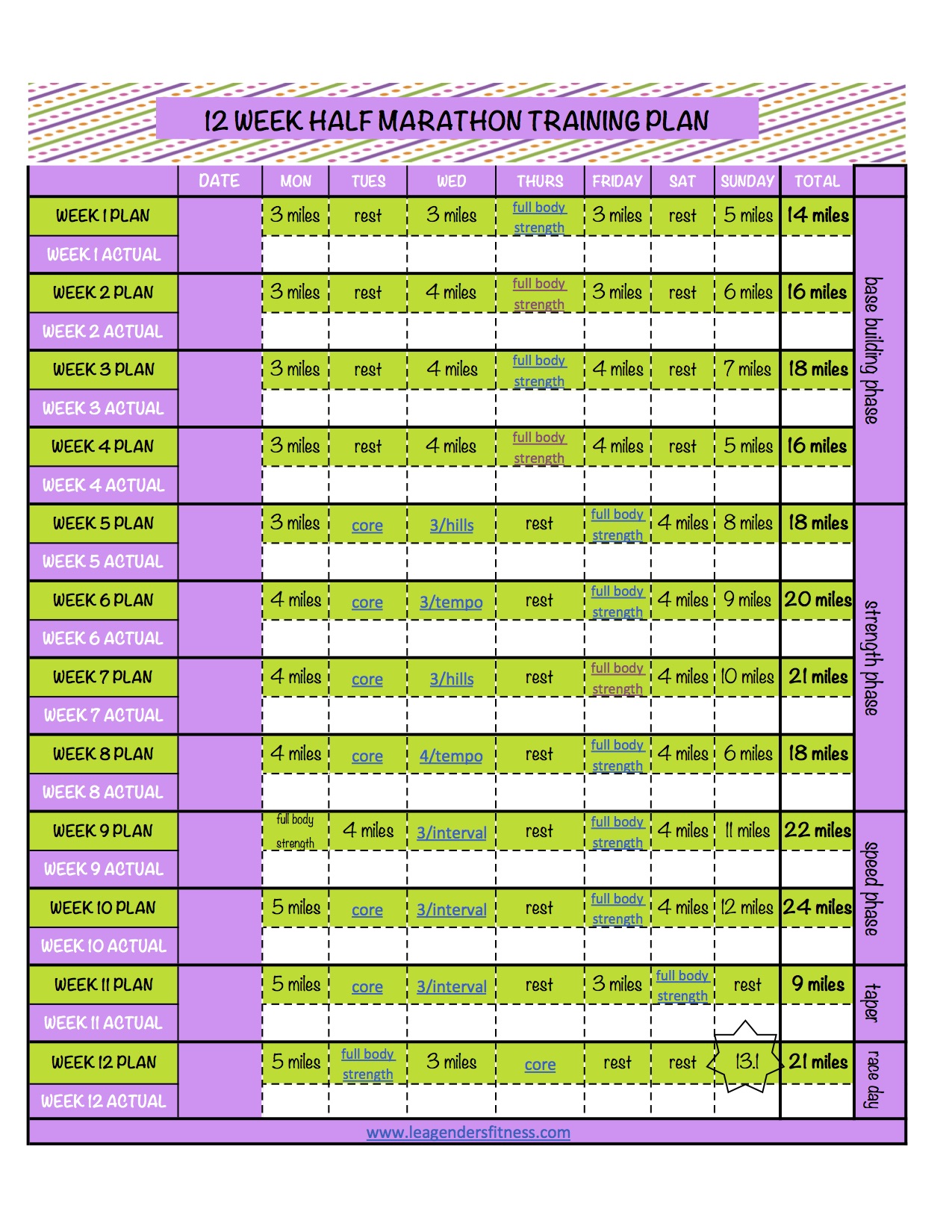
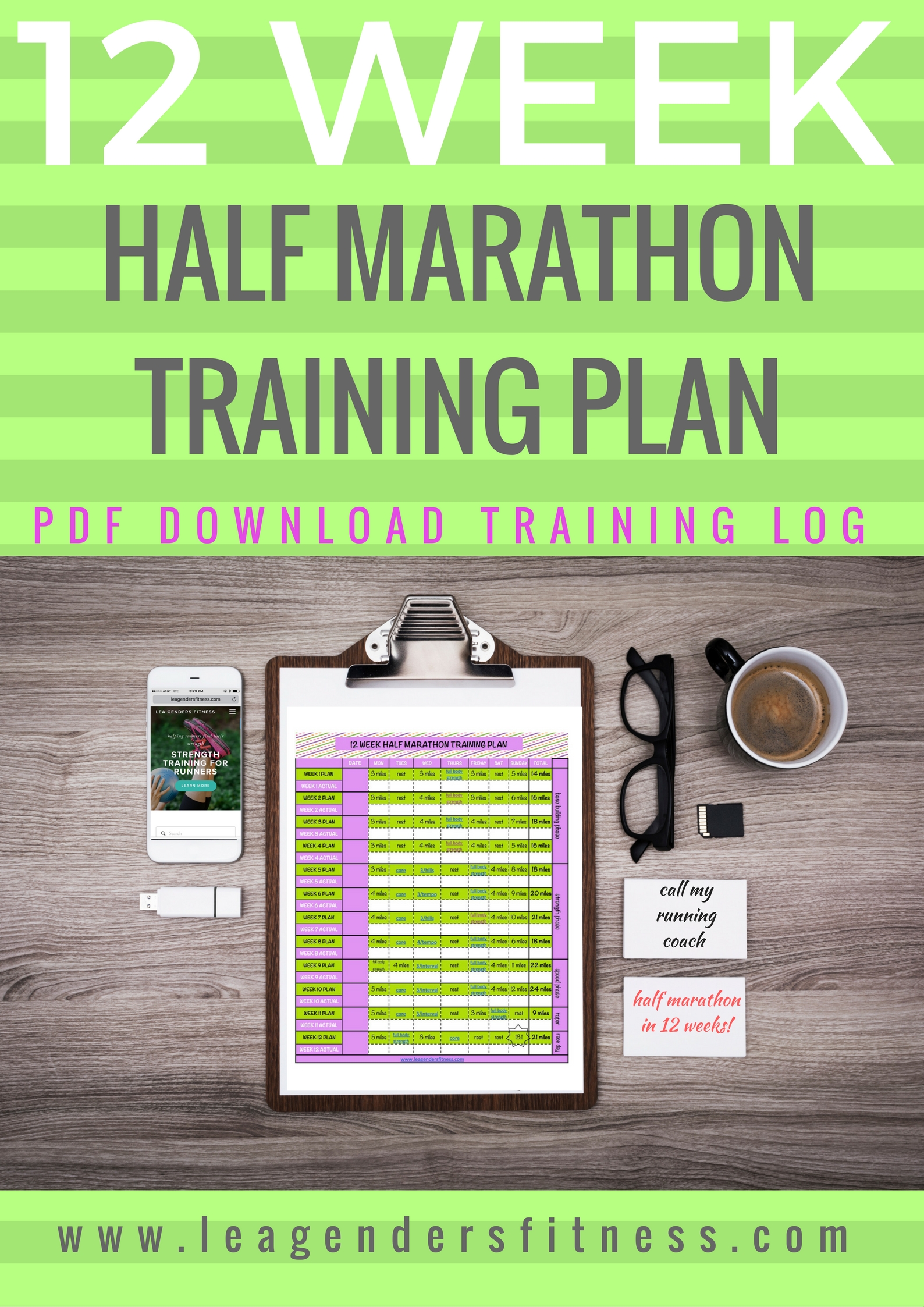
Would you like to train with me? For Workout Wednesday I am thrilled to share my personal 12 week half marathon training plan. 

12 week half marathon training plan.jpg

I haven't been running long distances much this fall/winter so it is time to start training for my half marathon at the end of March 2017. Following a training plan is a great way to stay motivated to exercise well into the new year. 

I starting building a training plan to get myself back up to 13.1 miles. I am happy to share it with you but as always, there are a few caveats. First of all, I am a certified running coach, but I am not your running coach. Since I don't know your exercise abilities, injury background or medical history, please see your doctor before beginning any new exercise program. This program is intended for an advanced beginner or intermediate runner. You should be able to run at a conversational pace (meaning you can hold a full conversation without gasping for breath while running at a slow pace) before starting this program. 

Because I am who I am (the strength training for runners coach), this half marathon training plan may not look like your typical plan. My plan includes strength training days because I think they are really important. While running will be my priority, I will still find a day or two each week for strength training. A full body strength training day and a core day once a week should be sufficient. 

THIS 12 WEEK HALF MARATHON TRAINING PLAN IS BROKEN INTO FOUR PHASES

BASE BUILDING PHASE

Even though I am an experienced runner, it is still a good idea to start any plan with a base building period. Since I haven't been running a lot lately, I gave myself four weeks to build a base. Depending on your current fitness level, you could shorten this phase. All runs in this phase should be done at conversational pace. We will slowly start to build our long run in this phase.

STRENGTH PHASE

When I talk about strength in this context, I am a referring to running strength. We will start to incorporate hills and tempo runs into our workouts. 

SPEED PHASE

The speed phase for half marathon training includes running intervals. I generally recommend no less than 1/2 mile intervals for half marathon speed work. We don't spend a lot of time doing shorter intervals for half marathon training. 

TAPER PHASE

This is when we will back off the milage and long runs to taper in order to prepare for race day.

You may notice that that there are rest days, easy run days and/or core days immediately following high intensity days. We always want to allow low intensity days like core work and conversational pace milage after high intensity days to allow our bodies to properly recover. Remember that our bodies adapt, get stronger and faster during rest, not during the workout. Allowing the proper recovery is an essential part of this half marathon training plan.

I included a PDF printable download at the end of the post so that you can print out the half marathon training plan and fill in your actual mileage each week. Running plans should always be dynamic, meaning that you should be willing to change and adjust as needed along the way. If I was your running coach, we would review your log at the end of the week and based on how you felt and performed, we would make adjustments if necessary. It is important when following a plan from the internet that you don't look at it as a rigid all-or-nothing plan. 

The perfect plan is one that fits into your lifestyle. If you feel you need an extra rest day after a long run, then take it. If you have to swap a running day and a strength training day because you can only get to the gym on certain days, then swap them. If you need to do your long run on Saturday instead of on Sunday, then do it. As a coach, I wouldn't expect you to complete the plan exactly as written for 12 weeks. Life happens, things change. This is not an excuse to blow-off the plan, but rather permission to make appropriate changes as needed. The most important part of the plan is to build the long runs and weekly mileage slowly over time. 

I caution you not skip any rest days or add more mileage to the plan unless you are an experienced runner who has completed many half marathons. The mileage build-up is strategic. Doing too much too soon is one of the biggest mistakes runners make. 

Are you ready to start training? I invite you to download my 12 week half marathon training plan printable PDF so you can log your progress along the way.

Want more personal support? Work with me!

Like this post? Please consider sharing or saving to Pinterest

Coach Lea


Ask The Trainer: Do I Really Need Rest Days?

Welcome to my new series, Ask the Trainer! I take your questions and answer them on the blog so others can benefit from the answers. I am not a medical professional. Please always direct medical questions and health concerns to your doctor. I am happy to provide my opinion on topics of exercise, training and running. 

Our first question is a great one from Annie.


My name is Annie. I came across your blog on Pinterest and have looked through a lot of it. I've been a runner for about 5 years now. I've done several 5Ks and one half marathon. I teach so it is hard to find time to run (I'm not a big fan of the treadmill) and it gets dark early now. I'm wanting to get back into consistent running so I can do another half marathon eventually and honestly running helps me manage stress. I would love to have a running coach, but I can't afford that right now but I wondered if you would be willing to answer a question about rest days... I deal with excessive exercise and anorexia nervosa, so rest days are something I don't take. I do a workout every single day for at least an hour and am on my feet all day teaching, etc. I saw "rest day" on the training plan I followed for my half marathon, but didn't take it (I would take a rest day from running, but not from HIIT and strength). I saw what you wrote about the need for "rest days" but does that mean not to do anything exercise wise or just not run? I would appreciate some guidance. Thank you and I will continue to follow your blog!

Annie

Hi, Annie.

First of all, thanks so much for checking out my blog. I appreciate the support.

As a general rule, I do recommend at least one full rest day a week from strenuous exercise, including running and strength training. I usually recommend stretching, light Yoga, foam rolling or walking on those rest days for clients who want to keep moving.

Our bodies adapt to exercise (build muscle, get stronger, get faster) during rest, not during the actual exercise, so rest days are important to allow your muscles to repair and rebuild. If you are resistant to a complete rest day, I would at least recommend a very easy short run at a very light effort 1-2 minutes slower pace than usual.

However with all that being said, since I don't know you personally it is hard for me to say what your body needs. We are all different and only you know how your body responds to the stress of exercise. Based on what you told me, you seem to have a tolerance for a high volume workout schedule. 

My advice would be to pay close attention to some potential warning signs of overtraining such as irritability, insomnia, lack of focus, exhaustion, lack of progress in training, injuries, among other symptoms. However, if you can honestly that say that you look, feel and perform your best, I'd be remiss to tell you to change something that is working for you. It's important to cover all three: how you look, how you feel and how you perform. If you listen to your body, those things will tell you if you're on the right track in regards to your exercise volume, intensity and nutrition. If you look great but feel lousy and perform at a low level, something probably is not right. 

If you deal with eating and exercise disorders as you mentioned I strongly recommend working with medical professionals to help you navigate those issues. 

So long answer short, I believe that athletes benefit from at least one full rest day a week because our muscles need the rest to repair and rebuild. Very low volume and intensity on those days should be enough rest. I personally alternate between high intensity days, low intensity days and rest days. For example I might have a HIIT (high intensity interval training) day followed by an easy run day, then heavy(ish) lifting day, then an easy run day, HIIT day and a rest day. Sleep is also important for recovery, work towards 7-8 hours of sleep per night. I have found as I am getting older I need more rest days than I did even five years ago. 

If you listen to your body and are willing to make changes to your lifestyle and exercise schedule as needed in order to stay healthy you'll be on the right track. 

Good luck and happy training for your next half marathon! Let me know how your training goes!

Like this post? Please consider sharing. 

What do you think? Any questions? Let me know in the comments, email me or submit your question to Ask The Trainer to be answered in a future blog post. 


Coach Lea

I am a NASM personal trainer and RRCA adult distance running coach that specializes in strength training for runners. I offer in-person training in the Shredshed, online training and Fit to Run bootcamps. If you are interested in a more in-depth running or strength training plan, please contact me. Have questions? I'd love to help. 

While I am a certified personal trainer, I am not your personal trainer. Since I don't know your exercise abilities, injury background or medical history, please see your doctor before beginning any new exercise program. This is an opinion blog. No information in this blog is intended to be taken as medical advice or prescription. Please see your doctor and/or registered dietitian for any health concerns.

EMBRACING THE SUCK TO REACH YOUR GOALS

My social media friend Fit Regular Guy commented on my post "7 Things You Should Never Say to a Runner" and remarked that #6 on the list was a variation of the "4 Stages of Suck," an article he published on his blog. I loved his article and it got me thinking about what it means to embrace the suck. 

Embracing the suck means accepting the temporary discomfort of the moment. It is about mental toughness. It is about overcoming discomfort. It is about delaying gratification. It means that instead of trying to feel comfortable by any means necessary that you realize that discomfort often means growth, so you not only accept it, but you embrace it. It sucks but you are grateful for it. 

It's a mind shift. It's a way of reframing difficult situations, so your brain isn't thinking of ways to get you out of it, but rather ways to get you through it, because you know on the other side is mental and physical growth. 

This applies to many facets of life, exercise is one. Sometimes exercise is hard and it sucks. Sometimes running sucks. Do you quit or keep going? Do you give up or embrace the suck?

Getting out of bed early in the morning when it is cold may require you to embrace the suck. You could go back to bed because it is warm and cozy there, or you could embrace the suck and do what needs to be done.


TWEET THIS: Embrace the suck to meet your fitness goals


An important distinction here is that suck refers to being uncomfortable, tired or out of your comfort zone. Suck does not mean physical pain or injury. In those cases you should immediately stop, rest and/or get help as to not cause further damage.

Train your brain to embrace the suck when doing the difficult things that can lead to positive results. Instead of thinking about how hard it is, think about how tough you are for sticking it out. Think about how you do hard things that other people won't do. Think about the great results that can come from your temporary acceptance of the suck. 

The key is to identify it and embrace it for what it is, not try to get out of it. Next time you are uncomfortable, embrace it, be grateful for it, get through it, because the tough times make you stronger. 

Like this post? It helps me when you share or save on Pinterest. 


Coach Lea

I am a NASM personal trainer and RRCA adult distance running coach that specializes in strength training for runners. I offer in-person training in the Shredshed, online training and Fit to Run bootcamps. If you are interested in a more in-depth running or strength training plan, please contact me. Have questions? I'd love to help. 

While I am a certified personal trainer, I am not your personal trainer. Since I don't know your exercise abilities, injury background or medical history, please see your doctor before beginning any new exercise program. This is an opinion blog. No information in this blog is intended to be taken as medical advice or prescription. Please see your doctor and/or registered dietitian for any health concerns.


HIIT THE STAIRS WORKOUT

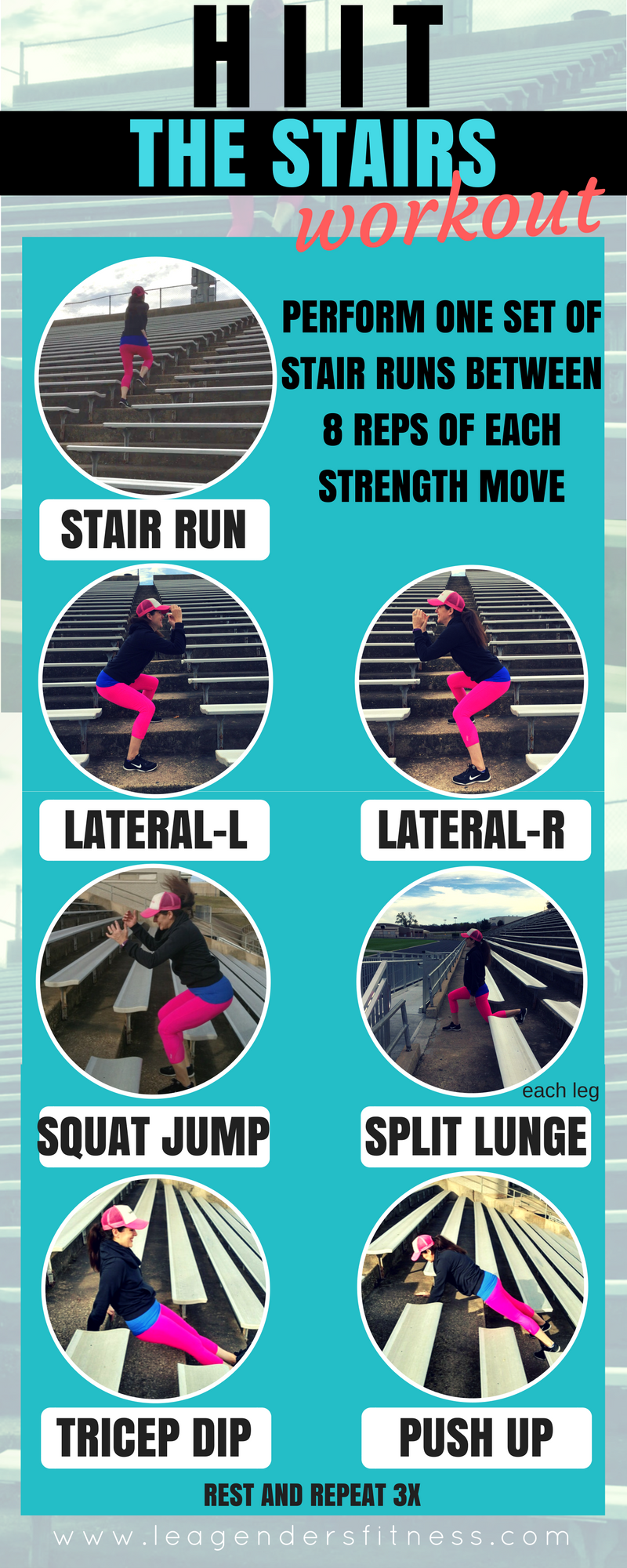
Welcome to the latest edition of workout Wednesday! This week we are going to H.I.I.T the stairs! H.I.I.T. means High Intensity Interval Training, of course. In this workout we will do an interval of high intensity stair climbs in between each strength move. 

Stair climb workouts are beneficial for runners because like hills, stair climbing helps build strength, speed and running efficiency. Work in stair or hill climbs once or twice a week in your schedule and you'll start to see improvements in your running. I love this workout because it combines cardio and strength in one efficient workout, all you need is a set of stairs. 

I went to my local track and used the stadium stairs (the same location we will be holding Fit to Run boot camps in January) but this workout can be done on any set of stairs inside or out. There were 30 steps in my climb. If you don't have as many steps in your staircase, just repeat the climb until you reach 30 steps. For example if your staircase has only 10 steps, repeat it 3 times. 

Always warm up before beginning any workout. 

STAIR CLIMBS

FORM

Keep your chest and head up with your shoulders back, eyes looking forward with your neck neutral. Keep your hands loose (imagine holding a potato chip between your thumb and pointer finger). Pump your arms at a 90 degree angle and do not allow them to cross over the front of the body. Lift your knees high as you progress to the next step. I like to think about moving vertically rather than forward. Bring those knees up high. 

SPEED

Start the bottom at a relaxed pace, gradually increasing speed as you progress to the top. The first few times it may be enough to just jog, you'll feel the change in intensity compared to running on flat ground. Over time you can increase speed as you improve.

RECOVERY

Recover by walking back down to the bottom before you perform each strength move.


THE WORKOUT

STAIR RUN

LATERAL SQUATS LEAD WITH LEFT LEG  / LATERAL SQUATS LEAD WITH RIGHT LEG x 8 REPS EACH LEG

Lower into a squat and take one large step to the side up the stairs. Staying in the low position bring your other leg up so both feet are on the same step, that is one rep. Perform 8 reps up the stairs leading with your left leg, then face the other direction to perform 8 reps leading with your right leg. Stay low! Walk back down to bottom.

STAIR RUN

SQUAT JUMPS x 8 REPS

Lower into a squat position and jump to the next step with both feet, landing softly in the low position (do not lock your knees). Walk back down to bottom.

STAIR RUN

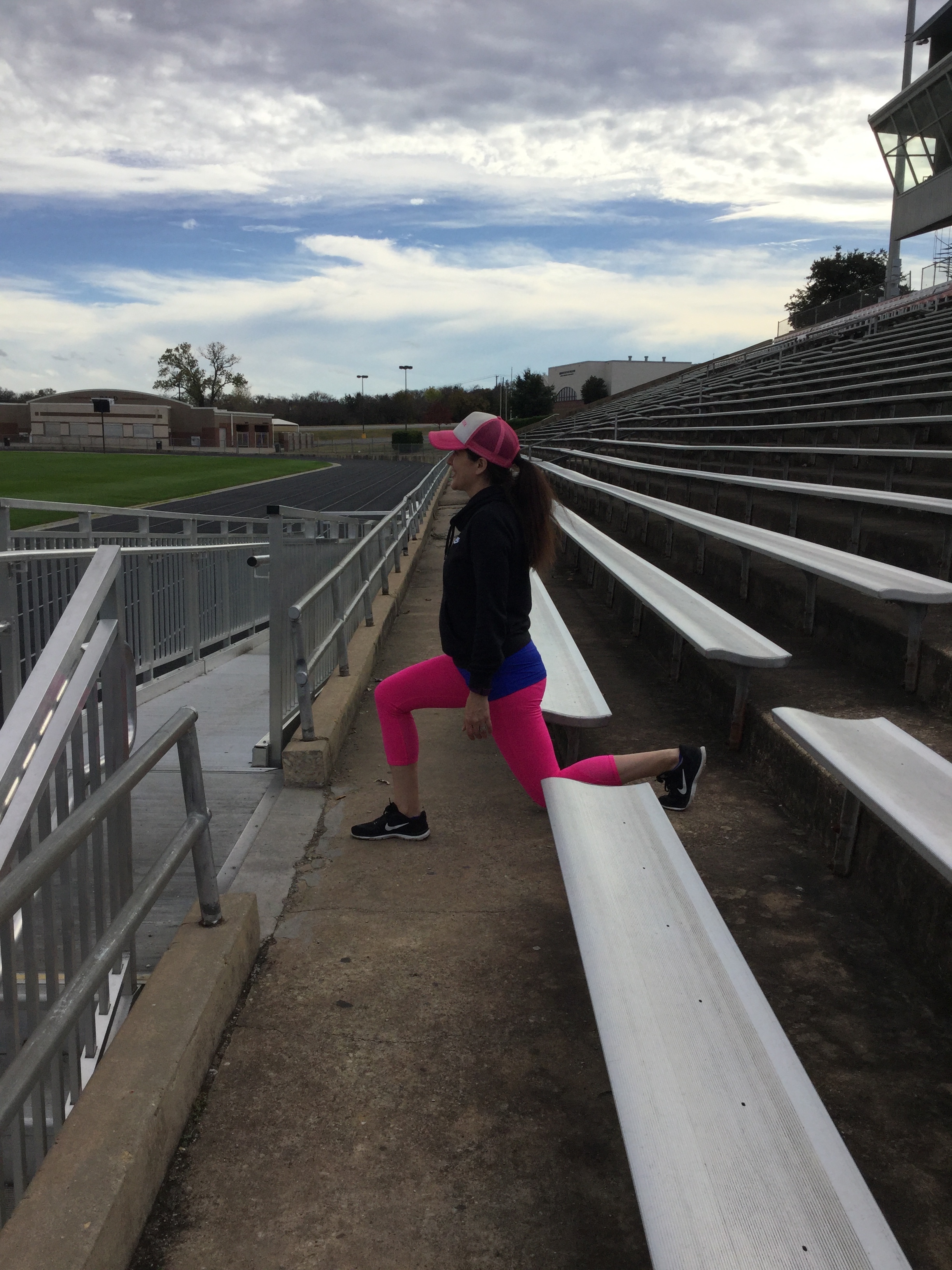
SPLIT LUNGE x 8 REPS EACH LEG

With one leg propped up behind you on the first step lower into a lunge position. Repeat for 8 reps then switch legs. 

STAIR RUN

TRICEP DIPS x 8 REPS

Position your hands shoulder width apart behind you on the step. Bend your elbows behind you to lower your body.

STAIR RUN

PUSH UPS x 8 REPS

Start in straight arm position with your hands placed a little wider than your shoulders. Keeping your body in a straight line, while engaging your core slowly lower your chest to the step. 

Rest for one minute (or as much as needed) and repeat two more times.

Always allow at least 48 hours between hard workouts. Never do intense workouts on back to back days. Your body repairs, adapts and grows stronger during rest (not during the workout), so it is important to allow it the proper recovery time. 

Give it a try and let me know what you think! Any questions? Let me know in the comments. 

Like this post? It helps me when you share or save to Pinterest.


Coach Lea