30 MINUTE TABATA-STYLE FAT BLASTER WORKOUT (GREAT FOR RUNNERS)

Hi, Friends. Welcome to the latest edition of Workout Wednesday. This week I put together a workout that is great for runners who want to squeeze in some strength training but don't have a lot of time. This is a perfect workout for after your run on an easy day (less than 30 minutes) or on a non-running day. It only takes 30 minutes, doesn't require any equipment and is a full body workout. This workout will benefit runners by improving running performance and overall athleticism. Strength training goes a long way in injury prevention for runners by strengthening the muscles surrounding the joints and strengthening the muscles that are not worked during running to help prevent muscle weaknesses and imbalances. Ready to get started?

WHAT YOU'LL NEED

You will need a Tabata timer. You can download free timers in the app store or play store. There are plenty of free options if you don't mind the ads. I use a GymBoss Timer (<--affiliate link) in the #shredshed and at my bootcamps

TABATA: HOW IT WORKS

Tabata is one of my favorite workout formats because it is quick and effective. The idea is to workout as hard as possible (high intensity) for 20 seconds, rest for 10 seconds and repeat for four minutes. 

In this circuit we are combining a strength exercise with a cardio exercise. In each round you will perform:

EXERCISE 1: 20 SECONDS

REST: 10 SECONDS

EXERCISE 2: 20 SECONDS

REST: 10 SECONDS

EXERCISE 1: 20 SECONDS

REST: 10 SECONDS

And so on...for four minutes.

Rest for one minute between rounds. Please always warm up before your workout and cool down/stretch afterwards.

THE EXERCISES

ROUND 1

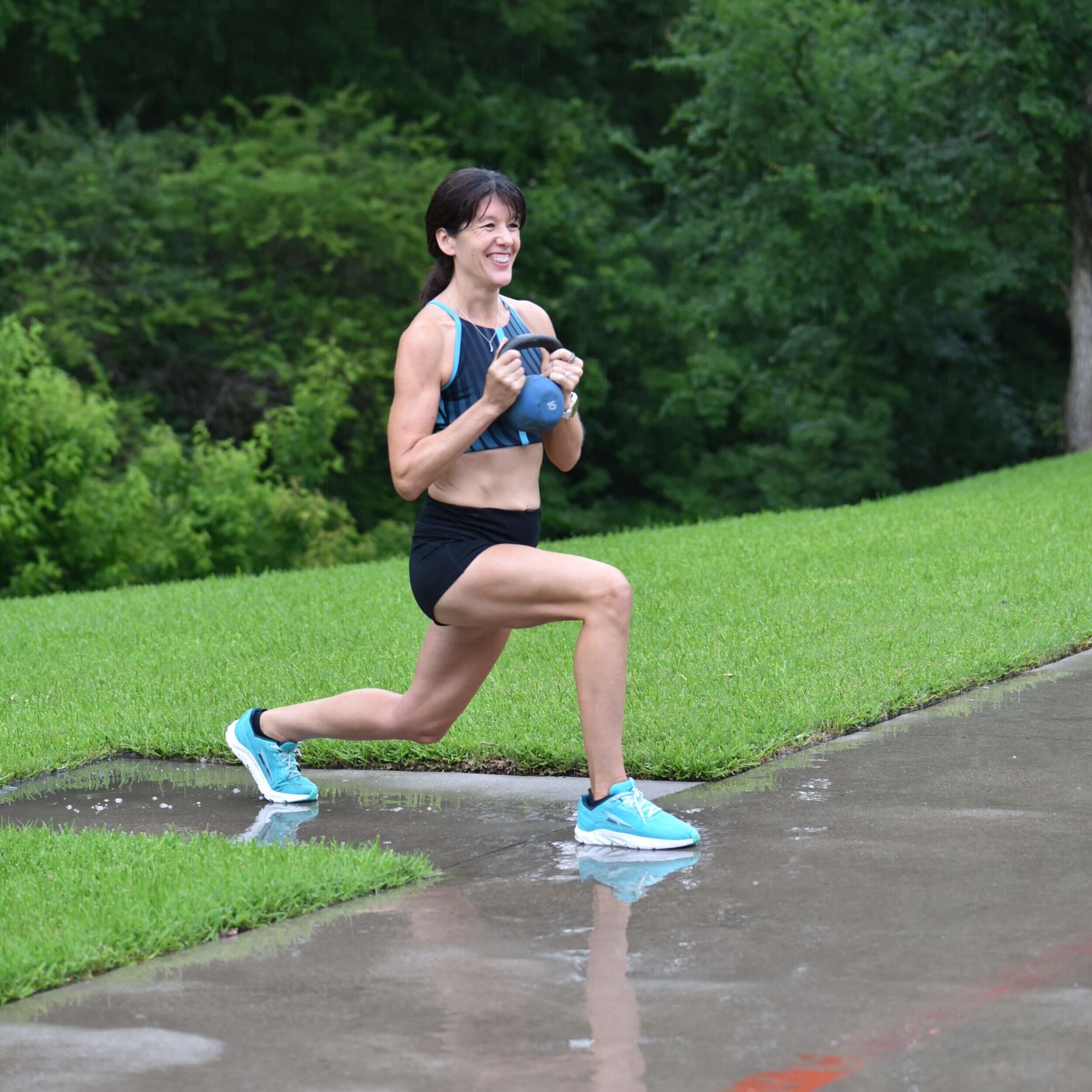
ALTERNATING LUNGES

With your feet hip width apart and your toes pointed straight ahead, engage your core and keep your back straight. Take one large step with your right leg to lunge forward until your front knee is lined up over your ankle and your back knee is nearly touching the floor. Resist the urge to lean forward or rest your arms on your thighs. Once you are in the lunge position pause for one second and push back up to starting position. Repeat on opposite leg, alternating for 20 seconds.
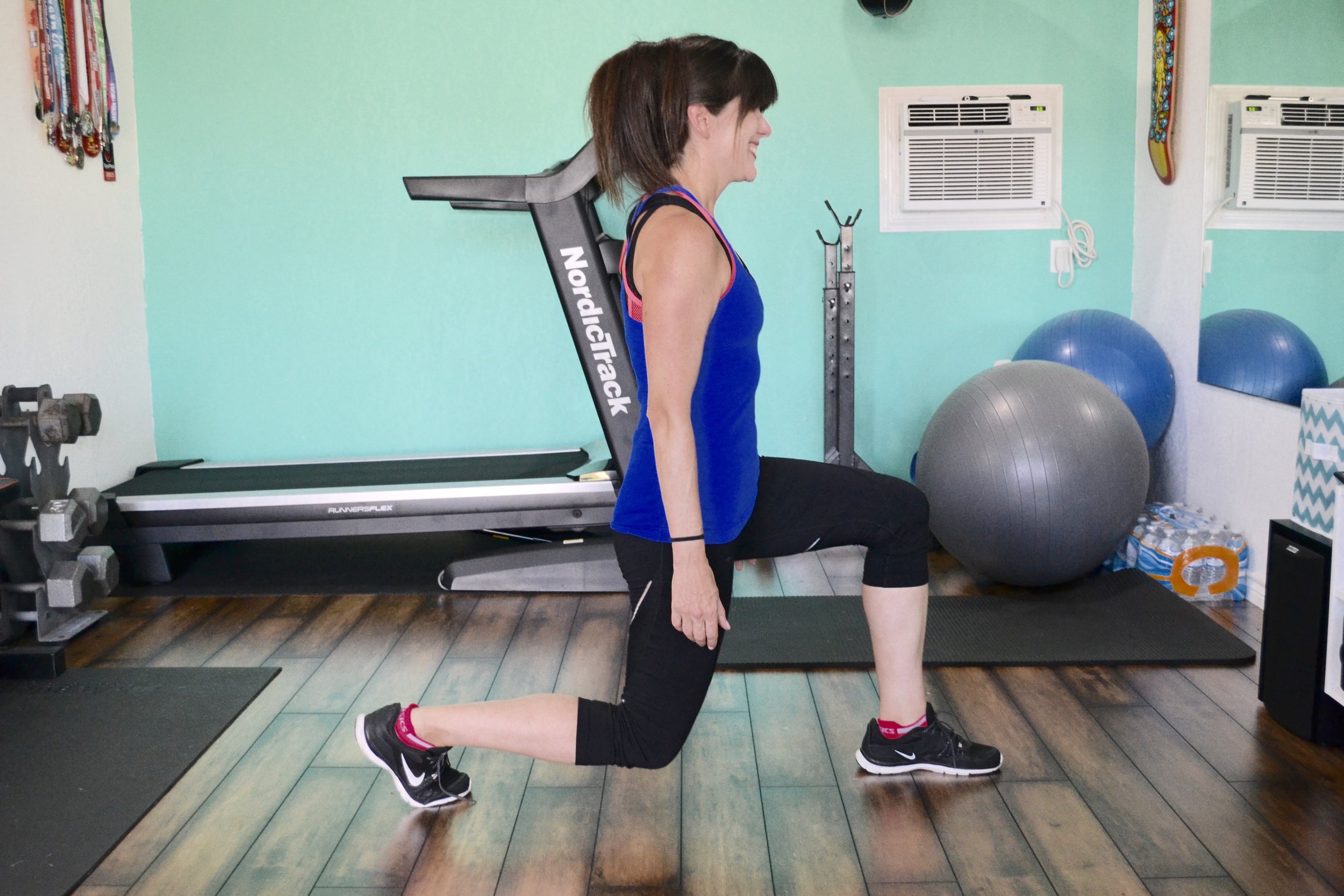
Lunge

Lunge

SWITCH LUNGES

Lunge forward as described above with your right thigh parallel to the floor. Swing your arms for balance and momentum, jump up and switch legs landing in a lunge with your left foot forward. Repeat for 20 seconds.

ROUND 2

PUSH UPS

Start in a high plank position with your hands placed directly under your shoulders. Keep your body in a straight line from your shoulders to ankles. While engaging your core slowly bend your elbows to lower your chest to the floor. Once in the low position push back up to the starting position. If this is too challenging, drop to your knees. 

MOUNTAIN CLIMBERS

Start in a straight arm plank position with shoulders directly over wrists. Bring your knee in towards your elbow then back to plank position. Repeat with opposite foot. This is one rep. Move as quickly as possible while keeping your core engaged.

Mountain Climbers

Mountain Climbers

ROUND 3

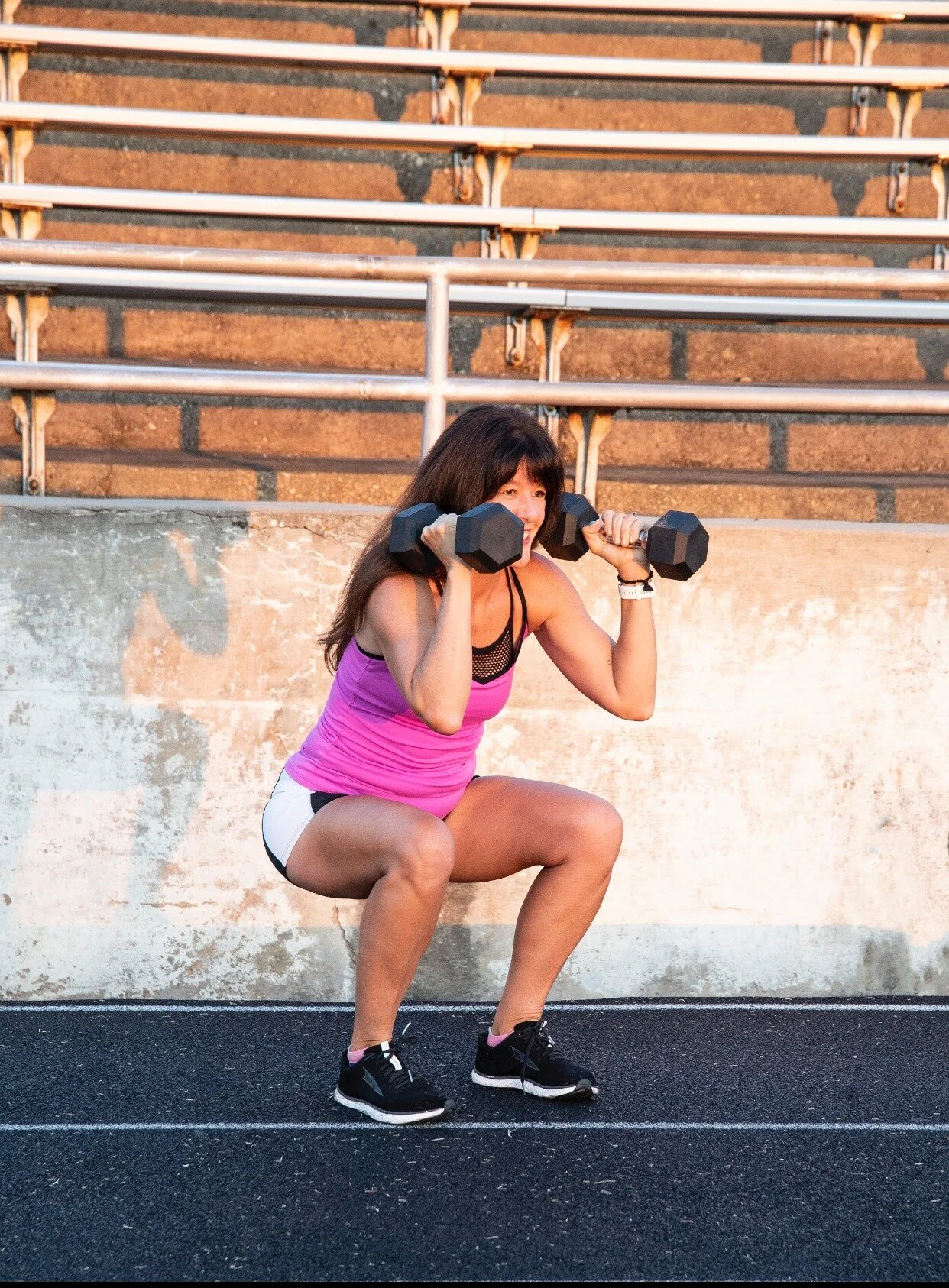
SQUATS

Starting with your feet hip width apart push your hips back and lower until your thighs are parallel to the floor (like you are sitting back in a chair) or as low as your flexibility allows. In the low position, engage your core, squeeze your glutes and push up to standing. Take a deep breath in as your lower to the squat and breath out as you return up to standing.

Squat

Squat

HIGH KNEES

Stand up straight with the feet hip width apart. Jump from one foot to the other while using your core to lift your knee to hip height. Swing your arms with each rep. Touch the ground with the balls of your feet quickly moving back and forth between legs.

ROUND 4

HIGH PLANK

In a high plank position place your shoulders directly over your wrists. Your body should form a straight line from your head to your heels. Don't allow your hips to drop or raise up. Engage your abs and breathe normally. Hold for 20 seconds

High plank

High plank

PLANK JACKS

Starting in a high plank position as described above with your feet together at the starting point. Jump your legs wide out to the sides (like the motion of a standing jumping jack) and then back together.

ROUND 5

SIDE LUNGE (EACH SIDE)

With both toes pointing forward, push your hips back and take a large step to your right and bend your right knee into a side lunge position and straighten your left leg. Lower your hips as low as your flexibility will allow. Push back to starting position and repeat on the other side alternating for 20 seconds.

CURTSY SQUAT WITH HOP

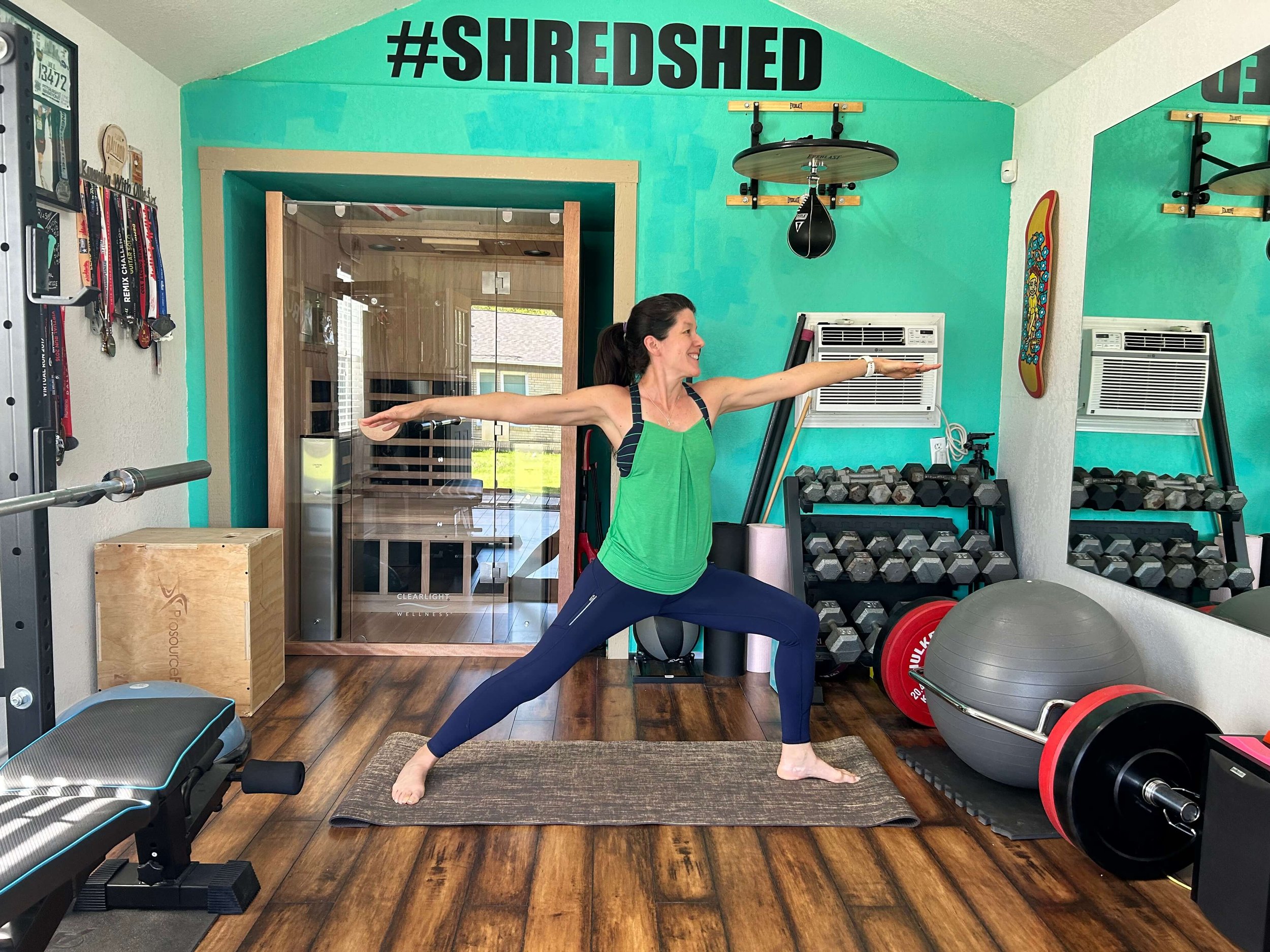
Stand with your feet hip apart. Cross your right leg behind the body and to the left. Bend left knee 90 degrees or as low your flexibility will allow, toes pointing forward. From the low position hop back up to the starting position and lower to the other side. Repeat for 20 seconds.

Curtsy squat in the #shredshed

Curtsy squat in the #shredshed

ROUND 6

SUPER MAN

Lie face down on your stomach with your legs and arms extended and your palms facing the floor. Simultaneously lift your chest, arms and thighs several inches off the floor up toward the ceiling while holding your midsection stable. Hold for two seconds and lower back down.

BURPEES

Stand with your feet hip width apart, lower into a squat position until your hands are flat on the floor in front of you. Jump your legs backwards into a high plank position. Jump both feet forward so you are back in the squat position. Jump up and raise both hands over your head. If this is too challenging, step back and forward from plank position instead of jumping. 

Burpees don't like you either.

Burpees don't like you either.

Give it a try and let me know what you think. Always remember that intense workouts like this one should be surrounded by easy days and/or rest days. Adaptations (aka getting strong) occur during rest. Allow your body the time it requires to repair, recover and get stronger. 

Have questions? Leave them in the comments or be a part of my new series "Ask the Trainer" and have your questions answered in a future blog post.

Like this post? It helps me when you share or save to Pinterest

Coach Lea

I am a NASM personal trainer and RRCA adult distance running coach that specializes in strength training for runners. I offer in-person training in the Shredshed, online training and Fit to Run bootcamps. If you are interested in a more in-depth running or strength training plan, please contact me. Have questions? I'd love to help. 

While I am a certified personal trainer, I am not your personal trainer. Since I don't know your exercise abilities, injury background or medical history, please see your doctor before beginning any new exercise program. This is an opinion blog. No information in this blog is intended to be taken as medical advice or prescription. Please see your doctor and/or registered dietitian for any health concerns.

Running A-to-Z W is Weight Loss (Running for Weight Loss)

Hi, Friends! Welcome to another edition of Running A-to-Z. If you've been following along, each week I cover a running-related topic following the order of the alphabet. I can't believe we are on letter 'W" already. Time flies when you're having fun blogging about running. If you missed any posts in this series you can catch up on letters A-V here.

W is for Weight Loss: Running for Weight Loss

Weight loss should be easy. In order to lose weight you must create a calorie deficit by consuming less calories than the calories burned from maintaining your resting metabolic rate and physical activity. Eat less. Workout more. Easy, right? 

Not so fast. Our bodies are not machines that simply take in fuel and use it until it's gone, there are a lot of factors that go into weight loss: your genetics, your environment, your physiology (hormonal or metabolic conditions), your mindset and your lifestyle & exercise habits. 

Since I am not a scientist, doctor or nutritionist we are just going to cover the basics of running for weight loss. The way I see it, It comes down to three factors:

AEROBIC EXERCISE

Running is a great way to burn calories when you are trying to lose weight. Running burns approximately 100 calories per mile or every 10-12 minutes (depends on some factors, but this is a reasonable average). It is important to note that if you don't like running, then feel free to substitute another cardio exercise that you do enjoy. But I guess if you didn't enjoy running then probably you wouldn't be here, unless you're my mom or my best friend. (Hi, Mom.)

If you are already running, you have a few choices to increase calorie burn. It is generally recommended 250 minutes of aerobic exercise a week for weight loss, which is about 4 hours a week. In short, try to get in 30-45 minutes of cardio most days of the week, but please take rest days.

RUN MORE

If you are currently not running 250 minutes a week, slowly build up the time you spend running by just adding 15 minutes extra a day or one mile a week for three weeks, then back off the mileage the 4th week to recover. Repeat this process until you reach your time goal. Adding too much too soon will only lead to injury or burnout, so it is better to increase slowly over time. The most important thing is to find something that is sustainable. 

RUN AT HIGHER INTENSITY

Short on time? Running High Intensity Interval Training (HIIT) workouts may be the answer. After warming up, trying running for one minute a high intensity that elevates your heart rate and breathing rate until you couldn't hold a conversation outside of a couple words at a time. Then walk or jog to recover for a minute (or longer if needed). Repeat several times for a short and effective workout. You'll increase your calorie burn compared to steady-state running and increase your EPOC (Excess post-exercise oxygen consumption) which means that you are still are burning calories at a higher rate after you complete your workout. My note of caution is to always sandwich high intensity days between low intensity days and rest days. Don't perform high intensity workouts back to back. Never increase intensity and mileage in the same week, as this is a recipe for injury. Give HIIT workouts a try one or two days a week for weight loss.

VARY YOUR WORKOUTS

You body is very good at adapting, which means it gets more efficient performing the workouts. This is good and bad. Great that the workout feels easier, but not so great that you are not burning as many calories as you were three months ago doing the same activity. The key is to continually change the variables so you can continue to improve. You can adjust your pace (run faster), the rest intervals (shorter), the time spent running (longer) or the number of days (more) to continue to progress.

STRENGTH TRAINING

Strength training is essential to weight loss. You can run and lose weight, but weight training helps you build and maintain (aka not lose) muscle mass. Muscle requires more energy at rest, so the more muscle you have the more calories you burn when you are not working out. Weight training increases your metabolic rate, maintains and builds muscle mass, improve performance and helps prevent injury. You don't have to turn into a gym rat, but make time 2-3 days a week for a 30 minute full-body workout session (or maybe 15 minutes after you finish your run several times a week). Runners should put extra focus on hip/core exercises

NUTRITION

Nutrition is probably the most important factor when trying to lose weight. As we discussed above, you want to create a calorie deficit in order to lose weight. We sometimes wonder why runners gain weight when training for marathon? It happens to the best of us. How does someone run so many miles and still not lose weight? Again there are a lot of factors at play, but it often comes down to nutrition. 

Running can make you feel very hungry. If you ran a 14 mile training run, you may feel you deserve that large bacon cheeseburger, side of fries and 2 cold beers. And honestly, I am all about balance. Maybe you did deserve it and that's fine, but once in awhile, not all the time. It's great when it is the exception, not the rule. A cheeseburger after every training run will kill your weight loss efforts. Save it for race day celebrations.

When you are training heavily you may feel hungrier than usual, all the time. It may help to eat small but frequent nutrient-dense meals (aka mostly whole foods) to help curb the hunger. Generally speaking most people do well to eat protein and most of their carbs surrounding their workouts.

The key is to find the balance. You know when your energy is in balance (not too much, not too little) when you look, feel and perform your best. Eat too little and you will feel it and see it in your performance, eat too much and it can lead to weight gain or stalled weight loss. If you struggle to find this balance, I recommend that you work with a nutritionist or registered dietitian (RD).

If you want to use running as a tool to lose weight, I think you are on the right track. You may need to increase the time and/or the intensity you spend running (slowly over time). Don't forget the importance of weight training in the weight loss puzzle and nutrition may be the most important component. Creating a calorie deficit while still maintaining an energy balance is the key to successful weight loss. 

Have questions? Leave them in the comments or be a part of my new series "Ask the Trainer" and have your questions answered in a future blog post.

LIke this post? It helps me when you share. 


Coach Lea

I am a NASM personal trainer and RRCA adult distance running coach that specializes in strength training for runners. I offer in-person training in the Shredshed, online training and Fit to Run bootcamps. If you are interested in a more in-depth running or strength training plan, please contact me. Have questions? I'd love to help. 

While I am a certified personal trainer, I am not your personal trainer. Since I don't know your exercise abilities, injury background or medical history, please see your doctor before beginning any new exercise program. This is an opinion blog. No information in this blog is intended to be taken as medical advice or prescription. Please see your doctor and/or registered dietitian for any health concerns.

5 KINDS OF JUNK FOODS DISGUISED AS HEALTH FOODS

One of the most challenging parts of living a healthy lifestyle is sorting through all the information and misinformation out there. Some say the "magic formula" for successful weight loss is to exercise regularly and eat healthy foods in a calorie-deficit. But what exactly does "eat healthy foods" mean? It can be confusing with all the mixed messages and misleading food marketing labels.

The most important thing to understand is that food marketing labels are sometimes intentionally deceiving. Many foods are marketed as healthful choices when in reality they are quite the opposite. 

This isn't intended to be a post about what you should or should not eat. Each person needs to make those choices for themselves, possibly under the direction of their doctor or registered dietitian (RD). This is a post about being aware of what you are eating, so that you can make the best decisions for yourself, your health and your family, based on reality, and not on misleading food packaging marketing.

5 KINDS OF JUNK FOODS DISGUISED AT HEALTH FOODS

1. YOGURT

Yogurt is one of the worst offenders of misleading marketing, often advertised as a diet food. Most flavored yogurts are very high in sugar and often have artificial sweeteners and/or high-fructose corn syrup. They can have as much sugar as a cup of ice cream, but people eat them and think they are making a good choice for their body. 

Try buying plain Greek yogurt, which is higher is protein and lower in sugar than traditional yogurt and then add fresh fruit or berries for flavor. If it is not as sweet as the yogurt you are used to, it is because it has a lot less sugar.

2. PROTEIN BARS

Protein bars are often advertised in health and fitness magazines by models with six-pack abs. Everyone knows protein is important for building and maintaining muscle, right? Right. But A lot of these packaged protein bars are nothing more than glorified candy bars with added protein. Check the ingredient list, sugar content and calorie content. They are often high in calories, sugar and are highly processed. I think they are OK in moderation but generally should not be consumed as a health food. I enjoy some protein bars, but consider them an occasional treat, not a healthy staple.

Try to get most of your protein from whole food sources like lean meats, beans, nuts and leafy greens.

3. FROZEN DIET DINNERS

Frozen diet dinners are often too high in sodium and processed ingredients and too low in nutrients to be considered a healthy food, but with labels like "Healthy Choice" and "Weight Watchers" we can be misled into thinking that they are a good choice for our body. 

Try meal prepping for the week with these mason jar salads for a quick, fresh lunch on the go. 

4. FAT FREE FOODS

Let me let you in on a little secret. If the food label boasts claims of Fat Free or Low Fat, it is often a red-flag that the food is not healthy at all. You see they take out the fat, but then add more sugar and processed ingredients so it still tastes good. Read the nutritional and ingredient label to be sure what you're eating.

Our bodies need healthy fats. Reducing intake of healthy fats does not necessarily equate to reduced body fat. You need a healthy balance of protein, carbs and fat in your diet.

5. ORGANIC, GLUTEN-FREE OR LOW-CARB PACKAGED FOODS

Watch out for buzz words on packaged foods like organic, gluten-free, and low-carb. While natural foods that are organic, gluten-free and low-carb are obviously just fine, processed foods with these labels are not any healthier than their counterparts. Organic junk foods are not any better for you than regular junk food. A gluten-free cupcake is still a processed low-nutrient food. Low-carb cookies are still cookies. When it comes to packaged foods, these types are labels are generally marketing labels designed to mislead you. (Obviously if you have celiac disease or a gluten intolerance a gluten-free label is helpful, but for the rest of the population it doesn't mean much in terms of the the health status of a food.)

Honorable mentions of junk foods disguised as health foods are dried fruits, trail mix, processed meats, veggie chips, sports drinks and cereal. Most of these have either too much added sugar or sodium to be considered healthy. Always look for the most natural alternative. 

I encourage you to ignore package marketing all together, read the nutrition label, take note of the calories per serving and number of servings in the package. Pay attention to the sugar content per serving and most importantly, the ingredient list. 

If you want to eat junk food then it's always OK to enjoy an occasional treat. It is actually healthy for us to have a balanced approached to nutrition (no one can eat 100% perfectly all the time). The idea is to learn to decipher between health foods and junk food, so that you don't eat junk food that you think is healthy. Eat healthful foods from nature most of the time and when you want to enjoy an indulgent treat, do it with your eyes open.

For any serious nutritional concerns please see a registered dietitian. Have questions? Leave them in the comments or be a part of my new series "Ask the Trainer" and have your questions answered in a future blog post.

Like this post? It helps me when you share.


Coach Lea

I am a NASM personal trainer and RRCA adult distance running coach that specializes in strength training for runners. I offer in-person training in the Shredshed, online training and Fit to Run bootcamps. If you are interested in a more in-depth running or strength training plan, please contact me. Have questions? I'd love to help. 

While I am a certified personal trainer, I am not your personal trainer. Since I don't know your exercise abilities, injury background or medical history, please see your doctor before beginning any new exercise program. This is an opinion blog. No information in this blog is intended to be taken as medical advice or prescription. Please see your doctor and/or registered dietitian for any health concerns.


The Great Pumpkin Workout

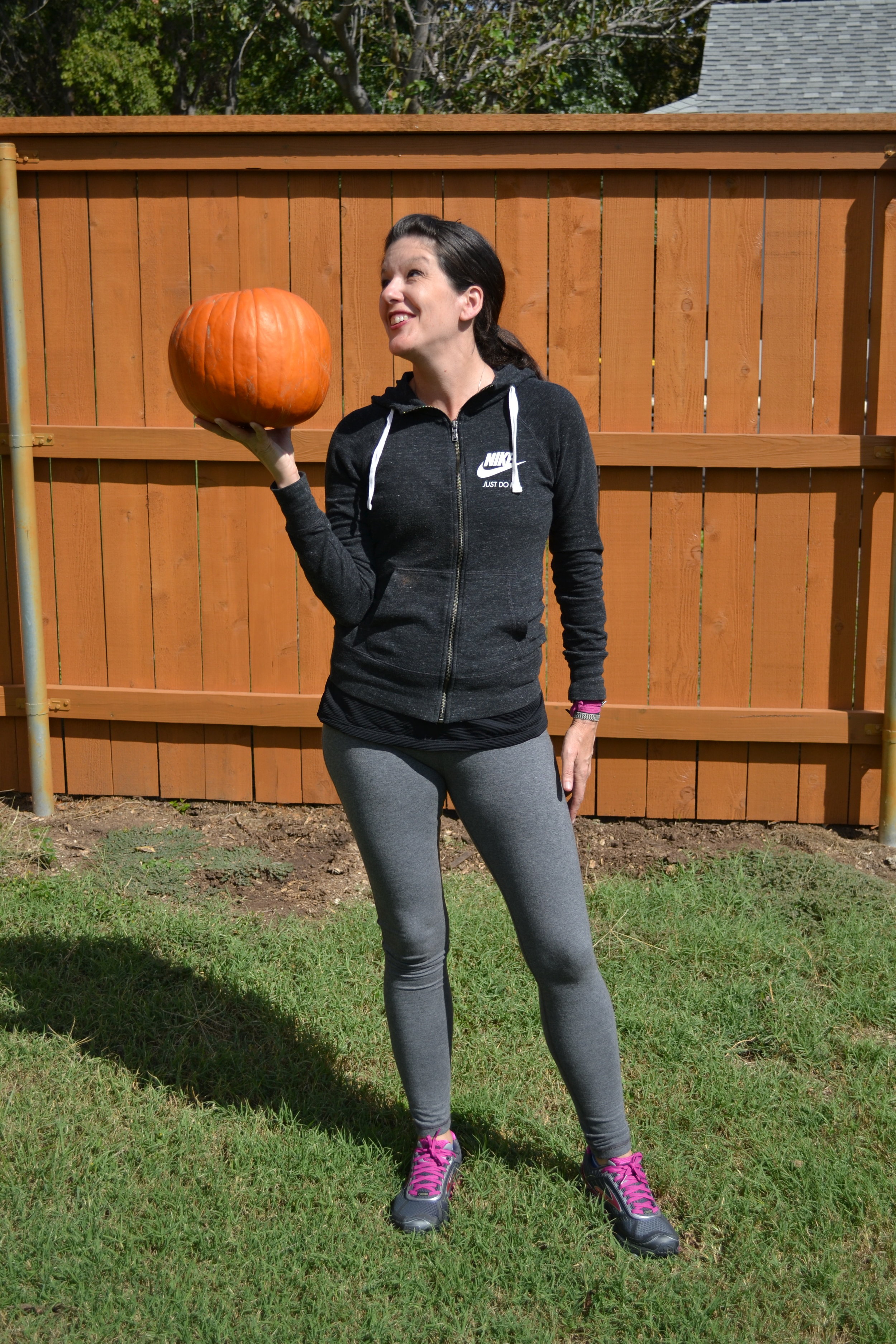
Welcome to another edition of workout Wednesday! This week we are having some fun with a pumpkin. I picked up a 9 lb pumpkin from the grocery store and realized that a pumpkin is very similar to a medicine ball. With everyone going pumpkin-everything crazy lately, I thought a full body pumpkin workout would be a fun way to celebrate the upcoming fall holidays. Maybe when we're done, we can make a pie with it. It's called balance. 

Pumpkin or medicine ball...you decide.

Pumpkin or medicine ball...you decide.


The Great Pumpkin Workout

Repeat each exercise for the numbers of reps indicated below, moving quickly from one exercise to the next. Repeat 3 times. If you don't have a pumpkin, then you can do this workout with a medicine ball. 

SQUAT WITH OVERHEAD PRESS x 12

FORWARD LUNGE WITH STRAIGHT ARM TWIST (ALTERNATING LEGS) x 12 EACH LEG

LATERAL SQUAT (RIGHT LEG LEAD) x 9

LATERAL SQUAT (LEFT LEG LEAD) x 9

RUSSIAN TWIST X 6 EACH SIDE

LIFT AND CHOP  X 6 EACH SIDE

AB REACH x 9

CARDIO - LATERAL JUMPS OVER THE PUMPKIN FOR ONE MINUTE

No worries. If I drop it, I'll just make pumpkin pie.&nbsp;

No worries. If I drop it, I'll just make pumpkin pie. 

Have questions? Leave them in the comments or be a part of my new series "Ask the Trainer" and have your questions answered in a future blog post.

Like this post? It helps me when you share.


Coach Lea

I am a NASM personal trainer and RRCA adult distance running coach that specializes in strength training for runners. I offer in-person training in the Shredshed, online training and Fit to Run bootcamps. If you are interested in a more in-depth running or strength training plan, please contact me. Have questions? I'd love to help. 

While I am a certified personal trainer, I am not your personal trainer. Since I don't know your exercise abilities, injury background or medical history, please see your doctor before beginning any new exercise program.

Running A-to-Z: V is for Vocabulary

Welcome to another edition of Running A-to-Z where I cover a running-related topic following the order of the alphabet. I honestly can't believe the weeks are flying by so quickly. We are on letter V already! Only 4 weeks left in the alphabet and then I am going to publish this whole series in a free downloadable ebook! If you missed any past posts can can catch up on letters A-through-U here

Runners have their own language. Besides the acronyms (BQ, PR, LSD & DNF) there are a whole list of words that may have new runners or our non-runner friends scratching their heads in confusion. Study up friends, we may have a have a pop quiz at the end. While, of course, this is not an all-inclusive list of running terms, here are some of widely used terms to brush up on to be in-the-know in the running community. 

Running A-to-Z: V is for vocabulary. Today's vocabulary lesson is running terms.

CORRAL

In a big race runners are grouped in corrals at the starting line based on their estimated finish times. The corrals kick off every few minutes to space out the runners so the fastest runners start first and the slower runners are in the back.

FOOT STRIKE

Foot strike is how and where your foot hits the ground: Heel strike, mid foot strike and forefoot strike. You can argue amongst yourselves which is best. 

FARTLEK

Not just a funny word, it means speed play in Swedish and is a form of speed training in which the pace and distance are varied in a go-as-you-please interval style workout. For example in a Fartlek workout you might run a mile to warm up, then speed up until you reach that telephone pole ahead, walk until the park bench, then run faster again until the white van. 

GLYCOGEN

Glycogen is carbs stored in the muscles and liver used for energy. Once glycogen stores are depleted during long distance running energy levels plummet and you may "hit the wall."

NEGATIVE SPLITS

Negative splits are a positive thing. It means running the 2nd half of a race or run faster than the first. 

PACE

Pace is the number of minutes it takes to cover a mile. 

PRONATION

Is how your how your foot rolls inward when running (or walking). Normal pronation is when the foot makes contact on the outside of the heel first, then the foot rolls towards the inside until the entire foot is on the ground before pushing off from the ball of your foot. Overpronation is when your foot rolls too far inward causing you to push off from your big toe, which is a common cause of injury.

STRIDES/STRIDERS

Strides or striders are used to build speed and efficiency either during the workout or a finisher during training. They are short and fast surges of speed from 50-100 meters with jogging in between. 

TAPER

Taper, the 5 letter word that every runner hates. Taper is when runners decrease the weekly mileage leading up to a big race. Often referred to as a taper-tantrum because runners hate running less, even when they know it's good for them. 

TEMPO

Tempo runs are done at a steady-state faster than conversational pace but not at an all-out effort. It is not sprinting but running at a comfortably-hard pace for 20 minutes to up to an hour.  It feels challenging but not so hard that the pace can't be maintained over a few miles. 

Did I miss any essential vocabulary terms? Ready for your pop quiz? What's your favorite thing about running? Tell me in the comments!

Have questions? Leave them in the comments or be a part of my new series "Ask the Trainer" and have your questions answered in a future blog post.

Like this post? It helps me when you share.


Coach Lea

I am a NASM personal trainer and RRCA adult distance running coach that specializes in strength training for runners. I offer in-person training in the Shredshed, online training and Fit to Run bootcamps. If you are interested in a more in-depth running or strength training plan, please contact me. Have questions? I'd love to help. 

While I am a certified personal trainer, I am not your personal trainer. Since I don't know your exercise abilities, injury background or medical history, please see your doctor before beginning any new exercise program. This is an opinion blog. No information on this site is intended to be taken as medical advice. Please see your doctor or registered dietitian regarding any health concerns.