Warm up, Cool Down & Stretching

In this day and age we are often short on time so we look at ways to make things more efficient. What can we do faster? What can we do in less time? Sometimes that means that we do interval workouts instead of ones that take more time with long rest periods. Sometimes it means we increase the intensity but spend less time working out overall. These are great solutions to working out more efficiently but one thing you should never do to save time is skip the warm up, cool down or stretching portions of your workout. Skipping your warm up, cool down and stretching will not get you to your goals faster and may lead to injury, hinder your results and performance. 

FOAM ROLLING

foam rolling in the SHREDSHED

foam rolling in the SHREDSHED

Foam rolling is called self-myofascial release. It is similar to a massage in that it releases muscle tension in overactive or shortened muscles. Use a foam roller (or similar device) before exercise to apply pressure to break up the knots within the muscle to release muscle tightness or tension. Foam rolling is suggested before stretching to potentially improve flexibility. I go into more detail on foam rolling in this post about foam rolling for runners. Foam rolling is appropriate before or after exercise.

WARM UP

GENERAL WARM UP

An example of a general warm up is walking for 5-10 minutes before running or lifting weights. A general warm up is not necessarily specific to the movements that will be performed during the workout, but it prepares your body for the workout by increasing heart rate, raising your body temperature, increasing blood flow to your muscles and mentally preparing you for higher intensities. 

SPECIFIC WARM UP

A specific warm up mimics the motions of the activity that will be performed during the workout. An example of a specific warm up is body weight squats before doing back squats with a weighted bar in the gym or high knees/butt kicks before a run. 

STRETCHING

Stretching before exercise warms up your muscles, improves flexibility and can help correct muscle imbalances. 

ACTIVE-ISOLATED STRETCHING

Active-isolated stretching is moving the joint through the full range of motion and holding the stretch for only 2-3 seconds. This is often considered superior to static stretching (holding the stretch for 30 seconds) because there is some evidence that static stretching before a workout can hinder performance in athletes performing explosive or power exercises. Consider the type of exercise you will be performing when choosing your stretch.

DYNAMIC STRETCHING

Dynamic (or functional) stretches are ideal for reasonably healthy and fit individuals. Dynamic stretches use momentum to take the joint through the full range of motion repeatedly. Hip swings, high knees, butt kicks and skips are examples of dynamic stretches.

COOL DOWN

The goal of the cool down is to gradually cool body temperature, reduce heart rate and slowly transition the body from exercise back to rest. You can reduce soreness and stiffness with a cool down after you exercise.

STATIC STRETCHING

Static stretching is holding the muscle in a stretched position for a minimum of 30 seconds. It allows your body to cool down after intense exercise and relaxes the muscles you worked. Exercise shortens and tightens the muscle, stretching it after exercise returns the muscles to their normal state, beginning the recovery process and improving flexibility.

Repeat after me: "I will never skip my warm and cool down again and I will foam roll and/or stretch before/after every workout." Your body will thank you for it!

Like this post? Please consider sharing.

Coach Lea

I am a NASM personal trainer and RRCA adult distance running coach that specializes in strength training for runners. I offer in-person training in the Shredshed, online training and Fit to Run boot camps. If you are interested in a more in-depth running or strength training plan please contact me. Have questions? I'd love to help. 


While I am a certified personal trainer, I am not your personal trainer. Since I don't know your exercise abilities, injury background or medical history, please see your doctor before beginning any new exercise program.


Running A-Z: N is for Newbies Success Principles for New Runners

Welcome to the latest edition of Running A-Z where I cover a running related topic in the order of the alphabet. This week we are on the letter N. Newbies: Success principles for new runners. If you missed any of the previous Running A-Z articles you can catch up on letters A-M here

N was a tough letter. I'll admit when I came up with the idea to write about running topics following the alphabet, I didn't plan ahead on what the topic would be for each letter. I knew that some letters would be more challenging than others. N was a tough one. Hubby's brilliant idea? Running naked. Good one, babe. Although I did consider spinning the topic a bit to be less about running without clothes (stupid, of course) to running "naked" aka without technology. Then I came to my senses and decided to write an article dedicated to the success principles for new runners. 

I have dedicated many articles to how to run efficiently, how to run faster and how to improve in running, but before you start thinking about those things as a brand new runner, it is more important to nail down the basic success principles. Get your mind ready for the challenge ahead. If you follow these five principles I can guarantee much smoother sailing (or running, I suppose) than if you did not. 

success principles for new runners

success principles for new runners


Have Patience

Not everyone loves to run. People remind me all the time that they hate running. But I know the truth. A lot of people only think they hate running because they never gave it a real chance. Most people quit before breaking through to that sweet spot when running becomes enjoyable. I'm not suggesting that everyone should love running. If it is not your thing, that is OK, move on and find some other way to move your body that you actually enjoy. My point is that if you quit in the early stages because it sucks (and no sugar coating, it does suck at first) you will never find out if you actually can enjoy it or not. Give it time. Have patience in the process. 

Be Consistent

The only way to get better at running is to run. Remaining consistent, especially in the beginning when you are developing as a runner is important. If you run once a week it will take much longer to make progress than if you run three times a week. If you run three times a week for three weeks, but then take two weeks off, you are losing fitness as fast as you are gaining it. You'll never get better without consistent action. Commit to running three times a week, even if that just means running one mile or just 15 minutes at a time. Getting out the door is often the hardest part. Force yourself to be consistent in order to build a solid running base.

Take it slow

I don't mean running speed, but starting off at slow and sustainable pace is advisable. When just beginning many new runner runners follow training plans that are far too aggressive for their abilities. Doing too much too soon is a sure fire path to exhaustion, burnout and injury.

A better action plan would be to ease into your new running routine. Start by committing to just 15-30 minutes three days a week. Allow proper rest and recovery days in between workouts. This will allow your body (and mind) time to adapt to your new program and allow for plenty of room for growth well into the future. You can always add more days, miles or time as you progress.

Put in the Work

Accept that it will take some hard work to achieve your goals. If you are mentally prepared for the challenge, the more likely you will succeed. Work hard and do your best, whatever that may be for any given day. Showing up and doing the work will ensure success. 

Set Goals

Write your running goals down. Set weekly, monthly and long term goals. Have both process goals (i.e. I will run 3 times this week) and result goals (I will improve my 5K time by 1 minute or will complete a 10K in six months). Working towards a written goal goes a long way in maintaining consistency and dedication to the process.

Be accountable

Be accountable to someone else. Tell people your goals. Sign up for a race. Some people start blogs to document their training, others do it on Instagram or they find a running partner, join a running group or hire a running coach. We sometimes are all too quick to let ourselves down, but will be held accountable to someone else. Find your people and get to work!

Are you ready for this adventure called running? I can tell you that it changed my whole life. If you would have told the younger version of me that I would one day become runner, a personal trainer and running coach, I probably would have fallen off my bar stool in laughter and disbelief. 

Have patience, be consistent, take it slow, put in the work, set goals and be accountable to someone else and I can guarantee your success. 

Like this post? It helps me when you share on social media.


Keeping running, friends.

Coach Lea

I am a NASM personal trainer and RRCA adult distance running coach that specializes in strength training for runners. I offer in-person training in the Shredshed, online training and Fit to Run boot camps. If you are interested in a more in-depth running or strength training plan please contact me. Have questions? I'd love to help. 

While I am a certified personal trainer, I am not your personal trainer. Since I don't know your exercise abilities, injury background or medical history, please see your doctor before beginning any new exercise program.


Runners are Gross: 7 Things We Don't Tell You

Being a runner is really gross. There are things we runners don't talk about to our non-runner friends. But if you've ever been on a long run with a friend  or a total stranger, these topics frequently come up in conversation.

 No one tells you running is so gross until it's too late and you're already addicted. 

Runners are gross...

Runners are gross...


#1. We Love to Sweat

I love to sweat. Sweat is gross, smells gross, makes my hair gross, but feels amazing. Call me weird, but if you run, you know that I'm not weird at all. Of course we wear protection (aka deodorant) but we really don't mind the sweat. 
 

#2. We Secretly Like Porta-Potties

There is something weird that happens when you start running. The farther you get away from a suitable toilet, the stronger the chance of the urge to go. You're officially a runner when you spot a disgusting, over-flown, stinky, no-flush, no-toilet-paper, porta-potty in the distance and you feel like the luckiest person on earth. 


#3. We Blow Snot in Public

Any runner worth their snot (you see what I did there?) can shoot a snot rocket with the accuracy of a sharp shooter. It is a skill that is quickly acquired by runners as it is necessary for survival in the wild (or on the streets). Spitting is also socially accepted runner-approved behavior. 
 

#4. We Blister

They are ugly. They hurt. They bubble. They burst. They rub raw. They are part of the game. As runners, we do all the right things to minimize them, yet they sometimes find a way to creep in anyway. Stay far away from cotton socks to help prevent blisters before they invade. Try rubbing ointment on blister prone spots before you run to reduce friction. 
 

#5. We Have Girl Problems

My deepest apologies to my male readers, but this is a reality that deserves a mention. Have you ever heard about women's cycles synchronizing? Well, I think that I sync according to my race schedule. Seriously. Not fun for 13.1 miles.
 

#6. We Lose Toenails

Not only do we we lose weight when we run, we also lose toenails. Who needs toenails anyway? It is a small sacrifice to make for the love of the run. I kid. I kid. Really, if you buy your shoes 1/2 size to one size bigger than usual so that you have at least a thumb space in your toe box you will likely will never have to deal with black or lost toenails again.
 

#7. We Chafe

Last but not least, we get that horrible burning and rash that shows up in all those places we don't talk about, but we can talk about them now: your armpits, your nipples, between your legs, and under your heart rate monitor. And guys, I'm sure you have a whole different pair of issues (pun intended) I'd rather not know about. I usually don't notice the rash until I jump in the shower. Ouchy! Ointment before you run on the areas that may rub together can help prevent the problem.

Did I miss any? How else are runners gross? Can you relate? Tell me in the comments. 

Like this post? Please consider sharing. 

Unilateral Leg Training for Runners

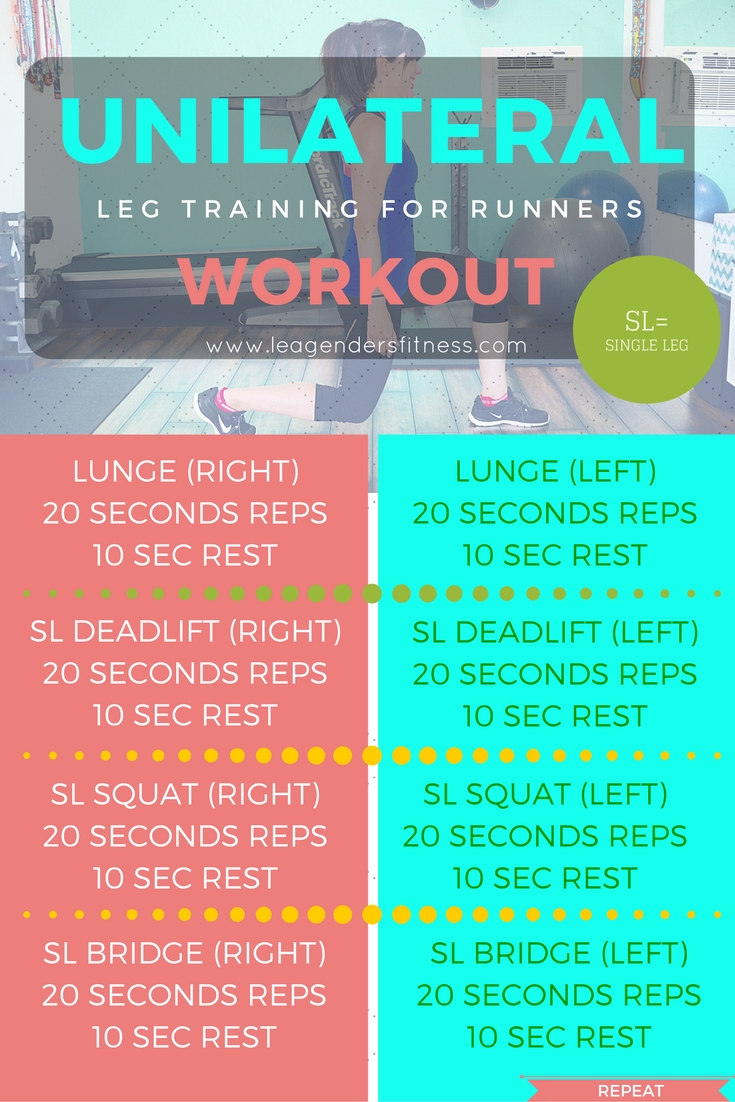
Welcome to another edition of workout Wednesday! Today we are talking about unilateral leg training for runners. What is unilateral training? It is training one side of the body independently from the other. Think about it for a moment. When you run you repeatedly transfer your body weight from one leg to the other for the duration of the run. Since you run on one leg at a time, it only makes sense to strength train one leg at a time. 

While traditional bilateral (two leg) exercises like the squat are great for runners, you can take it to the next step in strength and balance by training each leg independently to increase runner-specific strength and help ward off injuries. I recommend incorporating both bilateral and unilateral training into your program.

WHY UNILATERAL TRAINING?

When you train both legs at the same time you may be reinforcing strength imbalances. If one side of your body is stronger than the other, that side is going to compensate for the weaker side. Training each limb independently will build up the strength on your weaker side and eventually even out the strength of both sides. If you don't train unilaterally, the dominant side of your body will stay strong, while the weaker side will stay weak. These imbalances can lead to injuries. 

I also love unilateral training because it requires more stability and forces you to balance and build core strength. Balance and core strength are essential for runners. 

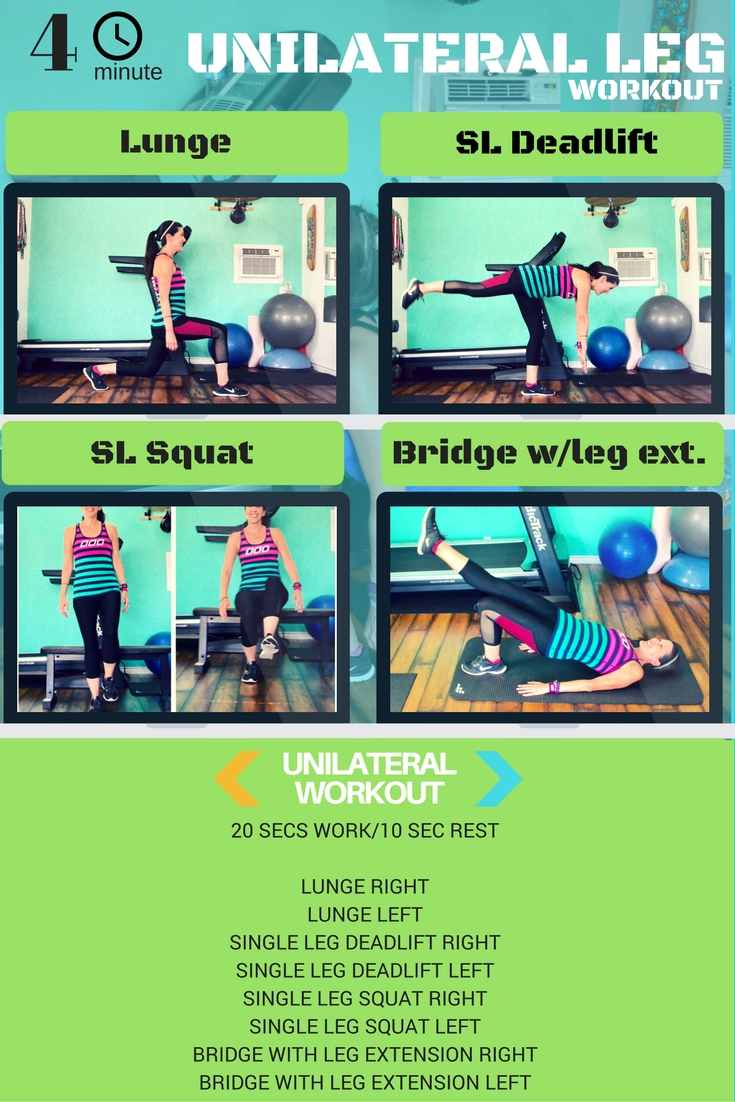
Try these unilateral exercises in your next leg workout. Perform these moves without weights at first until you master technique and form. As your balance and stability improves, add weight to the exercises for an additional challenge.


Lunge 

Lunge

Lunge

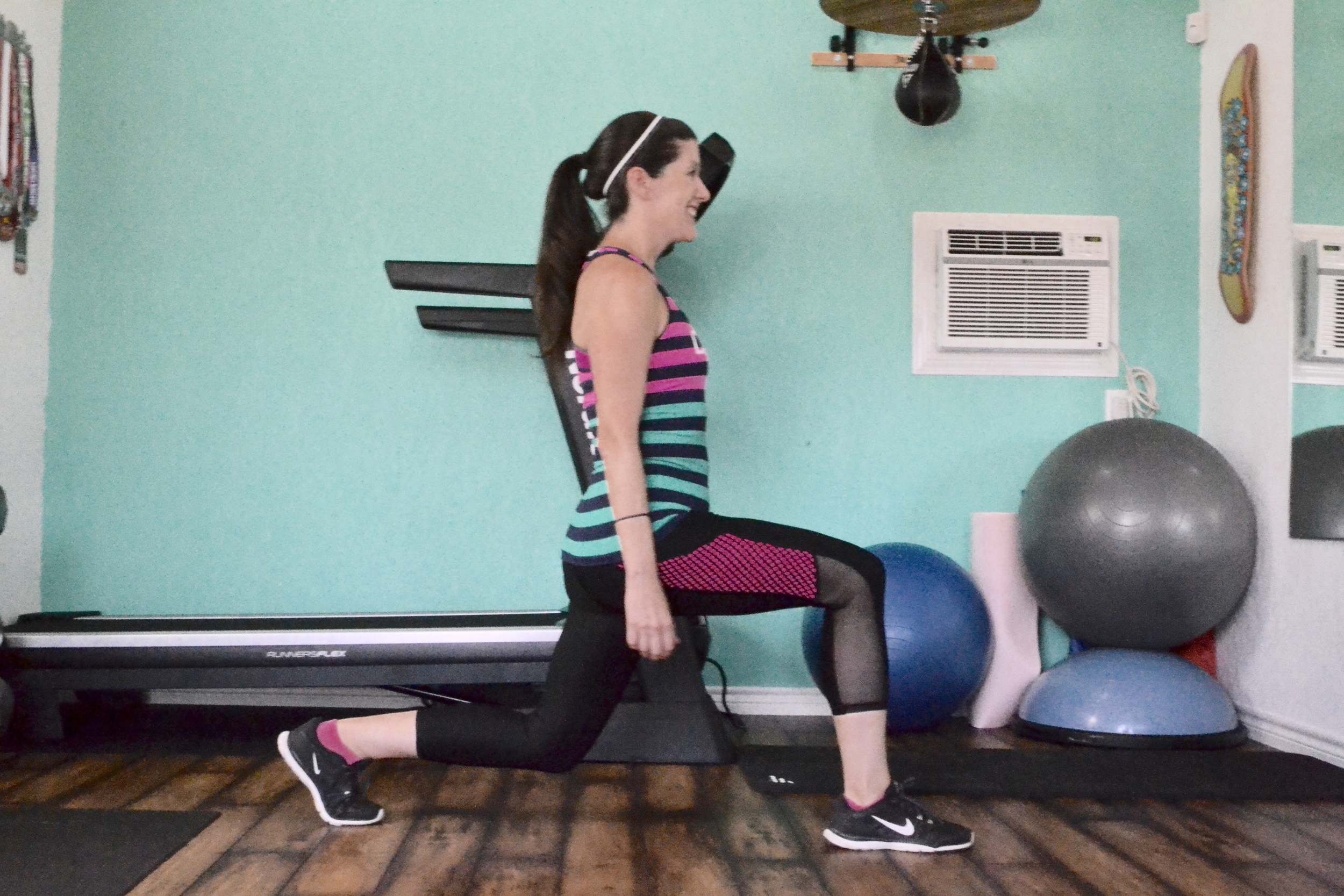
With your feet hip width apart and your toes pointed straight ahead, engage your core and keep your back straight. Take one large step with your right leg to lunge forward until your front knee is lined up over your ankle and your back knee is nearly touching the floor. Do not allow your knee to move forward over your toes. Resist the urge to lean forward or rest your arms on your thighs. Once you are in the lunge position push back up to starting position. Repeat for 20 seconds.

Single Leg Deadlift

single leg deadlift

single leg deadlift

Standing on one leg, keep your knee slightly bent and perform a deadlift by bending at your hip while keeping your back straight and neck neutral. Extend your free leg behind you in line with your body. Lower until your back is parallel to the floor. With your back straight return to the upright position. Repeat for 20 seconds.

Single Leg Squat

While the single leg squat is an advanced move, there are a couple of variations that almost anyone can perform. I like using a bench for the low position. Balance on one leg and lower yourself until you are sitting on the bench. Your knee may want to cave inward, which is sign of a muscle imbalance. Work to keep your standing knee inline with your outside toe as you lower to the bench. Keeping the 2nd leg off the ground stand back up to the starting position.

single leg squat

single leg squat

Another variation is the single leg wall squat. Lower yourself into a wall squat position, with your back flat against the wall and your thighs parallel to the ground. Lift one leg off the floor and straighten it in front you. Repeat for 20 seconds.

Bridge with leg extension

Lie on your back with your knees bent and lift your hips off the floor while engaging your glutes and abs. Straighten one leg. Keep your leg in a straight line with your body and your knees together. Hold for 20 seconds.

bridge with leg extension

bridge with leg extension

Perform each of the exercises in a Tabata-style format: 20 seconds work/10 seconds rest for four minutes. Rest one minute then repeat the circuit two more times. This is a quick and effective unilateral workout that you can tack on to the end of your run.

Like this post? It helps me when you share!


Coach Lea

I am a NASM personal trainer and RRCA adult distance running coach that specializes in strength training for runners. I offer in-person training in the Shredshed, as well as online training. If you are interested in a more in-depth running or strength training plan, please contact me. Have questions? I'd love to help. 

While I am a certified personal trainer, I am not your personal trainer. Since I don't know your exercise abilities, injury background or medical history, please see your doctor before beginning any new exercise program.


Running A-Z: M is for Mental Tricks for Runners

Sometimes running is easy. There are times when I get lost in the miles and they just fly by, but other times it can be hard. Sometimes my mind is running faster than my legs and I can't get into the right mindset to keep going when it gets tough. How do you get through those tough runs when your mind just won't quit? You learn to toughen up your mind. 

I often think that running can be more of a mental game than a physical one. It seems sometimes my head tries to talk my legs out of doing what they need to do. Whether you need mental strength for long runs, races, or just to get started, these are my best tips for conquering your mind on your runs. I think of mental toughness like a muscle: you have to work it for it to get stronger. 
 

Banish Negative Thoughts


I don't know where those thoughts come from or why our own thoughts can be so self-sabotaging, but recognizing that our negative thoughts can be lies can be the difference between pushing through to the next level or giving up. Anytime you start to have a negative thought try to replace it with a positive mantra. Usually I just repeat something easy like, "You can do it, you rock." (OK, don't laugh. It works.) Borrow mine or come up with your own less-dorky mantra. It's almost impossible for a negative thought to creep in when repeating a positive mantra.


Mentally Break up the Miles 


When I am running a long run I break up the miles in my head into more manageable segments. I'll run three mile loops and count loops instead of miles. 15 miles is only five loops. Five loops seems much more manageable than 15 miles. Sometimes I'll run out and back equal distance and only focus on getting to the halfway point. Once I get halfway, then I just have to run home (or call hubby from my cell phone and tell him to pick me up. Just kidding). Mentally breaking up the miles into smaller manageable segments makes it seem less daunting.


Focus on the Mile You are in


Try not to count the miles you have left to go. Focus on the mile you are in. Try to live in the moment and take in your surroundings. Have you ever started a marathon (or half) and at mile one started counting down to the end? I have and it's mental torture. If you are running mile one and already calculating the remaining miles, it is going to be a long race. Instead focus on mile one while you are in it, and try not to think too much about mile 26 (or 13) until you get there. 
  

Find a Running Partner


Ollie, my dog is a great running partner, but he is not a great conservationist. When I run with a friend, the kind that can talk back, the miles fly by and I almost forget I am running. I've had fabulous long runs with friends and the miles just vanished in the socializing.


Be Thankful for Every Mile


The best strategy I ever used to get through a half marathon is that I thought of 13 people that I loved and I dedicated each mile to a single person; thinking about them and being thankful that they are (or were) in my life. By focusing on another person from a place of gratitude, the miles flew by. There were times when I reached the end of the mile and I wish I had more time for that person. Can you believe I just said I actually wished I had more time at each mile? It wasn't my fastest half marathon time, but I may have cried tears of joy several times. It was an emotional and wonderful race. 

I often think about how grateful I am just to be able to run. I remember that I am thankful for strong legs, a healthy heart and the motivation to be out there in the first place. Remembering that running is a gift and privilege not afforded to everyone can help me get through tough times during a run.
 

Accept it


Running isn't always easy. If it were easy, everyone would do it. Part of the reason I love running so much is that it challenges me. Accept that running is hard at times. It is those tough times that make you stronger as a runner and as a person. I like the saying "get comfortable with being uncomfortable." Being uncomfortable forces us to grow. During those tough times on long runs, fast 5Ks or intervals that push my limits, I remember that this hard part is the good part. It is what makes me stronger. 

Do you have any mental tricks that you use to get through a run when the running gets tough? 

Like this post? It helps me when you share!

Coach Lea

I am a NASM personal trainer and RRCA adult distance running coach that specializes in strength training for runners. I offer in-person training in the Shredshed, as well as online training. If you are interested in a more in-depth running or strength training plan, please contact me. Have questions? I'd love to help. 

While I am a certified personal trainer, I am not your personal trainer. Since I don't know your exercise abilities, injury background or medical history, please see your doctor before beginning any new exercise program.