FULL BODY STABILITY BALL CIRCUIT WORKOUT

I love the stability ball. Even though most people associate the stability ball with ab exercises, it is an extremely versatile piece of exercise equipment that can be used to strengthen the entire body while challenging your balance and core stability. 

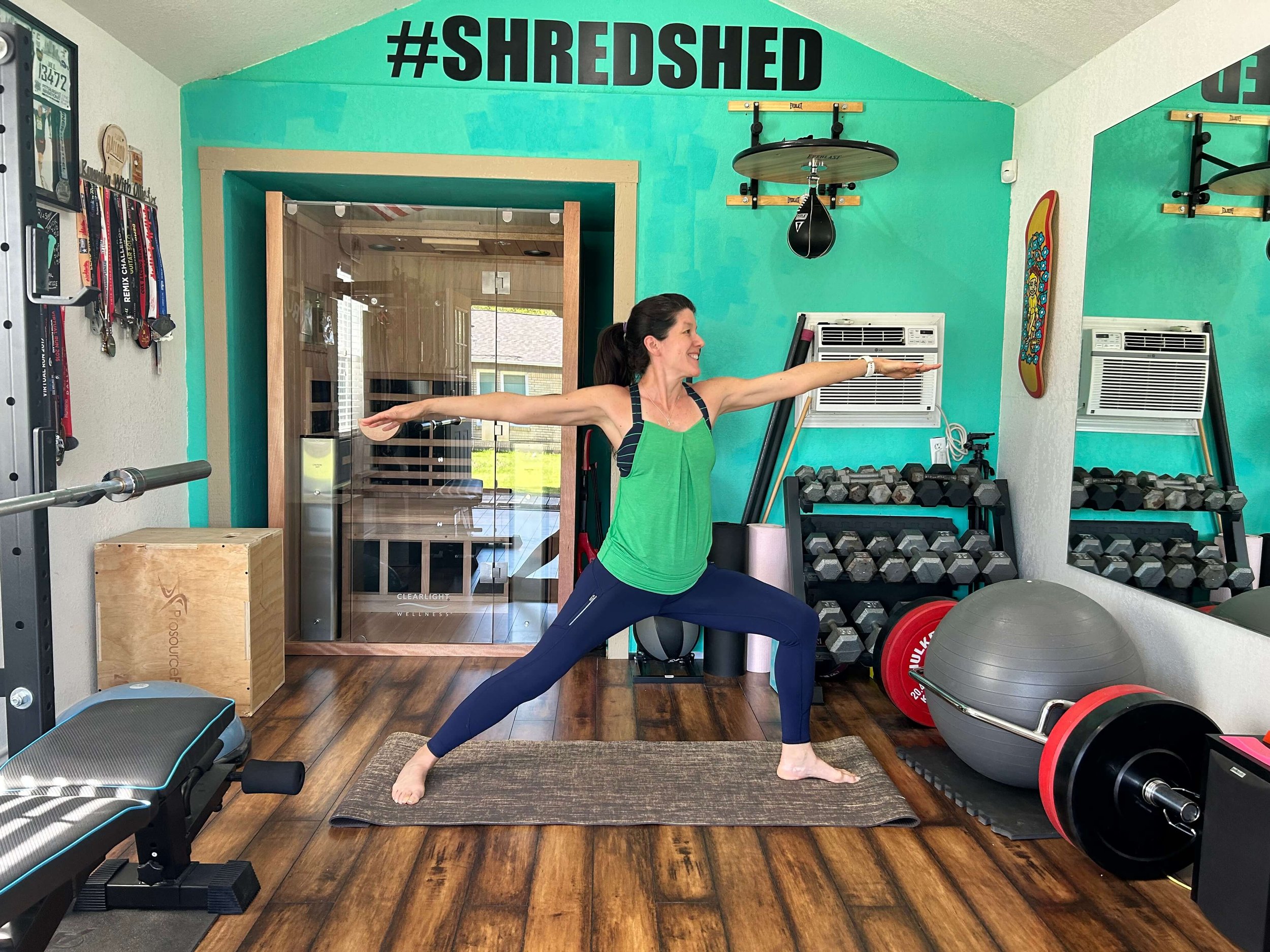
Stability ball training in the Shredshed

Stability ball training in the Shredshed

If you were to build a house you would start with the foundation. Before you start lifting heavy weights, it is best to build a strong foundation by working on balance and stabilization first. The stability ball will challenge your proprioception and help strengthen your stabilization muscles and joints by providing an unstable (but controllable) base. 

Some of the benefits of balance and stabilization training are enhanced joint stability, increased flexibility, improved posture control, improved balance, stabilization, and coordination.
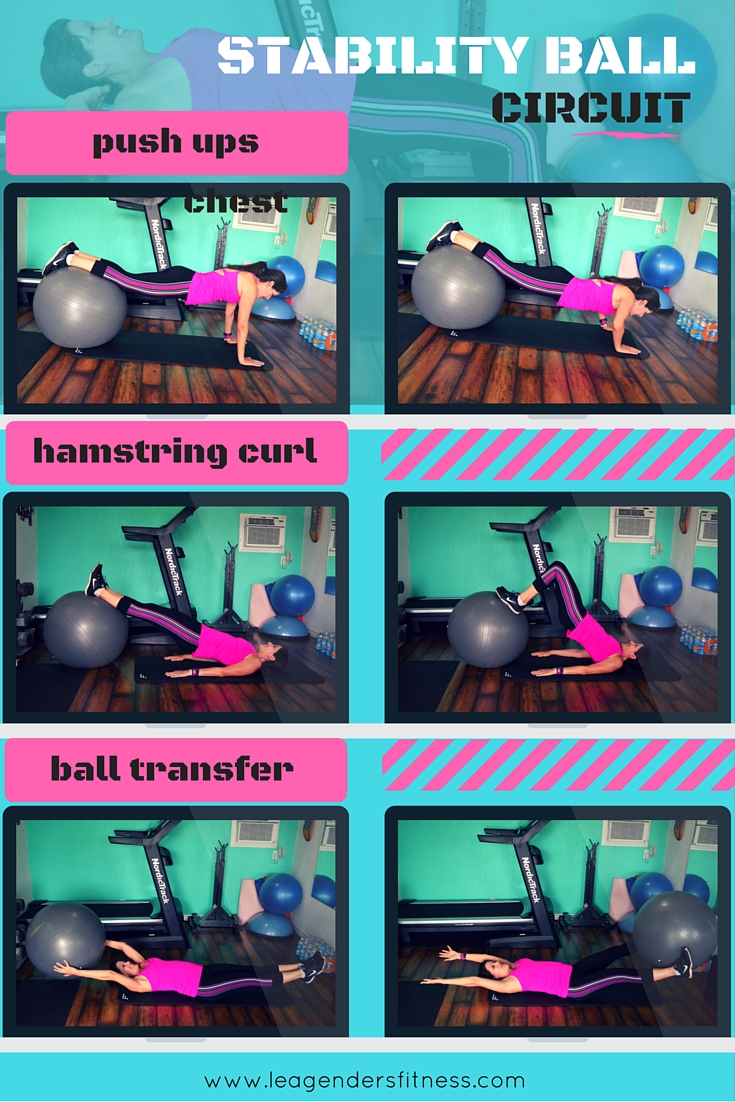
Full body stability ball circuit #1

Full body stability ball circuit #1

Perform each exercise for 12-15 reps before moving on to the next exercise with little or no rest. Repeat the circuit three times, resting for up to one minute between circuits.

Stability Ball Push-ups

Position the stability ball under your thighs and walk your hands out until you come into a high plank position with your shoulders directly over your hands and the ball under your shins. Bend your elbows to lower yourself down to perform a push-up. Repeat for 12-15 repetitions.

Hamstring Curls

Lie on your back and position the stability ball under your calves. Engage your abs and squeeze your glutes as you lift your hips off the ground into the starting position. Bend your knees and lift your hips to curl the ball towards your body using your hamstrings. Straighten your legs back out and repeat 12-15 repetitions without lowering your hips to the ground.

Stability Ball Transfer 

Start by lying on your back with your arms and legs both fully extended hovering off the ground. Place the ball between your feet, extend your arms overhead and slightly raise your shoulders off the mat into a crunch.

Using your lower abs, lift the ball to the center. At the top, pass the ball into your hands. Lower your legs and lower your arms holding the ball overhead, so that the ball hovers over the floor, but doesn't touch. Crunch back up to pass the ball back to the legs to complete one full repetition. Complete 8-12 reps (or as many as you can complete, this is challenging!).

Once you complete three rounds of the first circuit, grab a quick water break and move on to the next circuit.

Stability Ball Circuit #2

Stability Ball Circuit #2

Perform each exercise for 12-15 reps before moving on to the next exercise with little or no rest. Repeat the circuit three times, resting for up to one minute between circuits.

Ball Squats

Place the ball against a wall and position the ball in the small of your back. With your feet slightly wider than hip width, walk your feet forward. Lower yourself into a squat until your thighs are parallel to the floor, or as lower as your flexibility will allow. Be careful not to lean back into the ball, but to use it as a guide to lower yourself. Once in the low position, press through the heels, engage the glutes to push back up to standing. Repeat for 12-15 reps.

Ball Tucks

Position the stability ball under your thighs and walk your hands out until you come into a high plank position with your shoulders directly over your hands and the ball under your shins. Using your lower abs, pull your knees in towards your chest. Extend your legs back straight, engage your core and make sure not to lower the hips between reps. Repeat for 12-15 repetitions.

Ball Crunch

Position the stability ball under the small of your back. Place your hands behind your head (do not pull) and lift your shoulders and chest up into a crunch. Hold for 3 seconds in top position while engaging your entire core. Slowly lower down, slightly extending back over the ball. Repeat for 12-15 repetitions.

It's important to remember that while I am a personal trainer, I am not your personal trainer. Please consult with a medical professional before beginning a new workout program. 

Do you own a stability ball? I'd love if you would give my circuits a try and let me know what you think!

Like this post? Please consider sharing. 


Running A-Z: G is for Gear (What you Need and Don't Need to Get Started Running

Whoever said running is a free sport either isn't an active runner or isn't very good at math. Although it's true that the streets are free to run, you need a certain amount of gear to run safety and comfortably. Then when you start adding up the costs of things like GPS watches and races, running can get downright expensive. Let's break down the list of running gear and expenses and talk about what you need to get started, what you can live without and what is purely a luxury.

Shoes

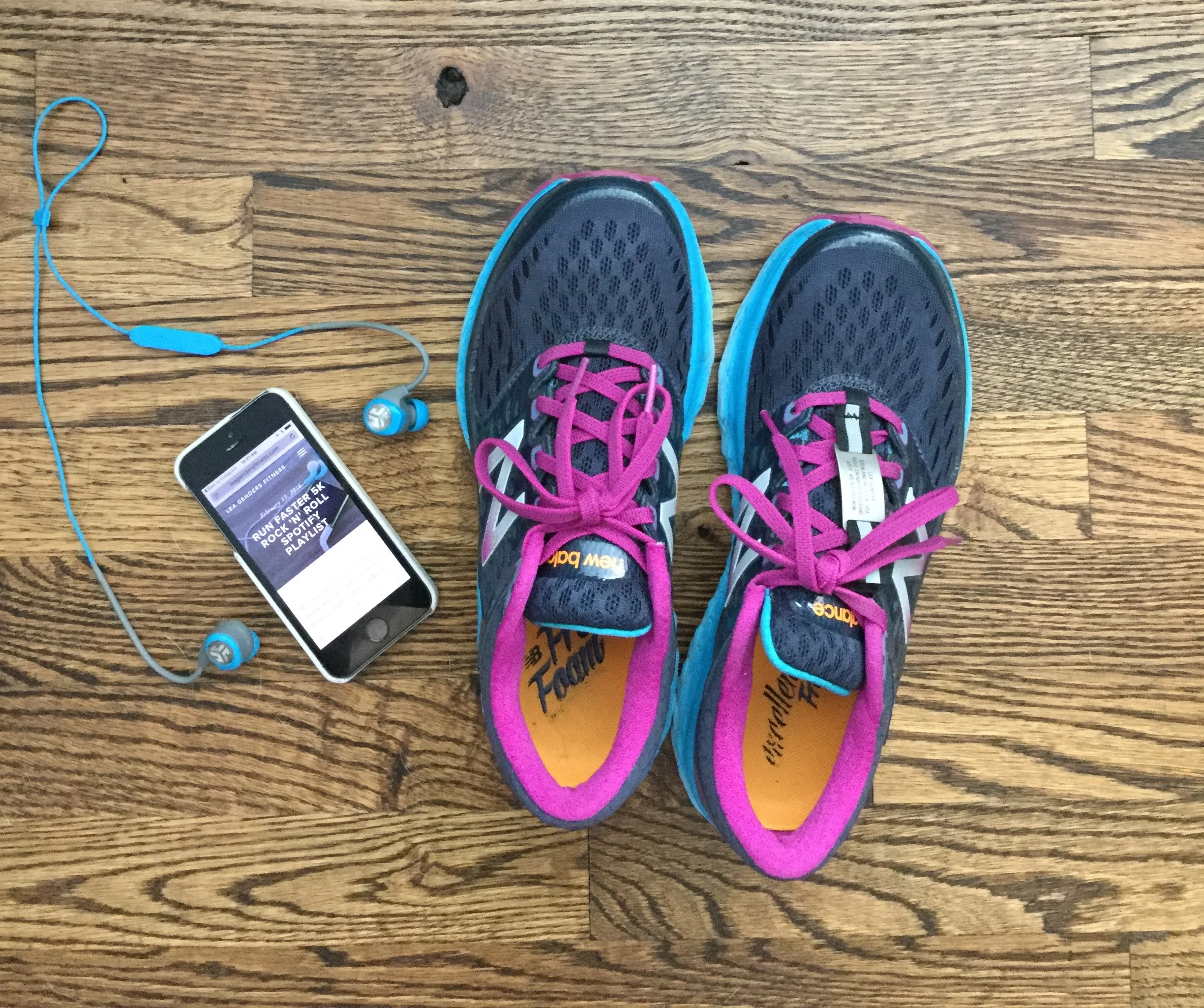
Shoes are the one thing that you can't skimp on when it comes to running. You need to invest in at least one pair of running-specific shoes if you plan on running on a regular basis. These should be shoes that you wear only for running. You shouldn't wear your running shoes to Zumba class or to walk around the mall. Running shoes are for running only.

One reason is that running shoes provide support for motion in the sagittal plane only (that is front to back movement like in running). If you are moving laterally, like you might in a bootcamp class or in Zumba, then these shoes won't provide the support you need for those types of movements. Secondly, running shoes are generally more expensive than cross training shoes and typically last 300-500 miles no matter how you are putting on those miles. So if you are wearing your running shoes as your daily shoes, then you are literally burning money when you burn the rubber off those soles. Use your less expensive gym shoes for your daily comfortable walking-around shoe.

A good pair of running shoes will provide the support you need to run safety and help prevent injury. If you are putting in significant miles each week, like someone who is training for a marathon, I would recommend having two pair of running shoes and rotating the shoes every other run. 

Be sure to watch the tread on the bottom of the shoes and replace as needed, typically every 300-500 miles. 

Apparel

While you don't need to break the bank to buy running apparel, there are few things that you need to look for when purchasing running clothes. Look for clothing made with performance fabrics. Performance fabrics are generally man-made fabrics (polyester blends) that wick moisture away from the body. This means when you sweat, instead of the material absorbing the water and showing embarrassing sweat spots, it pulls the moisture away. This will help you stay cool, dry and comfortable. It doesn't need to be expensive, many discount brands and sporting good stores offer performance fabrics at a reasonable cost.

Avoid cotton shirts, shorts and especially socks. Read the garment's fabric content and choose items without cotton. Cotton socks will absorb your sweat and can cause nasty blisters. Polyester blend fabrics are your best choice for all your running clothing right down to your socks. 

Running Technology

Now that you have your running shoes and you're dressed in your non-cotton apparel, you're ready to run. Except some runners wouldn't dream of leaving the house without their GPS watch, heart rate monitor, MP3 player, wireless headphones, step tracker and cell phone.

There is a relatively new concept called running-naked and don't worry, it is not what it sounds like, I fully recommend that you wear clothes when you run so you avoid arrest. Running naked means running without technology.

GPS WATCH

It can be nice to have a GPS watch to track your mileage, pace and route, but sometimes, especially for new runners, it is best to run by how you feel, rather than trying to keep up with some arbitrary pace on your watch. Your daily pace can be affected by a lot of factors, like how well you slept, how stressed you feel, how well you ate and how recovered you are from your last run. It is not always the best thing to run according to the pace that you think you should be running. It can be better to run by how you feel.

With that being said, I often run with my GPS watch, but it purely an optional luxury. I leave it at home when I need to get out and just run for pleasure.

Heart-rate monitor

A heart-rate monitor can be very helpful to determine effort because your heart rate gives you an accurate indicator of how hard you're working. Most GPS watches these days come with a wrist-based heart-rate monitor (no chest strap needed) but because this is relatively new technology, it may not be as accurate as a chest strap. A heart-rate monitor is great for training, but running according to your breath (talk test) and RPE (rate of perceived exertion) can be all you need. 


MP3 player

I avoid listening to music and wearing headphones when running on the street for safety reasons. It is important that you can hear the cars and are aware of your surroundings. I wear my headphones when I run at the track or on the treadmill. Music can be a great motivator for running. Sometimes an uptempo song can help increase your pace because you naturally speed up to match the beat of the song. Just be aware when on a long run or when trying to pace yourself, music can sometimes cause you to speed up when you should be keeping a particular pace. Music is great, just be aware how it is affecting your pace. 


Cell Phone

You already own a cell-phone. I recommend you carry it on every run outdoors in case of emergency or burning desire to order a pizza on your long run.

Running Accessories

The list of possible running accessories goes on and on. I like to carry a running belt for my keys and cell phone when I run on the street or at a race. They are relatively inexpensive and eases the hassle of carrying your small personal items items with you when you run. 

Once you have the basics of shoes and clothes covered, you're be all set to start running. But I have a feeling once you've been bitten by the running bug, you will rationalize spending every free dollar on running gear, accessories and races. 

What are your running gear essentials? Did I miss anything?

Like this post? Please consider sharing.


Workout Wednesday: Speed and Strength Track Workout for Runners

As a running coach and a personal trainer I understand that it can be challenging for runners to find the time to do their (needed!) strength training. You want to run more in order to improve in running. You're afraid if you do lower body strength training that you'll be sore and it will hurt your future runs. Not to mention, when do you find the time to squeeze it all in?

I developed this track speed and strength interval workout so that you can do your running workout and leg strength workout on the same day! It should about an hour to complete and you'll be stronger for it. It may make you temporarily sore, especially if you are not used to strength training, but in the long run you'll be stronger, faster and less prone to injury. What's not to love about that? 

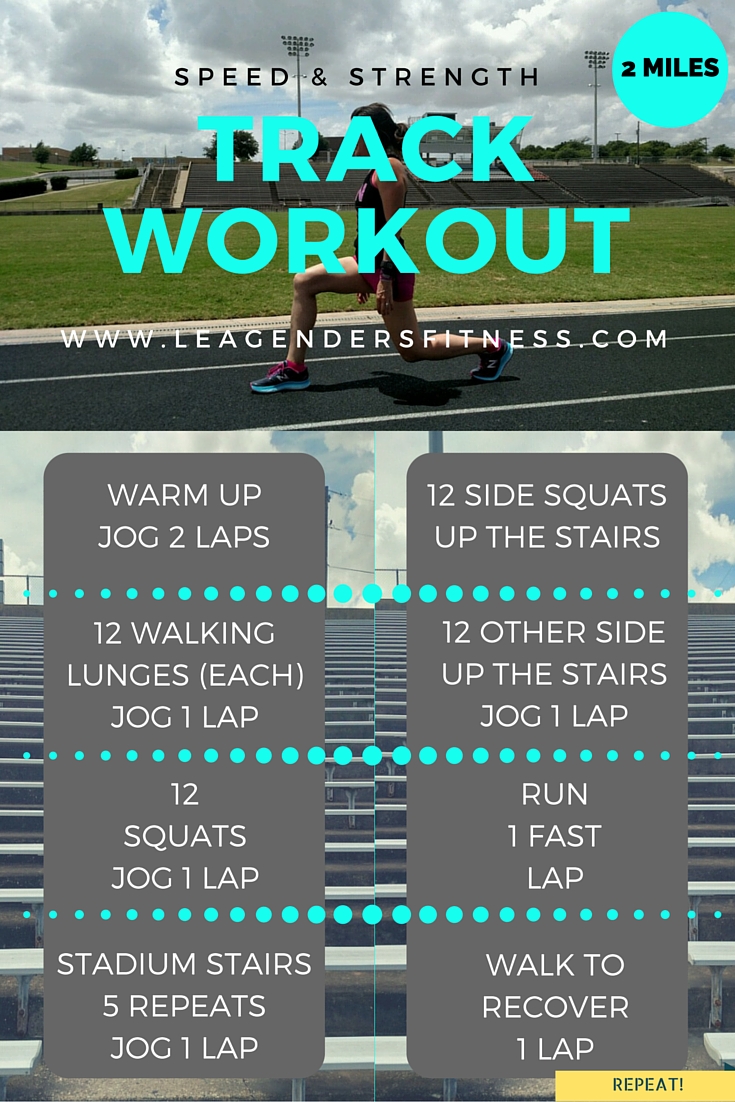
Speed and Strength Track Workout

Warm up by jogging two times around the track, which is 800 meters or a 1/2 mile. 

WALKING LUNGES

Perform 12 walking lunges on each leg on the straight of the track. Be sure if there are other people or runners on the track that you yield to them and always stay on the farthest inside lane (aka out of the way). Once you complete 12 walking lunges on each leg jog the rest of the way around the track at a conversational pace. 

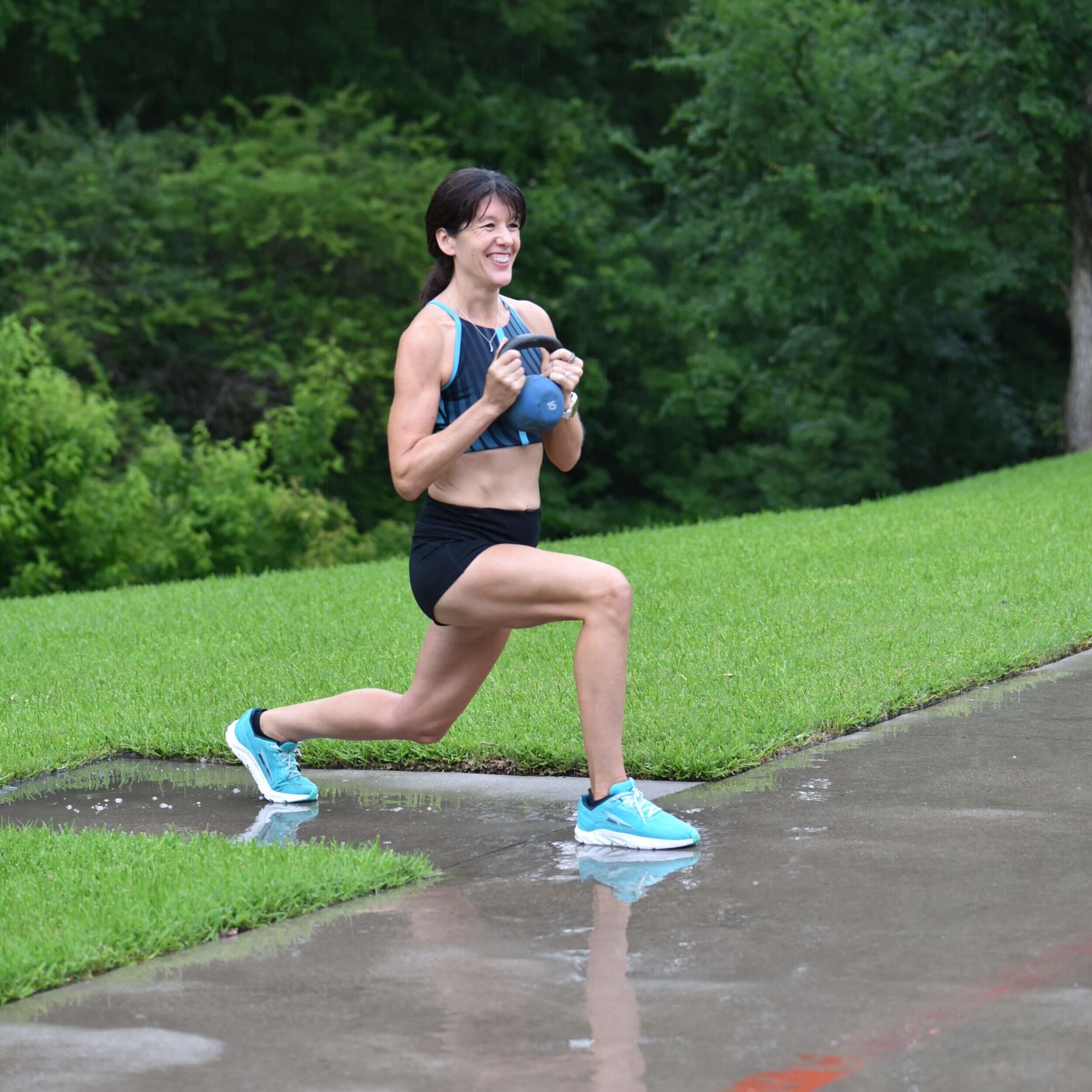
With your feet hip width apart and your toes pointed straight ahead, hold your core stable and your back straight. Take one large step to lunge forward until your front knee is lined up over your ankle and your back knee is nearly touching the track. Do not allow your knee to go forward past your toes. Once you are in the lunge position push back up to standing with your back leg. Repeat with other leg. While in the low position resist the urge to lean forward or rest your arms on your thighs.

SQUATS

Perform 12 squats and then jog the rest of the way around the track at a conversational pace.

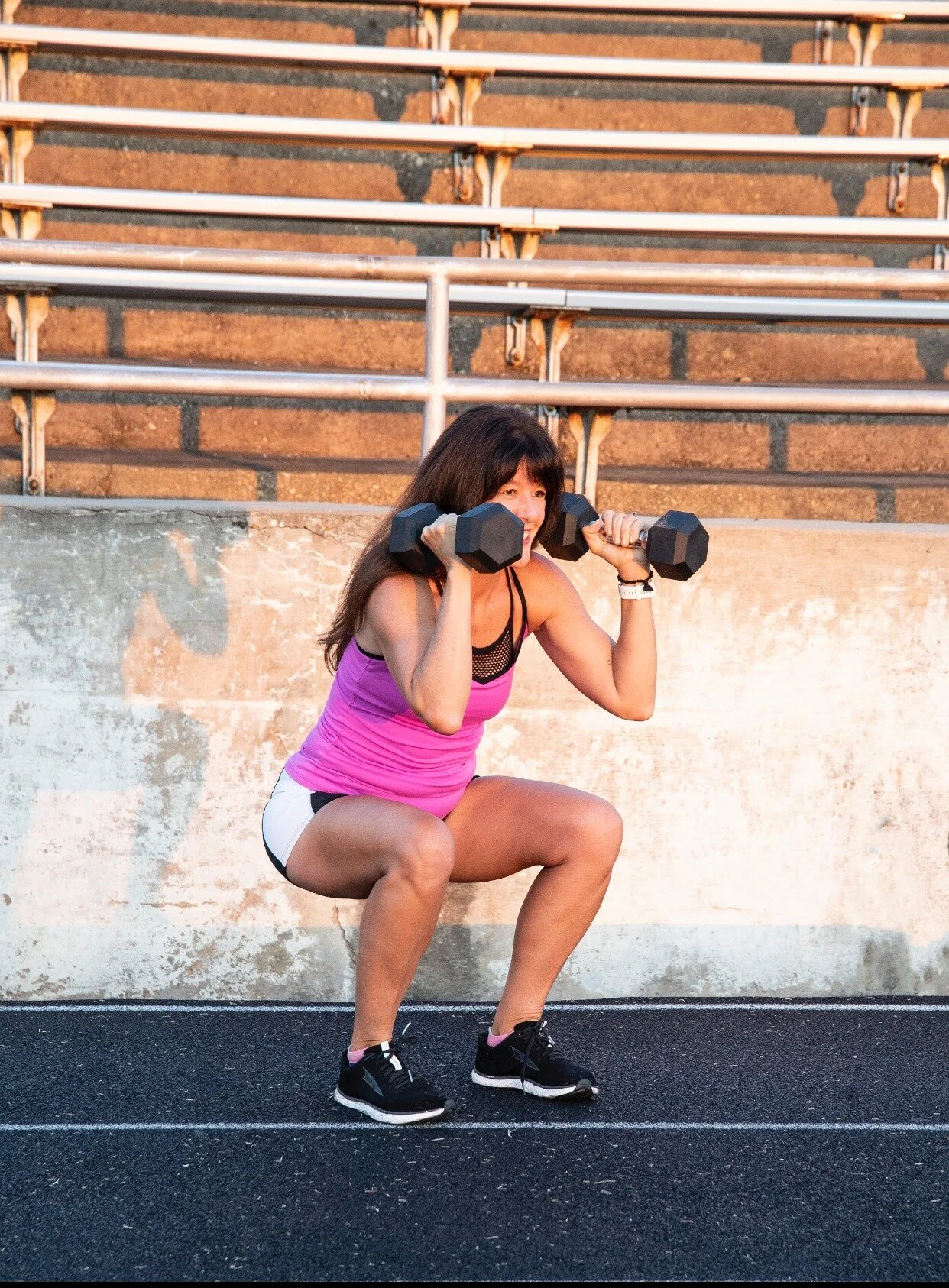
Starting with your feet hip width apart push your hips back and then lower  your body by bending your knees until your thighs are parallel to the floor or as low as your flexibility will allow. In the low position, engage your core, squeeze your glutes and push up to standing. 

STAIR REPEATS

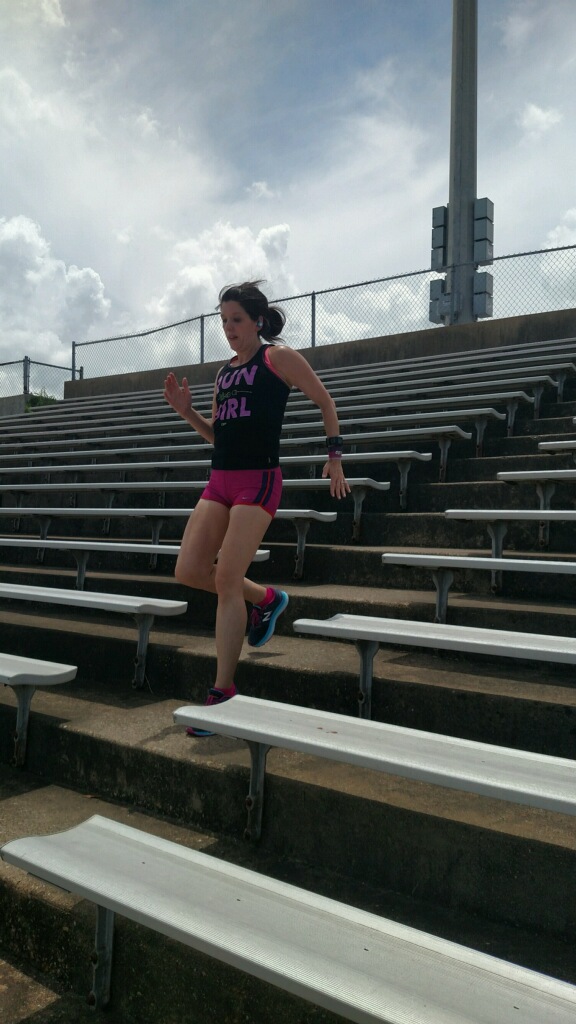
Run up and jog or walk down the stadium stairs. Run up the stairs as quickly as you can, swinging your arms as you go. Repeat five times, then jog one time around the track. 

SIDE SQUAT UP STAIRS

Side squat up 12-15 steps. Face the other direction to work the other leg and side squat 12-15 steps. Jog or walk back down the stairs and jog one time around the track.

Stand sideways on the bottom step. With your back straight, push your hips back and bend your knees to lower into a squat position. Using your leading leg, step up to the next highest stair. Follow with your back leg. Try to stay in the low position as you work up in 12-15 steps. 

Face the other direction to work the other leg and repeat on other side for 12-15 steps.

RUN!

Run fast for one lap around the track. You should be working hard and breathing heavily for this lap. You get to rest after this, so give it all you have!

Walk one lap around the track to recover.

That's 1.25 miles work + your warm up and cool down = 2 miles. Beginners, you're done! Good job. 

Intermediate to advanced runners: Rest and repeat 1 or two more times or until an hour is up.

It is important to remember that while I am running coach and personal trainer, I am not your running coach and personal trainer. Please speak to your doctor before beginning any new exercise program and/or work with a fitness professional who knows your unique abilities and goals. 

I'd love if you would give this speed and strength track workout a try and let me know what you think!

Like this post? Please consider sharing.
Running A-Z: F is for Fartlek (Train to Run Faster with Fartleks)

I am having a great time with this new running A-Z blog series. Every week I cover a new running-related topic following the order of the alphabet. I am wide-open for future topic suggestions. Let me know in the comments. This week we are on the letter F. F is for fartlek! 

Fart what? Yes. Fartlek. After all these years of running it may still make me giggle like a 12 year old girl, but fartleks are an effective, fun way to train to run faster.

Fartleks are a form of interval training. You practice periods of fast running without specific speed or distance goals, followed by rest intervals based on feel. It is a go-as-you-please interval plan that can be fun and challenging for new and experienced runners alike! 

Fartlek is a Swedish word that means speed play. Ollie, my dog, describes it best. 

I run faster to chase a squirrel and slow down to sniff a tree. I think you runner humans call that Fartlek, I call it life.
— Ollie

Have you ever picked up a running magazine and felt confused by the running plans? The article might recommend to run half marathon pace for 800 meters, or 10K pace for 400 meter repeats, or 5K pace for 400 meters divide by four and subtract 10 seconds. Huh? If your head is spinning because you can't calculate math in your head, (or particularly well with a calculator, like me) or you don't have a track nearby, then fartlek might be the interval training plan for you. 

The great thing about fartleks is that you don't need any special equipment, a GPS watch, a track or a treadmill. You run entirely by feel. A heart rate monitor can be helpful to monitor effort, but not necessary. 

Warm Up

Warm up between five and 10 minute by walking or jogging at conversational pace. You should be able to hold a conversation at this pace without stopping for deep breaths between words or sentences. Breathing should be very easy.

Speed Interval

After you are warmed up, it is time to start your first fartlek interval. Choose a spot ahead in the distance, maybe a parked car, a telephone pole or a stop sign. You choose the distance. Pick up your pace so you are running faster with a rate of perceived (RPE) exertion between a 7-9 until you reach your destination.

RPE is a great way to calculate effort if you don't have a heart rate monitor. Use this chart to help determine RPE.

RPE is a great way to calculate effort if you don't have a heart rate monitor. Use this chart to help determine RPE.

Recovery Interval

Slow to a jog (or walk, if necessary) to return to conversational pace. This interval takes as long or as little time as needed for you to recover from your speed interval. The key here is to be honest with yourself. Don't start running until you are breathing normally again, and (important!) don't jog or walk any longer than you need to in order to recover. As soon as you are recovered, prepare for your next speed interval. 

Recovery time can vary from workout to workout, day to day based on a variety of factors: the weather, how well you ate (fueled), how well you slept, how recovered you are from your last workout. 

Your workout may look like this: Warm up. Run fast to the top of a hill, recover as you jog down the other side of the hill, run to the park bench, then run faster until you reach the white minivan in distance. Recover as needed then run fast to the next stop light. 

Continue for 25-45 minutes depending on your running experience. 

Fitting it all in

Effort sessions should be limited to two times a week for beginners and no more than four times a week for advanced runners. Any type of speed work, tough strength training workouts, hill repeats or long runs are considered effort sessions. Your body needs time to repair and recover after a hard workout, so allowing rest periods and recovery workouts in between tough sessions will allow you to come back stronger for your next one. 

I recommend a fartlek session once a week for speed training. It is a fun and effective way build speed work into your running and strength training routine without too much pressure!

Have fun with it. 

Like this post? Please consider sharing

Any questions? Have you ever trained to run faster with fartleks? Hit me with your favorite fartlek joke. Let me know in the comments.

Coach Lea