What Should I Do First: Strength Training or Running?

What Should I do First? Strength Training or Running? 

First of all, congratulations for incorporating both running and strength training into your weekly routine. As a running coach and a personal trainer, I believe the strongest runners are the ones who make time for strength training.

What comes first? Running or Strength Training?

What comes first? Running or Strength Training?

I understand that it can be tricky fitting it all in, it is something I have to work at in my own training. I want to put in enough miles to stay consistent and improve in my running, but I also want to make sure I am doing at least the basic strength, balance and stability exercises to stay strong and healthy. Not to mention I still need build scheduled rest days into my weekly training schedule. How do I make it all fit?

One great way to do this is to perform some strength training moves on the same day as you run. Then the question arises, what should you do first, run or strength train? You should do whatever one is most important to you. Think about your goals and which activity will bring you closer to achieving your goals.

If your main goal is to run a marathon, then running should come first, since running is your primary goal. You could then choose to do some strengthening moves after you run and allow for a full rest day after this hard workout. Remember that rest is essential in order to improve.

If your main goal is to build strength, then strength training should come before you run. You will have the most energy for the activity you choose to do first, so it should be the most important to you based on your goals. 

If your main goal is fat loss, I think that both running and strength training are equally important. Cardio exercises that gets your heart rate up (like running) will help you lose fat, but you want to make sure you are not also losing muscle, so strength training is important. I usually recommend to my fat loss clients that they do their cardio work first, so they have the energy to raise the intensity enough for fat loss. 

If I am training for a race then running will be my priority, but in my off-season (aka hot summers), strength training takes the front seat. There is no right or wrong answer. It's up to you to decide what is best for you, based on your current goals. 

What do you do first? Running or strength training? 

Coach Lea

Like this post? Please consider sharing.


WORKOUT WEDNESDAY: FOUR MINUTE SQUAT CHALLENGE

I love quick and effective workouts. Not every workout that you do has to be an intense hour-long session. It took me a long time to break out of the all-or-nothing mindset. I used to think if I didn't have the time for a full-blown workout, I wouldn't bother with one at all. The truth is that a 15 minute workout that you actually do is always 100% better than the hour workout you didn't do. 

Today's squat challenge explores eight different squat variations. It is a fun way to get in a lower body workout and possibly try some new moves. If you are a runner, this is great workout to do after you finish your run to squeeze in some quick strength training. 

Can you find four minutes in your day for this fun squat challenge? You will perform this squat circuit Tabata-style, which means you will do work for 20 seconds, then rest for 10 seconds for four minutes. If you want to make it more challenging, rest for one minute after each four minute circuit and repeat until your Glutes are on fire!

This circuit incorporates eight squat variations. 

1. Traditional Chair Squat

Push your hips back and lower until your thighs are parallel to the floor (like you are sitting back in a chair) or as low as your flexibility allows. In the low position, engage your core, squeeze your glutes and push up to standing in an explosive movement. Return to center, pushing hips back and repeat for 20 seconds. Take a deep breath in as your lower to the squat and breathe out as you return to standing. Rest for 10 seconds before moving on to the next exercise.

2. Wall Squat

Stand against a wall and lower your body to a squat position so that your thighs are parallel to the floor. Keep your back straight, your core engaged and your arms pressed into the wall. Do not rest your hands on your knees or lean forward. Hold in an isometric low position for 20 seconds. Rest for 10 seconds before moving on to the next exercise.

3. Curtsey Squat (Right Side)

Stand with your feet shoulder-width apart, hands on hips. Cross right leg behind the body and to the left. Bend left knee 90 degrees, or as low your flexibility will allow, toes pointing forward, then return to starting position. Repeat for 20 seconds on one side. Rest for 10 seconds before moving on to the next exercise.

4. Curtsey Squat (Left Side)

Stand with your feet shoulder-width apart, hands on hips. Cross left leg behind the body and to the right. Bend right knee 90 degrees, or as low your flexibility will allow, toes pointing forward, then return to starting position. Repeat for 20 seconds on one side. Rest for 10 seconds before moving on to the next exercise.

5. Lateral Squat (Right Side)

While facing forward, with toes pointing straight ahead, take a wide step out to your right side. With your hips back, bend your right knee, while straightening your left leg. With your back straight, hing at your hips to touch the floor with both hands on either side of your foot. Do not allow your knee to move forward beyond your toe. Be sure to keep your torso and both feet facing forward. Repeat for 20 seconds. Rest for 10 seconds before moving on to the next exercise.

6. Lateral Squat (Left Side)

While facing forward, with toes pointing straight ahead, take a wide step out to your left side. With your hips back, bend your left knee, while straightening your right leg. With your back straight, hing at your hips to touch the floor with both hands on either side of your foot. Do not allow your knee to move forward beyond your toes. Be sure to keep your torso and both feet facing forward. Repeat for 20 seconds. Rest for 10 seconds before moving on to the next exercise.

7. Sumo Squat

With your legs in a wide stance and toes pointing out, push your hips back and lower yourself into a sumo squat. Do not allow your toes to move beyond your toes. Repeat for 20 seconds. Rest for 10 seconds before moving on to the next exercise.

8. Sumo Squat (Pulse)

With your legs in a wide stance and toes pointing out, push your hips back and lower yourself into a sumo squat. Do not allow your toes to move beyond your toes. Stay in the low position and pulse the reps without returning to standing for 20 seconds. Rest for one minute before repeating the circuit.

Give it a shot and let me know how you feel!

Like this post? Please consider sharing.


Coach Lea


Running A-Z: E is for Endurance, How to Build Running Endurance

Welcome to the latest installment of Running A-Z where I cover a running related topic following the order of the alphabet. This week we are talking about how to build running endurance without risking injury. 

If you are a distance runner or want to be, you should be focusing on building your cardiovascular endurance. Running endurance is how long you can run. A new runner may be looking to build their endurance so they can run a 5K without stopping and a more experienced runner may want to run a full marathon. These are both great goals that require the same process. 

Gradual Adaption

The safest way to build endurance is through gradual adaptation. This means that you must not rush the process. It takes time, consistency and patience to build endurance without risking injury. If you are new to running this process will take longer than someone who already has an established running base. Be patient.

Rules of Running Endurance 101

Never increase intensity (speed) and volume (milage) in the same week. This means if you are doing speed work to increase your pace, your overall mileage for the week should remain the same that week. On weeks where you increase your milage do not also increase the intensity of your workouts. 

Increase milage by approximately 10% per week. Every 4th week, drop the milage to allow your body a chance to recover. 

All endurance training running should be done at a conversational (slow) pace. This means you should be able to have a conversation with your coach or running partner for the duration of the workout. If you are breathing heavily, you should slow down (to a walk if necessary). Once you build endurance for a particular distance, you can then work on speed to cover that distance faster. 

Rest days and easy mileage weeks are essential to successful endurance training. Overtraining will lead to injuries and depleted energy. It may be tempting to push harder and run longer in hopes of achieving faster results, but this will often backfire. It is during the recovery periods that your body adapts and grows stronger. Always allow rest days in between effort session (fast or long runs) for proper recovery. 

Aim for 7-8 hours of sleep a night. If you are going to bed at midnight and getting up a 5am for your training run, you are not doing your body any favors. Sleep is mandatory for a recovery.

See my post on nutrition for runners for more tips on how to effectively fuel for running.

Are you working on your cardiovascular endurance? How can I help? 

Coach Lea

like this post? Please consider sharing.


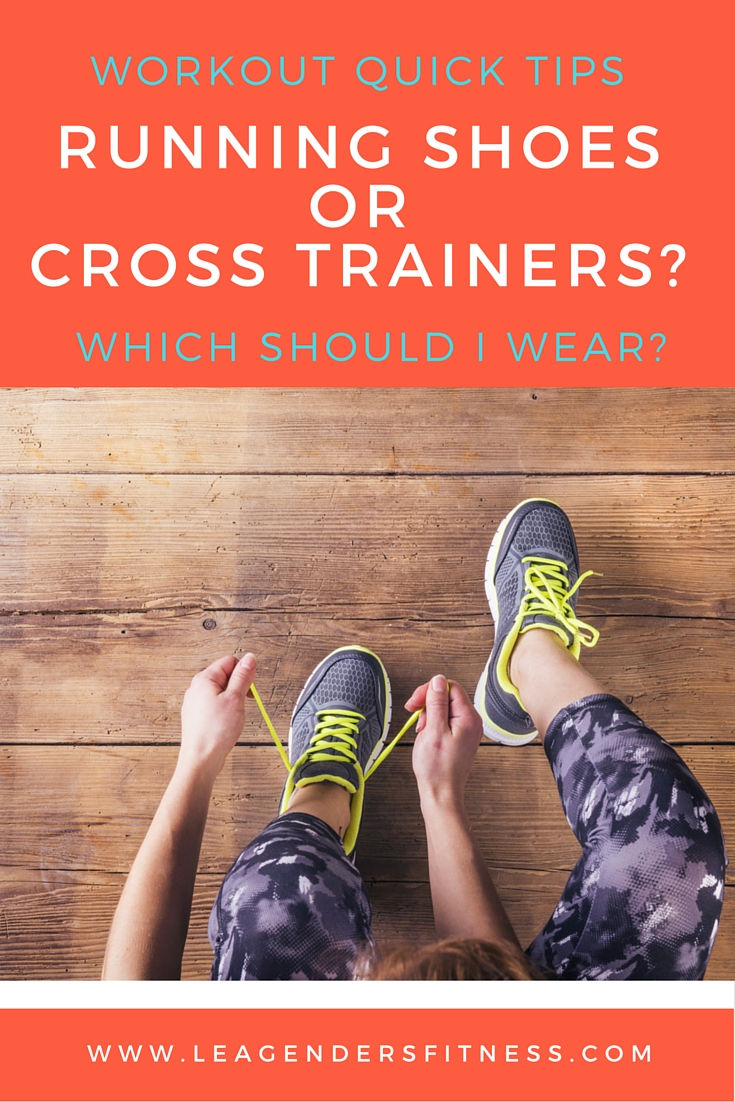
Quick Tip Friday: Running Shoes or Cross Trainers?

Can I run in my cross training shoes? Can I cross train in my running shoes?

Running shoes vs. trainers

If you are not putting in a ton of running miles each week, you can run light miles in your trainers, but you shouldn't cross train in your running shoes! Running shoes provide support for forward and back movement, not lateral (side to side) moves.

You need trainers for your gym classes (think boot camps, Zumba, cardio classes, etc.) or at home workout videos. If you run a moderate amount, you should have running shoes for running and trainers for everything else. Running shoes are generally more expensive than trainers, so if you cross train in your running shoes you are burning money and risking possible injury. Any questions? Ask in the comments.

Like this post? Please consider sharing!


Coach Lea

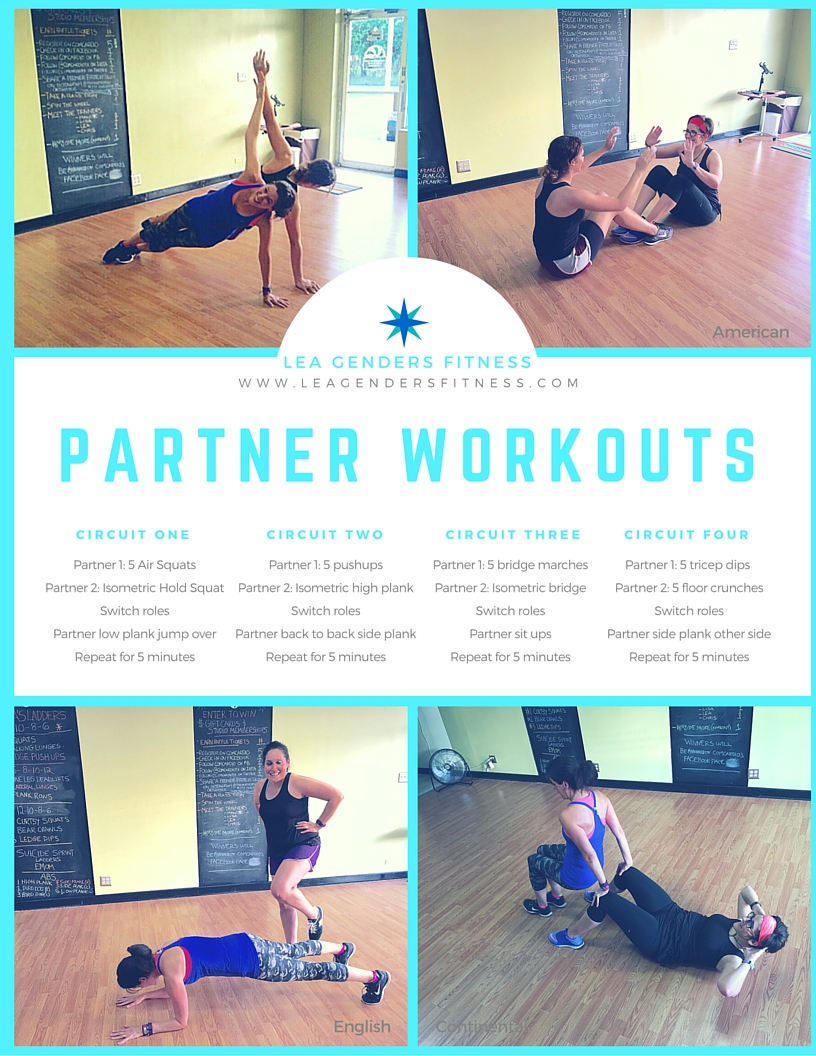
Workout Wednesday: Awesome Partner Workouts

Friends can be a great motivator to exercise. It is true that sometimes we feel more obligated to our friends and family than we do to ourselves. We may not think twice about cancelling on ourselves for our daily workout, but if we know we have someone counting on us we are more likely to show up so we don't let them down. 

I developed this fun partner workout for my boot camp. When we work together to achieve our goals, we may push ourselves harder, have some friendly competition, have more laughs and often can enjoy it all a little more. 

If you have a friend that is your workout buddy, your running partner or your accountability mate consider yourself fortunate. A good friend can be a major motivator in your healthy lifestyle. 

Partner Workout

Partner Workout

In our camp, we worked through five circuits. Each circuit had three exercises, five reps each, that our partners worked together to complete as many times as possible in five minutes. 

Circuit One

Partner one: 5 air squats

Partner two: Isometric low squat hold for the duration of the partner's reps.

Switch roles.

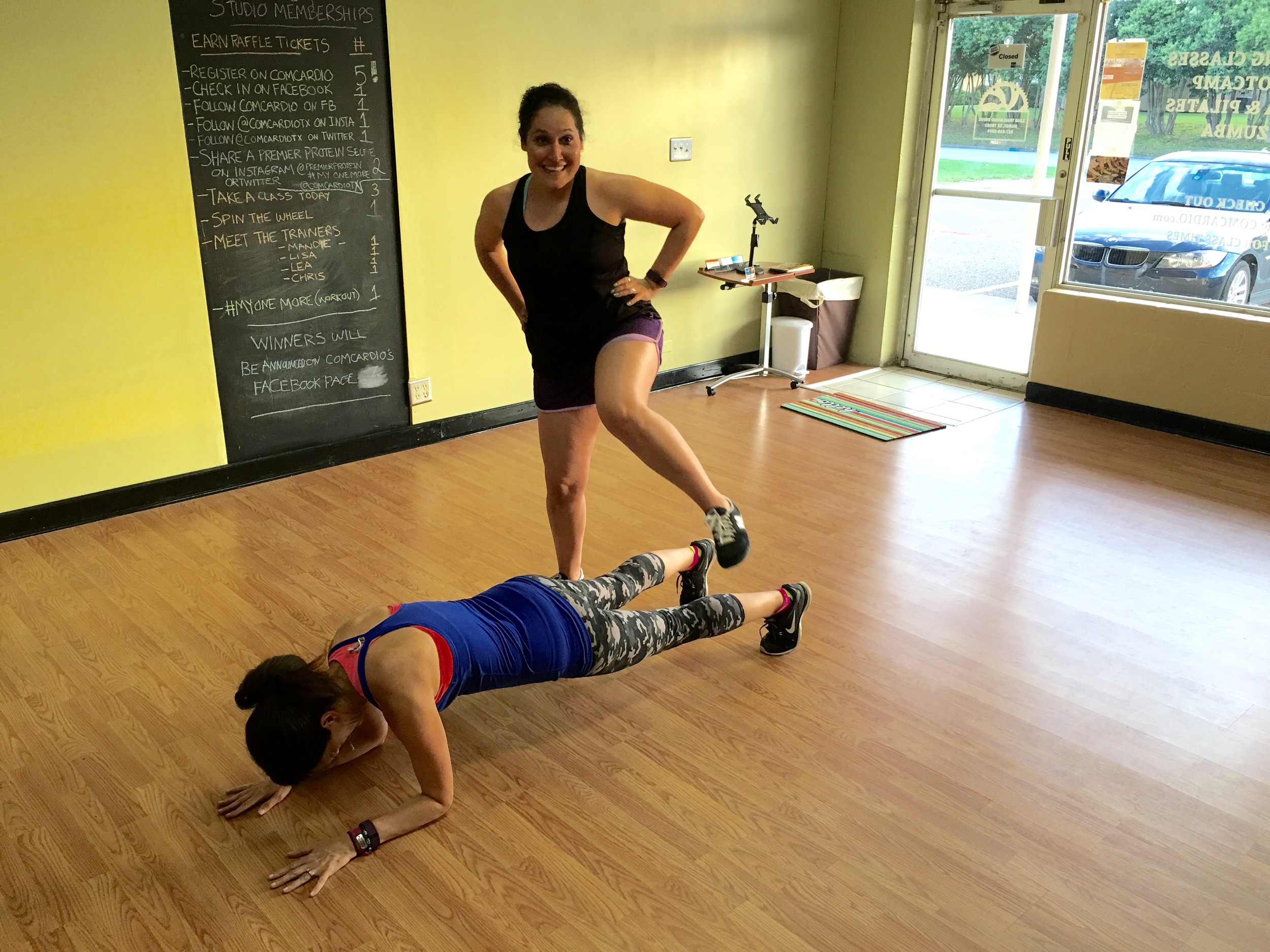
Partner exercise: Low plank jump over. One partner holds a low plank and the second partner jumps or steps over their partners ankles five times before they switch positions.

Repeat circuit for five minutes

partner exercise: low plank jump over

partner exercise: low plank jump over

Circuit Two

Partner one: 5 push ups

Partner two: Isometric high plank hold for the duration of the partner's reps.

Partners switch roles

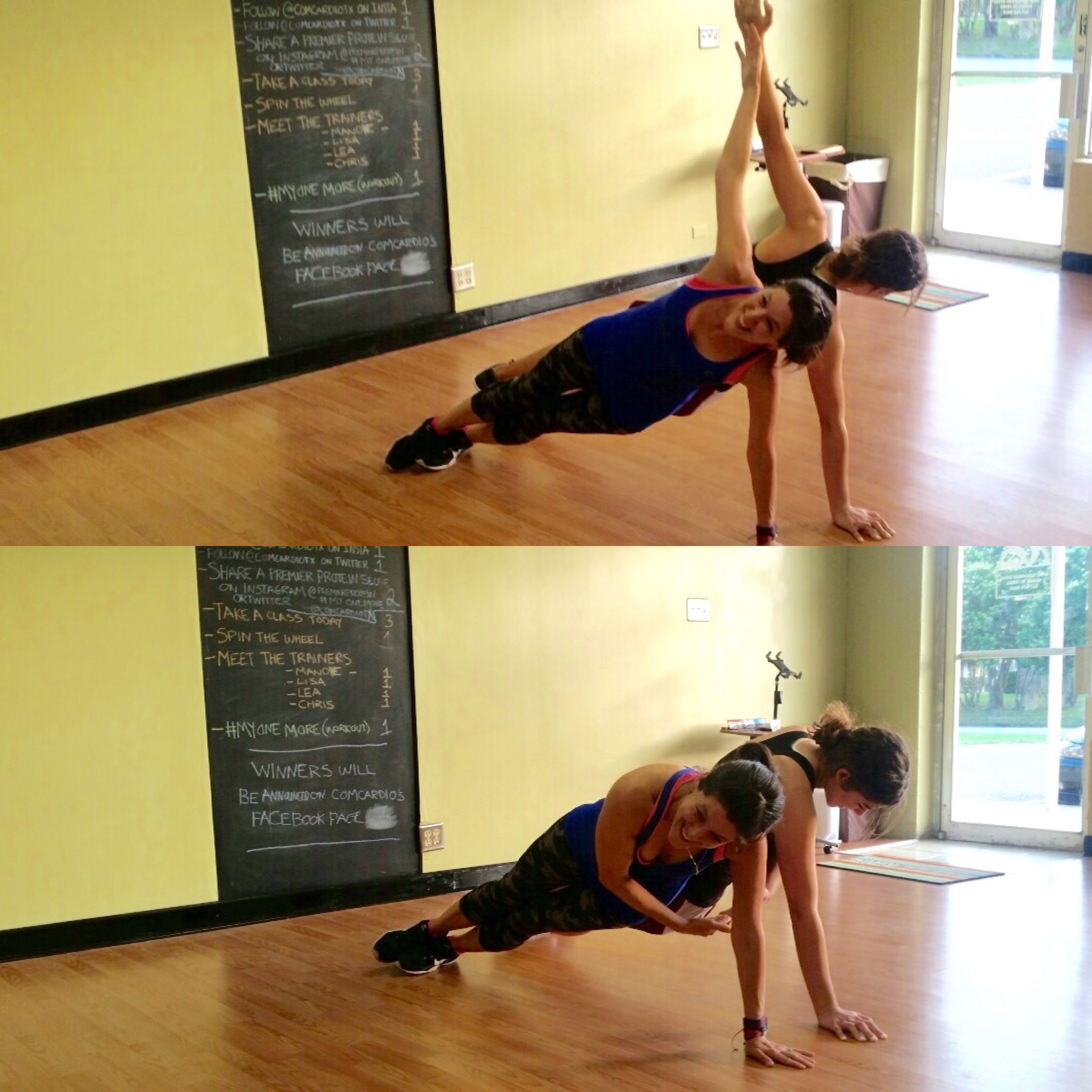
Partner exercise: Back to Back side plank with twist. Partners perform a straight arm side plank so they are back to back. With one arm straight in air, touch hands in the high position, then reach below to touch hands under the plank. Repeat five times.

Repeat circuit for five minutes.

Partner exercise: Back to back side plank with twist

Partner exercise: Back to back side plank with twist

Circuit Three:

Partner one: 5 reps (each leg) bridge march

Partner two: Isometric bridge hold in high position for the duration of the partner's reps

Partners switch roles

Partner exercise: Partner assisted sit ups. Partners sit facing each other and lock ankles. Sit up towards your partner and  hi-five in the high position. Repeat five times.

Repeat circuit for five minutes

Partner exercise: Sit ups

Partner exercise: Sit ups

Circuit Four:

Partner one: 5 reps of static lunge right leg

Partner two: Isometric hold of low right leg lunge position for the duration of the partner's reps

Partner one: 5 reps of static lunge left leg

Partner two: Isometric hold of low left leg lunge position

Partners switch roles

Partner exercise: High Plank hi five. Face your partner in a high plank position. Make sure your wrists are directly below your shoulders and your body is in a straight line from your shoulders to your toes.

Partner exercise: High plank high five

Partner exercise: High plank high five

Repeat circuit for five minutes.

Circuit Five:

Partner one: 5 triceps dips on partners knees 

Partner two: 5 floor floor crunches

Partner exercise: Crunches, tricep dips

Partner exercise: Crunches, tricep dips

Partners switch roles

Partner exercise: Back to Back side plank, switch sides from earlier circuit. Partners perform a straight arm side plank so they are back to back. With one arm straight in air, touch hands in the high position, then reach below to touch hands under the plank. Repeat five times.

Partner exercise: Back to back high plank (other side)

Partner exercise: Back to back high plank (other side)

Repeat circuit for five minutes.

Recruit a friend and give it a shot! Let me know what you think!

Coach Lea

Like this post? Please consider sharing.