RUNNING

10 GIFT IDEAS EVERY RUNNER WILL LOVE

I don't mean to freak you out or anything but there are only 45 days left until Christmas! Where the heck did this year go? It was January, I blinked and now we are 45 days away from Christmas! It's time to start making our lists and checking them twice. 

If you love a runner or if you are a runner, I put together a list of holiday gift items that any runner will love. This also may be a thinly veiled personal wish list (hint hint friends and family).

This post contains affiliate links. That means if you click on a link in this post and make a purchase, I make a small percentage of the sale with no additional cost to you. No one is getting rich here, it just helps with the running (pun intended) of this blog. Thanks, as always, for your support. 

10 Gift Ideas Every Runner Will Love. Save to Pinterest

10 Gift Ideas Every Runner Will Love. Save to Pinterest

FLIPBELT ZIPPER

Runners need a place to stash their keys, ID and phone (and food) when out for a run. A FlipBelt is a sleek alternative to a fanny pack. It's big enough to hold an iPhone, it doesn't bounce when you run and all your belongings are safely zipped away. If you don't buy this for your favorite runner and they lose their keys on a run, it's kinda your fault. Live with that guilt.

COMPRESSION SOCKS

Some runners wear compression socks for recovery after a long and tough race and some runners wear them as a fashion statement. If you're thinking that you're pretty sure the runners you know already have a pair of compression socks, let me assure you that a runner can never have too many pairs. Choose wild colors for best results. Works well as a lucky charm. You can take credit for their next personal record.


RUNNING CLOTHES

Funny running shirts always go over well with runners. I chose these two since I have another blog about running with my dog. Insert funny running saying on a shirt for a gift that any runner will love.


DAILY RUN CALENDAR

It's the gift that keeps on giving. Give a daily running calendar to keep your runner motivated all year long. 

PONYTAIL HEADBAND

This is literally the best invention ever. We runners don't let pesky things like cold and wind keep us from running. This headband will help your favorite pony-tailed runner brave the cold weather to keep running towards their goals. 
 

RUNNER'S MEASUREMENT WINE GLASS

Wine and running seem to go hand in hand. Your favorite runner will love this wine glass to help them drink in moderation. Hah. 

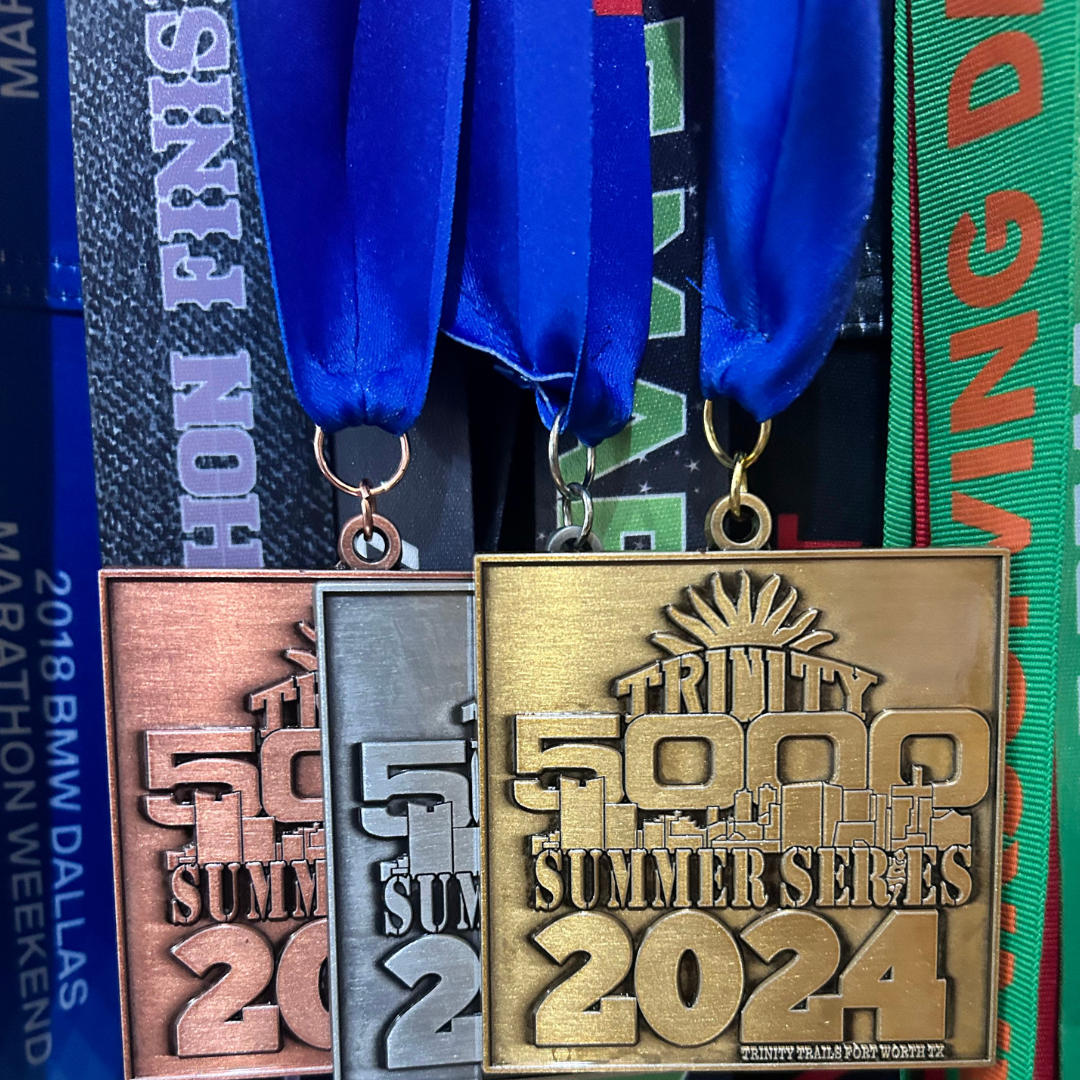
MEDAL AND BIB HOLDER

The only thing a runner loves more than running is talking about running. Let them display their race accomplishments with pride. Then every time you visit they can recount all their race stories mile by mile. Sounds like fun, right? 

RUNNING JOURNAL

If perhaps you have grown tired of hearing your favorite runner talk about running all the time, buy them this training journal so they can write down all their training runs, races, goals and achievements so you don't have to hear about it.

WIRELESS EARBUDS

Any runner would love these JayBird wireless earbuds so they can jam to their favorite running playlist to drown out the chatter of life and maybe their running partner. 

GPS WATCH

The ultimate running gift is a GPS watch so your favorite runner can track every step, mile & pace improvement. They can save their music right to the watch and sync those new wireless headphones for a great running experience. You will win Christmas with this gift. 

Like this post? It helps me when you share with your friends and followers

What's on your Christmas wish list? Did I give you any ideas? Did I miss anything awesome. Are you taking notes? Someone print this for my husband. 

Lea signature.jpg

Challenging Interval Track Workout to Increase Speed

Welcome to latest edition of workout Wednesday when each week I share a running or strength training for runners workout. This week we are heading out to the track for a challenging but fun interval track workout! Let's go!

IMG_2548.JPG

INTERVAL TRACK WORKOUT

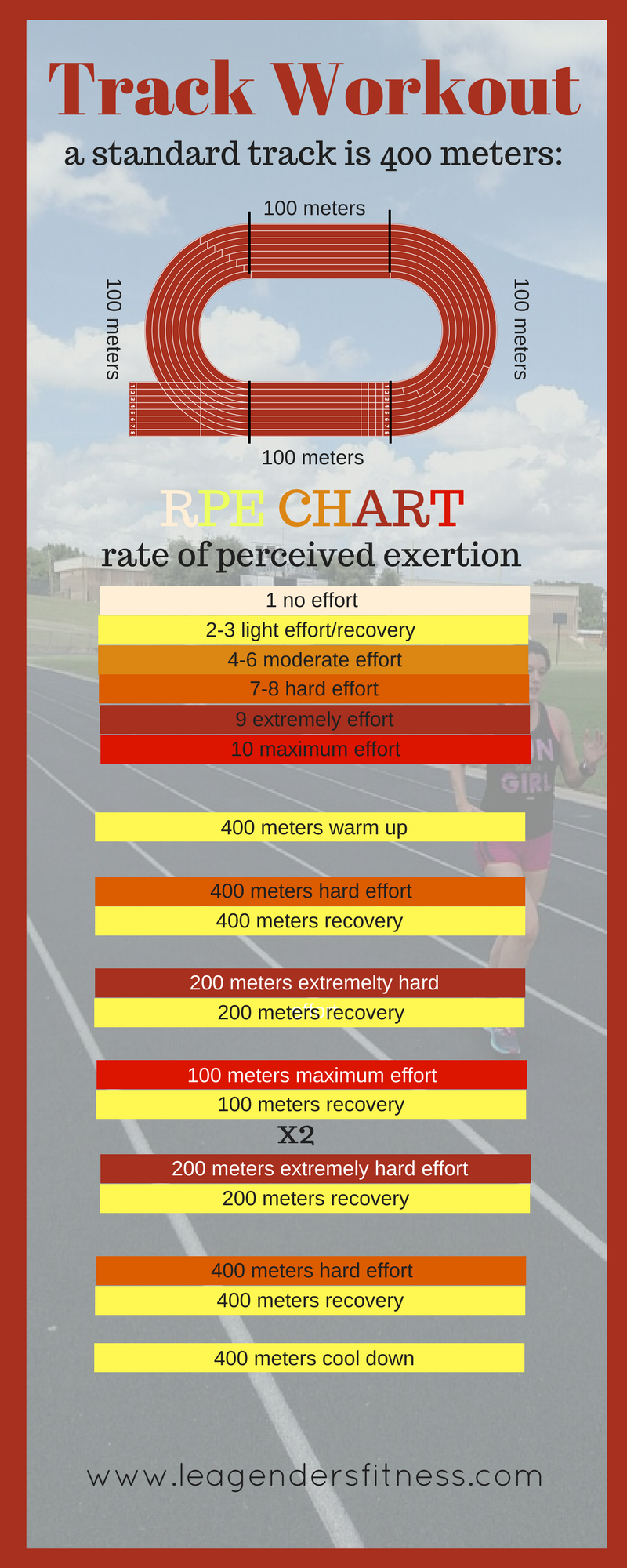
A track is like a highway, the left lane is the fast lane. If you are not running fast, yield to the faster runners and move over to the outside lanes. A standard track is 400 meters or a 1/4 mile from the inside lane. Four times around the track in that lane is one mile. This workout will challenge you through 2.25 miles including a warm up and cool down.

I recommend this dynamic warm up before beginning any running workout. 

track workout (2).png

Use the rate of perceived exertion chart to determine your effort level as you complete the workout. The intensity goes up as the distance of the interval goes down. The shorter the distance, the harder you are working. Recover with a brisk walk or jog for the same distance as the work interval.

400 meters around the track one time with a light jog to get warmed up
400 meters around the track one time with a hard effort, but not so hard you can't maintain it
400 meters around the track one time with a light jog or brisk walk to recover
200 meters halfway around the track at an extremely hard effort
200 meters halfway around the track with a light jog or brisk walk to recover

That's one mile. Congratulations. 

100 meters 1/4 of the track at an all-out effort on the straights
100 meters 1/4 of the track at a walk to recover on the bends
100 meters 1/4 of the track at an all-out effort on the straights
100 meters 1/4 of the track at a walk to recover on the bends

200 meters halfway around the track at an extremely hard effort
200 meters halfway around the track with a light jog or brisk walk to recover
400 meters around the track one time with a hard effort.
400 meters around the track one time with a light jog or brisk walk to recover

Two miles. Done and done. 

Go ahead and take a victory recovery lap. You're done!

Hard workouts like this one should be followed by a day or two of recovery days or easy runs. Never attempt interval workouts on back to back days. Remember that you get stronger and faster during recovery, not during the workout. For maximum results, always allow your body time to recover and rebuild from tough workouts. Most athletes will benefit from just one or two hard effort workouts per week. 

Give it a whirl around the track and let me know how it goes!

Like this post? It helps me when you share with your friends and followers. 

Lea signature.jpg

Run with Purpose to Reach Your Running Goals

I told one of my running coach clients that we were going to build a running plan so that each run had a purpose. My client said, "But Lea, I already have a purpose for every run: not to die." She's funny, isn't she? While that is a noble objective, if you want to reach your running goals, each of your weekly runs should have a specific purpose. Spoiler alert: The purpose of every run is not to run harder and faster. 

Why do we need a purpose for every run? Because if we don't know what we're trying to achieve, we will never get there. if you aimlessly hit the road every other day for the rest of your life, you will probably improve a little in the beginning (the infamous newbie gains) then level off and never quite get anywhere, running the same paces and distances over and over again. 

Let's talk about the purpose of different types of running workouts.

run with purpose to reach goals.png

PURPOSE: TO RUN FASTER

If you want to run faster, it is important to vary your paces. Long and short interval workouts are great for this purpose. Longer intervals (between 3 to 15 minutes or 1/4 to 2 miles) help your body learn to run more efficiently at faster paces. Shorter intervals (30 seconds to 1 minute or 100 -200 meters) helps improve your leg speed. 

Any type of intervals are best for experienced runners who have built a running base of consistent milage for 4-6 weeks. Work at your own fitness levels, do not attempt to hit arbitrary paces from the internet. You will know what 'hard' feels like for you based on how you are breathing and the talk-test. Work at your own level. Coach rant over. 

PURPOSE: TO RUN LONGER

If you are training to run an endurance race, you can start including long runs into your training plan to prepare your body to run long distances. A long run is any run that is one hour and beyond. A long run pace should be a minute or two slower than your 5K pace. You should plan to go slow as you build your endurance. You can work on speed once your body adapts to the longer distances, but to avoid injury, never increase pace (intensity) and distance in the same week. 

I often have to remind myself to go slower in the beginning than I feel I need. You remember that old Beastie Boys song? "Slow and low that is the tempo." Repeat that mantra in your head as you hit the road for your long run. Try to run a negative split, this means that you run the second half of your run faster than the first. Start out slow, if you still feel great at the halfway mark, feel free to pick up the pace a bit and finish strong. 

It's a good idea to increase your long run distance by 10% every two weeks then back off the milage on the 5th week. (Yes, I know may plans do it much faster than this, but it's better not to rush progress in order to avoid injuries.)

PURPOSE: TO RECOVER

Not every run should be fast and long. There is a benefit to running easy runs on a consistent basis. An easy run is one that is less than an hour and can be done at conversational pace. You should be able to run and chat with your running buddy without gasping for air between words or sentences. (My running buddy has four legs, but I still talk to him.)

Recovery runs should be done between hard workouts. If you run intervals or hills on Monday, do at least one recovery run and then a rest day before attempting another hard-effort workout. Recovery runs helps build a running base for overall strength and economy. 

Remember that our bodies adapt (get stronger and faster) during rest, not during the hard workouts. These types of recovery runs (and actual rest and sleep) are essential in order to reap the benefits of hard workouts. 

If you are running hard every time you hit the road, it will be very hard for you to reach your full potential without injuries, burnout and overtraining. 

PURPOSE: PROMOTE GOOD RUNNING FORM

Add strides to the end of your runs two to three times a week in order to promote good running form and train your fast twitch muscle fibers. Strides are short bursts of running for about 100 meters. Start at conversational pace, gradually increase speed, then decelerate at the end. It should be smooth relaxed cadence while focusing on form. While it's fast at a point, it is not an all-out sprint. Recover fully between strides until your heart-rate returns to normal. Repeat 6-8 times. 

Do your runs have purpose? What is the purpose of your next run? Have questions? I'd love to help

Like this post? It helps me when you share with your friends and followers. 

Lea signature.jpg


Try Aerobic Power Intervals to Improve Your V02MAX

Welcome to the latest edition of workout Wednesday when each week I share a new running or runner-specific strength training workout! Are you new here? Sign up to receive all the running, strength training and nutrition tips right in your email box each week. 

This week I am sharing an effective workout to train your cardiovascular system. I know you already have a big heart, but this workout will train to give you a bigger heart so you can pump more blood and become a more efficient runner. 

WHAT IS V02MAX? 

V02MAX is the size of your aerobic engine, it's the maximum rate in which your muscles can consume oxygen and the best indicator of your aerobic fitness. You can train to improve your V02MAX with aerobic power intervals. 

THE WORKOUT

V02max aerobic power intervals - Pin for later!

V02max aerobic power intervals - Pin for later!

This is an intermediate level workout. You should be fairly comfortable with running before attempting this workout. You should have built up a solid running base by running on a regular basis for at least four to six weeks.

WARM UP

Always warm up before a workout. Here is a dynamic warmup to try before your next run. I also recommend this five minute hip strength workout, then jog for 5-10 minutes before you begin the workout. 

3-5 MINUTES MAX HEART-RATE

The first interval is 3-5 minutes at max or near max heart-rate. The pace should be feel hard, a 9 effort on a scale from 1-10. While it should feel hard, it shouldn't be so hard that you can't maintain the pace for 3-5 minutes. If you know your 5K pace from a recent race, run this interval about 15 seconds faster than your 5K pace. You should be able to maintain a consistent pace throughout the interval. It's tough. Hang in there.

3 MINUTES RECOVERY

Recover with a brisk walk or jog to prevent heart-rate from dropping too much.

REPEAT

There is no set numbers or repetitions. You should repeat until you are fatigued. To start you may just do the work interval two times. 

RECOVERY

This is the most important part of the workout. Always allow adequate time for your body to recover from hard workouts. Do not attempt to do this workout on back-to-back days. Take a rest day, an easy run day or an active recovery day on the day following this workout. Our body adapts (gets stronger and faster) during rest, not during the workout. You will not see the full benefit of hard workouts without adequate rest periods. Got it? Good. 

Give it a whirl and let me know how it goes. 

Like this post? It helps me when you share with your friends and followers. 

Lea signature.jpg


How To Break Through a Running Plateau

When you first start running, just making it around the block feels like a big accomplishment...and it is one. Then you successfully make it around the block a few times, build up to a mile without stopping, then three, then six miles and maybe even achieve a half or full marathon (or beyond)! It's just amazing what our bodies can do. What once seemed impossible has become a reality.

But sometimes once you build up your endurance to run longer distances, your progress can stall. Maybe you're not getting any faster anymore. It seems you run the same distances at the same paces and are not improving. You want to qualify for a big race, achieve a new PR, beat your husband (just sayin') or just improve your running for your own satisfaction, but it seems you have hit a running plateau.

It happens to the best of us. Why does it happen? Because we are human. Our bodies are adaptation machines. They are built to adapt to the stresses we place upon them. That is why it seemed impossible to run three miles when you started, but now you can run 13. If you challenge your body (in a safe and predictable manner) it will improve, grow stronger and faster. Once your body adapts to the work you are currently doing, if you don't continue to challenge your body in new ways, your progress will stall.

how to break through a running plateau.png

HOW TO BREAK THROUGH A RUNNING PLATEAU


RUN CONSISTENTLY

If you hit a running plateau the first thing to look at is if you are running consistently. It is hard to improve if you aren't running enough to adapt. To continue to improve you need to run regularly over the long term. That means week after week you are putting in the miles. If you run for two weeks, then take a week off, then run for a week before taking another two weeks off, you won't see much improvement over time. Consistency is the key to success (in everything, not just running!). Before you follow any of the other tips in this post, make sure you have built up a solid running base by running on a regular basis for four to six weeks. If you haven't been doing this, you'll likely see improvements by just running more consistently.

VARY YOUR PACE

Once you are running on a regular basis for a period of time, most people will be ready to start varying their paces. If you run the same paces at every workout, your body will adapt and you will cease to improve. There are two ways I recommend my runners to add in faster paces into their routine. Varying your paces during your workouts can help you break through a plateau.

1. TEMPO RUNS

Tempos are run at a pace often described as "comfortably hard." Notice I am not telling you what pace you should run. Only you know (and your coach if you are working with one) knows what a comfortably hard pace feels like to you. It is just what it sounds like, it should feel hard, but not so hard that you can't maintain it over 3-5 miles. Most people are not able to hold ongoing conversations at this pace (maybe just a few words or a sentence between breaths). It is not a sprint. It is a faster pace than a comfortable pace, not so fast that you are gassed after 500 meters. Play with it. Experiment. Find the pace for you. You may find that you go out too fast and can't maintain it. Slow down, catch your breath and try again. Tempo runs help train your body to run faster with less effort. 

2. FARTLEKS

Fart...what? Fartlek is a swedish word that means speed play. I like Fartleks because they are unstructured and fun! You don't have to try to hit certain paces for a predetermined amount of time. Leave the GPS watch at home at hit the streets for a fun and unstructured interval session. Always warm up before your workout, run at an easy pace for five or ten minutes, then pick up the pace when you hit a landmark, choose another landmark ahead and sprint until you get there.

For example, you may increase your pace as you run from the bottom to the top of a hill. You may start running faster at the park bench and keep going until you reach the red truck. You'll speed up at the brick mailbox and slow down to recover once you hit the stop sign. See how that works? It's unstructured, you pick up the pace based on what feels good, you run slower to recover for as long as you need. You work within your own limits and abilities without trying to hit predetermined paces or distances. It is an ideal for a runner who wants to introduce running intervals into their training plan.

HILL REPEATS

Hill repeats are an excellent way to build running strength and break through a plateau. Find a hill on a moderate incline for about 1/4 mile or one that takes about one minute to climb. Warm up before your begin your workout and run on a flat surface for 5-10 minutes before beginning your hill repeats.

Start at a relaxed pace slowly increasing speed as you crest the hill. Be sure to keep your chest and head up with your shoulders back, eyes looking forward (not at the ground). Lead with your hips as if a rope was tied around your waist pulling you forward. Once you reach the top of the hill, slow to a jog or walk and return to the bottom. Start with 3-4 repeats and increase the reps over time.

In the beginning, it may be enough to just jog up the hill on repeats to break through a plateau. You can run them faster as you get stronger. Always leave yourself room for improvement. Most athletes will thrive on just one or two hill repeat sessions a week.

STRENGTH TRAINING

Have you been running and not getting faster? Strength training can help. Runners who strength train are stronger, faster and less prone to injury. Just 2-3 full body runner-specific strength training sessions a week or 10 minutes a day after your run will make you a more well-rounded athlete. I saw my biggest running PRs after I started strength training.

REST/RECOVERY/STRESS MANAGEMENT

We don't get stronger and faster during those hard workouts. Our bodies actually adapt and get stronger during rest. If you don't rest, you don't allow your body the time it needs to recover so you can run stronger and faster in your next workout. If you are not seeing improvements in your running, take a good hard look at your rest protocol. Are you resting after hard workouts? Are you allowing your body the time it needs to recover? If you push your body too hard without adequate rest, it will eventually break down on you.

We don't train in a bubble, which just means our whole lifestyle affects our running. Are you getting enough sleep (7-8 hours a night), are you managing stress, keeping alcohol and nutrition under control? If you're not sleeping and fueling properly, your body won't have the resources available to make you stronger and faster. 

HIRE A COACH

Are you still stuck? A running coach can help determine your current fitness level and create the best programming to improve your running and smash through that plateau. They can help make sure you progressing properly (not too soon, not too slow) to avoid injuries and make the most effective use of your training time. A coach will incorporate the above strategies tailored to your unique needs to help you meet your goals. Need help? Have questions? I'd love to help. 

We are limited, to a point, by our genetics. Some of those genetic freaks will out-perform us mere mortals no matter how hard we work. However, there is almost always room for improvement unless you are already performing at the highest level (most of us are not). It's just important not to compare our progress and performance with other runners. That's how runners get injured. Go at your own pace. Push your own limits. Don't compare yourself to anyone else except who you were yesterday.

Like this post? It helps me when you share with your friends and followers!
 

Lea signature.jpg