RUNNING

Hot Tips for Cold Weather Running

I live in Texas so my window of opportunity to write about cold weather running is limited. Last week we had a 30 degree day and a 70 degree day. I pulled out my gloves and hat, only to quickly put them away again. While the weather here is fickle, it does get cold.

I moved to Texas from Pennsylvania largely to get away from the snow and ice. I was 23 at the time and I had just about enough to shoveling the snow out from under my tires, my car locks freezing over and icy road conditions. They don't close the schools and businesses for a drop of snow (or 5 feet) like they do here. You just have to deal with it.

Before I moved here I didn't realize it snowed in Texas. I thought that because it was a southern state, like Florida, that it didn't snow. I was wrong. Obviously we don't get the snow like up north, but it still snows nonetheless. If I would have known it snowed in Texas I may have decided to move somewhere else. Good thing I was fooled because if I didn't move here, I would never have met my husband.

Despite the fact that there is snow in Texas and the temperature can drop quite low, I still want to keep running. I take it indoors on the treadmill all the time, but I prefer to run outdoors, so I try to make it work outside when it is safe to do so.  

1. Dress in Layers

The rule of thumb is to dress for 10-20 degrees warmer than the current temperature, because once you start running, you will warm up considerably. Ideally you would dress in layers. A long sleeve synthetic (aka not cotton) base layer, a warmer zip up on top and if really cold a third layer. You can always remove layers as you go if you get too hot once you start running.

2. Head, Fingers, Knees and Toes

It sounds like a children's song: Head, Fingers, Knees and Toes, but it is a good reminder to cover all exposed skin. We lose heat from our extremities so a hat and gloves go a long way in keeping us warm. For cold and windy days, I like a wear a neck gaiter (either attached to a top or a separate piece) to cover my mouth and nose. 

3. Wear Fitted Clothing

You want to wear clothes that provide both insulation and breathability. Fitted clothing keeps the cold air from creeping in under your clothes. You can layer loose fitting clothes over your first fitted layer.  

4. Avoid cotton socks

Cotton absorbs water and can provide an unfavorable environment for your feet when you sweat. To keep your feet dry and blister free look for socks made from synthetic materials that help wick moisture away from the skin. 

5. Hydrate

It may seem like you don't need to hydrate as much much it is cold but it is just as important as in warm weather running. Hydrate early and often during cold weather runs, just like you would in the heat. 

6. Warm up Indoors

Take five to ten minute and warm up indoors before heading out for a cold weather run. You want to get the blood flowing to your muscles in preparation for your workout. Some jumping jacks, high knees and butt kicks (dynamic stretches) should do the trick. If you like Yoga, also try a few sun salutations to get those muscles warmed up before your run. It may take a little longer to warm up in extremely cold weather so it is important to warm up indoors to prevent injury.

7. Prepare Mentally

Running in cold weather can be uncomfortable, but preparing for it mentally can make it more bearable and make you stronger. I look at it as another opportunity to practice stepping outside my comfort zone. You are building mental toughness (as well as physical toughness) every time you hit the road in uncomfortable situations. Mental toughness is a skill that transcends far beyond your running journey.

Of course, I recommend common sense. In extremely cold, icy or snowy conditions, take your run indoors, schedule a rest day or do some other physical activity inside. Be safe, friends!

Do you run in the cold, take it to the treadmill or take time off until Spring? Will a little preparation, you can run outdoors all winter long! 

Like this post? It helps me when you share or save to Pinterest.

12 Week Half Marathon Training Plan and PDF Download

Hello, friends. I am excited to tell you that I just registered for the Dallas Rock 'n' Roll half marathon in March. If you want to run it with me, I have a discount code (code:LEAGENDERS) from the rock 'n' roll marathon series because I am a 2016 rock 'n' blogger. This code worked for all 2016 races and works for some of the early 2017 races, including Dallas. 

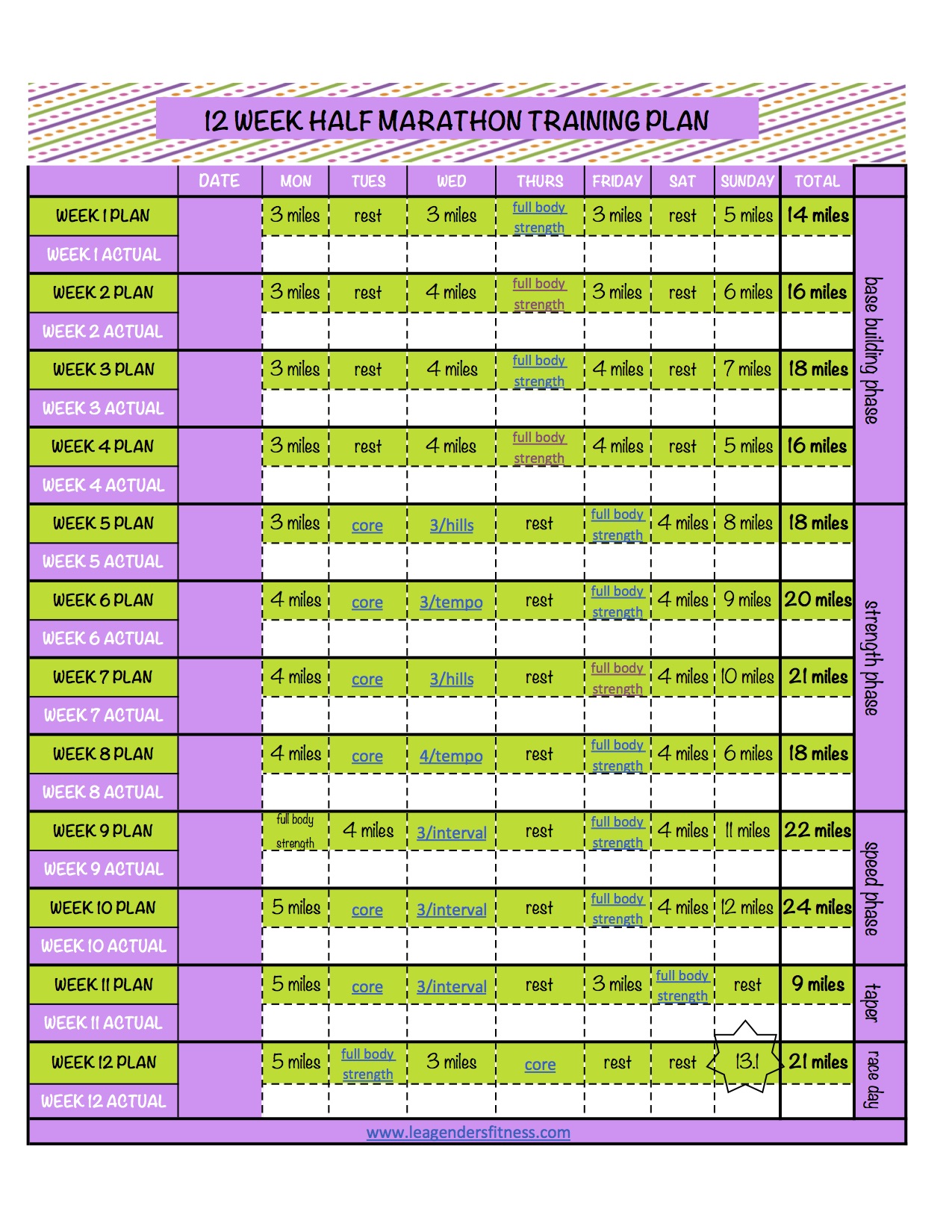
Would you like to train with me? For Workout Wednesday I am thrilled to share my personal 12 week half marathon training plan. 

12 week half marathon training plan.jpg

I haven't been running long distances much this fall/winter so it is time to start training for my half marathon at the end of March 2017. Following a training plan is a great way to stay motivated to exercise well into the new year. 

I starting building a training plan to get myself back up to 13.1 miles. I am happy to share it with you but as always, there are a few caveats. First of all, I am a certified running coach, but I am not your running coach. Since I don't know your exercise abilities, injury background or medical history, please see your doctor before beginning any new exercise program. This program is intended for an advanced beginner or intermediate runner. You should be able to run at a conversational pace (meaning you can hold a full conversation without gasping for breath while running at a slow pace) before starting this program. 

Because I am who I am (the strength training for runners coach), this half marathon training plan may not look like your typical plan. My plan includes strength training days because I think they are really important. While running will be my priority, I will still find a day or two each week for strength training. A full body strength training day and a core day once a week should be sufficient. 

THIS 12 WEEK HALF MARATHON TRAINING PLAN IS BROKEN INTO FOUR PHASES

BASE BUILDING PHASE

Even though I am an experienced runner, it is still a good idea to start any plan with a base building period. Since I haven't been running a lot lately, I gave myself four weeks to build a base. Depending on your current fitness level, you could shorten this phase. All runs in this phase should be done at conversational pace. We will slowly start to build our long run in this phase.

STRENGTH PHASE

When I talk about strength in this context, I am a referring to running strength. We will start to incorporate hills and tempo runs into our workouts. 

SPEED PHASE

The speed phase for half marathon training includes running intervals. I generally recommend no less than 1/2 mile intervals for half marathon speed work. We don't spend a lot of time doing shorter intervals for half marathon training. 

TAPER PHASE

This is when we will back off the milage and long runs to taper in order to prepare for race day.

You may notice that that there are rest days, easy run days and/or core days immediately following high intensity days. We always want to allow low intensity days like core work and conversational pace milage after high intensity days to allow our bodies to properly recover. Remember that our bodies adapt, get stronger and faster during rest, not during the workout. Allowing the proper recovery is an essential part of this half marathon training plan.

I included a PDF printable download at the end of the post so that you can print out the half marathon training plan and fill in your actual mileage each week. Running plans should always be dynamic, meaning that you should be willing to change and adjust as needed along the way. If I was your running coach, we would review your log at the end of the week and based on how you felt and performed, we would make adjustments if necessary. It is important when following a plan from the internet that you don't look at it as a rigid all-or-nothing plan. 

The perfect plan is one that fits into your lifestyle. If you feel you need an extra rest day after a long run, then take it. If you have to swap a running day and a strength training day because you can only get to the gym on certain days, then swap them. If you need to do your long run on Saturday instead of on Sunday, then do it. As a coach, I wouldn't expect you to complete the plan exactly as written for 12 weeks. Life happens, things change. This is not an excuse to blow-off the plan, but rather permission to make appropriate changes as needed. The most important part of the plan is to build the long runs and weekly mileage slowly over time. 

I caution you not skip any rest days or add more mileage to the plan unless you are an experienced runner who has completed many half marathons. The mileage build-up is strategic. Doing too much too soon is one of the biggest mistakes runners make. 

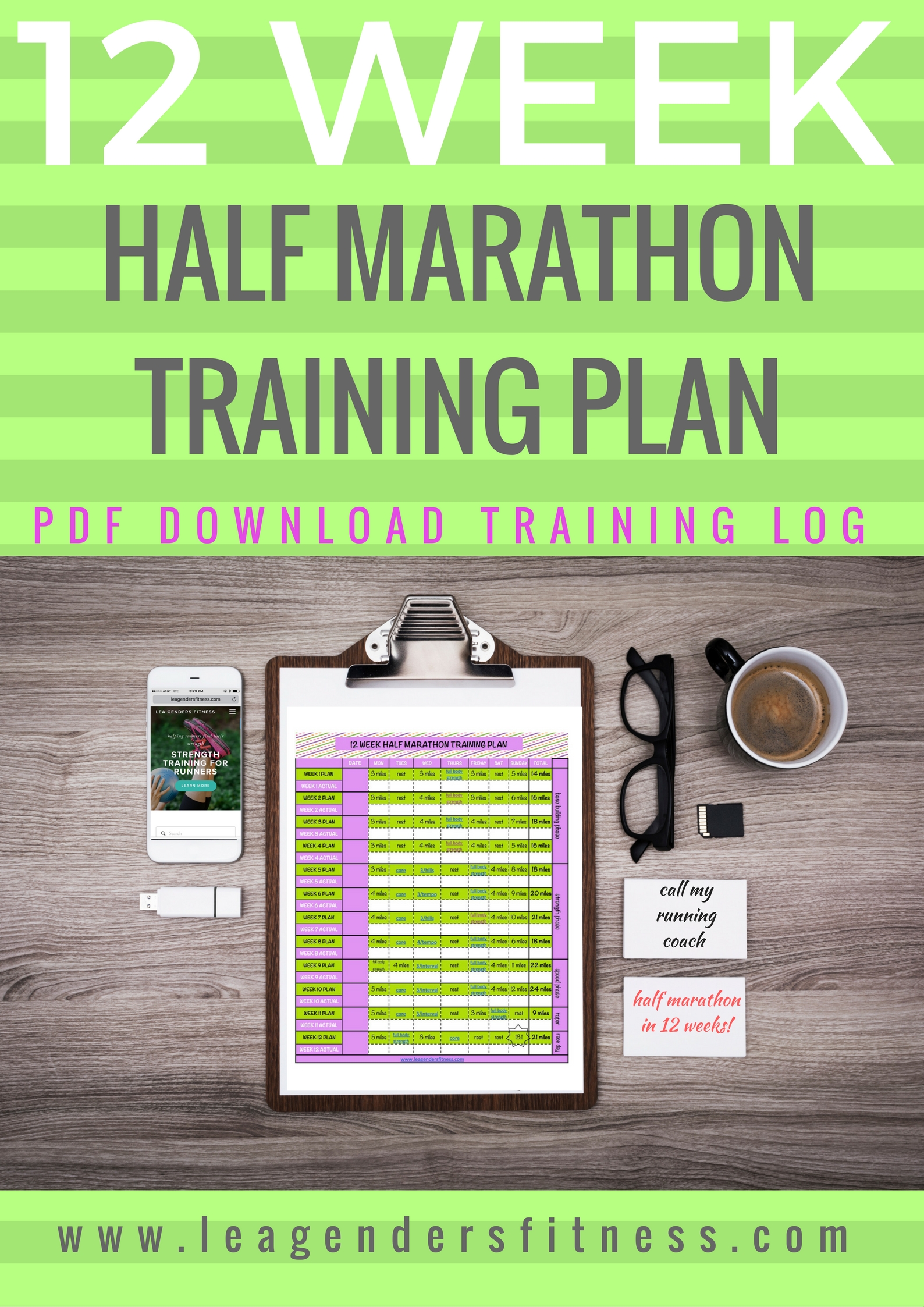
Are you ready to start training? I invite you to download my 12 week half marathon training plan printable PDF so you can log your progress along the way.

Want more personal support? Work with me!

Like this post? Please consider sharing or saving to Pinterest

Coach Lea


Make a New Year Race-olution: 5 Ways to a Better Race in 2017

January 1st is right around the corner and everyone is making their New Year resolutions. Instead of paying penance for your holiday indulgences with a diet of carrot sticks and celery, I have a better idea. How about a New Year Race-olution?

Now this is a resolution I can get behind. Whether you are an experienced racer or a newbie wanting to tackle your first race, here are five ways to better race in 2017.

1. SIGN UP FOR A RACE AND SET A GOAL

Choosing a race that is 3-6 months in the future goes a long way in staying motivated to work out well into 2017, when most people's resolutions will be collecting dust along side their exercise equipment.

Choose a race distance that is challenging enough to keep you motivated to train, but not so outside of your scope of experience and abilities that you set yourself up for failure. You should aim high with your goals though, with the proper training and guidance you can do more than you think!

2. DO SPEED WORK

If you want to run a better race in 2017, you'll need to start by logging those training miles. Once you have a solid running base of running three to four days a week for four to five weeks it's time to start speed work, which will be a key element to achieving a better race in 2017. If you want to run faster, you need to train to run faster. Hill repeats, track work, stairs and Fartleks can all be effective ways to build speed. Aim for a speed session once or twice a week.

3. DON'T NEGLECT CROSS TRAINING

Low impact cross training is good way to increase your endurance base without adding additional stress on your joints. Activities like biking, swimming, hiking, rowing, walking or the elliptical are all great cross training choices for non-running days.

While it may be tempting to adopt an all-running-all-the-time training plan, the smartest use of your workout schedule could be to carve out some time for some strength training. A lot of runners neglect the strength portion of training, but it is vital to getting stronger and staying injury free. Stronger legs just may bring you across the finish line at a faster pace. Aim for full body strength training session at least two times a week. There are plenty of quick and effective strength workouts in the archive.

4. BE FLEXIBLE AND REST

Yoga is a great cross training activity that can benefit runners, but when I say flexible I am referring to your training plan. It will be easy to put together an aggressive training plan, then get burnt out, or worse, injured before you have the chance to meet your race goals for 2017. Listen to your body. Take rest days. Take as many as you need. Push through those hard runs, push through feeling uncomfortable, push through laziness but never ever push through pain or injury.

A few days off from running or even a week off (if necessary) for recovery is just a blip in your overall training plan. Remember that it is during rest that your body is recovering and getting stronger! Rest is an important part of the equation. Train smart and schedule those rest days for a better race in 2017.

5. FIND A TRAINING PARTNER AND HAVE FUN

Long after the excitement of signing up for a race has faded, you will still need to be training in order to achieve your race-olution. One way to keep it fun and motivating is to find a running partner or sign up for training with an organized group. Joining a running group or boot camp can be a excellent way to get expert advice from a running coach and make some new running friends. 

I am looking forward to achieving my New Year's Race-olution. I'll be running a better race in 2017. How about you? Are you missing any of these in your training plan? Are you ready to make a New Year's Race-olution? Let me know in the comments.

Like this post? It helps me when you share or save to Pinterest!


Coach Lea

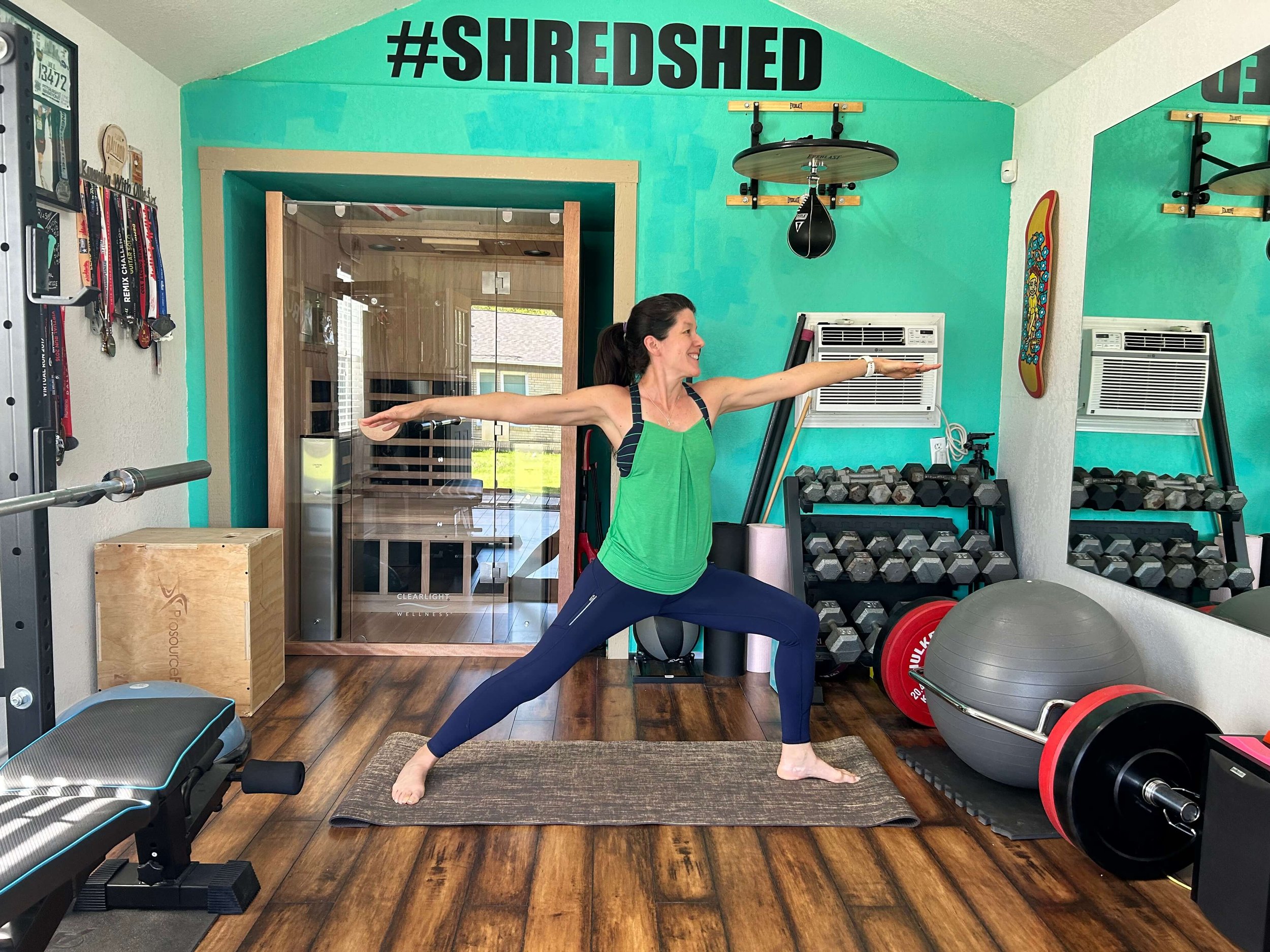
I am a NASM personal trainer and RRCA adult distance running coach that specializes in strength training for runners. I offer in-person training in the Shredshed, online training and Fit to Run bootcamps. If you are interested in a more in-depth running or strength training plan, please contact me. Have questions? I'd love to help. 

While I am a certified personal trainer, I am not your personal trainer. Since I don't know your exercise abilities, injury background or medical history, please see your doctor before beginning any new exercise program. This is an opinion blog. No information in this blog is intended to be taken as medical advice or prescription. Please see your doctor and/or registered dietitian for any health concerns.

7 Things You Should Never Say to a Runner

Hi, Friends! Back in 2005 I had a cousin visit me in Dallas from out of town. He was in town for a work conference and reached out to me through my parents to see if I wanted to get together. He was someone that that I knew growing up, but he was several years older than me and we were never that close. I probably hadn't seen or talked to him in ten years prior to that dinner. 

He walked into the restaurant wearing a Titleist hat. I knew it had something vaguely to do with golf, but a golf enthusiast I am not. In an awkward attempt to make conversation with this person who was family, but virtually a stranger I asked him, pointing to his hat, "Are you a Titleist?" 

It was admittedly a really stupid question. As if they just give hats to the winners of golf tournaments. Congratulations on winning, here is your hat to show the world you now hold a golf title. He (righfully) looked at me like I had two heads and informed me that Titleist was a golf ball brand. Ah, OK. Makes sense. 

I don't know golf and I asked a stupid question. People do it to runners all the time. You can't fault them, really. Most of the time they are just trying to take an interest. You don't know what you don't know. I certainly can't expect all my non-running friends to brush up on all things running just so they know the proper questions to ask me, but there are silly things that people say to runners over and over again.

If you want to be informed here is a short list of things you should never say to a runner. 


ISN'T RUNNING BAD FOR YOUR KNEES?

Why is everyone so worried about my knees? Running is good for your health and body. Sure, running is a high-impact activity, but as long as a runner progresses properly (building milage and speed slowly over time) and participates in some sort of strength training activities, their knees will probably be fine. There is some risk in any physical activity, but it is always less risky than being a couch potato. 

DID YOU WIN YOUR RACE? 

We don't run races to win them. Well, most of us. We run races to challenge ourselves, to join in with a community of runners, for fun and mostly just to finish. No, I didn't win. I didn't take the podium. That was never the point. Unless they volunteer the information, you probably shouldn't ask them their finishing time either. A better question to ask would be "Did you have fun?"

I RAN A 5K MARATHON ONCE.

I know the distances can be confusing and a lot of people associate any organized race with a marathon. A 5K is 3.1 miles and a marathon is 26.2 miles. It is an accomplishment to run and finish any race distance, but a 5K is not the same as a marathon. 

RUN, FORREST, RUN.

This stopped being funny in 1995 and it was never funny while being yelled out the window of a car while passing a runner. 20+ years later there should be newer ways to insult runners by now. 

I ONLY RUN IF SOMEONE IS CHASING ME.

I know you're trying to be funny and kudos for the effort, but this is what every "funny guy" says to runners. See also: I only go for beer runs. If you say this to a runner they are groaning on the inside because they have heard it a million times. We politely laugh but you may need to work on your material. 

I TRIED RUNNING ONCE AND I HATED IT.

Everyone hates running the first time they try it. Probably the first 20 times. If you tried running on the treadmill I don't even want to talk to you until you hit the streets or trails. Running is one of those activities that you have to give it a little time in order to adapt. It gets better, it gets easier. I promise. 

That being said, I don't expect everyone to love running. If it is not your thing, then that's fine. I encourage you to try different forms of exercise to find the thing that you do love. The form of exercise that you choose is not as important as just choosing an exercise. Anything. So whether it is running, biking, walking, Crossfit, bootcamp, weight lifting or trampoline jumping, find what you love and go out and actually do it. 

DON'T YOU GET BORED?

Running is a form of mediation for me. It is my quiet time away from technology (and people). It my time to unravel the thoughts, struggles and stresses that get tangled up during the day. It is how I manage stress. It is how I stay healthy. So, no. I don't get bored. 

If you don't know what to say to a runner, just say I am proud of you or congratulations on finishing your race. In the meantime I'll Google "Things to Never Say to a Golfer" so that next time that cousin is in town, I can ask intelligent questions. As long as we can agree that a marathon is 26.2 miles. Every. Single. Time. 

Runners, Did I miss anything?

Like this post? Please consider sharing. 

Coach Lea

I am a NASM personal trainer and RRCA adult distance running coach that specializes in strength training for runners. I offer in-person training in the Shredshed, online training and Fit to Run bootcamps. If you are interested in a more in-depth running or strength training plan, please contact me. Have questions? I'd love to help. 

While I am a certified personal trainer, I am not your personal trainer. Since I don't know your exercise abilities, injury background or medical history, please see your doctor before beginning any new exercise program. This is an opinion blog. No information in this blog is intended to be taken as medical advice or prescription. Please see your doctor and/or registered dietitian for any health concerns.


How to Transition from Running/Walking Intervals to Running

Welcome the latest edition of Workout Wednesday! This week we are talking about how to transition from running/walking intervals to running without walk breaks.

When you first start running it is very common to use run/walk intervals in order to adapt to running. There is absolutely no shame in walking. A lot of people are very successful running full and half marathons on a run/walk program with very impressive finishing times. If you are happy with your run/walk plan and you're continuing to progress, there is no reason to change your program. However if you're interested in transiting from run/walk intervals to running without walk breaks, I may be able to help you with the plan that worked for me when I first started running.

Most people start in the same place, it is very common be short of breath when you first start running. You have to stick with it through that hard beginning part in order to become a stronger runner. It does get easier, I promise. 

Once you have been performing run/walk intervals for a few months, you may be ready to train to run without walk breaks. I suggest that you have a solid running base before starting this program. You should be running (with walk breaks) several days a week for at least four weeks. Follow the below plan two to three days a week with full rest days in between training days to allow for proper recovery.

HOW TO TRANSITION FROM RUNNING/WALKING INTERVALS TO RUNNING WITHOUT WALK BREAKS

The key to train to run without walk breaks is to first start by taking walk breaks. Hear me out. If you stick with the program you will progress to running without walk breaks.

Walk for a few minutes to warm up. Try some dynamic stretching and/or foaming rolling to warm up before you get started.

Start running at a very slow pace. Go even slower than you think you can maintain. It's better to go too slow than too fast at this point. We can work on speed later, for now we are working on endurance. A slow pace is key.

Run until you feel like you just can't run for one more second, then try to count out 50 more steps. This may help you push past any mental barriers. When your mind says no more, see if your body has 50 more steps. It is important to be sure that you are listening to your body and not your mind. Is your mind telling you can't go on? Or is it your body? Sometimes your mind will tell you to stop, but think about it first. Can I breathe? Are my legs OK? How do I feel physically? If it is just your mind, keep going. Your thoughts can lie, especially when you are trying new things.

Once you are sure it is your body and not your mind slow to a brisk walk. Now here's the key to the whole plan: Only walk as long as you need to in order to recover your breath. It is really important to be honest with yourself and start running again as soon as you are able. When your breathing returns to almost normal It is time to start running again, don't walk for one second longer than necessary.  

Repeat the running cycle. Run as long as you can. When you think you need to stop, try to count out 50 more steps. You are probably feeling uncomfortable, but as long as you aren't feeling any physical pain, push yourself to keep running for just a little bit longer. When you are sure it is your body and not your mind, it is time to walk briskly again to recover.

Start the run cycle again. 

The idea is that you run for as long as you physically can, then walk only as much as necessary. If you continue this cycle, while being completely honest with yourself, over time your run intervals will become longer and your walk intervals will become shorter, until there are no walk intervals at all.

This process can take between four to ten weeks depending on your starting fitness level and dedication to the program. Remember that no matter what you are trying to achieve, consistency with your training is the single best path to success.

I can clearly remember the great feeling the first time I realized that I didn't need to stop for a walk interval, that I could keep running. Don't listen to your mind, listen to your body.

This same technique can be used to improve your running pace. Just replace the walk intervals with slower run internals. Run fast, then run slower to recover until you don't have to run slower anymore at all.

When you set out to run these intervals run according to time and not distance. For example, make a plan to run for 30 minutes, not three miles. You'll find that over time you will be able to cover the distance in less time. 

Give it a try and let me know how it goes.

Like this post? Please consider sharing!

NEED MORE HELP? WORK WITH ME!