You know the saying, "It's not a sprint, it's a marathon"? It's often applied to work and life as a reminder to pace yourself for the long haul, because we tend to think the only way to get results is by applying maximum effort.
I ran the Fort Worth Half Marathon last weekend and executed this philosophy in its most literal sense. I ended up running my second-fastest half marathon ever by intentionally holding myself back. It was a great reminder that steady execution and smart pacing beat going all-out until you crash and burn. The same goes for any big goal in life, including your health and fitness.
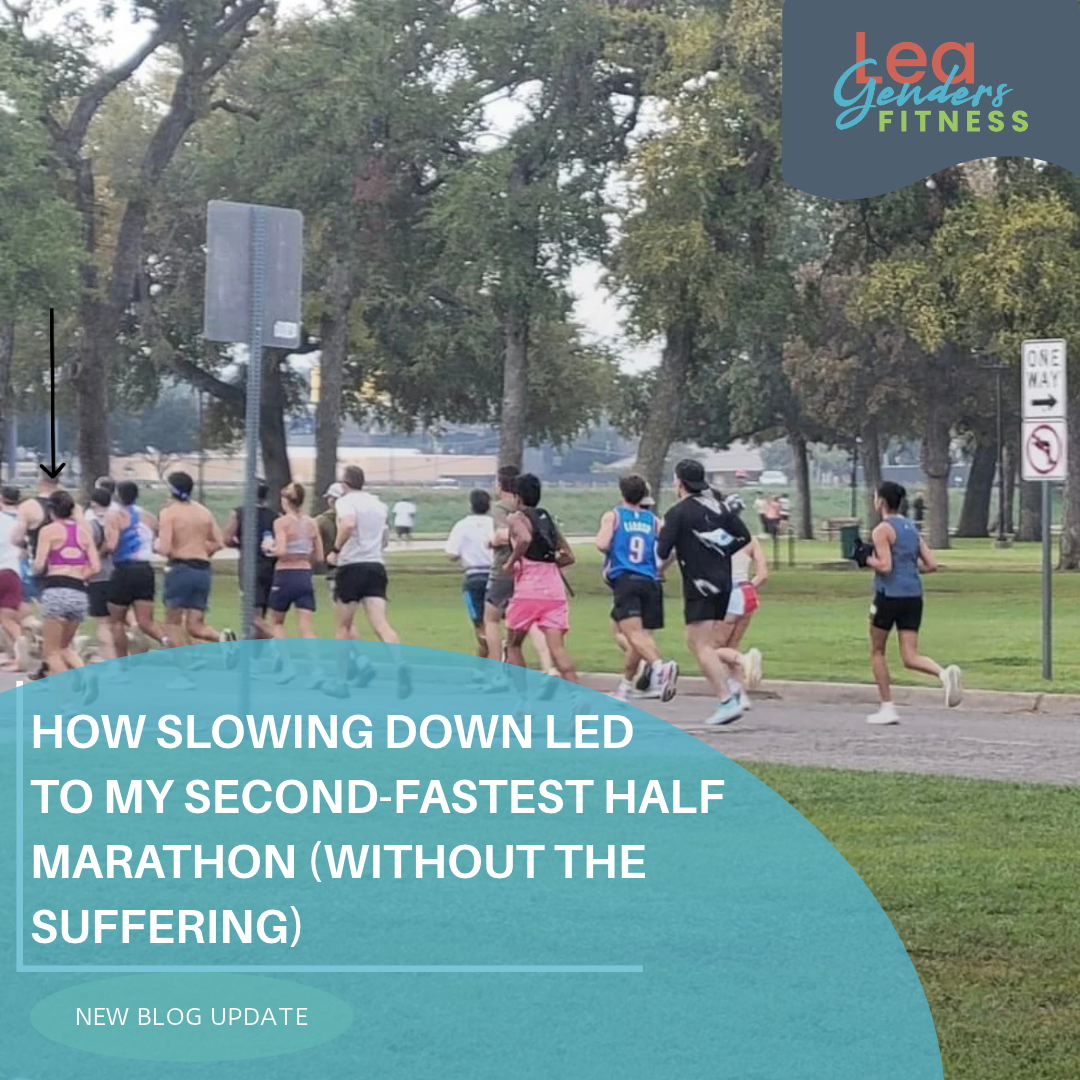
Why I Signed Up Four Days Before Race Day
This race was a last-minute decision. In fact, it all happened so quickly that some of the people closest to me did not even know I was running. I had been training for the Dallas Half Marathon in December, but because I felt so good and was progressing so well, I accidentally peaked too soon. I hit an 11-mile long run on October 25th, seven full weeks before my target race. Oops.
I looked online and saw that the Fort Worth Half Marathon was on November 8th, which was perfect timing for a tune-up race. It offered a great low-pressure opportunity to test my pacing strategy, practice fueling, and build some confidence while taking advantage of my current training status.
The last time I ran a half marathon was in September 2024 on my 50th birthday. I was undertrained, the weather was terribly hot, and I blew up after the halfway point, earning my lifetime personal worst time. I hadn't run a half marathon since that day, so I felt a positive experience here would take the pressure off my upcoming December race.
Four days before race day, I signed up for the Sunday Fort Worth Half Marathon event. It fell on a planned step-back week in my training schedule, so I hadn't done a heavy long run the weekend prior. My legs were in pretty good shape to race.
Pre-Race Rest, Bad Runs, and Race Morning Fueling
I registered on Wednesday, and my final run before the race was Thursday morning. It was terrible. My legs felt heavy and tired. While I usually have to hold myself back from running too fast, I had no problem slowing down that morning because my slower pace was about as fast as I could go.
I was not overly worried because I knew I had two full days of rest lined up before the race. I skipped running and stuck to light strength workouts that went easy on the legs. Besides, I have a working theory that when your very last run before a race feels awful, it is a sure sign that a great race is coming.
On race morning, about two hours before the start, I ate my favorite pre-race breakfast: two toaster waffles and two toaster mini pancakes topped with syrup.
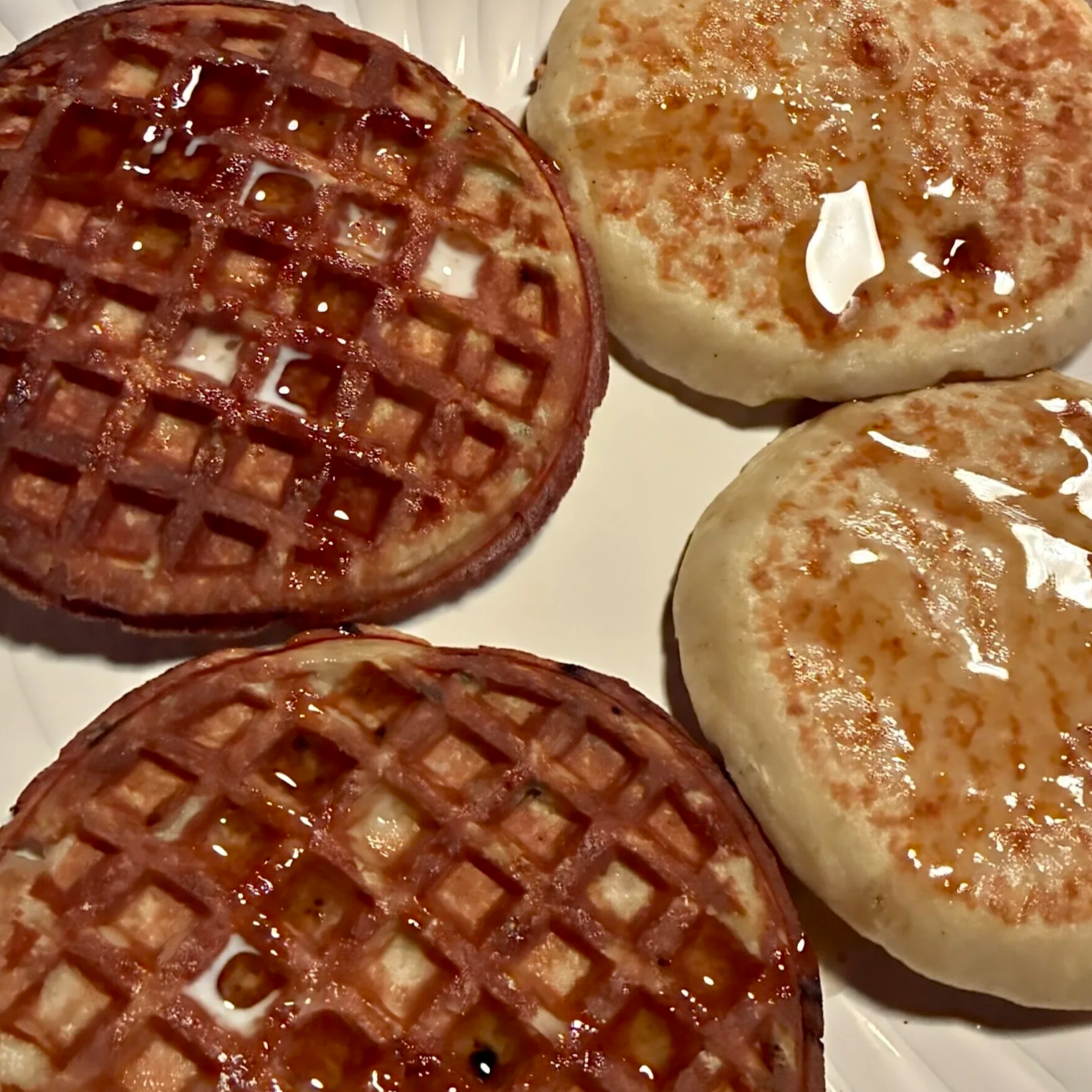
breakfast of champions
Executing the Game Plan: Smart Pacing and Fueling
My main goal for this race was not to suffer, which is rare for me on race day. Usually, if I am trying to set a personal record, some suffering is required. (See: My 10K PR post.) But this race was not about chasing a PR, I wanted to practice a pace I could maintain for a steady finish.
To keep myself from burning out early or suffering at the end, I set pace alerts on my watch that would come through my headphones to keep from running too fast. For miles one through three, my watch alerted me if I ran faster than 8:50 per mile. For miles four through eleven, I set alerts to slow down for anything faster than a moderate 8:30 pace. For the last two miles, I turned off alerts completely and ran by feel. This strategy helped me keep a sustainable pace and achieve a negative split (finishing the second half faster than the first).
Anyone who has run a race knows that it can be hard to have the discipline to go slower in those early miles when legs are fresh and race energy and excitement are high. But it felt really good to be reminded to slow down constantly, especially as my legs started to feel tired mid-race. Going slower in the early miles went a long way toward feeling strong at the end.
My fueling strategy went just as smoothly. I took a fuel gel at mile three and another at mile eight. That gel at mile eight was the first time I have ever felt a direct physical boost from a gel. Usually, I take it and just assume it is doing its job behind the scenes, providing glucose to my working muscles so I do not fade, I don’t usually feel anything. But this time, I felt a jolt of energy, which was surprising. I looked into it, and it seems that because I was moving at a more sustainable pace, my body was less stressed and much better able to process the incoming carbohydrates.
By the time I passed mile twelve, my brain was a bit foggy. Even though I had audio cues giving me stats at every mile, I couldn't remember whether I was in the middle of mile eleven or twelve. And because I was moving a bit faster in these final miles, I was deeply relieved when I rounded the corner and saw the finish line ahead.
The Finish Line
I crossed the finish line feeling great. Sure, my legs were fatigued from thirteen miles, and I was glad to be done, but I still felt strong enough to kick the last 0.2 miles at an under-8-minute pace. While my finish time was not an all-time PR, it was my second-fastest half marathon ever, which is a fantastic sign given that my effort felt solidly moderate (not hard). With a small extra push, I can likely beat my best half marathon time in December.
Overall, the Fort Worth Half Marathon was a wonderful experience. It is smaller than massive events like the Cowtown Marathon or the Dallas Marathon, but it had plenty of water stations, engaged volunteers, great crowd support, and finish line celebrations. I even got an onsite post-run assisted stretch from www.runnerrepair.com. This race bridged the gap perfectly between smaller local park runs and giant city marathons. Not too big, not too small—like Goldilocks—just right. Plus, the finisher medal is a giant belt buckle, what could be more Fort Worth? If you’ve been considering this race, I can give it my full (unbiased) recommendation for a fun and well-organized experience.
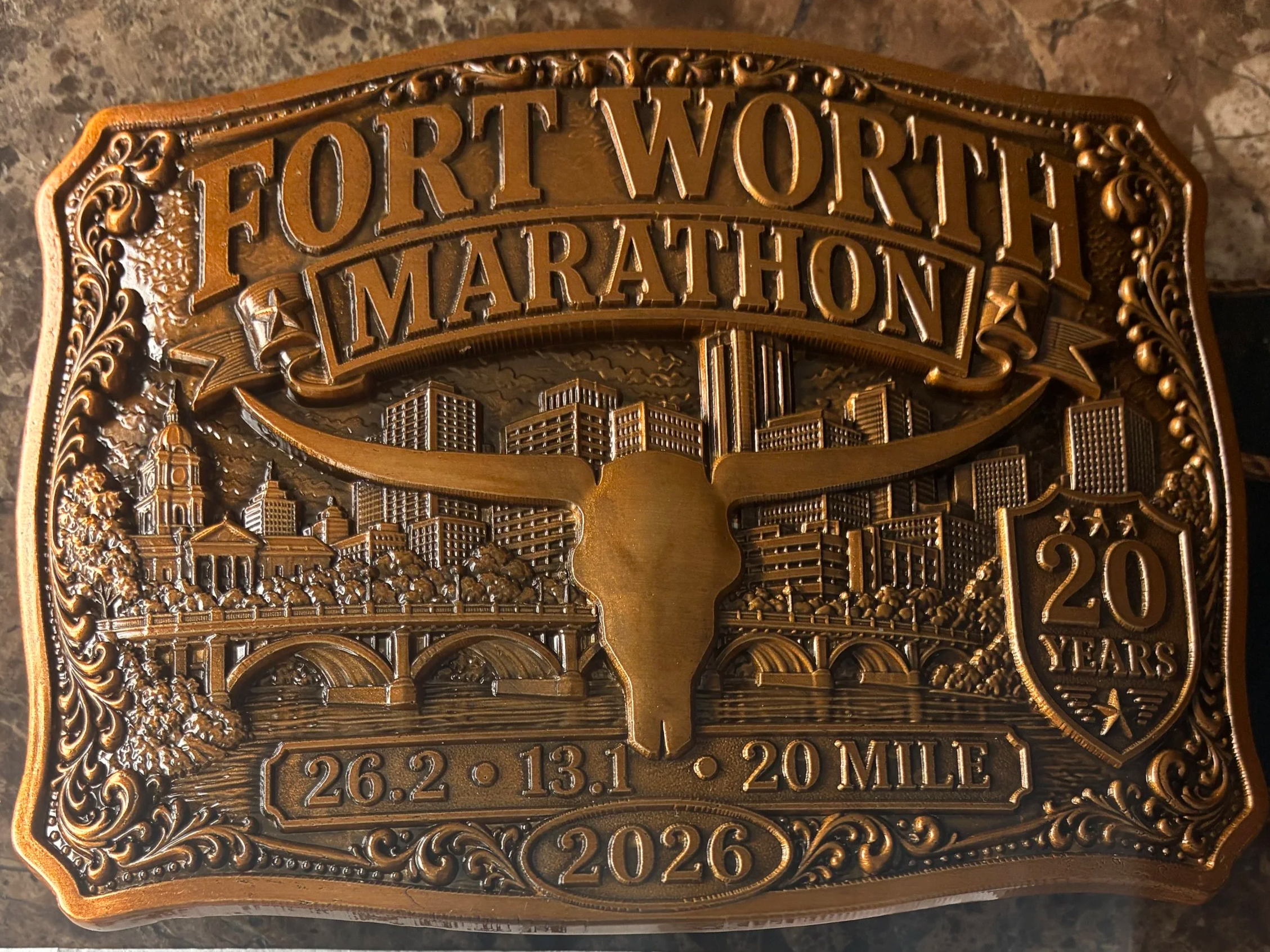
Fort Worth Marathon belt buckle finisher’s medal
INTRINSIC VS. EXTRINSIC MOTIVATION: RUNNING WITHOUT SOCIAL MEDIA
This race was all about intrinsic satisfaction: for the first time since social media existed, I crossed a finish line and didn’t post about it on Facebook or Instagram. Gasp!
If a tree falls in a forest and no one is around to hear it, does it make a sound? If I run a half marathon and don't share it on socials, does it even count? Apparently, it does!
Running without posting takes the focus away from extrinsic validation (comments, likes, age-group trophies) to intrinsic satisfaction (knowing I executed a smart, strong race). It also brought back some familiar feelings. Before I quit drinking six years ago, I thought it sounded almost impossible to go on a vacation, to a concert, a wedding, or an event without having a drink. Once I actually did those things, I realized not drinking made those experiences better overall. The idea of running a half marathon without posting about it on social media felt almost as impossible and absurd as a trip to the beach without wine did back then.
(Aside from LinkedIn for my business and Strava to support my coaching clients, I'm on an extended break from mindless scrolling.) But I still got to share my achievement. My finish time uploaded to Strava, I texted my close friends directly, and shared the story right here with you. It turns out you can run a race without Instagram. Who knew? lol
I’m hoping my break from social media will end in the same way my breaks from alcohol did, with the realization my life is better overall without it!
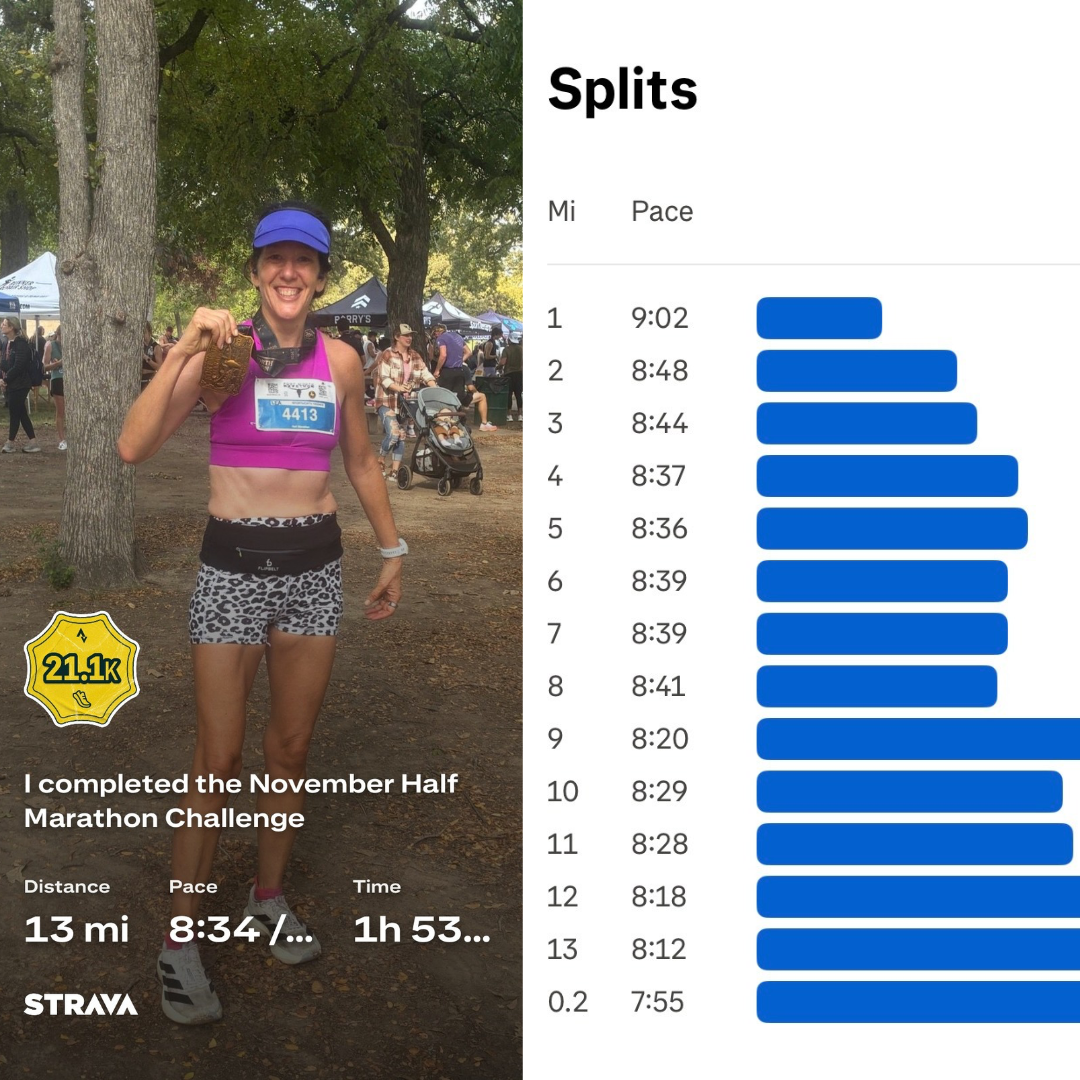
My Strava share
DON'T CALL IT A COMEBACK: I'VE BEEN HERE FOR YEARS
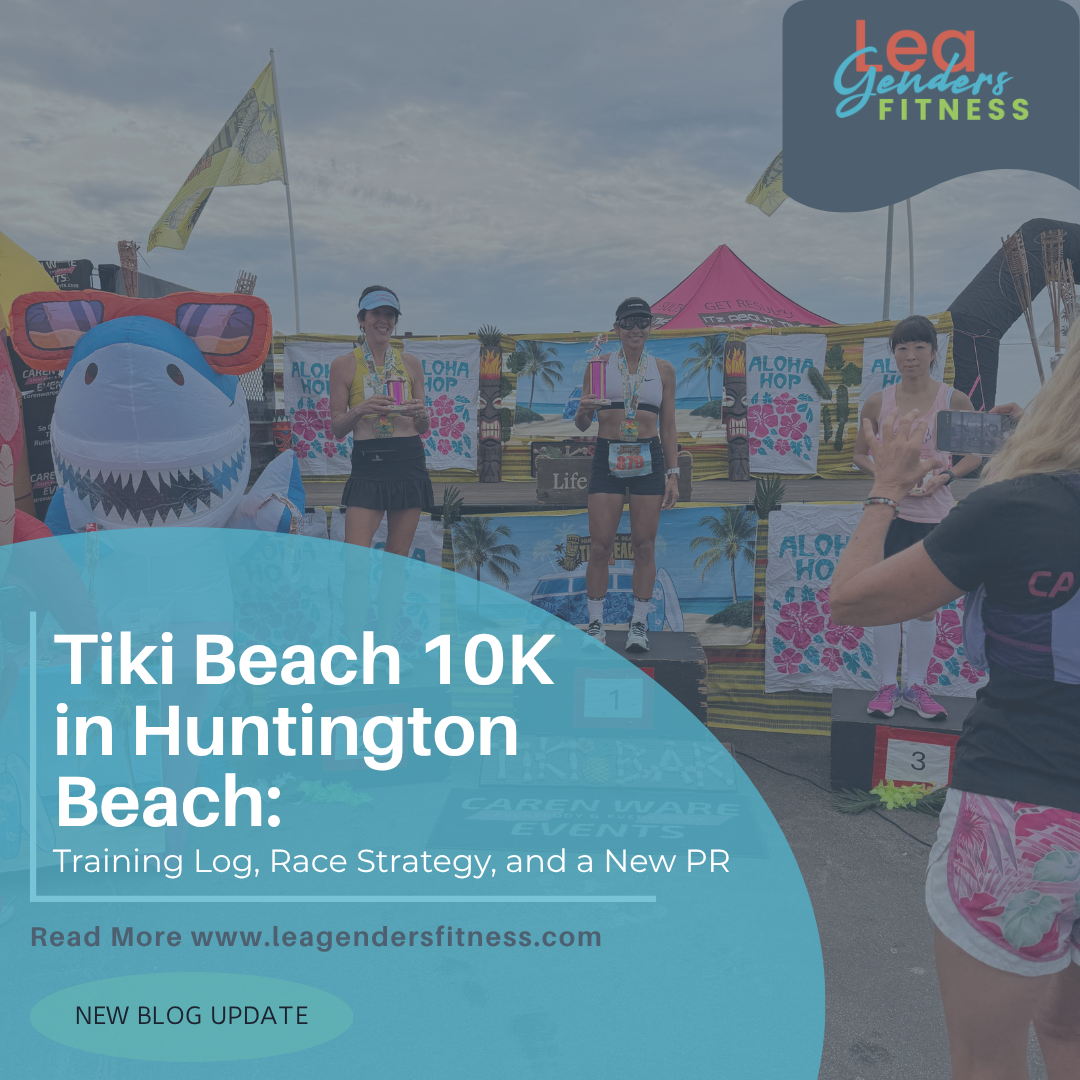
This felt like the ultimate confidence builder and a bounce back (🎶 don’t call it a comeback 🎶) from my poor September 2024 performance. But there is an interesting twist. During that bad race two years ago, despite running my personal worst time, I actually won first place overall for Masters Female (fastest over 40). At this race, I didn’t win an age group award.
So, in the race where I took first place, I was disappointed with a hard, miserable performance. In this race, without an age group placement, I walked away thrilled with my personal execution. It just goes to show that running is always a race of YOU against YOU. Winning an award is fun, but I would choose a satisfying personal performance every single time.
Lea
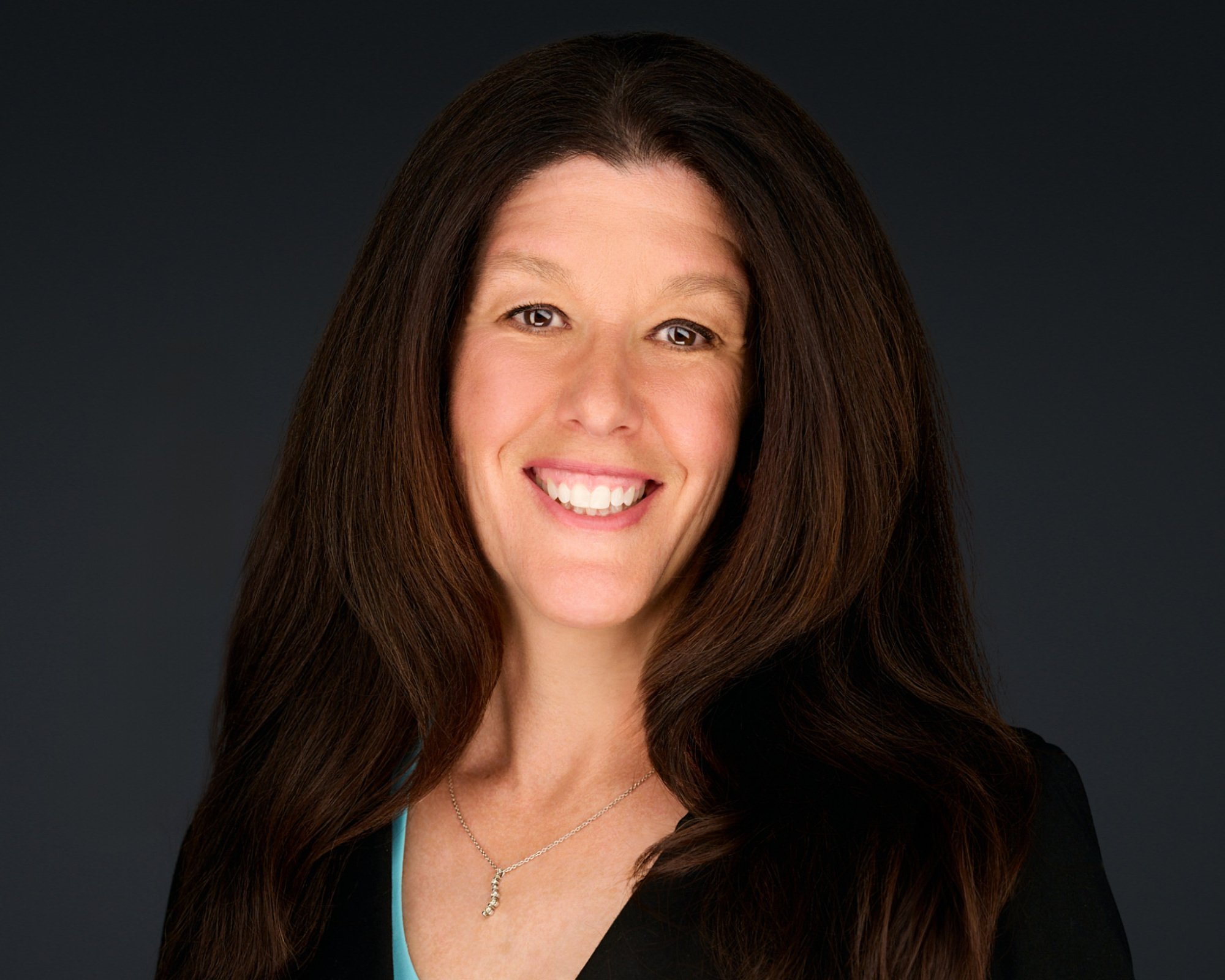
Lea Genders is a board-certified health coach, personal trainer, and workplace wellness consultant based in Fort Worth, TX. She offers corporate wellness programs for employee health and productivity, as well as in-person and virtual training / coaching for individuals worldwide. Her blog shares expert guidance on strength training, running, and sustainable nutrition @fortworth_trainer

Signed up for the Fort Worth Half Marathon just four days before race day as a last-minute tune-up, and it turned out to be the ultimate comeback race. By locking into a smart pacing strategy I crossed the finish line with my second-fastest half marathon time ever. Here is how staying patient early on set up a strong, rewarding finish!