How to Find Your Perfect Running Pace

The biggest mistake most new runners make is that they start out too fast and burn out quickly. One of the biggest mistakes intermediate runners make is that they run too fast, too often and don't allow for proper recovery. You see a trend here? Whether we are impressing our Instagram friends with speedy paces or we are trying to achieve a pace that is outside of our current fitness level, most of us can learn a lot by putting the GPS away and running by feel.

If we set aside the runner ego that tells us we have to run fast all the time, then we can run by feel on our slow runs and our fast runs to perform better, recover better and reduce chance of injury. So throw away that GPS watch and let's get started. (Ok, that thing is expensive, maybe don't throw it away, just set it aside for now.)

The best way to run by feel is using the Rate of Perceived Exertion chart and the talk test. 
how to find your perfect running pace. save to Pinterest for later.

how to find your perfect running pace. save to Pinterest for later.

WHY RPE?

Every runner is different. A nine minute mile pace may feel like a RPE 4-6 for one runner and a RPE 9 for another. It's important in your training to work at your own fitness level and not according to arbitrary paces (especially when following workouts on the internet). If you always run according to your personal effort level, you will be able to choose the appropriate paces for your interval runs, long runs and recovery runs and progress accordingly. 

RPE 1 NO EFFORT

You are probably participating in marathon of the NetFlix variety at this effort level. Sitting. No effort at all.

RPE 2-3 LIGHT EFFORT

A light effort may be a moderate to brisk walk. It feels easy and you could likely go an extremely long distance before getting tired.

RPE 4-6 MODERATE EFFORT

This effort is a usually a running pace often referred to as conversational pace. It is exactly what it sounds like, you should be able to hold a full conversation with your running partner without taking gasps of breath between words or sentences. My running partner doesn't talk back, but that doesn't stop me. (Note to new runners, it may take 3-6 months before any runs are conversational, this is normal. Just be sure to take plenty of rest days and walk breaks as needed until you get there.)

Easy short runs for recovery and most long runs should be done at conversational pace. Conversational-paced runs should be done the day or two after hard efforts runs or long runs to allow your body to recover. 

RPE 7-8 HARD EFFORT

Hard effort pace is sometimes called tempo pace or comfortably-hard pace. You can usually speak a sentence or two but will need to take gasps of breath. You feel like you are working hard, but you still can maintain the pace over a few miles or long intervals. This is usually the top end of your aerobic threshold.

RPE 9 EXTREMELY HARD EFFORT

At a RPE 9 you can only speak a word or two at a time (and that word just might be a cuss word.) You would not be able to hold this pace for a long time or distance. You usually perform at a RPE 9 pace during sprint intervals. 

RPE 10 MAXIMUM EFFORT

RPE 10 is the top end of the effort chart. You are completely out of breath and unable to talk at all. You would not be able to hold this level of effort for long. It would most likely be appropriate for short sprint intervals.

RPE CHART

RPE CHART

Instead of becoming a slave to your GPS watch, let it work for you. Experiment a little bit with pace on your next run. What pace are you running when you are at conversational pace? What is your hard effort pace? What is your max effort pace? Give it a try and let me know how it goes in the comments, on Instagram or on Twitter. The beautiful thing with RPE is that as you adapt and grow faster/stronger the chart adapts with you. 

If you always run your long intervals at RPE 7-8, you will find over time that the pace increases while your effort is the same. Our body adapts to the stresses we place upon it, which means if you run the same pace all the time, it will get easier and your workouts won't be as effective. If you run according to effort and the talk test you will always keep improving. 

Like this post? Know someone who would benefit from it? It helps me when you share with your friends and followers. 

THE PLAYLIST HIIT RUNNING WORKOUT

I  get most excited and energized by blogging, running and rock music so I am always thrilled when I get the opportunity for a passion trifecta to blog about running and music. 

Welcome to workout Wednesday when each week I share a new running or strength for runners workout. This week we have a fun running workout that takes all the pressure and stress out of your runs and lets you just go with the flow, or the beat of the music. 

The idea is to create a playlist with the beats per minute or BPM in mind. We start with a song with a mid tempo BPM for a moderate pace to warm up and then alternate between higher BPM songs and medium BPM songs until the run is complete. 

We naturally match our stride to the BPM so we may feel motivated to keep up a faster pace in sync with the music. Since most songs are around three minutes long (give or take), a playlist built around BPM can be the perfect high intensity interval workout.

The Playlist HIIT running workout. Save to Pinterest for later.

The Playlist HIIT running workout. Save to Pinterest for later.

Start off with a song with a mid tempo BPM to get started, then make the next song on your playlist an uptempo song with 155-185 BPM. Some say 180 is the perfect BPM for runners as it's been claimed that 180 strides per minute is the most efficient turnover. 

How do you find BPM of popular songs? The site songbpm.com lets you enter any song and it returns the BPM. Spotify also has playlists built around BPM, so you can pick and choose your favorite songs to build you own playlist HIIT workout around the music that you love.

If you like alternative rock like I do, your playlist might look something like mine. With this playlist we are alternating between mid tempo and up tempo songs. I created a playlist on Spotify if you want to hear my song selections. Create your own playlist with the music that you love. 

THE PLAYLIST HIIT WORKOUT


Against Me! Don't Lose Touch 120 bpm

The Yeah Yeah Yeahs Phenomena 157 bpm

Band of Skulls - Sweet Sour 127 bpm

The Hives two-timing touch and broken bones 165 bpm

The Black Keys  Howlin for you 133 bpm

Cake the distance 183 bpm

Young the Giant My Body 130 bpm

Millencolin - Ray 197 bpm

The fratellis - Henrietta 122 bpm

The Kills Sour Cherry 160 bpm

Create your own playlist and see how it feels to run by music bpm. As a running coach I will advise you to not try to run faster than your current fitness level. If you can't keep up with the tempo of the song, it's always better to go at your own pace for safety and sanity.

I'd like to thank hubby, the drummer, for a little bit of music education as I put together this post. 

Like this post? Know someone who might like it too? It helps me when you share with your friends and followers. 
Lea signature.jpg

What's the Best Diet? 5 Qualities of a Healthy Diet

When I tell people that I am a nutrition habits coach they often ask, what's the best diet? They must assume that I hold all the dieting secrets, and have the inside scoop of the top secret magic diet that will melt all their fat and therefore, all their problems away. Not so fast.

Let's first talk about the word diet. It has a negative connotation. It is becoming a dirty word in the industry. When I mention striving to eat a healthy diet someone inevitability says, "It's not a diet, it's a lifestyle." I agree, the farther we can get away from food rules, the better off most of us will be. 

Your diet is what you eat. You may consume a diet of mostly Cheetos and fast food. While that certainly is not a weight loss diet, it's still a diet. People who have Celiac disease may be on a Gluten-free diet under their doctor's supervision. A weightlifter may be on a high protein diet and an endurance athlete may be on a high carbohydrate diet. Someone who is passionate about animal rights may be on a Vegan diet. Everyone is different and has different dietary needs based on personal preferences, goals and their own body.

There are a lot of weight loss diets circling around. There's the Ketogenic diet, The Atkins diet, the Mediterranean diet. There's Paleo and the Daniel Diet. You may remember once popular diets like Zone diet or the South Beach diet, and while not technically diets per se, concepts like intermittent fasting and Whole 30 have gained popularity. They all follow different protocols but they all promise weight loss results. How can that be? 

How do you know which is the best diet? What is actually healthy for your body? Which diet will cause you to lose those extra pounds once and for all? If you've tried everything from Weight Watchers to the Slim Fast diet of the 90s, you may be a little fed up with the whole process of dieting. The only way to tell what is the best diet for you is to try it, and if you tried them all (like I have) you probably have discovered that diets that severely restrict calories, food groups or entire macronutrients are hard to adhere to, and a diet you don't stick with will never work. 

The truth is almost any diet will be effective if you can stick to it over the long term. It depends on your lifestyle, your preferences and you own body. Some people thrive on a low carb diet, some people turn into a scarier version of the wicked witch of the west (raises hand!). There is no one best diet for everyone, but there may be a best diet for you. 

What's the best diet? 5 qualities of a healthy diet. save to pinterest for later.

What's the best diet? 5 qualities of a healthy diet. save to pinterest for later.

THE BEST DIET HAS THE FOLLOWING QUALITIES

1. It's sustainable over the long term.

I would advise my nutrition clients not to waste their time with the cabbage soup diet, unless they plan on only eating cabbage soup for the rest of their lives. The problem with short term diets is they provide short term results. Even if you lost the weight on the "magic" cabbage soup diet, you will likely gain it back once you go off the diet. The best diet is one that works with your lifestyle and you can sustain it for life. Don't bother going on and off diets. Experiment to find something you like and that works for you and stick with it. 

2. Makes you look, feel and perform your best

There is nothing inherently wrong with trying a new way of eating to see if it will work for you. In fact, experimenting with nutrition is encouraged, how else can you learn what your body prefers and needs? The most important thing is to keep note of how this new way of eating makes you look, feel and perform. Don't try to force something that is not working for you. If you feel terrible all the time, your hair is falling out and you don't have the energy to exercise, then it may be time to reevaluate your diet and make adjustments accordingly. Just because something is working for your gym buddy, doesn't mean it will work for you. Everyone will react a little differently.

With that being said, I will also advise you to give it time, because dietary changes can cause temporary reactions that will pass once your body adjusts. It's like giving up caffeine. You will probably deal with terrible headaches for a few days, but it's just your body adapting to the change. Give any new diet adequate time and evaluate how it makes you look, feel and perform. Always be willing to adjust when necessary. 

3. Is well-rounded and it is not severely restrictive.

As humans, we naturally want what we can't have. Any diet that severely restricts calories or macronutrients (like fats or carbs) will be harder to stick to over the long haul for most people. A well-rounded diet will ensure that you are getting the macro and micronutrients (vitamins and minerals) that your body needs to feel its best. When you severely restrict your intake, the body reacts with strong hunger signals and most people will eventually cave in to the cravings and overindulge in response. Instead of a restrict/hunger/overindulge cycle, most people do best with a more moderate approach to nutrition by eating a wide variety of mostly whole foods from nature, while allowing some room for treats. Everyone is different and should experiment to find the ideal protein, fat and carb balance. 

4. Allows for indulgences and life balance

Your diet does not exist in a bubble. You have a life to live and your nutrition is a part of your life, not a separate entity. Maybe you could quit your job and live on a weight loss ranch for six months to achieve results, but most of us have lives, friends, careers and families. We have parties, business meetings and holiday celebrations. Spending time with other people and enjoying yourself is a big part of a healthy lifestyle and if you lock yourself in your room in fear of being exposed to a glass of wine or a carbohydrate, then that's not healthy either. The best diet gives you some breathing room to enjoy life. 

5. Puts you in a calorie deficit

I saved the most important point for last. You lose weight when you're in a calorie deficit. That means you lose weight when you consume less calories than you burn. No matter what diet you choose to follow, if you are in a calorie deficit, you will likely lose weight. Of course, it is not always all that simple, because our bodies are complicated, but the first place to start is with a calorie deficit.

If you eat a perfectly organic, grass-fed "clean" diet but still consume more calories than you are burning then you can't expect to lose weight.

One of the reasons that people lose weight on low carb diets is that they stop eating bread, pasta and processed carbohydrates, which cuts out a large amount of calories. One of the reasons people lose weight on low fat diets is because fats have higher calories that carbs and protein, so when you restrict fats, you naturally cut calories. There's no magic in any particular diet. If you work to reduce your calories about 500 a day below what you burn, you should see a 1-2 pound of weight loss per week. (but keep in mind that weight loss is rarely linear. It would be rare to lose two pounds weeks every single week over a long period of time. The two pound a week rule is an average over time.)

If you restrict too much it can have negative consequences. Most people with thrive on a moderate cutback of calories to lose weight. If you are reasonably active, you sleep well, work to keep stress levels low and eat in calorie deficit most of the time, you will likely lose weight. Don't underestimate the importance of sleep and stress management when it comes to fat loss. However, if you seem to be doing everything right but still not losing weight, a doctor or Registered Dietitian can help you run tests to see where there might be other issues preventing fat loss. 

WHAT'S THE BEST DIET?

You see, there is no magic shake, drink, pill or food combination that causes weight loss. The most effective diet is one that you will stick to, that makes you look, feel and perform your best, that is well-rounded and allows for indulgences and most importantly, puts you in a calorie deficit. 

As a nutrition habits coach, it is not my job to tell my clients what to eat. I help educate them on reading nutrition labels and making healthier choices. I provide them with accountability for the choices they make and help them learn to listen to their bodies so they can eat in a way the works best for them. I have clients on different types of diets that they chose based on their lifestyle, preferences and interests. I don't discourage experimenting with healthy nutrition and I certainly don't tell my clients what they should or shouldn't do. I help them figure out for themselves what version of healthy living works best for their own body. If something they are trying is not working, I help them figure out the next steps. 

If you are tired of going on and off diets, yo-yoing in weight or feeling frustrated with the conflicting nutrition information out there, my nutrition habits coaching may be a great fit for you. We build solid healthy habits over time for a sustainable approach to fat loss. Interested? Take this survey to see if you would be a good fit. Try the first month at 75% off. 

There is no magic diet, the magic is inside YOU.

Still have questions? I'd love to help. 

Like this post? Do you know someone it could help? It helps me a lot when you share with your friends and followers. 
Lea signature.jpg


5 Healthy High Protein Smoothie Recipes

Happy Friday, friends! We made it through another week and it's time to relax and recover for the weekend, unless you're anything like me and you have family to attend to, friends to see, chores to get done and a race that's not going to train for itself! Weekends may offer a change from the routine but they often can be busier than the work week!

While weekends may be our chance to unwind a bit, don't let the freedom of the weekend derail all your health and fitness goals. While it is perfectly acceptable (and encouraged) to indulge once in a while to stay sane and happy, I try to keep my diet and exercise plan on track throughout the weekend, despite the craziness. 

5 healthy high protein smoothie recipes


One way to start your weekend off on the right foot is with a high protein breakfast. Consuming protein helps us stay feeling full and satisfied longer after we finish our meals. It is also necessary in order to breakdown, build and preserve lean muscle mass. If you are trying to lose weight adequate protein intake is essential. When you lose weight, you want to make sure you are losing fat and not muscle. Preserve muscle while you lose weight by Including resistance training in your workouts and consuming enough protein. Depending on your goals, aim for .5 to .8 grams of protein per pound of body weight. 150 lb person may aim for 75 grams (to preserve lean muscle) to 120 grams (to build muscle) per day. If you are getting considerably less than this now, start on the low end. 

Protein shakes don't have to be boring. I wrote a post over on my other blog and since I know all my readers don't subscribe to both blogs (but please do!) I thought I would share these healthy high-protein recipes for you. These are all personally taste-tested and delicious. 

5 healthy high protein smoothie recipes - save to Pinterest for later!

5 healthy high protein smoothie recipes - save to Pinterest for later!

CLASSIC GREEN SMOOTHIE

Sneak in a serving of spinach, you can't even taste it in this classic green smoothie.

1 scoop of vanilla protein powder
1 small banana
1/3 cup plain Greek Yogurt
1 handful of fresh spinach
1 cup of milk or almond milk

COCOA MINT SMOOTHIE

Don't let the Girl Scouts have all the fun. Try this healthy high protein twist on the classic Thin Mint.

1 scoop of chocolate protein powder
1 banana
1 tablespoon of cocoa powder
1/2 teaspoon of peppermint extract
1 cup of milk or almond milk

TROPICAL DELIGHT SMOOTHIE

Close your eyes and imagine a tropical vacation complete with little umbrellas in your pineapple flavored drinks.

1 scoop of vanilla protein powder
1 handful of fresh spinach
1/3 cup of frozen pineapples
a pinch of coconut
a pinch of sliced almonds
1 cup of milk or almond milk

APPLE PIE SMOOTHIE

While it is almost never appropriate to eat apple pie for breakfast, you can have this healthy, high protein alternative any meal of the day. 

1 scoop of vanilla protein powder
1 sliced apple
1 teaspoon of cinnamon
1 cup of milk or almond milk

ORANGE CREAMSICLE SMOOTHIE

Reminisce about the summers of our youth and the beloved ice cream truck while you sip on this delicious orange creamsicle smoothie. 

1 scoop of vanilla protein powder
1 medium orange, peeled
1/3 cup of plain Greek nonfat yogurt
 cup of milk or almond milk
 

Like this post? Do you know one person this could help? You help me grow when you share with your friends and followers. 

Lea signature.jpg

CORE STABILITY BALL TRAINING

Welcome to the latest edition of workout wednesday when each week I share a new running or runner-specific strength training workout. 

This week we are talking about core stability and strength. As runners, core strength is important to keep proper form, to provide a stable base between the lower and upper body and to power our stride. You don't need to spend hours in the gym or devote your life to strength training to reap the benefits of runner-specific core work. Spend 5-10 minutes on core exercises before you hit the road for your next run. You'll help activate running muscles and core training can be part of your warm up before you hit the road.

This post contains affiliate links. That means if you click on a link and make a purchase, I make a small percentage of the sale with no additional cost to you. No one is getting rich here, it just helps with the cost associated with running (pun intended) this blog. Thanks, as always, for your support. 

EQUIPMENT

STABILITY BALL

You can work to strengthen your stabilization muscles and joints by providing an unstable, but controllable base like a stability ball. Some of the benefits of balance and stabilization training for runners are improved joint stability, increased flexibility, improved posture control, improved balance and coordination. 

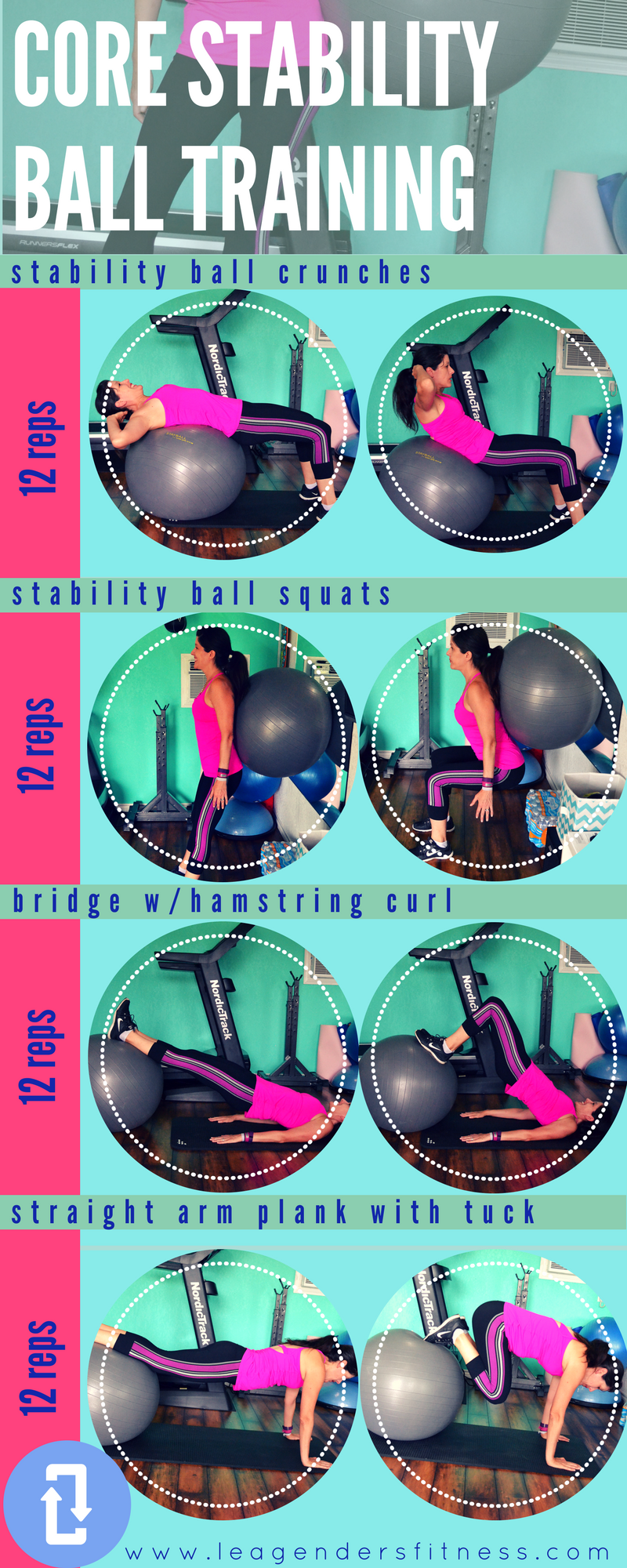
Core Stability Ball Training. Save to Pinterest for later. Download a printable PDF of this workout.

Core Stability Ball Training. Save to Pinterest for later. Download a printable PDF of this workout.

CORE STABILITY BALL TRAINING WORKOUT

BALL CRUNCH

Position the stability ball under the small of your back. Place your hands behind your head, do not pull on your neck, and lift your shoulders and chest up into a crunch. Engage your abs and hold for 3 seconds in top position. Slowly lower back to the starting position. For an added challenge hold a medicine ball for additional resistance. Perform 12 repetitions before moving onto the next exercise. 

BALL SQUATS

Place the ball against a wall and position the ball in the middle of your back. With your feet about hip width apart and your toes pointing straight ahead, walk your feet forward. Lower yourself into a squat until your thighs are parallel to the floor, like you are sitting in an invisible chair. Be careful not to lean back into the ball, but use it as a guide to lower yourself. Once in the low position, press through the heels and push back up to standing. For an added challenge hold a medicine ball at your chest. Perform 12 reps before moving onto the next exercise.

BRIDGE WITH HAMSTRING CURLS

Lie on your back with the stability ball positioned under your calves. Lift your hips off the ground into the starting bridge position, engage your abs and glutes. Bend your knees and lift your hips to curl the ball towards your body. Straighten your legs back out and perform 12 repetitions without lowering your hips to the ground.

STRAIGHT ARM PLANK WITH TUCK

Position the stability ball under your thighs and walk your hands out until you come into a high plank position with your shoulders directly over your wrists and the ball under your shins. Pull your knees in towards your chest to roll the ball forward, then straighten your legs to return the ball to the starting position. Do not to lower the hips between reps. Perform 12 repetitions, take a one minute break then repeat the circuit one or two more times. 

Do you work in core and stabilization exercises into your running routine? Give this one a try and let me know what you think on Instagram, Twitter or in the comments!

download a printable PDF core stability workout

download a printable PDF core stability workout

Did you like this post? Do you know one person who might benefit from it? It helps me grow when you share with your friends and followers. 

Lea signature.jpg