
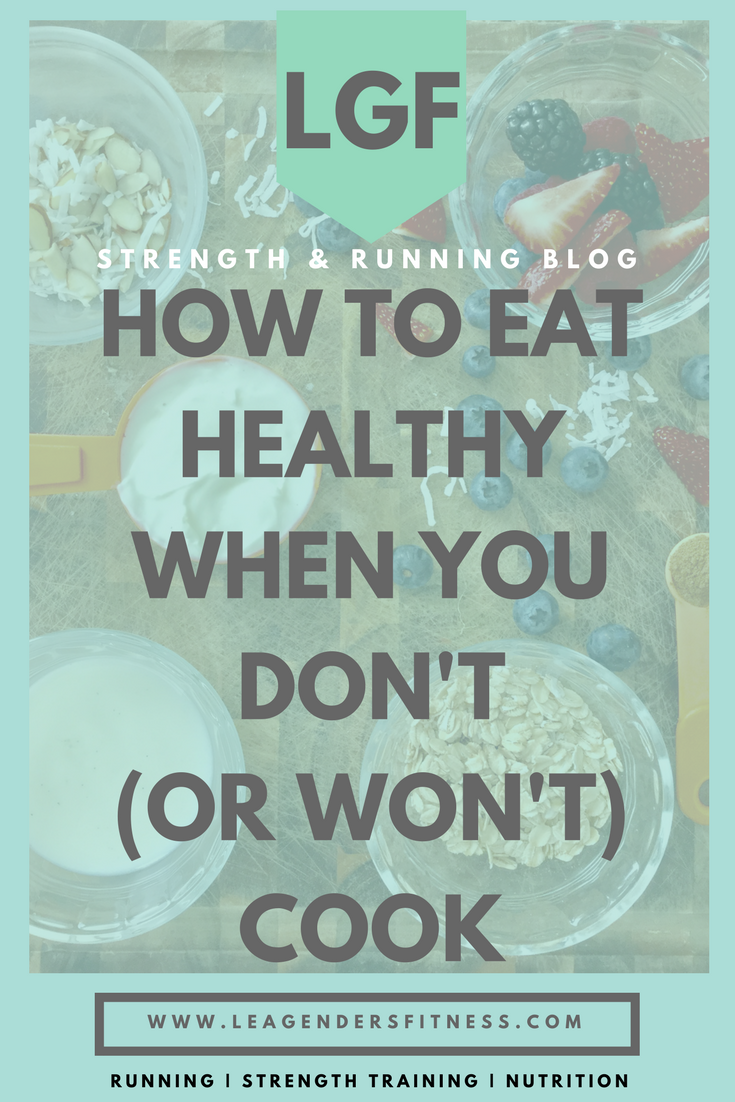
How to Eat Healthy When You Don't (or Won't) Cook

You want to eat more healthfully, you just have this one limiting factor, you don't cook...or you don't want to cook. Who has the time anyway? It's just so much easier to order takeout, go out to a restaurant, or hit the drive-through. Right? Not so fast. Eating healthfully doesn't have to be complicated or time-consuming.

I get it. Unless you have your own personal chef or are married to one (or a wannabe one, like me), then preparing healthy meals can seem like a huge undertaking. I am not a cook. My husband likes to joke that I could burn cereal. He thinks that since I am part Italian, I should have inherited amazing cooking skills passed down genetically from the generations. Not so much. It's not unusual that I call my more domesticated sister and ask her a random cooking question that leaves her laughing on the floor. "What does it mean when the recipe says to ...."

I'm no cook, but I learned how to get around my handicap years ago. You can eat healthfully, even when you don't know how or want to know how to cook. It doesn't even take a lot of time, just a little planning. If you stick to the basics, you can eat healthfully, even when you don't (or won't) cook. 

I used to have a friend who would go all-out and make these extravagant healthy meals for her family that would take hours to prepare, but when she didn't have the time or energy to prepare those meals, she would resort to ordering pizza because it was easy. It's fine to have an occasional indulgent meal, but there is no need to use time or energy as an excuse to eat unhealthy foods. There are plenty of choices in-between that extravagantly prepared healthy meal and pizza delivery. It's not a choice between eating perfectly or terribly, we have a lot of healthy, easy to prepare choices in the middle. 
 

HOW TO EAT HEALTHY WHEN YOU DONT OR WONT COOK.png

MEAL PREP

Meal prep is a great way for people who don't have a lot of time to prepare their meals for the week. When you put in the effort upfront, it is easier to make a healthy decision during the week. I know what you are thinking. "Lea, I just told you I don't cook and now you're telling me to meal prep? What part of 'I don't cook' didn't you understand?" Hear me out.

If you make your food upfront you only have to cook once and you're set for the week. Bake your lean protein in bulk. I buy two pounds of chicken at a time and bake it in the oven (at 350 for 30-35 minutes, add dab of butter so they don't dry out) or I ask hubs to cook on the outdoor grill. Freeze the leftovers. You can add cooked chicken to salads, to whole wheat wraps or pair with a side of healthy carbs or vegetables.

Cook your chicken in advance then prepare and serve it different ways to avoid boredom (see below for ideas). 

DSC_0832.JPG

CROCKPOT MEALS

I don't watch 'This is Us' but even I heard about the Crock-Pot story. Don't throw away your Crock-Pot just yet. Slow cookers are an easy way to meal prep because you add lean meat (healthy. check.) and veggies (healthy. check.) in a pot, turn it on, walk away and it cooks all by itself. A quick Pinterest search will give you tons on recipes (i.e. ingredients to add to the slow cooker). Make more than you need and freeze the leftovers for a quick meal for the future. 

ROTISSERIE CHICKEN

Buy a fully-cooked rotisserie chicken from the grocery store for already prepared protein to add to your meals. No cooking required.

BUFFET/SALAD BARS

My friend at work gave me this idea. She buys her cooked meats from buffets and salad bars from stores like Whole Foods or Central Market. If you don't want to or don't have time to cook it is a quick (albeit, more expensive) way to grab some healthy protein for your meals.

BUY FROZEN FOODS

OK, fine. You really don't want to do anything that even resembles cooking. Frozen foods from the grocery store may be the answer. Make sure you check the ingredient list that there are not a lot of added ingredients and preservatives, but food manufacturers are making frozen food more natural now due to customer demand! Don't trust the packaging marketing though, the words "all-natural" on the front of the package means next-to-nothing. Read the ingredient list on the back of the package and choose products with just a few ingredients that you can recognize. Again, it's not all-or-nothing, a frozen meal is still usually a healthier option than a fast food meal. We are not striving for perfection, just better. 

FROZEN VEGETABLES

Frozen vegetables are picked at their peak ripeness and are just as healthy as fresh. Buy the microwavable steamable veggies for a quick and healthy side dish. Don't be afraid to add seasonings, butter or cheese for flavor. Remember it's not a choice between steamed no-flavored vegetables or no vegetables at all. Eat your veggies. How can you make it work for you? 

FROZEN MEAT

I buy all-natural frozen turkey or chicken patties that can be cooked on a frying pan in 8-15 minutes, no actual cooking skills required. You can also buy the precooked chicken breasts that just need to be defrosted. 

EAT FRESH

The good news is that you don't have to cook in order to eat one of the healthiest meals out there, salads! Chop a variety of colorful veggies and add to spinach leaves for a nutrient-dense meal.

FOOD DELIVERY SERVICES

If you really don't want to cook you can have healthy meals delivered or make meal prep easy by using one of those services that send all the ingredients and the recipe card for an easy to follow dinner with no grocery shopping required, like Hello Fresh or Blue Apron. These may be a little more expensive, but a great choice for people who are just too busy to research and shop for their own meals.

HEALTHY AND EASY LOW-PREP IDEAS FOR EVERY MEAL.png

EASY LOW-PREP IDEAS FOR EVERY MEAL

BREAKFAST

Eggs can be cooked on a frying pan in just a few minutes, hard-boiled in 12 minutes, or microwaved (make sure you completely break up the yolk to avoid an egg-plosion before microwaving) in about a minute.

Protein shakes are an easy option when you don't have time to cook. Add protein powder, fruits, and veggies (try spinach!) to a blender for a quick and healthy breakfast on the go, here are some protein shake ideas from my Running with Ollie blog.

Old-fashioned oatmeal can be cooked on the stovetop or in the microwave. Buy the plain old-fashioned oatmeal in the canister and add fruit, berries, and/or cinnamon for natural flavoring. You can prep delicious oatmeal in advance with overnight oats.

LUNCH

Whole wheat wraps with prepared chicken or pouch tuna.

Add chicken to fresh spinach and chopped veggies for a delicious salad. Premake salads for the week in mason jars for a quick healthy lunch on the go.

DSC_0693.JPG

Use a whole-wheat pita as a pizza crust, add sauce, cheese, chicken, and load up with veggies for a healthier pizza lunch. 

DINNER

Frozen turkey burgers cooked and served on a whole-wheat flat bun is a delicious high-protein healthy meal in about 10 minutes.

Add chicken to brown rice, vegetables, cheese, and salsa for a Mexican-style burrito bowl. You can buy microwavable brown rice for a quick meal. 

Add low-sugar red pasta sauce to chicken for an Italian-style meal. Try a spiralizer to make noodles out of vegetables (no cooking skills required!).

Add chicken to a big bowl of fresh spinach and colorful chopped veggies for a delicious nutrient-dense meal. 

SNACKS

Cottage cheese, plain Greek yogurt (flavored with fresh fruit or berries), nuts, seeds, and fruits all make quick and healthy snacks.

The key thing to remember is that healthy cooking (and healthy living in general) is not all-or-nothing. Do the best you can what is reasonably available to you at the moment. You don't have to eat or cook perfectly to see results. Be mindful of your choices and try to choose 'just a little bit better and you'll do fine overall. The choice is never just between the perfect healthiest choice or the nutritionally worst choice possible, there are a whole lot of options in the middle. Be mindful. Do the best you can and it will always be enough. When you mess up (we all do, we're human after all) pick back up and try again at your next meal. 

WORK WITH ME
Lea signature.jpg

Coach Lea

Like this post? Do you know one person who could benefit from reading it? It helps me grow when share with your friends and followers. 


10 RUNNING SONGS ABOUT RUNNING TO POWER YOU THROUGH YOUR NEXT RUN

There is nothing I love more than popping in my headphones and hitting the road to combine my love of music with my love of running. I often get lost in the music when I am out for a run. I appreciate the beat that pushes me to go a little faster and the lyrics that suddenly all seem to be about running. Maybe I have one-track running mind when I'm out on the road but I use those lyrics to motivate me to keep going, to run faster or to finish strong. 

I know all these songs are not intended to be about running but I change the context for my own purpose, to push me through my long run or across the finish line a little bit faster. If you're an alternative rock music fan like I am, I think you'll enjoy my songs about running (even if they're not really about running).

10 running songs to power you through your next run.png

SONGS FOR THE BEGINNING OF YOUR RUN TO MOTIVATE YOU TO GET STARTED

Cake: The Distance. “He’s going the distance. He’s going for speed. She’s all alone. In her time of need. Because he’s racing and pacing and plotting the course. He’s fighting and biting and riding on his horse, He’s going the distance.”

Foster the People: Pumped up Kicks “All the other kids with the pumped up kicks, You better run, better run." 

Florence + the Machine: Dog Days Are Over “So you better run. Run fast for your mother, run fast for your father. Run for your children, your sisters and brothers.”

The Downtown Fiction: I just wanna run " I just wanna run (run run run) I just wanna run (run run run)"

SONGS FOR THE MIDDLE OF YOUR RUN TO ENCOURAGE YOU TO STAY STEADY

The Kills: U.R.A. Fever “You are a fever, You are a fever, You ain't born typical…..Left right, left right, keep it up son” 

The Dead Weather: Jawbreaker "I run so far away from you. Don't matter where I've been. Run around the world from you. And here you are again."

Meices: Ready Steady Go "Ready steady, go. Ready steady, ready steady, ready steady, ready steady
Ready steady, ready steady, ready steady, go."

Raconteurs: Steady as She Goes "Steady as she goes (steady as she goes). Steady as she goes (steady as she goes).

SONGS FOR THE END OF YOUR RUN TO FINISH STRONG

Young the Giant: My Body. “My Body tells me no, but I won’t quit cause I want more, cause I want more." 

White Stripes: Stop Breaking Down "Everytime I'm walkin', down the streets, some pretty mama she starts breakin' down. Stop breakin' down, yes stop breakin' down."

Awolnation: Burn it Down "Burn it down, baby, burn it burn it down." (I change the lyrics in my head to "run it home, baby, run it run it home" and is the perfect uptempo song for a strong finish.)

What do you think? Did I miss any running songs about running? What song is your favorite on your running playlist. Let me know in the comments or on twitter.

Like this post? It helps me when you share with your friends and followers.

Lea signature.jpg

4-3-2-1 COUNTDOWN INTERVAL RUNNING WORKOUT

Welcome to the latest edition of workout wednesday when each week I share a new running or strength training workout. This week we are talking about running intervals. If you are trying to improve speed and efficiency for your runs, then speed intervals are your new best friend.

Interval workouts are appropriate for runners with a solid running base (consistent three to four easy runs a week for four to six weeks). 

This workout is based on feel, so throw your GPS watch in the trash (ok, that thing is expensive, don't do that) or just turn off the settings so your pace doesn't show on the screen. This isn't about matching a certain pace, it's all about effort. 

Hard effort means you are breathing heavily and could not hold a conversation without taking gasps of breath between sentences or words if you tried to talk to your running partner. (my running partner doesn't talk back.) It should be challenging, but not so challenging that you can't hold the pace for four minutes. In other words, don't attempt an all-out sprint on your first hard effort interval. In the world of hard effort intervals four minutes can feel like an eternity. Pace yourself appropriately. It probably will take some experimenting to the find the proper pace, run as fast as you can while still maintaining the pace for up to four minutes. 

During your recovery intervals either slow to a jog or a walk to catch your breath. 

This workout can done in under 20 minutes. I suggest a dynamic warm up before any running workout and then jog for a few minutes before heading into your first interval. 

This is a great workout for a treadmill or with a timer on the street or track.

4-3-2-1 COUNTDOWN INTERVALS RUNNING WORKOUT

warmup
4 minutes hard effort
2 minutes recovery effort
3 minutes hard effort
2 minutes recovery effort
2 minutes hard effort
1 minute recovery effort
1 minute hard effort
1 minute recovery effort
cool down

4-3-2-1 countdown interval running workout. save to Pinterest for later.

4-3-2-1 countdown interval running workout. save to Pinterest for later.


Cool down with a jog or walk until your heart rate returns to normal. Most athletes only need to perform high intensity workouts like this once or twice a week. Always allow at least 48 hours between hard workouts and get adequate rest and recovery. Adaptation (getting faster or stronger) happens during the rest after the workout, not during the workout itself. If you don't allow your body the proper time to recover and rebuild you will never see the full benefit of your hard work. 

Try this workout and let me know how it goes in the comments or on Instagram or Twitter

Like this post? Can you think of one person who may benefit from this workout? It helps me grow when you share with your friends and followers.

Lea signature.jpg

10 Daily Healthy Habits that will Change Your Life

The truth is that most people know what they should be eating in order to lose weight. Most of us know that if we limit processed foods, avoid excess calories and focus our diets around whole foods from nature that weight loss will follow.

It's not about what you know, it's what you do. Most people know. Most people don't do. 

Why? Because behavior change is hard. Over time the foods we choose, prefer and consume become ingrained habits that are difficult to change. We order pizza on Friday night because that's just what we do. We hit the drive through on the way to work in the morning because we don't have time to cook breakfast. Two glasses of wine with dinner? It's our habit. We choose what is easy, what is convenient and what feels good. It's human nature. 

10 HEALTHY HABITS THAT WILL CHANGE YOUR LIFE.png

The key to sustainable weight loss is to change your habits, so that what is easy, convenient and what feels good is the healthy choice. It's not a quick fix. In fact, it is a slow process. It takes time and work, but when you develop new habits you change your brain and body from the inside out for sustainable fat loss. 

The mistake most people make is that they get fed up with feeling sluggish and overweight and they wake up one morning and decide to change their whole life in one day. No more processed foods, no more sugar, no more alcohol and while we're at it, no more carbohydrates. That should do it. Except it rarely works that way. After a few weeks or a few days (or few hours, let's be honest) we get overwhelmed with all the changes, we crave our old favorites or we face a temptation and we go back to what feels easy, what is convenient and what feels good. 

What if instead of severely limiting your calories or cutting out entire macronutrients (like fats or carbohydrates) you worked on changing your daily habits so that you became more mindful of your choices? What if you didn't try to change everything at once for rapid weight loss that isn't sustainable?

It's not sexy. It takes time. It takes work, but would you rather lose 20 pounds in 12 weeks and put it back on (plus more) 12 weeks after that because you lost it too fast and lost muscle too? (Been there, done that. Not fun.) Or would you rather lose 20 pounds over 20 weeks (or 50 pounds over 50 weeks) and have it stay off for life? You win when you play the long game. 

Throw away your scale (it only tells a portion of the story anyway) focus on your daily habits and the results will follow. 

What kind of habits am I talking about? 

10 HEALTHY HABITS THAT WILL CHANGE YOUR LIFE

1. The habit of daily movement

2. The habit of eating vegetables with every meal

3. The habit of eating lean protein with every meal and snack

4. The habit of packing your lunch for work or school

5. The habit of weekly meal prep

6. The habit of cooking/eating meals at home

7. The habit of eating slowly

8. The habit of replacing highly processed snacks with healthy snacks

9. The habit of eating until satisfied (then stopping)

10. The habit of sleeping well

Don't try to develop all these habits at once. Start at the top of the list and work your way down. They say it takes 21 days to form a new habit, I just gave you 210 days of habits to work on. Just image the changes that will follow if you master the above habits. It's not easy, but it's worth it.

HEALTHY HABITS TRACKER.png

I created this worksheet to help you track your new habits. The idea is that for week one and two you work on the first habit and check off every day that you complete it. On week three and four you add in a new habit while continuing your week one and two habit. Every two weeks you add in a new habit while continuing to work on existing habits. Will you check off every single day? Probably not. The idea is to bring awareness to the new behaviours you are trying to learn. By the end of 30 weeks you will have worked on establishing 10 new habits that can change your life. 

Do it yourself and watch what happens. Need help? Need accountability? My online nutrition habits program from Precision Nutrition is a year long curriculum that walks you through habit change step by step, day by day. Spend 15-20 minutes a day working on habit change for long term sustainable results. Interested? See if you would be a good fit for the program by filling out this questionnaire. Like what you see? The first month is 75% off to try. No contracts, no long term commitment, except your own commitment to give it your best effort. It's not easy, but it is life changing.  

Like this post? It helps me when you share with your friends and followers.

Lea signature.jpg


The Four Pillars of Optimal Running Performance

One of the reasons I love running is because it is a sport that is accessible to most reasonably healthy people. Buy a good pair of shoes and start running. Sure, there's a lot to learn along the way, but most people can just strap on a pair of shoes for the first time and begin their running journey. 

As a running coach I've come up with the four pillars of optimal running performance. If you want to optimize your running performance, it's important that you are working to improve in these four areas. This is especially helpful If you have been running for a while and looking to take your running to the next level or if you've been wondering why you have not been improving. When I work with new running clients, one of the first things we do is review if there is room for improvement in any of these areas.

Yes, you can strap on your shoes and start running, but if you want a long, healthy and successful running journey, you'll do best to make sure you are not neglecting any of the four pillars of optimal running performance.

the four pillars of optimal running performance. save to pinterest for later

the four pillars of optimal running performance. save to pinterest for later


PILLAR ONE: PACE VARIETY

If you want to be a better, faster, stronger runner then your first fitness priority should be running. You have to put in the miles on a regular basis, week after week. Once you build a running base (at least three times per week for four to six weeks) it's important that you vary your training paces for optimal running performance. In addition to your base runs at conversational pace, work to include one of two of the below effort runs into your training schedule each week. 

TEMPO RUNS

Tempo runs are completed at a pace that is comfortably-hard. It's slower than a sprint or a speed interval, but faster than what is comfortable. It should be a pace you can maintain over a few miles. During tempo runs, you should be able to get a word or sentence out, but not able to hold a full conversation without gasping for breath. Experiment with pacing to see what feels right for you. Comfortably-hard is the goal for tempo runs. Tempo runs help you improve your aerobic capacity, which means you are training so that you can run faster with less effort in the future. 

HILL RUNS

Hill training is great for new (and experienced) runners who are ready to introduce high intensity training into their workouts without worrying about running specific paces or intervals. Hills build runner-specific strength and speed. Find a hill with a visible incline and practice running up the hill at a moderate pace and recovering with a walk or jog back to the bottom. Find a hill that takes you 45 seconds to a minute to run from the bottom to top. Start with 3-4 hill repeats and build up to 8-10 over time. I wrote a post in more detail about hill training, click here to learn more. Runs hills a few times and your runs on flat ground will feel easy peasy. 

INTERVALS

If you always run the same pace, you don't teach you body to run faster. Intervals can be shorter bursts of fast running or longer intervals of fast running between periods of recovery, depending on your goals. 

Marathon runners see the best performance results on race day by including long intervals (1/2 mile to two mile of faster paced segments) in their training plan. 5K runners may see improvement by including short intervals of 30 seconds to one minute repeats. 

LONG RUNS

Build endurance and train your body to run farther by incorporating long runs into your training schedule. Slow your pace by 30 seconds to 1 minute per mile than normal when you are increasing your distance. Increase your long run distance by no more than 10% per week. A good way to start is to add a half mile to a mile to your long run every week for three weeks, then back down to a shorter distance on the fourth week to allow your body to recover. Repeat the cycle every four weeks until you reach your goal distance. Never increase both intensity (run pace) and volume (run distance) in the same week to avoid injury and additional stress on your body.

PILLAR TWO: NUTRITION

You're running on a regular basis, you're including some varying paces in your training week. In order to perform your best, it is important you you fueling properly for optimal running performance.

Focus on the quality of food, by consuming mostly whole foods from nature. Limit highly processed foods. Consume quality food in proper portions for best results. Take a cue from Goldilocks. If we eat too much we feel bloated and sluggish, if we don't eat enough, we may have low energy and poor performance. Find your own unique balance.

CARBOHYDRATES

While there may be a lot of hype around low-carb diets, most athletes perform best while consuming appropriate amounts of high-quality carbohydrates. Our body's preferred energy source is carbohydrates and if you limit the carbs you eat before or after your training runs, you may be limiting your performance. (Of course, there are exceptions, but most athletes thrive on whole foods carbohydrates.) The key is to choose the whole foods carbs from nature (potatoes, oatmeal, fruit, vegetables) in proper portions. For most athletes, a serving is one or two fist sizes of high-quality carbohydrates. Sorry folks, that overflowing plate of pasta and a basket of bread isn't what I mean.

It's smart to limit processed carbs. It's smart to be mindful of the number of carbs we are consuming. It's smart to consume most of our daily carbs around our workout times. It's not optimal to remove carbs altogether. Learn more in this post called how to cut carbs without cutting your sanity. The key is to find the right balance of carbohydrates for your training goals.

It may take some experimenting to find the right balance for you. Take note of how you look, feel and perform and adjust your nutrition accordingly.

PILLAR THREE: STRENGTH TRAINING

Strength training for runners, my favorite topic to go on and on about. I built a whole blog and business around the notion that runners need to strength train. Runners who strength train are stronger, faster, and less prone to injury. You don't have to spend five extra hours a week inside of a gym. (Who has time for that?) Work in three to five 20 minute full-body strength training sessions a week (either on non-running days or on easy running days) to build runner-specific strength. Focus on core/hip strength moves that include balance, lateral, and rotation moves to become a stronger runner. Don't neglect stretching, foam rolling, and mobility work. It's all part of the program. Balance your running with strength training to become a more well-rounded athlete. 

PILLAR FOUR: REST

The four-letter word, every runner loves to hate. R-E-S-T. Resting is not laziness. Rest is as important to your training plan as your scheduled workouts. Your body adapts (gets stronger and faster) during the rest period after the workout, not during the workout itself. You must allow your body the time it needs to repair and rebuild your muscles. If you don't rest, you will never see the full benefit of your hard work and you may risk injury, burnout or overtraining. Take a day or two to recover each week, your running performance depends on it. 

Give yourself a break between hard workouts and long runs. Never do high-intensity workouts back to back, give yourself a rest day or lower intensity day between hard workouts. Most athletes only need one or two high-intensity days a week to see improvements.

SLEEP

What does sleep have to do with my running performance, you ask? Everything! A lot of your body's recovery processes happen during sleep. Having trouble recovering from workouts? Not losing weight? Trouble managing stress? Sleep quality and quantity may be to blame. When it seems like you're doing everything right in regards to nutrition and exercise, but you are not seeing the results you desire, look closely at your sleep patterns. Aim for 7-8 hours of sleep for best results. 

Do you have all the pillars of optimal running performance covered? Need help?

WORK WITH ME


Like this post? It helps me when you share with your friends and followers.
Lea signature.jpg