THE DOS AND DON'TS OF STRENGTH TRAINING FOR RUNNERS

You're a runner and you heard that strength training is important for runners. You know you should be including strength training, but you've not quite figured out how to make it all work in your training schedule. It's easier to just lace up your shoes and go out for a run than it is to figure out how to add in strength training. You don't exactly have spare time laying around like your husband's socks. If you're going to do this it has to be quick and effective. 

Strength training for runners is important, not only for injury prevention, but for your running performance. Strength training will help you become a strong and faster runner. It can be the difference between a potential injury and new PR.

But strength training for runners is not the same as strength training for muscle growth or strength training for other sports. Runners need running-specific strength. What does that mean? Let's explore the Dos and Don'ts of strength training for runners. 

the Dos and Don'ts of strength training for runners

the Dos and Don'ts of strength training for runners

THE DOs of STRENGTH TRAINING FOR RUNNERS

Do include exercises in all planes of motion 

When we run, we are moving in one plane of motion (the sagittal plane, forward and backward). When we pound out the miles week after week we can develop muscle imbalances because we don't develop strength in the other planes of motion, which can lead to injuries. The best way to injury-proof your running is to include strength exercises that include lateral and rotational exercises to cover the frontal and transverse planes respectively. Try incorporating side lunges, curtsy squats, one leg lift and chop and plank to side plank.

Do full body exercises at least twice a week

For best results, do full body exercises at least twice a week. This can be two 30 minute sessions or four 15 minute sessions. Any less than twice a week, you won't get the full benefit of the strength work (although I will argue that something is always better than nothing). 

Do single leg and balance exercises

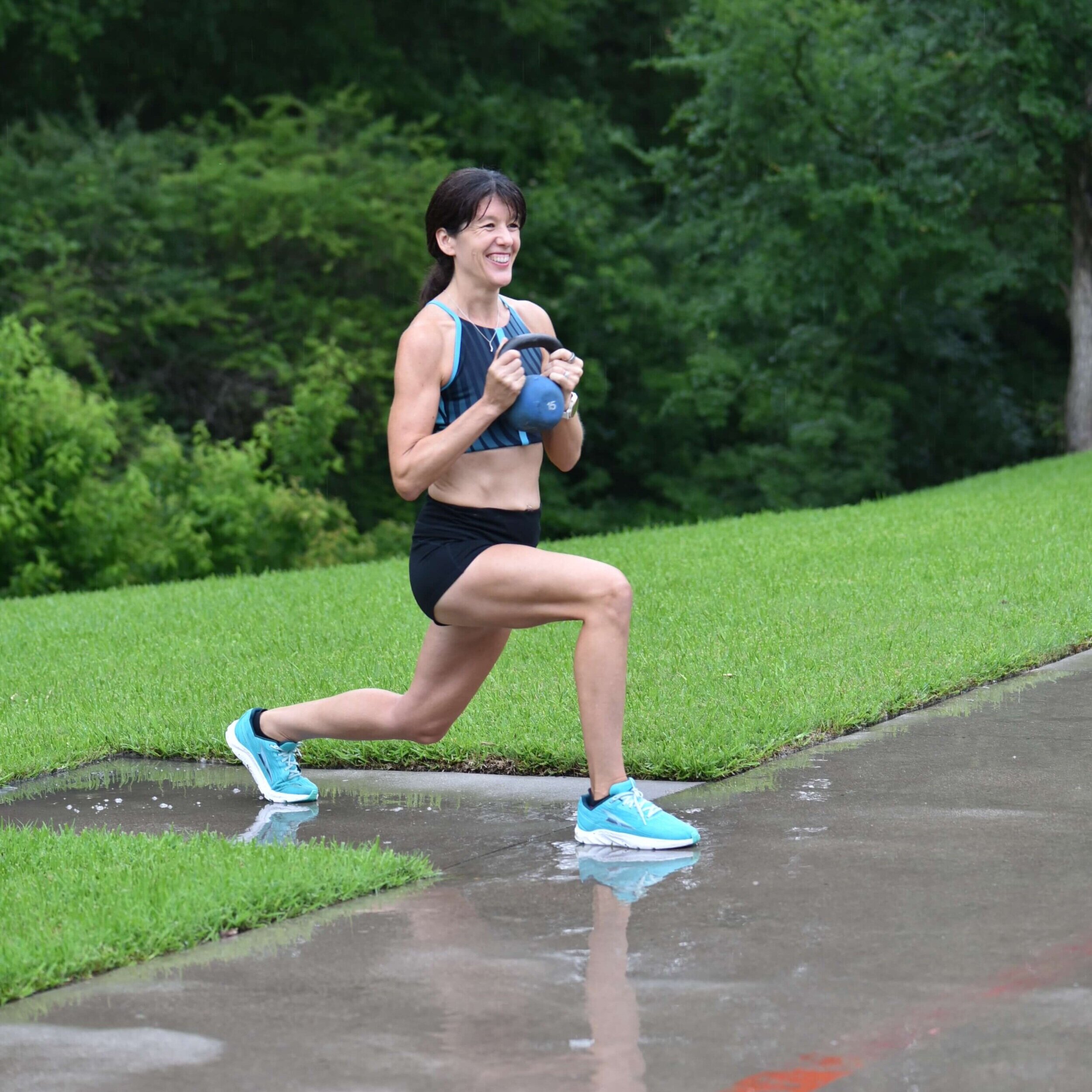
Runners benefit greatly from unilateral (single leg) exercises like single leg deadlifts, lunges and single leg lift & chop. When we run we are repeatedly balancing on one leg at a time over the miles. When we build single leg strength and develop strong balance our running performance will improve.

Do multi joint exercises

We want to get the most bang for our strength training buck so we can get it done and get back on the road, right? Multi-joint exercises are more effective and efficient because they work multiple muscles in one exercise. Squats, deadlifts and lunges are all great examples. Skip the bicep curls and the leg extension machine and choose multi joint exercises instead.

Do be consistent

Strength training only works if you do. If you do your exercises one week, but then skip two weeks, you won't see the full benefit of your work. It's more important to be consistent than anything. Even if you can just do 10-15 minutes at a time, work to maintain consistency in your strength training. 

THE DON'TS OF STRENGTH TRAINING FOR RUNNERS

Don't neglect your upper body

It may seem like that as runners we only need to build a strong lower body, but strong arms, back and shoulders power our stride and provide stability for our running form. Push ups, rows and shoulders presses should be included in your strength training for runners plan.

Don't spend hours in the gym

Don't waste any time in the gym. Runners do best to work in a circuit fashion, which means to move from one exercise to the next with little to no rest between exercises. Complete a set of exercises moving between lower body and upper body movements. For example, perform a set of single leg deadlifts, followed by a set of push ups, followed by a set of rows and finish up with lateral lunges. Once you complete all the exercises, take a brief break and repeat the circuit one or two more times. Bodybuilders need long rest periods between sets, runners do not. More quickly, but slow enough to keep proper form. 

Don't do hard running workouts and strength workouts in the same day

If you run hills, intervals or a long run and then attempt a strength workout, your strength workout will suffer and you could end up injured, overtrained or burned out over time. It's better to schedule strength training on days that you are not running, or on easy effort running days. I will do a strength training session in the morning of a day that I have an easy three mile run on the schedule. Never do strength training and running on the same day if the total workout is more than an hour and a half. At that point, the risk for injury starts to become greater than the benefit of the workouts.

Don't ignore pain

No pain no gain is bull crap. Push through discomfort, push through breathing heavily, push through muscle burning, never ever ever push through physical pain during running or strength training. Pain is your body signaling you that something is wrong. Always listen to pain. Learn to tell the difference between feeling pain and feeling discomfort.

Don't neglect rest days

I know it can be challenging to fit everything in: the miles, the strength training and the rest. Always take at least one full rest day a week (sometimes you may need two or even three). If you have to cut something out of the schedule to make it work, never cut out the rest day. We adapt to exercise (get stronger and faster) during the rest periods after the workout, not during the workout itself. If you don't allow your body the proper time to recover you won't see the full benefits of your hard work. I know that sometimes for runners, the rest is the hardest part, but it may just be the most important day of your training schedule. 

Got it? Good. Need more help or individual attention? If you live in Fort Worth, at the time of this post, I have openings for strength training sessions to improve running performance and fat loss. Live outside of Fort Worth? Contact me to learn about how we can work together online. 

Like this post? It helps me when you share with your friends and followers.


Questions? I'd love to help. 

COACH LEA


Unilateral Single Dumbbell Exercises for Runners

Welcome to the latest edition of Workout Wednesday when each week I share a new running or strength training for runners workout. 

This week we are focusing on unilateral strength, that means working on one side at a time. When we run we repeatedly balance on one foot at a time for the duration of our workout. Building unilateral strength improves our running performance and helps to avoid muscle imbalances that can lead to injury.

These exercises just require one dumbell. I recommend an 8 to 12 pound dumbbell to start. 

Move through each exercise in a circuit style. Complete the reps assigned and move on the next exercise with little to no rest. Move quickly, but go slow enough to maintain proper form. This is not a race against the clock. Once you complete all eight exercises on both sides, rest for a minute and repeat the circuit one or two more times. 

unilateral single dumbbell exercises for runners.png

PLANK ROWS

A plank row is an effective exercise for runners. A plank requires core stability and the row movement with a dumbbell builds strong back muscles. A runner needs a strong back to power the stride and maintain running form over long distances. This is a tough move that will build runner-specific strength and stability in the core/back. 

Start in a straight-arm high plank position with your wrists directly under your shoulders and your legs slightly wider than hip width for stability. Keep your body in a straight line from your shoulders to ankles while engaging your core. Do not allow your hips to hike up or sag down.

Hold a weight in one hand on the floor. With your core tight and your glutes engaged keep your elbow pointing up towards the ceiling and close to your side as you pull the weight up from the floor. Do not allow your body to rock as you row. Hold everything steady. Perform the reps on one side, then repeat on the opposite side.

ELBOW PLANK TO SIDE PLANK

The elbow plank to side plank exercise is a rotational core stabilization move. It's important for runners to have a strong core in all planes of motion to maintain proper running form and avoid imbalances. 

Begin in a low forearm plank position. Position your elbows on the floor with your hands flat on the floor and your shoulders directly over your elbows. Do not clasp your hands in front of you. Your body should be in a straight line parallel to the floor. Engage your core, pulling in your belly while breathing normally. Be careful not to sink your hips or raise your butt in the air. 

Twist to the right to move into a elbow side plank position keeping your right leg in front of your left for stability. Reach your arm to the ceiling and hold for 3-5 seconds before returning to plank position. Repeat on the right side for the assigned reps, then switch to the other side. 

WEIGHTED SIDE LUNGE

Runners move in one plane of motion, forward, so it is important to build lateral strength in the frontal plane to avoid muscle imbalances that can lead to injury. This side lunge exercise strengthens the important but often overlooked gluteus medius muscle using a dumbbell on the opposing lunged side.

Face forward with toes pointing straight ahead, hold a weight in your left hand and take a wide step out to your right side. Push your hips back, bend your right knee while straightening your left leg. With your back straight and chest up, hinge at your hips to bring the weight in your left hand to touch the floor next to your right foot. Do not round your back or allow your knee to move forward beyond your toe. Be sure to keep your torso facing forward. Perform the assigned reps, then repeat on the other side.

SINGLE LEG LIFT AND CHOP

This is an effective balance and rotational exercise for runners. Building both balance and rotational strength is essential for runners. 

Stand on your right leg with your knee soft (not locked) and grip the weight on each end with two hands. Reach your arms straight up over your right shoulder and slightly twist your torso to the right. Bring the weight across your body and down towards the outside of your left knee by rotating your torso and shoulders. Perform the reps then stand on the other leg and repeat on opposite side. 

SINGLE LEG DEADLIFT

Building unilateral hip strength is highly beneficial for runners. The single leg deadlift builds single leg/hip strength and balance. 

Standing on one leg, keep your knee slightly bent and perform a deadlift by hinging at your hip while keeping your back straight and neck neutral. Extend your free leg behind you in line with your body. Grip the weight on each side with two hands and lower until your back is parallel to the floor. With your back straight return to the upright position. Perform the reps on one side then repeat on other side.

STATIC LUNGE TO SINGLE ARM SHOULDER PRESS

Performing a single arm shoulder press in a kneeling lunge position requires core strength and stability. Get the most out of your workout by challenging your core while you perform the exercise.

With your feet hip width apart and your toes pointed straight ahead, engage your core and keep your back straight. Take one large step with your right leg to lunge forward until your front knee is lined up over your ankle and your back knee is on floor (in a "will you marry me" position). Do not allow your front knee to move forward over your toes. Resist the urge to lean forward or rest your arms on your thighs. 

Once you are in the lunge position, hold the weight on the same side as your back kneeling leg. Press the weight from the shoulder to the ceiling by straightening your arm. Squeeze and hold your glute muscles (while breathing normally) as you raise your arm to press the weight up to the ceiling. Perform all of the reps on one side, return to standing, then lunge with the other leg and repeat the reps on the other side.


Give it a try and let me know it goes. Do you ever do runner-specific strength training? Questions? I'd love to help. 

COACH LEA

Like this post? It helps me when you share with your friends and followers. 
Ditch the Diet: Learn to Listen to Your Body for Effortless Weight Management

Are you hungry or bored...or something else? One of the most effective ways to take back control of our eating habits is to learn to listen and interpret the signals our body sends. Our body is a communication machine. It tells us what it needs. We just need to learn to tune in and listen. 

It's not an easy task. We may have been ignoring those signals for years. Mindless eating, crash diets, food restriction, and the “good” versus “bad” food mindset can corrupt the way we respond to our body's signals. On top of that, manufacturers develop processed foods that are designed to be hyperpalatable (aka delicious) so you are encouraged to overeat.

Do you remember the Pringles potato chip commercial? "Bet you can't just eat one." They let us in on a major food manufacturer's secret. These processed junk foods are specifically designed to be irresistible, to override our body's natural signals so we eat too much and ultimately buy more. It's all part of the plan. Junk food is manufactured so you can't just eat one.

Have you ever opened a bag of chips with the intention of eating "just one serving" (according to the serving size on the back of the package is eight chips) but then didn't stop until you were licking chip dust from the bottom of the bag? What? Just me? I didn't think so. 

Instead of trying the latest fad diet that's all over the internet or restricting entire macronutrients (cough cough, carbs), first try to listen to your body and see what happens. Our body knows what it needs and it tells us, we just have to learn how to listen. Effortless weight management can happen when we tune in and respond.

DITCH THE DIET.png

LISTEN TO HUNGER SIGNALS

The first step is to consider the hunger signal our body sends. When you feel hungry can you tell the difference between physical hunger and psychological hunger? Are you hungry or bored? Are you hungry or does there happen to be a candy bowl within arm's reach? Are you hungry or do you just smell fresh baked cookies? Are you hungry or are all your friends eating Mexican food? Are you hungry or stressed? Learning to recognize the difference is a big first step in taking control of your eating habits. 

Try this exercise: When you feel hungry, stop and consider am I hungry or is something else? 

Am I Hungry?

Am I Anxious? 

Am I Lonely?

Am I Tired?

That spells H.A.L.T. Before you eat, HALT for five seconds and think first about why you are eating.

Awareness in thes first step. Keep track for a couple of days how you felt before you ate something, either a meal or a snack. Taking note of how you feel before eating over a few days can help you see trends in your eating habits. 

Maybe you recognize that you are eating because you are bored. It doesn't mean you have to immediately stop eating every time you are bored, but recognizing the difference between hunger and boredom is a great first step in learning to listen to your body.

On the days I work from home, I wander through the kitchen on my breaks from writing and pop something in my mouth at every round. Am I really hungry every 45 minutes? Did I need to eat that cheese stick, handful of grapes or nuts to satisfy my hunger or did I eat it because it was there and convenient? Most likely the latter. Knowing is the first step to changing.

If you are trying to lose weight (lose fat) then your daily goal is to be in a calorie deficit, to consume less calories than you burn for the day. Even if all your meals are on track, you can throw yourself out of a calorie deficit into a calorie surplus by mindless eating. The candy from your co-workers desk, the leftovers from your kid's plate and the pre-dinner and post-dinner snacks, they all add up. 

EAT SLOWLY

Once you determine that you are physically hungry and ready to eat, the next signal your body will send is a satiety or fullness signal. This one can be especially hard to hear because in our busy lives we tend to do everything at lightning speed, including eating. 

It takes about 20 minutes for the body to send fullness cues to the brain, so if you scarf your dinner down in four minutes flat, you never give your body the opportunity to communicate the signal that tells you it has had enough. You can overeat before you realize it. 

The solution? Slow down. Chew slowly. Put your fork down on your plate between bites. Savor every bite. Take a sip of water between bites. This is not a pie-eating contest. Set a timer. Plan to eat meals slowly and undistracted. Turn off the TV, put down the phone and step away from the keyboard. Give your meals the attention they deserve. This is more important than your Instagram feed or that email from your boss (just kidding boss, we'll call you back in 20 minutes).

EAT TO 80% FULL

Now that you are eating slowly and spending 20-30 minutes eating your meals, you can be more in tune with your body's fullness signals. Eat until you feel satisfied, not stuffed. Eat until you feel about 80% full. This can be challenging in the beginning, but with a little experimenting you can find your sweet spot. Include whole natural foods with fiber, protein, and fat to help you feel full and stay feeling full longer, so you are not hungry again an hour after you ate a meal.

IT'S OK TO FEEL (A LITTLE) HUNGER

Feeling a little bit of hunger is a natural human response. Slight hunger you can ignore is normal, especially when in a calorie deficit and trying to lose weight. When the hunger signals get stronger, usually 4-5 hours after your last meal, it may be time to feed the hunger. If you ignore the hunger signals too long, you may start to feel ravishingly hungry and that can lead to poor food choices. The key is to listen and feed your hunger signals just like Goldilocks would; Not too little, not too much. Not too soon, not too late. It takes practice.

Our body tells us when it is hungry it also tells us when it has had enough. Can you hear and interpret it properly? Once you learn to eat when you feel physical hunger rather than for social, emotional or environmental reasons, you slow down and stop eating when you feel about 80% full it becomes much easier and natural to maintain a healthy body weight.

Does all of this sound reasonable? Are you tired of strict diets, yo-yo weight gain/loss, food rules and quick fixes that aren't sustainable? Are you looking for a sane and sustainable plan that builds healthy eating habits from the ground up? Then join my online nutrition program that plays the long game for long-term results. The first month is 75% off so you can see if it will be a good fit for you. Choose between self-guided coaching at a huge discount or let me personally help you reach your goals. See if you qualify for nutrition habits coaching. 

Like this post? It helps me a lot when you share with your friends and followers.
Runners! Banish These Three Words to Own Your Run!

Runners! Stop apologizing for your runs! Ditch the disclaimers and own your run!

Are you as guilty of this? We, as runners, have a tendency to put a disclaimer on our runs. I hear it all the time, heck I even say these things sometimes...

"I know I'm not as fast as some of you but I ran my fastest mile today."

"I know it's not as far as some of you run, but I ran my longest run ever today!"

"I only ran three miles today."

"I just did the half marathon."

"I'm only running the 5K."

RUNNERS BANISH THESE THREE WORDS.png

BUT...ONLY...JUST. Runners! Stop saying these three words!

Why do we do this? In the world of social media, maybe we put a disclaimer on our achievements in case someone might try to undermine our accomplishment, we want to beat them to it. If we say it first, no one else can tell us we're not good enough. Maybe we compare ourselves to other runners and we feel like we don't measure up to the Insta-runners online. Maybe we're afraid of sounding like we are bragging about our runs. 

You know what? We should be bragging about our runs. Whether you ran one mile for the first time or you're an ultra marathoner, you should be proud. Whether you ran a seven minute mile or a 13 minute mile, you laced up your shoes, got out there and did something that was hard for you. 

IT'S ALL RELATIVE

The thing about hard work is that it is all relative. A runner completing a half marathon may be working just as hard as an elite marathoner. In fact, I'd venture to say that the newbie runner who completes their first half marathon in three hours is working harder than an elite athlete who completes a full marathon in less than that time. Slow or fast it doesn't account for individual effort and it certainly doesn't dictate whether the run was brag worthy. Did you do something that felt hard for you? Congratulations for pushing outside your comfort zone and doing hard things. You are already doing better than most.

STOP THE COMPARISON GAME

No matter where you are in your running journey, there will almost always be someone faster than you and someone slower. There will always be runners who can cover longer distances and runners that can't run as far. The truth is no one cares about your pace or distance as much as you do. Share your runs online. Tell your friends. Someone will be impressed that you are out there at all. We are all on our own journey. You know that gal online who runs an 8 minute mile? There was a time when she first started running that she was a lot slower too. Stop comparing yourself to other runners and be proud of your own accomplishments. 

BE PROUD

Own your run. Own your accomplishments. Be proud. I am proud of myself everytime I lace up my shoes. Sometimes I have great runs that feel speedy and effortless, then sometimes I have hard runs that feel like I am running on two stiff logs instead of legs. I'm still proud i'm out there trying. Running fundamentally changed who I am as a person, and I am better for it. Who would have thought that the young lady who was afraid to break a sweat would grow into a woman who regularly runs half marathons and coaches others to do the same? Certainly not me. 

It doesn't matter how long it takes you cross the finish line. It doesn't matter how far away that finish line is. It doesn't matter if you never toe the line at an official race. If you push yourself to run, then you are a runner.

“If you run, you are a runner. It doesn’t matter how fast or how far. It doesn’t matter if today is your first day or if you’ve been running for twenty years. There is no test to pass, no license to earn, no membership card to get. You just run.”
— John Bingham


Make a new year's resolution to banish the words but, just and only from your vocabulary and be proud every time you lace up those shoes. You earned it. 

Like this post? It helps me a lot when you share with your friends and followers.

Lea signature.jpg


LEGS & CORE TABATA FOR RUNNERS

Welcome to the latest edition of Workout Wednesday when each week I share a running or strength training for runners workout for you to try at home. Strength training makes us runners stronger, faster and less prone to injury, so it's a good idea for all runners in incorporate at least a little bit of strength training into their workout week. Runners should to focus on balance, single leg work, hip and core strength, while incorporating lateral and rotational moves. 

You don't have to spend hours in the gym at a time, just incorporate some runner-specific strength moves on your off running day or after an easy run for best results. 

This workout is based on a version of the Tabata protocol, which is 20 seconds of work, followed by 10 seconds of rest, repeated for four minutes. There are four rounds in this workout, so the whole workout will take you less than 20 minutes to complete including the rest periods. 

For each round you will perform:

Exercise 1 for 20 seconds
Rest for 10 seconds
Exercise 2 for 20 seconds
Rest for 10 seconds
Repeat until four minutes have elapsed. 

This post contains affiliate links, that means if you click on a link in this post and make a purchase, I make a small percentage of the sale with no additional cost to you. No one is getting rich here, it just helps with the running (pun intended) of this blog. Thanks, as always, for your support. 


Legs plus core Tabata for runners. Download a free printable version of this workout. Save to Pinterest for later

Legs plus core Tabata for runners. Download a free printable version of this workout. Save to Pinterest for later

EQUIPMENT

You can download a free Tabata app on your phone to help with the timing or use a timer like the GymBoss. 

I am using a 8lb medicine ball in this workout. You can do this workout with or without weight. 

LEGS + CORE TABATA WORKOUT FOR RUNNERS

ROUND ONE

RUSSIAN TWIST

Sit with your back at a 45 degree angle. Lift your heels off the ground to increase the challenge. Rotate your torso to touch the floor on one side, then alternate and touch the floor on the other side. You can add a weight or medicine ball to increase the challenge. Alternate sides for 20 seconds, rest for 10 seconds before moving on to the next exercise. 

BRIDGE WITH PRESS

Lie on your back with your knees bent and your feet flat on the floor. Hold a medicine ball at your chest and as you raise your hips off the floor so that your body forms a straight line from your shoulders to your knees, press the medicine ball to the ceiling. Pause at the top then slowly lower your hips back to the floor and the medicine ball back to your chest. Repeat for 20 seconds, then rest for 10 seconds before returning to the first exercise. Alternate between the two exercises for four minutes. Rest for 30 seconds to one minute before starting the next round.

ROUND TWO

ALTERNATING SINGLE LEG DEAD LIFT

Standing on one leg, keep your standing knee soft (slightly bent) and perform a deadlift by bending at your hip while keeping your back straight and neck neutral. Extend your free leg behind you in line with your body. Lower until your back is parallel to the floor. With your back straight return to the upright position. Alternate legs for 20 seconds, rest for 10 seconds before moving on to the next exercise. 

ALTERNATING LEG LUNGE

With your feet hip width apart and your toes pointed straight ahead, hold your core stable with your back straight and take one large step with your right leg to lunge forward until your front knee is lined up over your ankle, your right thigh is parallel to the floor and your back knee is nearly touching the floor. Do not allow your knee to go past your toes. Use your right leg to push back up to standing in the same position as you started. Alternate legs for 20 seconds, then rest for 10 seconds before returning to the first exercise. Alternate between the two exercises for four minutes. Rest for 30 seconds to one minute before starting the next round. 

ROUND THREE

PLANK HOLD

Start in a high straight arm plank position with your wrists directly under your shoulders with your legs wider than hip width for stability. Keep your body in a straight line from your shoulders to ankles while engaging your core. Do not allow your hips to hike up or sag down. For an additional change to your core, perform the straight arm plank with your hands on a medicine ball instead of the floor. Hold the position for 20 seconds, rest for 10 seconds before moving on to the next exercise.

MOUNTAIN CLIMBER

Start in a high straight arm plank position with your wrists directly under your shoulders with your legs wider than hip width for stability. Keep your body in a straight line from your shoulders to ankles while engaging your core. Do not allow your hips to hike up or sag down. Quickly bring your right leg, then your left leg in to touch your elbows. For an additional change to your core, perform the straight arm plank with your hands on a medicine ball instead of the floor. Repeat for 20 seconds, rest for 10 seconds, before returning to the first exercise. Alternate between the two exercise for four minutes. Rest 30 seconds to one minute before starting the next round.

ROUND FOUR

SIDE LUNGE

With both toes pointing forward, push your hips back and take a large step to your right and bend your right knee into a side lunge position and straighten your left leg. Do not allow your knees to move forward past your toes. Lower your hips as low as your flexibility will allow. Push back to starting position. Alternate sides for 20 seconds before resting for 10 seconds, then moving onto the next exercise.

SQUAT

Holding a medicine ball or a weight at chest level start with your feet hip width apart, push your hips back and lower until your thighs are parallel to the floor, like you are sitting back in a chair until your elbows touch your knees. In the low position, engage your core, squeeze your glutes and push up to standing. Take a deep breath in as your lower to the squat and breath out as you return up to standing.


Give it a try and let me know how it goes! Have questions? I'd love to help. Want to train with me? As of the time of the post I have personal training openings in Fort Worth. 

Like this post? It helps me a lot when you share with your friends and followers. 

Coach Lea

Lea Genders personal trainer fort worth