FIVE THOUGHT PATTERNS THAT SABOTAGE YOUR FAT LOSS EFFORTS

As we begin a new year many people make resolutions to change or improve their lives. While I teach that you don't have to wait for a new year, a new week or even a new day to start to make changes, it is the new year, so there is no time like to present to get after it. 

New year resolutions are often about the new actions we will take or the bad habits we will give up, but perhaps the most important factor we can work on is our mindset. Sometimes it's our own thoughts that hold us back from achieving our goals. We just have to learn to get out of our own way. 

Even with best intentions, we sometimes let our thoughts dictate our behavior and some thoughts can sabotage our fat loss efforts. Do you fall into any of these mind traps? I know I have.

thoughts that sabotage fat loss

FIVE THOUGHT PATTERNS THAT SABOTAGE YOUR FAT LOSS EFFORTS 

ALL-OR-NOTHING

All or nothing thinking is when you are either on your diet or off. There is no middle ground. You either only eat skinless grilled chicken breast and kale or you only eat cheeseburgers, double fries and dessert. It's like that old poem.

When she was good, she was very good indeed, But when she was bad she was horrid
— Henry Wadsworth Longfellow

People who subscribe to all or nothing thinking tend to have drastic weight fluctuations. They can only stay "on the wagon" for so long until that wagon crashes and burns. A better strategy is to make food choices on a continuum. This means that most of the time you give your best effort to eat healthful foods, but when faced with a food option that is less-than-healthy, you simply consider, "How can I make this choice a little bit better?" Maybe you eat your burger without the bun, maybe you replace those fries with a small salad or offer to share with a friend. When we stop striving for nutritional perfection and just be mindful of our choices and attempt to make them just a little bit better, everything changes. You can enjoy the foods you love in moderation, without guilt or shame. Healthy eating isn't about perfection but rather about making the best choice of what's reasonable in the moment.

BARGAINING

Bargaining is when you tell yourself if you eat this salad for lunch on Tuesday you can eat anything you want on Saturday. Bargaining can hurt more than it helps. To deprive yourself only to overindulge later defeats the purpose. You are the boss of you. You don't have to negotiate with yourself for anything. You make the choices and live with the consequences. You don't need to give yourself permission to eat something less-than-healthy by paying for it later with a protein smoothie.

We eat according to our priorities. Maybe most of the time it is our priority to eat healthfully, but there are times it is our priority to celebrate with loved ones over food and drinks...and that's OK. Bonding with people is a huge part of healthy lifestyle. You don't have to bargain with yourself for cheesecake. If you want it, eat it slowly, savor it and enjoy it and then move on to your next healthy meal. 

START OVER MONDAY

CALENDAR-2.png

When you tell yourself you will start over on Monday, or the first of the month, or the new year, you sabotage the time leading up to your fresh start. Why not just start now, or at your next meal? There is no pause button on a healthy lifestyle. A healthy lifestyle is how you live every single day. You don't have to be perfect, you just have to be mindful of your choices. When you tell yourself you can start over at some future date, you sabotage the days you are in. It doesn't mean you can't enjoy an indulgence. You never have to start over if you are always mindful of your choices, both good and bad.

PUNISHMENT/REWARD

Exercise is not a punishment for food. You don't have to pay penance for your pizza with burpees. Food is not a reward for exercise. You can reward yourself in other ways, how about a massage or new workout gear? Let's shift our mindset to exercising because it makes us feel great and eating foods that make us feel great, rather than a punishment/reward cycle. If we view exercise as punishment it makes it harder to stick to it over the long term. If unhealthy food is our only reward for hard work, we may sabotage our results. 

EASY BUTTON

As humans, we tend to look for the easy way out, the hack, the one neat trick that will solve all our problems, but healthy living isn't in a pill, shake or cleanse. When we shift our focus to supplements and fitness hacks, we get further away from actually achieving our goals. Precision Nutrition calls it "Mowing the lawn while your house is on fire." It's a great metaphor because yeah, maybe the grass needs to be cut, but if your house is on fire, you have more pressing concerns. Before you spend any time, energy or money on supplements or quick fixes, make sure your house isn't burning down. Are you covering the basics? Do you eat whole foods from nature most of the time? Do you move your body in a way you enjoy on a daily basis? Are you getting 7-8 hours of sleep each night? Are you managing stress? Most supplements and hacks only give you an edge when you're already doing everything else right, otherwise they're generally a waste of time. Focus on the basics. Get really good at healthy habits. 

I've done all of these and like most people, I am work in progress too. Having a healthy mindset is the first step in a healthy lifestyle. Once your mind is right, everything else falls into place. 

Do you like the way I think? Need help with your nutrition? I still have an opening in my nutrition habits coaching. Try the first month at 75% off. Kick off 2018 with healthy habits coaching, the sane and sustainable way to lasting weight loss. 

Like this post? Consider sharing with your friends and followers. 

Lea signature.jpg


Winter Has Come: 10 Tips to Survive & Thrive in the Winter Running Season

I'm sorry for yet another Game of Thrones reference. Really, I am, but Winter Has Come! I may live in the south now but as you know...the North Remembers. I am from Pennsylvania so I have plenty of experience beyond the wall (OK, I'll stop now). While it doesn't snow as much in Fort Worth, TX as it did in Pennsylvania, it still gets considerably cold here and we all have to take precautions to run safely during this season...you know, now that winter has come.

If you want to maintain your endurance fitness through the winter months or if you are training for a spring marathon you either have to embrace the treadmill or learn to survive and thrive while running outdoors in the winter. 

This post contains affiliate links. That means if you click on a link in the post and make a purchase I make a small percentage of the sale with no additional cost to you. No one is getting rich here, it just helps with the running (pun intended) of this blog. Thanks, as always, for your support. 

survive and thrive winter running.png

RUN WITH A PARTNER

While it's a good idea to run with a partner any season of the year, it can be especially helpful in the winter months when it is dark outside. Not only is there safety in numbers, it helps with running motivation when you have a partner to join in on the fun. Yes, this is supposed to be fun. If you don't know anyone that's crazy enough to want to run when it's cold and dark, consider joining a running, training group or even an online support group to find other weirdos, just like you (and me). 

WEAR REFLECTIVE GEAR AND/OR LIGHTS AT NIGHT

The days are shorter so running is the dark may be the norm this time of year. Wear reflective gear but I suggest you take this one step farther and run with a light at night. You can never be too safe. I like these knuckle lights, they are bright and they strap right to your hands. 


LEAVE YOUR HEADPHONES AT HOME

It's important that you can hear your surroundings, especially when it is dark outside and you may not be able to see as clearly as usual. You'll want to hear if someone or something is approaching your personal space. Keep your ears open for signs of cars, dogs and possible predators, Justin Timberlake can wait until your next treadmill run. 

ALWAYS CARRY YOUR PHONE

Always carry your phone. You never know when you may need to call for help (or a ride home when you get lost. What? Just me?). Wear a running belt to carry your phone and small belongings. I like the FlipBelt.

It happens.

It happens.

VARY YOUR ROUTE

It's easy to fall into a regular routine but when the run the same route at the same time every day, you could become a potential target. Challenge yourself to run a different route every day. Change the time of day that you run, or even by just 30 minutes to an hour. Be unpredictable.

CARRY ID

Carry your ID with you in case something happens or if you need to stop for a beer (wink). I have a Road ID on my running shoes in case I get separated from my belongings. I also really like the Road ID free app. Your friends and family can track you while you're out on your run and it will send notifications if you stop moving for more than five minutes. It's another layer of peace of mind for you and your loved ones and it may motivate you not to stop for a break at the donut shop.


BUNDLE UP/DRESS IN LAYERS

Cover exposed skin and dress in layers. The rule of thumb is to dress as if it's 15-20 degrees warmer than the outdoor temperature because you'll warm up as you start running. Wear synthetic (aka non cotton) clothes and socks. Cotton absorbs water and sweat and synthetic material pulls it away. It will help you stay dry and avoid chafing and blisters. Friends don't let running friends wear cotton. 

I love these gloves from Trailheads. The mittens flip back and tuck into the back of the glove for when you get too warm during your run. I'd show you a picture of mine, but they are covered in snot and spit (gross). These are by-far my favorite running gloves for cold weather.


WARM UP INDOORS

When it's cold outside, do your warm up inside to get the blood flowing, loosen up tight muscles and joints. I recommend a dynamic warm up like this one indoors before you hit the road. 

BUILD MENTAL TOUGHNESS

Use it or lose it. Flex your mental toughness muscle. If we only run in perfect conditions we won't have a lot of opportunities to run. Besides, once you get out there it is not usually as bad as you built it up in your mind. You can do hard things. Every chance you get to prove to yourself that you can, you grow a little stronger

USE COMMON SENSE

My husband likes to say that common sense is wildly uncommon, but use common sense when running outdoors in the winter. If there is extreme weather take your run indoors or take the day off. Don't risk your safety or health for a run. 

It can be a little harder to get motivated to run when it's cold and dark outside, but with a little planning and an extra layer of mental toughness we can get out there and survive and thrive this winter running season. 

Like this post? Consider sharing with your friends and family.

Lea signature.jpg


How to Fit Strength Training into Marathon Training

There's a difference between knowing what you're supposed to do and actually doing it. You know that strength training is important for runners but how do you find the time to fit strength training into your marathon training plan? How can you fit in all the miles, strength training, your family, your job, your responsibilities and (assuming you still have one outside all of that)... your life. 

WHY STRENGTH TRAINING IS IMPORTANT FOR RUNNERS

Before we get into the how let's first go over the why. Why is strength training important for runners? When we run, our bodies move through the sagittal plane (forward and backward motion). If you only run, then you are not building lateral strength in the frontal plane or rotational strength in the transverse plane. Developing strength in all planes of motion helps you avoid injury to become a stronger, well-rounded athlete. 

When you don't build strength outside of running you will develop muscle imbalances. This means that the strong muscles take over for weaker muscles that aren't developed enough and causes all kinds of alignment and recruitment problems. Common running injuries like hip pain, IT band syndrome and runner's knee are caused by weak or underdeveloped muscles. Injuries occur when there is an imbalance in strength. Hamstrings can get injured if weaker than the quadriceps. Muscle weakness at the hip can cause knee injuries. The muscle stabilizes the joints, so weak muscles lead to joint injuries. 

How to fit strength training into marathon training. Save to Pinterest for later.

How to fit strength training into marathon training. Save to Pinterest for later.

GET YOUR PRIORITIES STRAIGHT

While strength training is important, if you are training to run a marathon, you better get your miles in or else you will be in for a world of hurt on race day. If running a marathon is your goal then running should be your first priority. You can't skimp on the training miles in order to spend hours in the gym. You can't skip your long run in order to strength train and you shouldn't attempt to put in a weight lifting session right after a hard run. So how do you make it all work? 

FOCUS ON WHAT'S IMPORTANT

Strength training for body builders or power lifters is very different than strength training for runners. Runners need to focus on developing hip/glutes/core strength that includes rotational and lateral movements.

Runners will also do well to develop unilateral strength, which means you work one side at a time, like single leg deadlifts and lunges. When you run you are repeatedly balancing on one leg at a time, so building single leg and hip strength can immensely benefit your running.

Don't waste a lot of time doing bench presses and bicep curls because these exercises won't help improve your running like a pushup, squat or deadlift will. Focus on compound exercises that targets the hips/core and hamstrings to build runner-specific strength.

Don't underestimate the importance of upper body strength for runners because strong arms, shoulders and back power your stride and helps you maintain a good running form over long distances.

BE EFFICIENT

You know what you need to focus on, now you need to do it efficiently because you have a lot of miles to run and not a lot of time. Structure your workouts for the most benefit in the shortest period of time. Bodybuilders schedule long rest periods in between their sets because this is optimal for hypertrophy (bigger muscle size), but we are not trying to build giant muscles. Cut out the rest periods for a more efficient workout.

Runners can get their strength training in the shortest amount of time by structuring exercises in an interval format. Move from one exercise to the next with little to no rest between exercises. For example you may do a set of single leg deadlifts on each leg, a set of pushups, a set of lunges on each leg then a straight arm plank to side plank on each side. Do 8-12 reps of each exercise one after another without rest and then repeat the circuit two more times. In the end you will have completed 3 sets of 8-12 reps of each exercise without wasting any time staring at the clock between sets. A workout like this won't take much time at all. You could schedule it after an easy run or on an off running day. 

runner's interval workout.png

Try this five minute hip strengthening workout before you hit the road for your next run or do it in the morning when you roll out of bed. 

FORGET ALL-OR-NOTHING

 A little bit of strength training is always better than none. You don't need to spend an hour in the gym four to five times a week to see the benefits of strength training. Who has time for that? If you can get 10 minutes in every day, that is better than nothing, especially when you are just starting. I work to get at least two 30 minute full-body strength training sessions in a week with shorter 5-10 minute flexibility, balance, or activation exercises to supplement throughout the week. This is enough to see the benefits of strength training. 

TIPS FOR FITTING IT ALL IN

1. Schedule your running days first. Get the miles in for your marathon training.
2. Take at least one full rest day from running and strength training every week.
3. Don't schedule hard effort runs and heavy strength training on the same day.
4. Don't schedule running & strength training on the same day if it will total more than an hour and a half. After that amount of time your training sessions will suffer and the potential for injury is higher than the benefit. 
5. Don't schedule a hard strength training session the day before your long run.

EXAMPLE SCHEDULE WITH RUNNING & STRENGTH TRAINING

MONDAY HIPS + RUN
TUESDAY 30 MINUTE STRENGTH TRAINING
WEDNESDAY INTERVAL OR HILL RUN
THURSDAY 30 MINUTE STRENGTH TRAINING (+ EASY RUN LESS THAN 30 MINUTES IF DESIRED)
FRIDAY HIPS + RUN
SATURDAY LONG RUN
SUNDAY REST DAY/RECOVER WALK

Runners who strength train are stronger, faster, more well-rounded athletes that are less-prone to injury. What's not to love about that? 

Like this post? It helps me when you share with your friends and followers. 

Lea signature.jpg

Five Simple Steps to Eat Like an Athlete & Healthy Grocery List Download

It's the new year and the media is inundated with healthy living hacks and tricks. My social media feed is flooded with people trying 30 day nutrition challenges and starting new diets. If you are an athlete, you can safely ignore 99% of this noise. Most diets, nutrition and weight loss challenges are nothing but a distraction for athletes. If you want to get back on track after the holidays, the sane and sustainable way is to simply return to the basics. If you want a new year challenge, challenge yourself to ignore all extreme diet and exercise protocols and follow these five steps to eat like an athlete.

What do you need to eat in order to look, feel and perform your best?

Five simples steps to eat like an athlete

Five simples steps to eat like an athlete

1. FOCUS ON WHOLE FOODS

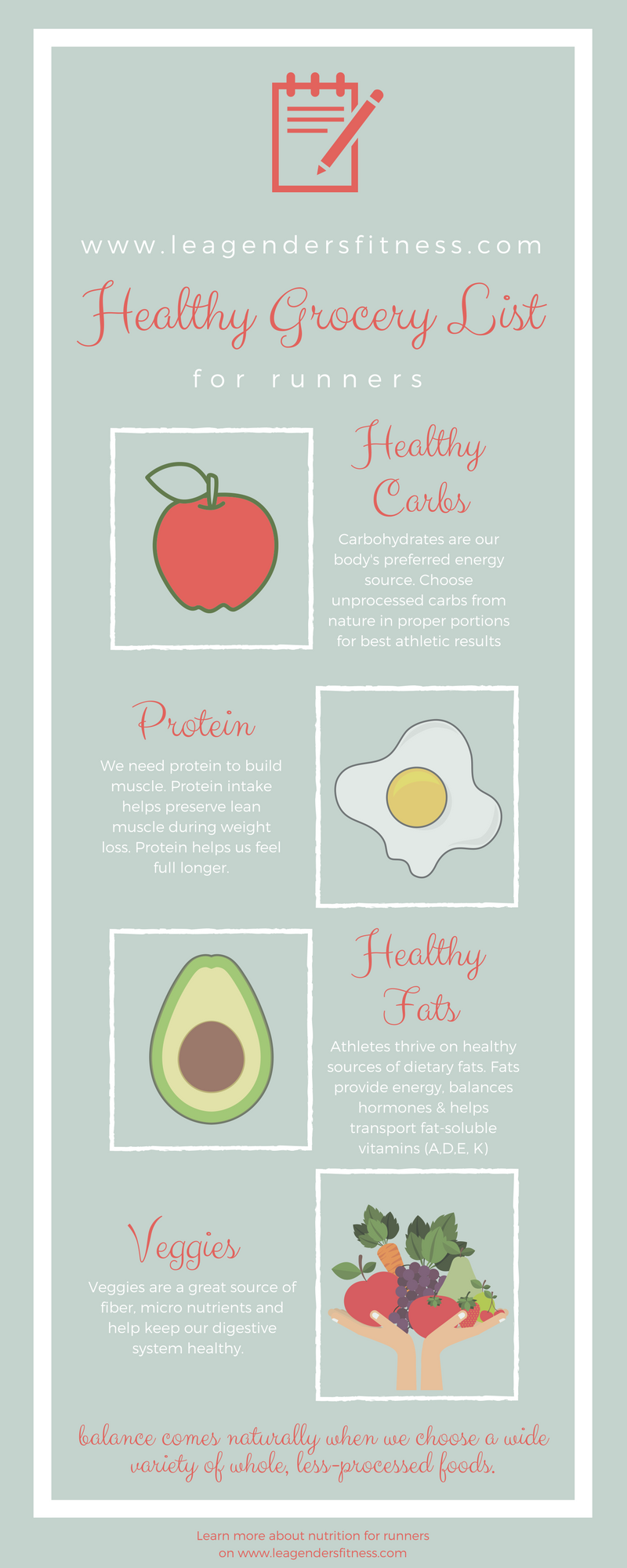
Balance comes naturally when we focus on consuming mostly whole, minimally-processed foods from nature. One easy way to shop for whole foods is to limit foods that are in a box or package. When choosing packaged foods look for short ingredient lists that you can pronounce. Stick mostly to the meats, fish, fruits, vegetables, nuts and seeds. Whole foods gives us the energy we need to perform our best while providing necessary nutrients.

2. HEALTHY, WHOLE, NATURAL CARBOHYDRATES ARE AN ATHLETE'S BEST FRIEND

While it may be a popular trend to go low-carb, it simply isn't necessary or optimal for athletes. Carbohydrates are our body's preferred energy source. The key is to eat quality carbohydrates and time them around our workouts. Plan whole food carbohydrates before and after your workouts for best results. How to cut carbs without cutting your sanity.

3. EAT YOUR PROTEIN

We need protein to build and repair muscle and it helps us maintain lean muscle during weight loss. Protein helps us feel full for longer after we eat and our bodies actually burn more calories to process protein than carbs or fats.

The National Academy of Sports Medicine recommends 0.4 grams of protein per pound of bodyweight for the average, sedentary person, but we're not sedentary or average, right? For athletes the protein requirements go up. For strength athletes the recommendation is .5 to.8 grams per pound of bodyweight and for endurance athletes (runners, that's you) it's .5 to .6 g/lb.

Challenge: For one day add up all the protein grams in the foods you eat. Are you getting the recommended amount according to your bodyweight? If you weigh 150 lbs, you should aim for at least 75 grams of protein a day. How does your diet measure up?

You can read more about getting more protein in your diet in this blog post from last year.

4. EAT THE RAINBOW

Red, orange, yellow, green, blue, purple. Can you get in all the colors in your fruits and vegetables? Vegetables are high in fiber and nutrients and generally lower in calories. They help get your digestive system healthy and um...moving. They help you feel full and are virtually impossible to overeat. Think outside the box about what fruits and vegetables you can try. Next time you're at the grocery store try to pick at least one fruit/vegetable from every color in the rainbow. There's a challenge I can get behind. Here are 10 easy ways to add more vegetables in your diet.

Red: Red peppers, apples, strawberries, tomatoes, cherries, red grapes, raspberries

Orange: Orange peppers, oranges, pumpkin, carrots, sweet potato, mango, peaches

Yellow: yellow peppers, yellow squash, bananas, pineapples

Green: Spinach, cucumbers, peppers, asparagus, celery, green beans, avocado

Blue: Blueberries, grapes

Purple: Eggplant, cabbage, plums, beets, purple squash

Eat the rainbow

Eat the rainbow

5. LIMIT ADDED SUGAR

While we could all probably stand to reduce our sugar intake, athletes don't need to worry much about natural sugars, those found in fruits and dairy. I suggest limiting your added sugar intake to about 25 grams per day. For one day, count the sugar grams listed on the back of the packages. Even if you don't usually eat traditional sweets like chocolate, cookies and cake, sugar is lurking in everything from ketchup, salad dressing, soups, granola and pasta sauces. If you don't pay attention it can add up quickly.

When counting daily sugar grams if it is a natural sugar found in fruit and dairy, you don't have to count it. As athletes our bodies need some natural sugars to perform our best.

Some foods have a combination of natural and added sugars. You can tell the difference because you won't see natural sugars on the ingredient list. When you see some of these sugars on the ingredient list, you know they are added sugars: cane crystals, corn syrup, dextrose, evaporated cane juice, fructose, fruit juice concentrate, glucose, high-fructose corn syrup, molasses, syrup. Tricky, huh? 

If you drink milk, then the sugar content listed on the label is natural sugars. If you drink chocolate milk, then the sugar listed on the label would be a combination of natural and added sugars (you can tell because the added sugars are listed in the ingredient list). If you eat plain yogurt, the sugar content listed on the label is natural sugars, if you eat flavored yogurt, the sugar content is a combination of natural and added sugars. Flavored yogurt is notorious for having a lot of added sugar. (Sometimes as much as a cup of ice-cream!) Try plain Greek yogurt and cut up berries or fruits for flavor. 

Add up the sugars you eat in one day and see where you land. Are you consuming 25 grams or less? You don't need to count the sugars in the fruit and dairy that you eat. How did you do? I wrote a few blog posts on the sugar if you want to dive a little deeper: 25 grams of added sugar per day, and a rant on sugar

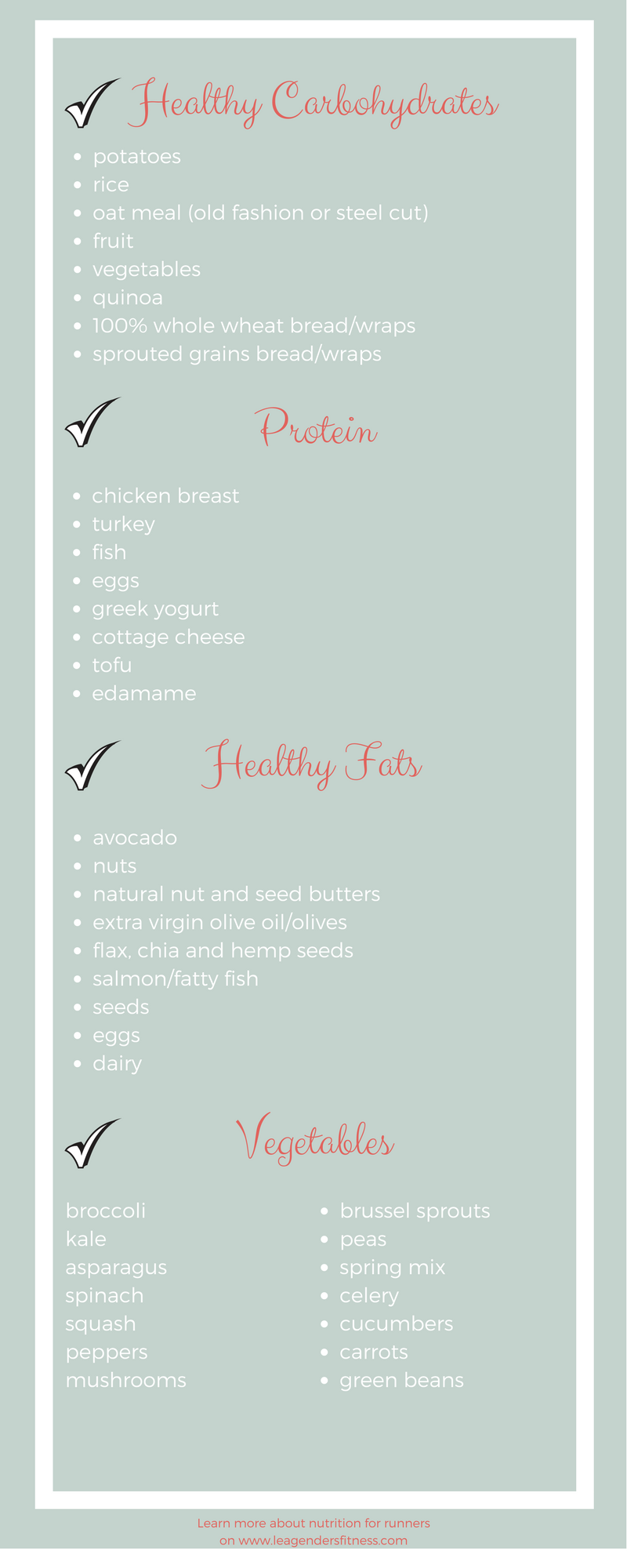
HEALTHY GROCERY LIST FOR ATHLETES

Healthy grocery list for runners. save to Pinterest for later

Healthy grocery list for runners. save to Pinterest for later

healthy grocery list for runners
download the free printable PDF healthy grocery list for runners. Save to Pinterest for later.

download the free printable PDF healthy grocery list for runners. Save to Pinterest for later.

If you are tired of nutrition challenges that don't provide long-term results, join me in my 12 month nutrition habits program for sane and sustainable results. If you know what to do but haven't been able to stay on track or if you are confused about what changes to make for the biggest results, this is the program for you. The first month is 75% off to try. Put the quick-fix mentality behind you and make lasting changes once and for all. See if you are a good fit. 

Like this post? It helps me when you share with your friends and followers. 

Lea signature.jpg

SPICE UP YOUR RUNNING PLAYLIST WITH THESE ALTERNATIVE ROCK SONGS (YOU PROBABLY NEVER HEARD)

The three Rs: Running, Writing and Rock music. They are my life's passions. If I can run, write and listen to music, I'm in my happy place. 

I grew up on '90s alternative rock music so it holds a special place in my heart. I heard Smashing Pumpkins on the classic rock station and realized that I am old now. That age thing doesn't keep me from the music I love or going to the concerts of my favorite artists, I just usually wake up the next day in worse shape than after a half marathon. 

Today I wanted to give you some ideas of alternative rock songs to spice up your running playlist. They may not be new songs, but some of them may be new to you. Sprinkle of these in and see if the beats push you across the finish line a little bit faster. 

alternative rock playlist


I resisted the urge to make this an all-Jack-White-all-the-time playlist, which is often the playlist in my ears. Check out these ten alternative rock songs to spice up your running playlist. Do you know these songs? These artists? They are among my favorites for running and for life. 
10 alternative rock songs to spice up your running playlist. Save to pinterest for later.

10 alternative rock songs to spice up your running playlist. Save to pinterest for later.

I added my song selections to a Spotify playlist so you can check them out for yourself. Do you have any suggestions of songs for my playlist? Will you add any of these to your running playlist? Anyone else out there a Jack White fanatic like me?

Like this post? Consider sharing with your friends and followers.