5 WAYS TO FIT STRENGTH TRAINING INTO YOUR RUNNING ROUTINE

Runners are notorious for being runners. D'uh, right? I know because I was there. I love(d) to run. I worked out an hour a day 4-5 times a week and it was all running, because that is what I loved to do. I know I needed to exercise and now I found this exercise that I love. I was burning calories, moving my body and strengthening my heart. I was exercising. Most people don't even get off the couch. Yay me.

Then someone comes along and tells me that it's not enough...that I just can't run all the time, that I need to do more. Even worse, I need to do less of what I love and more of something that I love not-so-much, strength training. UGH.

At that time I may have had visions of spending hours in the gym, but I quickly learned it didn't have to be all-or-nothing. There are many ways to work strength training into a running routine, I could do both. I could focus on running as my priority while also getting in my strength training. Turns out strength training made me a better runner. I got faster, leaner and was less prone to those pesky running injuries. What's not to love about that? 

The first step is to stop thinking of strength training as something that you have to do instead of running, consider it something that you do to improve your running performance. Just like sports athletes work with a strength coach, a runner can improve at their sport by focusing on gaining strength, improving flexibility and fixing imbalances.

5 WAYS TO FIT IN STRENGTH TRAINING IN YOUR RUNNING ROUTINE

ADD 15 MINUTES TO THE END OF YOUR EASY RUN DAYS

It doesn't have to be all-or-nothing. If you can't spend an hour on strength training, just add a quick strength workout to the end of your runs on easy days. Spend 15 minutes focusing on runner specific strength. Start with twice a week and add additional days as you get stronger.

BREAK UP THE MILES BY ADDING STRENGTH MOVES ALONG YOUR RUNNING ROUTE

Do it obstacle course style. Run a mile, then do 10 squats, 10 pushups and a 30 second plank. Repeat at the end of every mile. Vary your exercises on different days. On your next run do 10 lateral squats, 10 lunges and 10 tricep dips after each mile. 

Run past a park bench? Try these exercises. How about outdoor stairs? There are plenty of ways to break up your easy run with some strength training moves.

Try incorporating running intervals into your strength workouts, like this one. 
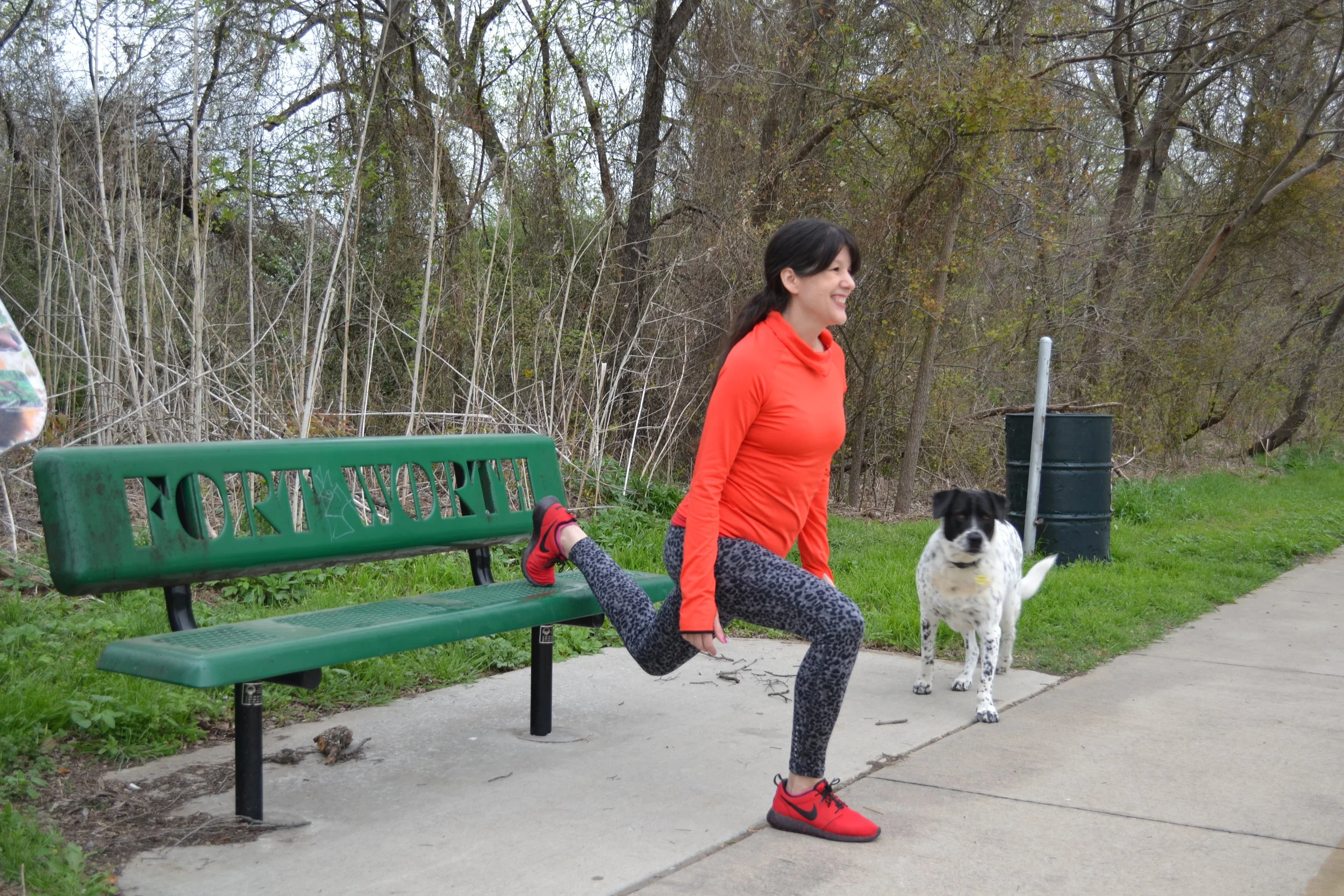
Go ahead get in those reps, your running partner can wait. 

Go ahead get in those reps, your running partner can wait. 

DO TWO 30 FULL BODY WORKOUTS A WEEK

If you would rather focus on running during your run days, then start with two 30 minute full body workouts each week. Try doing compound movements (like squats with overhead press) and circuit-style workouts help maximize your time in the gym to get the most bang for your biceps. 

JOIN A CLASS OR BOOTCAMP

Misery loves company? Or so they say. Too bad bootcamps are fun and when you join with other like-minded people you can get in running shape while having fun. 

HIRE A COACH

If you can't muster up the motivation to do anything but run, it may be time to hire a coach for some accountability. A coach can help ensure you are getting the most of that time away from running. I am both a running coach and a personal trainer, so I can help you meet your running goals while building runner-specific strength to avoid injuries.  

One point I'd like to reinforce is that strength training should always be done on easy run days. High intensity runs should not compounded by additional strength work. In other words, don't max out on hill work or speed intervals, then try to get in strength training afterwards.

Always take rest days after hard or high intensity days. Remember that our body adapts to the effects of exercise (gets stronger, faster) during rest, not during the workout itself. Always give adequate time for your body to rest and repair for maximum results. Got it? Good. 

Like this post? Please consider sharing. 

Coach Lea


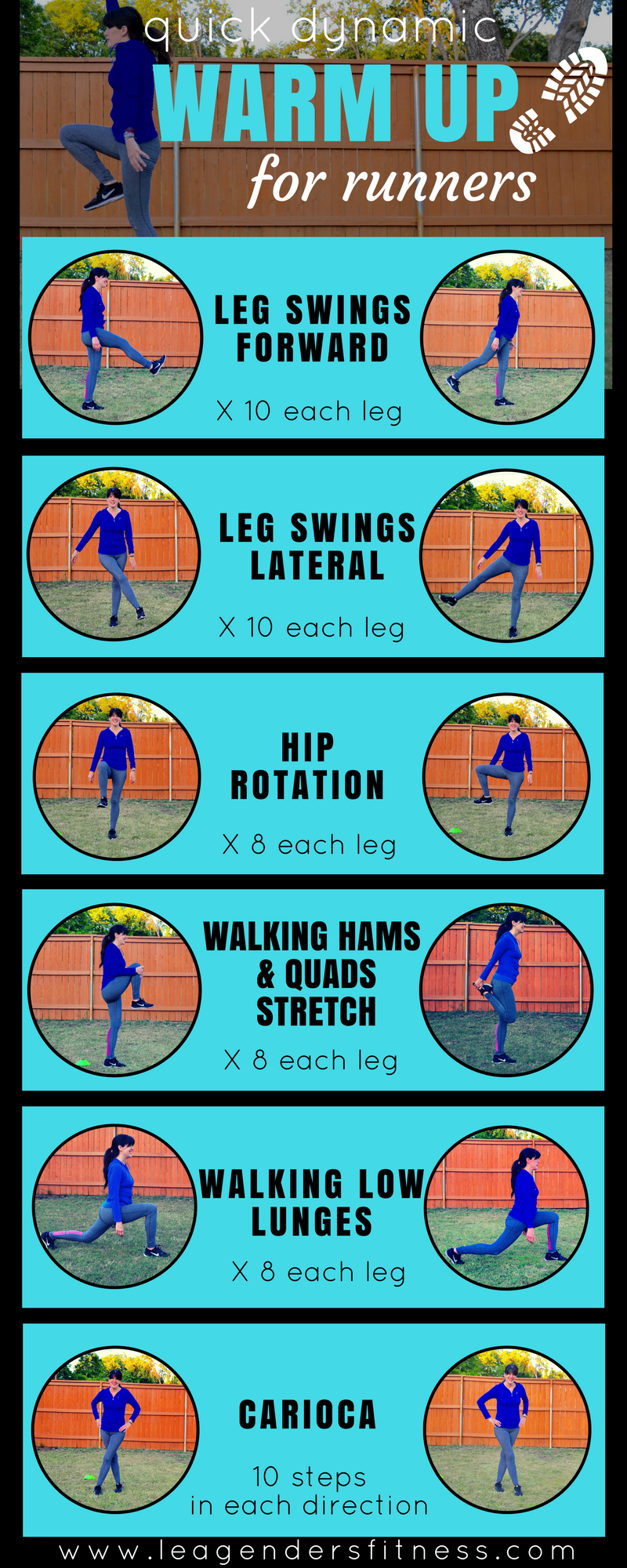
QUICK DYNAMIC WARM UP FOR RUNNERS

Welcome to the latest edition of Workout Wednesday! Today I am sharing a quick warm up to try before your runs. It's important to prep your body for the workout, so if you have just been just jogging, walking or worse, no warm up at all, then I suggest this dynamic warm up to prime your body for running. 

A dynamic stretch moves the joint through the full range of motion. This warm up increases blood flow, warms up muscles, improves hip mobility, core stability and balance. A quick dynamic warm up can improve performance and help prevent injuries. 


LEG SWINGS FORWARD/BACK

Standing on one leg with your knee (ever so) slightly bent, engage your core and squeeze your glutes (butt muscles). With a straight leg swing your leg out in front, then behind. Repeat 10 times on each leg. If you have to hold on to something or touch your foot down to maintain balance it is ok at first, but work on building balance over time. Have a strong core and balance will benefit your running form and efficiency over the long term. 

LEG SWINGS LATERAL

Standing one one leg with your knee (ever so) slightly bent, engage your core and squeeze your glutes. With a straight leg swing your leg out to the right then cross over the front leg to the left. Repeat 10 times on each leg. Work to build up balance over time.

HIP ROTATION

Standing on one leg, bend your knee to 90 degrees and lift your thigh up until it is parallel to the ground. Engage your core and glutes. Rotate your hip out to the side then return to starting position. Repeat 8 times on each side. 

WALKING HAMSTRING STRETCH

Standing on one leg, pull up the opposite leg and hug to your chest to stretch your hamstring muscles in the back of your leg. Hold the position for 2 seconds, lower your leg to step forward and repeat on other side. Walk forward bringing each leg to chest eight times. You could progress this exercise by performing high knees, quickly bringing your knees up alternating between right and left. 

WALKING QUAD STRETCH

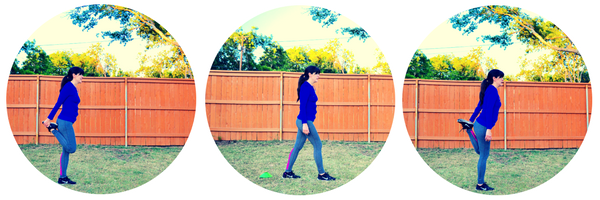
Standing on one leg pull your heel back until it touches your butt to stretch the quad muscles in your thigh. Keep your knees together. Hold for 2 seconds, lower your leg and repeat on other side while walking forward in a fluid motion. You could progress this exercise by performing butt kicks, quickly bringing your heel to your butt alternating between right and left.

WALKING LOW LUNGES

Step one leg forward into a low lunge while keeping the back leg as straight as possible. You'll notice when you straighten the back leg, you'll feel the stretch in your hip flexors, hold for two seconds. Keep your core engaged, your back straight and step the back leg forward to meet the front leg. Step forward with opposite leg and repeat eight on each side.

CARIOCA

No, I didn't mean karaoke. I'm not going to make you sing or worse, listen to me sing. This is a fun drill to open up your hips before your run. I recommend doing it once slow and then again as quickly as possible.

Start with your feet about hip width apart, step your left leg behind, then bring your right leg in front so you return to hip width stance, then bring your left leg in front and right leg behind to return to hip width stance. Take 10 steps in one direction, then 10 steps in the other direction.

HIGH SKIPS

Finish off your warm up with high skips to get your heart rate up a bit. Drive your right knee and right arm up while skipping, focusing on moving vertically. Switch leg and arm moving dynamically through the motion eight times per side.

Ready to run? Do you warm up before you run? If not, will you start? Pinky swear? 

Who's a good boy?

Who's a good boy?

Like this post? It helps me when you share.

Coach Lea

52 Healthy Habits: Drink More Water!

Welcome to the latest edition of 52 Healthy habits, where each week we tackle a new healthy habit. No matter where you are in your fitness and healthy lifestyle journey, there is always room for small incremental improvements. Each week we look for small ways to inch towards a healthier lifestyle. It's not about overhauling your whole life, but making changes that are sustainable over a lifetime. Common sense in an industry where it is uncommon. 

DRINK MORE WATER
 

I'll start by saying that we definitely need to drink water. Water has important jobs. Water brings nutrients to the cells and carries waste products away. It regulates our temperature and provides minerals.

Most adults need a baseline of 12 cups a day. Depending on the foods we eat, we get about four cups of water a day in our foods. Raw fruits and vegetables are mostly water. That leaves the general recommendation that you've probably heard of 8 cups a day.

Larger people may need more. If you're at high altitudes you may need more. When it's hot or dry you may need more. When you exercise you need more. To answer the question, "How much water should I drink?" The answer is, it depends. Let's start with a baseline:

IF YOU'RE MOSTLY SEDENTARY: 8 CUPS A DAY

Drink one cup upon waking, before you drink your coffee. 

Drink one cup before each meal and one cup during each meal 

Drink one cup a couple hours before bed. (Not too close to bedtime or you may end up interrupting your sleep with bathroom runs.)

FOR MODERATE EXERCISERS UNDER 2 HOURS A DAY: 12-16 CUPS A DAY

Drink 2 cups upon waking, before you drink your coffee

Drink 2-4 cups during workouts depending on the length and intensity of your workout

Drink 2-4 cups after workouts

Drink 2 cups at each meal

As always, you should experiment with water intake and adjust based on your body's feedback. Drink more if you feel thirsty and less if you feel water logged. While 8 cups a day is a baseline, everyone may have different needs. 

If you are not drinking any water right now, it is ok to start small and build over time. Focus first on just drinking one cup with each meal, when that becomes habit, continue to add until you reach the baseline. It should never be all-or-nothing. Do what you can today and work to improve over time. 


This post contains affiliate links. That means if you click on a link in this post and make a purchase, I make a small percentage of the sale with no additional cost to you. No one is getting rich here, it just helps with the running (pun intended) of this blog. As always, thank you for your support. 

STRATEGIES TO DRINK MORE WATER

MAKE IT A HABIT

By always drinking one cup of water upon waking and before each meal, you start to build a habit. After awhile It becomes second nature to drink water during those times.

SPARKLE, BABY!

Consider sparking water. Sometimes I want the fizz of a soda and sparkling water is a good alternative. Just be sure to read the ingredients listed on the nutrition label to ensure that it doesn't contain any "extra ingredients." Sparkling water isn't sweet, it tastes like water with bubbles. If it is sweet, then they added something to it. It's fine to drink artificial sweeteners in moderation, but they probably shouldn't be in every cup of water you drink a day.

DO IT LIKE THE SPAS DO!

Take a cue from the luxury spas and add cucumbers, berries, mint leaves or lemon to your water. It gives water a refreshing, natural flavor. You could just add to your water or use one of these fruit-infused water bottles.

HAVE A TEA PARTY

Add decaffeinated tea bags to your water. Drink it hot or cold. Green tea is great for you. Just be careful about adding too much caffeine. I personally try to limit by caffeine intake to 1-2 cups a day. 

TRACK IT

Use an app or a tracking log to track your water intake. Download my free tracking log! You may find if you start to pay attention to your water intake you will increase it. In order to improve anything, the first step is to measure where you are currently. 

BUY A REFILLABLE WATER BOTTLE

Buy a fun refillable water bottle to track your intake. 

Are you drinking enough water? Would you like to improve? Try one of these strategies to increase your water intake and let me know how it goes.

Need help with your nutrition strategy? Tired of dieting? Want help developing healthy habits while staying sane and balanced? My nutrition and lifestyle coaching program begins in June, get on the list for a big pre-sale discount. 

Need to catch up on the 52 healthy habits series? 

52 HEALTHY HABITS SERIES

week 1: Early to Rise
week 2: Track calories
week 3: Macro cycling
week 4: Morning pages (journaling)
week 5: Stop the scrolling (reading instead of social media)
week 6: Be a good student (take time for learning) 
week 7: Strength Training 15 minutes per day   
week 8: Eat more protein
week 9: Take a coffee break (break from caffeine)
week 10: Mindful eating
week 11: Create and follow a sleep ritual
week 12: 10 Easy ways to eat more vegetables 
week 13: A rant 
week 14: 10K steps a day

Like this post? It helps me when you share. 

Unicorn Protein Shake

Starbucks took over my social media feed the last couple of weeks with their Unicorn Frappuccino. 

I'll be the first to advise you that it's perfectly ok to eat (or drink) everything in moderation. If you really want that high-sugar limited-edition drink then I don't see a problem with it as an one-time treat. Yes, I know it has 79 grams of sugar. It's a lot. You probably shouldn't drink 79 grams sugar in one sitting every day, but every once in awhile a unicorn comes along and you may want to enjoy the treat with friends. 

The recommendation for health is to keep your added sugars to 25 grams a day or less. If you follow this guideline most of the time, then breaking the rule occasionally won't break your overall health. 

I don't see a problem as long as you go into it with your eyes wide open. You know what you are consuming is less-than-healthy. You know it's just an occasional treat. You enjoy it. You pay attention to how it makes you feel. You stop when you feel full. (You don't have to drink every last drop just because you bought it.) You move on to your next healthy meal. Consider it your indulgence for the week and move on with your life. 

Except it's too late. The unicorn has already come and gone. (Don't worry, given the success of the unicorn, I'm sure there is another magical mystical character drink waiting in the shadows.)

I personally wasn't drawn to the sugary drink. When you don't consume a lot of added sugar, then things like fruits and berries taste very sweet and delicious. I set out to make my own healthy version of the unicorn drink. 

When you are trying to live a healthy lifestyle, you don't have to give up all that tastes good. Sometimes you can make healthy swaps and find that same joy in a healthy version. I combined fruit, berries and protein powder for a delicious, filling...and pretty treat.

This post contains affiliate links, which means if you click on a link in this post and make a purchase, I make a small percentage of the sale with no additional cost to you. No one is getting rich here, it just helps with the running (pun intended) of this blog. 

Unicorn Protein Shake


Frozen raspberries
Frozen blueberries
Frozen pineapples
Small banana
1 scoop of vanilla protein powder

I made my shake in layers.
To start I mixed the frozen raspberries, 1/3 of the protein powder scoop and water in my Nutribullet.
I poured into a separate glass and placed in the freezer to set.

I rinsed the cup and made my second layer.
Frozen pineapples, small banana, 1/3 protein powder scoop and water to mix.

I rinsed the cup and made my third layer.
Frozen blueberries, 1/3 protein powder scoop and water to mix.

I let it all sit in the freezer for about 20 minutes, then I combined the layers and gently stirred them up with a straw.

Like this post? It helps me when you share!


Coach Lea


Are You Confused About Calories? Join the Club

Calories in, calories out. Right? 

Well, sort of.

It's more than a math problem. Despite the popular adage, fueling our bodies is not exactly like filling a gas tank. It's a little more complicated than that. 

When you take in more calories/energy than you expend you gain weight and when you take in fewer calories/energy than you expend, you lose weight. This is the law of thermodynamics. We just don't always know exactly how much we are taking in and how much we are burning.

Are calories important? Yes. If you have never tracked your calories before, it can be helpful to track for a few days to get an estimate of what you are taking in. It's a good starting point. Do most people need to track every morsel they consume for the rest of their lives? I say no. 

Why not? 

First of all, it is all a guessing game. Well, a guess-timate game. 

HOW MANY CALORIES DO I NEED?

How many calories should you eat to lose weight? Again, it depends. There are formulas and online calculators that can help you get in the ballpark. This is a great weight loss calorie calculator from Precision Nutrition. It considers all the important factors like current weight, age, height, sex, activity level. It is still an estimate. 

And if you tell the calculator you want to lose 40 pounds in 2 months it will probably give you some unrealistic number of calories to consume, because it is an internet calculator and not a real coach. An online calculator doesn't know what a realistic, sustainable weight loss goal looks like, it just calculates the numbers. Numbers in, numbers out. 

Let's assume you have a realistic, sustainable weight loss goal to lose two pounds a week over the next 15 weeks. You want to lose 30-40 pounds over the next four to five months. You plug in your numbers and get a calorie goal for each day. Great, you're on the right track. 

DO I NEED TO WEIGH AND MEASURE FOOD?

You open up a MyFitnessPal account and start entering in the foods you eat. There is another issue. Are you weighing everything? Are you measuring out the serving sizes? Was that banana a small banana or a medium banana? How many ounces of chicken was in that salad? Was it cooked in oil or butter? How much? Did you enter that coffee creamer? What were the ingredients in that 1/2 cupcake you ate at your co-worker's party?

Now, you can get close if you weigh and measure, which I think is a fine solution for a short-term. Is it sustainable to weigh and measure everything you eat for the rest of your life? Probably not. You might just drive yourself crazy first. 

Once you weigh and measure for a few days you might start to get an idea what a 1/2 cup looks like, what 4 oz of chicken is and what a tablespoon of peanut butter look like (Wait? It's not a heaping oversized spoon? Darn it.). This is great. You are starting to educate yourself on what proper portions look like and it can be a long term tool that will serve you for years to come.

AM I CALCULATING AN EXACT CALORIE COUNT?

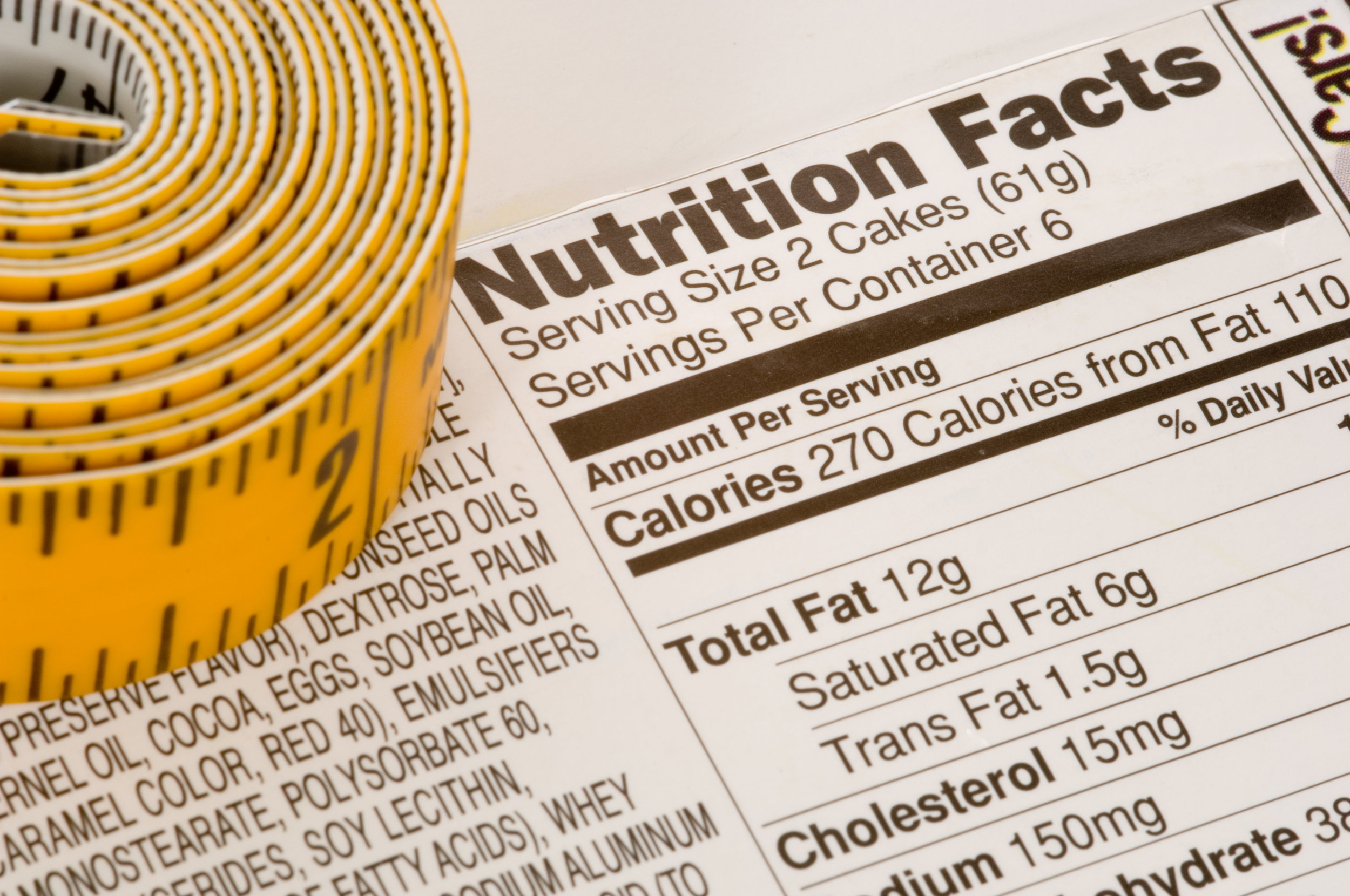
Unfortunately, still no. The calories listed on packages can legally be up to 20% inaccurate. So even if the package says 100 calories, it may be 120. Why is that? Well it is hard for food producers and restaurants to know the exact calorie count in foods. There are so many factors that can affect it: soil and growing conditions, ripeness at time of harvest, animals' diets and storage length. Different batches of of both natural and processed foods can vary in their exact contents. One test can't accurately predict all future lots. Calories for natural foods listed in databases are averages. 

So, in short, it's complicated. But wait...there's more.

DO I ABSORB ALL THE CALORIES I EAT?

We don't necessarily absorb all the calories we consume. Preparation and cooking time can change the nutrient content and individuals absorb calories uniquely and not necessarily the same each time. 

And the metabolism is adaptive. Your body adapts and your calorie needs change. 

We haven't even talked about calories out. Again, a giant guessing game. That calories burned number on your treadmill or your FitBit? Even when heart-rate is factored in it is a big fat guess that may be over-estimated. 

So calories in, calories out as a long term sustainable game plan may be an exercise in futility. 

DO I NEED TO TRACK CALORIES?

Am I telling you all of this to frustrate you? Should you throw your MyFitnessPal against the wall? We often want to try to control something that is simply out of our control. You can drive yourself crazy and still not get the results you want. The good news is that we don't have enter every calorie consumed into an app for the rest of our lives. 

Calorie counting, weighing and measuring at the beginning of your journey or when you want to get back on track can be a tool to give you an estimate of where you are starting. That can be beneficial.

Some people like tracking because it gives them accountability. They know that if they eat something they have to enter it in a food journal or app, so it helps them stop and consider what they are eating. Great. A food log can be a good thing when used properly, as a journal to review your daily food choices and how they make you feel.

Other people get obsessive about tracking and it takes over their lives (raises hand). Not great. Find the middle ground that works for you. 

If counting calories is not the solution, what is? How can I be mindful of what I eat? How can I make sure I am in a calorie deficit when trying to lose weight? Or get enough calories when I am trying to put on muscle?

PORTION SIZES

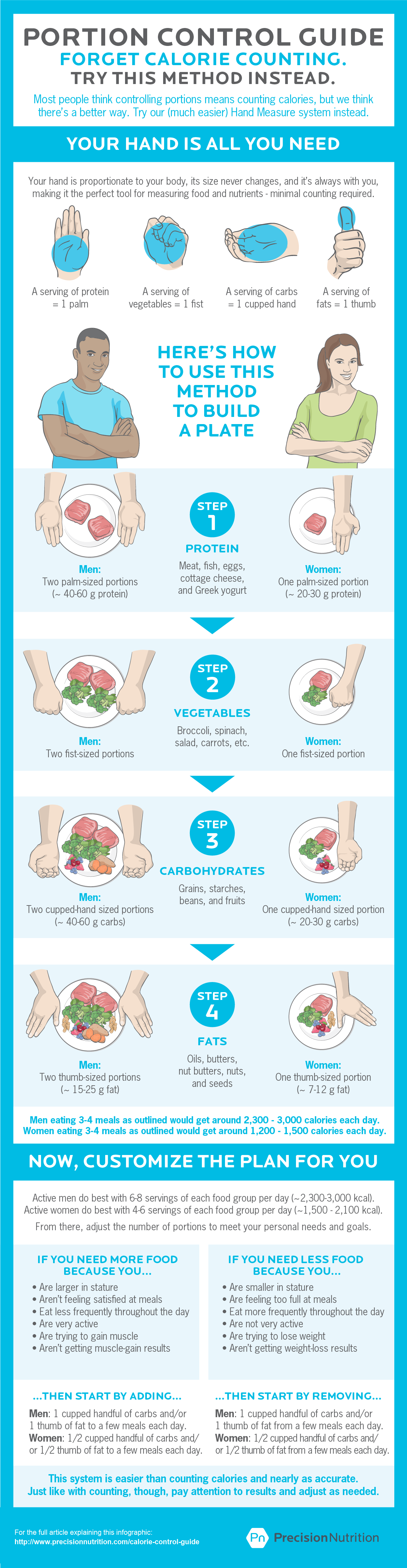
I like Precision Nutrition's method for determining portion sizes

FOR MEN

  • 2 palms of protein dense foods with each meal
  • 2 fists of vegetables with each meal
  • 2 cupped hands of carb dense foods with most meals
  • 2 entire thumbs of fat dense foods with most meals

FOR WOMEN

  • 1 palm of protein dense foods with each meal
  • 1 fist of vegetables with each meal;
  • 1 cupped hand of carb dense foods with most meals
  • 1 entire thumb of fat dense foods with most meals

It's a great starting point, but It's just that, a starting point. If you start to incorporate the hand method of portion sizes, you may need to adjust. If you find that you are very hungry 30 minutes after eating or if you are extremely active, you may need a little more. If you feel stuffed and haven't been as active, maybe a little less. Your needs will always be individual. Pay attention to results and adjust as needed. It's a common sense system that works and doesn't feel like punishment.

When you eat a casserole, obviously, the hand method doesn't work. You can easily eat a thumb-size portion of avocado or almonds (fats), but how do you eat two thumbs of eggs? Does bacon count as a protein or a fat? All good questions. Just remember that it is not meant to be another strict rule to follow, but a general guideline to give you an idea of where to start. You adjust in a way that makes sense to you, then monitor results. If you are lost, consider hiring a nutrition coach to help you on your path. 

GETTING STARTED

Eat slowly and pay attention to your your body's hunger and fullness cues. I wrote a post on mindful eating that may be helpful. (Spoiler alert: for one, put away your cell phone at the dinner table.) Keep a food journal if it helps you better evaluate what you are eating and how certain foods make you feel. 

We sometimes over complicate things. As a starting point, let's work to eat mostly whole, minimally processed foods from nature, while maintaining proper portions. Over time, once this becomes part of your daily habits, along with regular exercise and movement, your weight will most likely reflect your healthy lifestyle. 

I don't mean to oversimplify things either. Our bodies are complicated and each of us is different. We all have individual needs, preferences and lifestyles. Aim to find that sweet spot of sanity and sustainability. What habits can you sustain for the rest of your life? You can start by keeping paying attention to food quality, portion sizes and hunger cues and adjust as needed.

If you love counting calories and it works for you and your lifestyle, then great. I would not advise you to stop doing anything that benefits you as an individual.

It's just that if you are pulling out your hair counting calories, and you're not seeing the results you desire, just know it doesn't have to be that way. You can live a healthy, balanced life and never count a calorie again. 

Need help with your nutrition strategy? Tired of dieting? Want help developing healthy habits while staying sane and balanced? My nutrition and lifestyle coaching program begins in June, get on the list for a big pre-sale discount. 

Like this post? It helps me when you share. 


Lea

Coach Lea