Bodyweight Bootcamp: Four Minute Tabata-Style Workout

Guess what the #1 reason is that people give for not working out? Not enough time. We all know what that's like. Between work, family and social obligations it can certainly feel like there are not enough hours in the day to get everything done, especially that one hour workout that you intended to do. 

I have a solution. How about a four minute full body workout? Now, I'm not suggesting that anyone ever got in the best shape of their lives by working out for four minutes day. I'm saying for those days when life gets in the way, a quick four minute workout can help boost your energy levels, release those feel-good endorphins and help you get in a little strength and cardio training to maintain your fitness.

This is a twist on a Tabata-style workout. Traditional Tabata workouts push as hard as possible for 20 seconds, then rest for 10 seconds before moving on to the next exercise. In this version you will perform the moves for 20 seconds then do an isometric hold for 10 seconds. Repeat four times with a one minute rest between sets and in only 20 minutes you'll get in 4 sets of a full body workout. 

Ready?

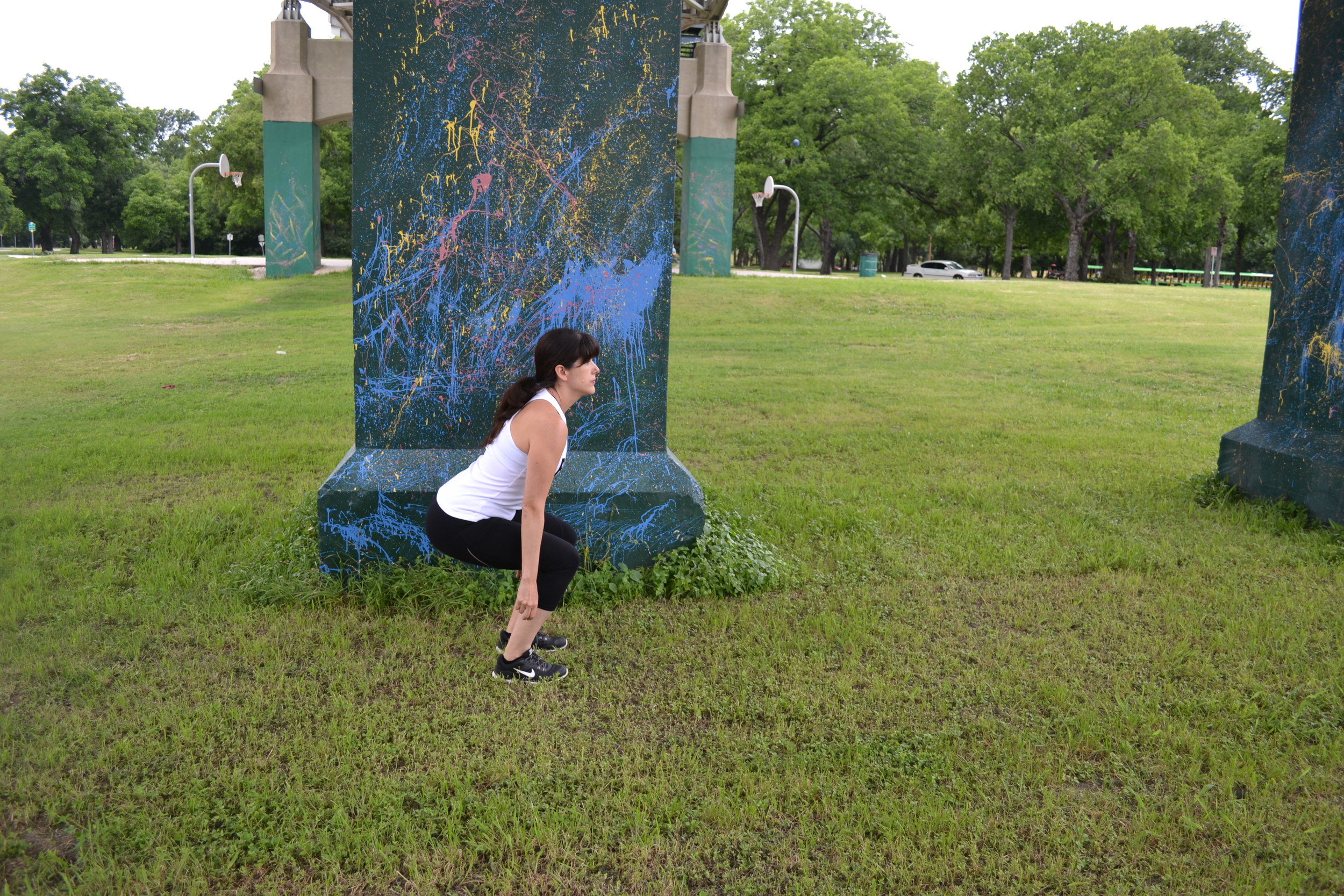
SQUATS

Starting with your feet hip width apart push your hips back and lower until your thighs are parallel to the floor, like you are sitting back in a chair, or as low as your flexibility allows. In the low position, engage your core, squeeze your glutes and push up to standing. Take a deep breath in as your lower to the squat and breath out as you return up to standing.

Repeat for 20 seconds then hold in the low squat position for 10 seconds.

PUSH UPS

Start in a high plank position with your hands placed a little wider than your shoulders. Keeping your body in a straight line, while engaging your core bend your elbows slowly to lower your chest to the floor. Once in the low position, push back up to the starting position. If this is too challenging, drop to your knees. 

Repeat for 20 seconds then hold in the low position for 10 seconds.

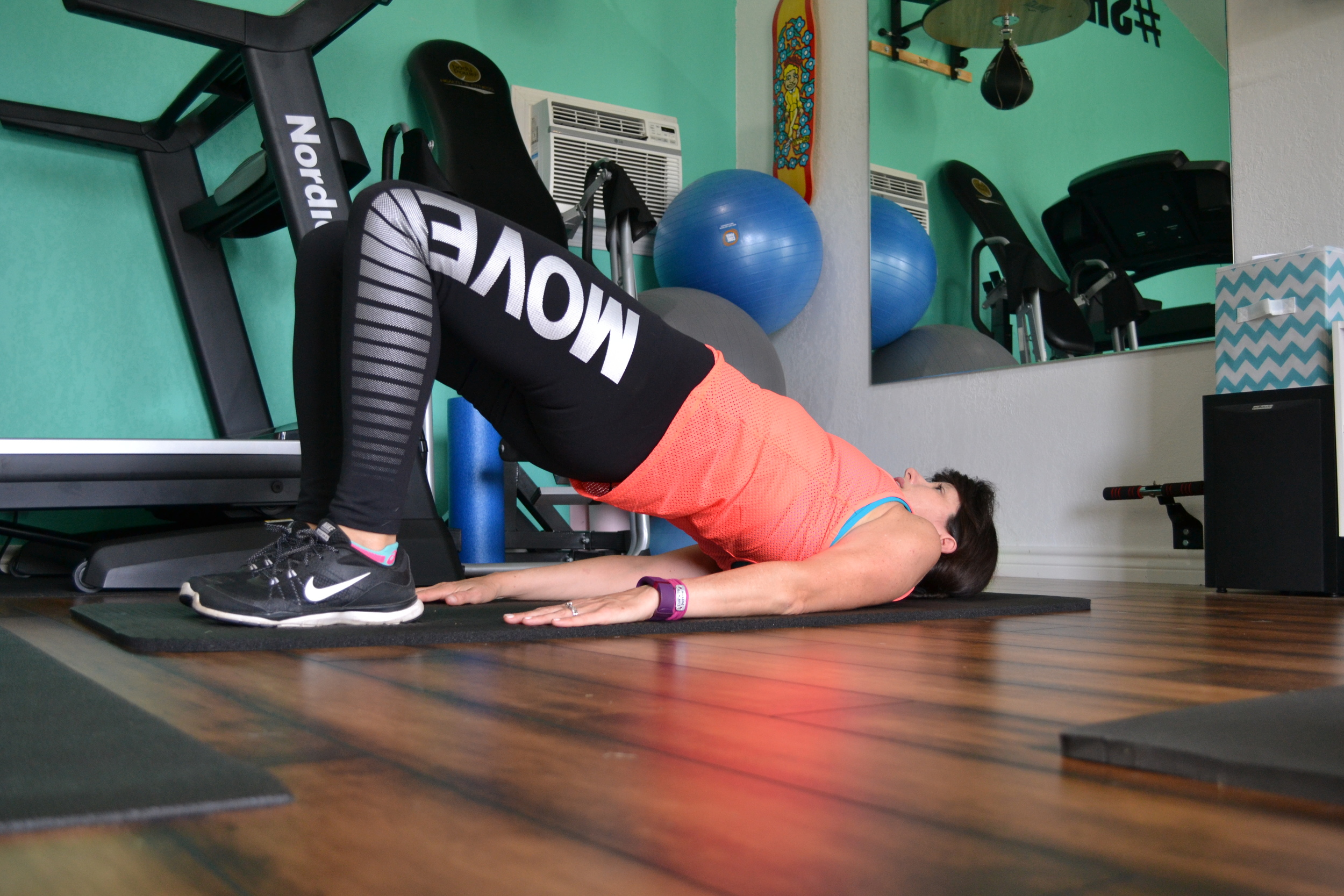
BRIDGE THRUSTERS

Lie on your back with your knees bent and your feet flat on the floor. Raise your hips off the floor so that your body forms a straight line from your shoulders to your knees. Pause at the top then slowly lower your hips back to the floor.

Repeat for 20 seconds then hold the bridge position for 10 seconds.
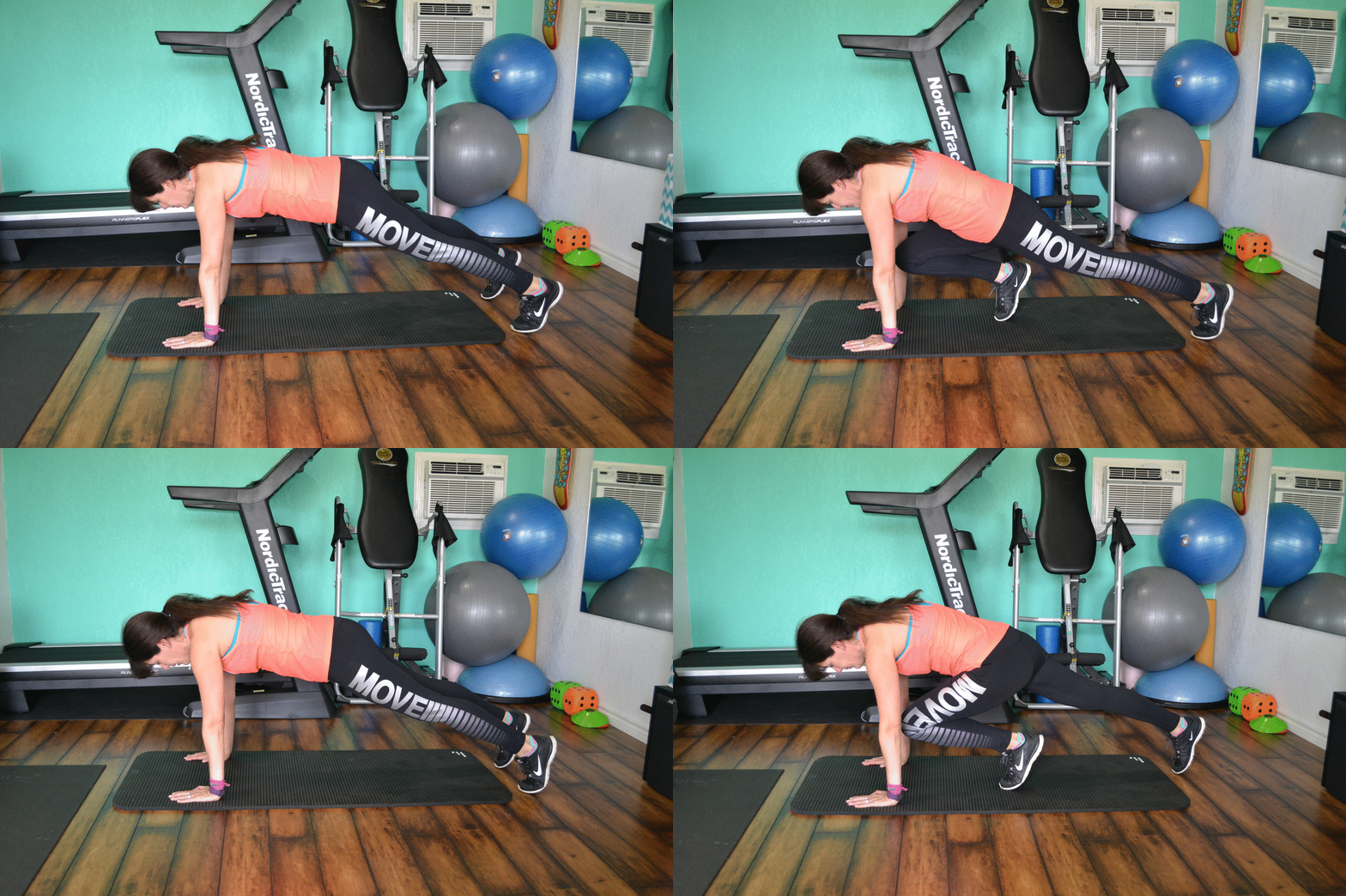
MOUNTAIN CLIMBERS

Start in a high straight arm plank position with your wrists directly under your shoulders with your legs wider than hip width for stability. Keep your body in a straight line from your shoulders to ankles while engaging your core. Do not allow your hips to hike up or sag down. Quickly bring your right leg, then your left leg in to touch your elbows.

Repeat for 20 seconds then hold the high plank position for 10 seconds.
LUNGES (EACH LEG)

With your feet hip width apart and your toes pointed straight ahead, hold your core stable with your back straight and take one large step with your right leg to lunge forward until your front knee is lined up over your ankle, your right thigh is parallel to the floor and your back knee is nearly touching the floor. Do not allow your knee to go past your toes. Use your right leg to push back up to standing in the same position as you started.

Repeat for 20 seconds then hold in lunge position for 10 seconds. Change legs.

DSC_0444.jpg

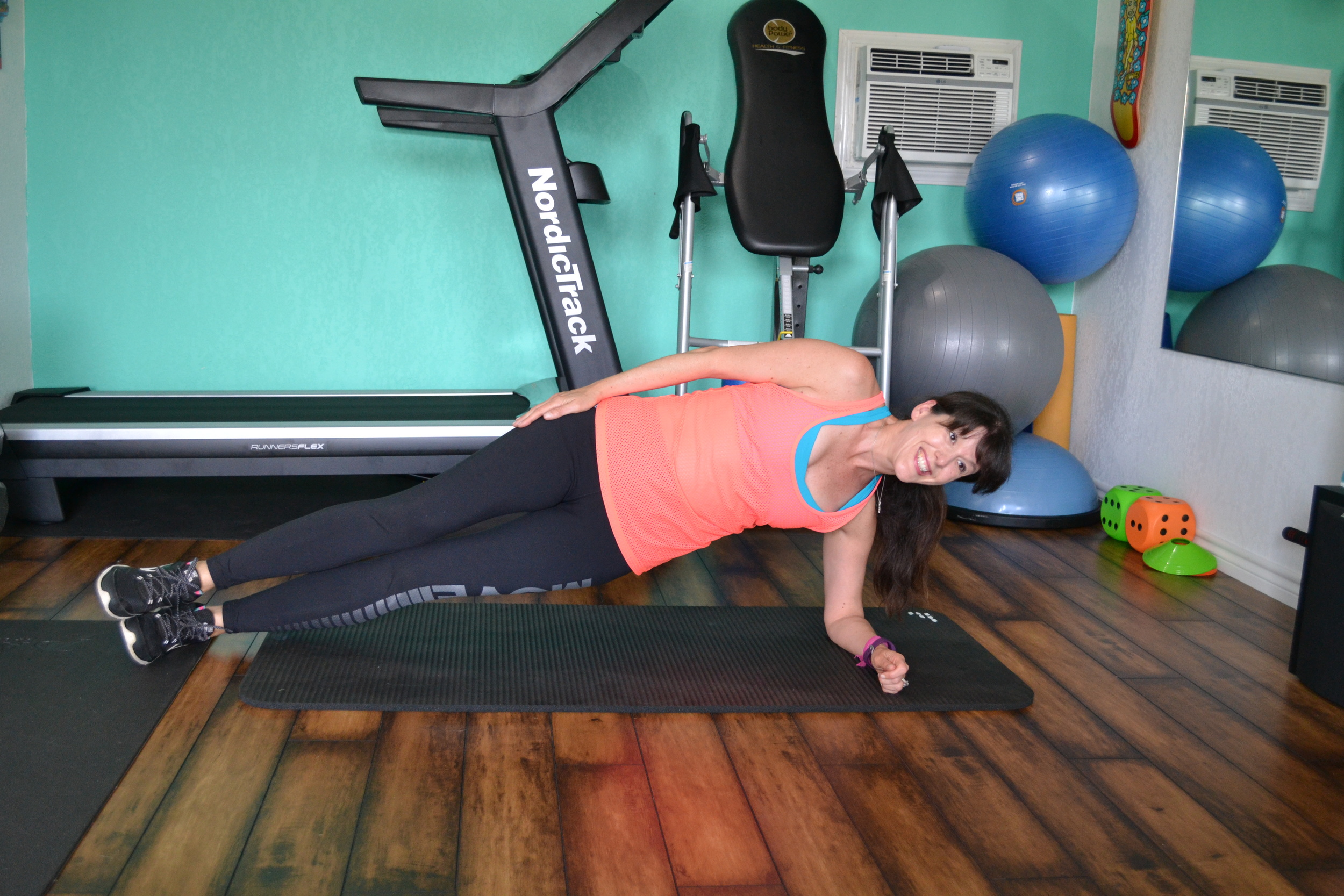
SIDE PLANK DIPS

Start in a side elbow plank position with your elbow directly under your shoulders. Keep your body in a straight line from your shoulders to ankles while engaging your core. Lower your hips to the ground to "dip" then return to side plank position. 

Repeat for 20 seconds then hold in side plank position for 10 seconds. Do not allow your hips to hike up or sag down while performing the isometric hold. Repeat on other side.
Can you find four minutes in your day to give it a try? If you do, let me know what you think!

Coach Lea


Running A-Z: A is for Acronyms (Running Acronyms Decoded)

Welcome to the first edition of a new series called Running A-Z. Each week I will cover a new running-related topic following the order of the alphabet. I'll confess that I have not yet planned the topics for each letter over the next 25 weeks. I will write these blog posts each week and hope that I don't get caught up on some of the tricky letters. Like X. Oh, wait. XT - Cross Training. I got this! Speaking of XT, do you ever get confused by all those running acronyms? 

A is for Acronyms

Whether you are a new or an experienced runner, chances are at some point you've been confused while reading a running-related article because it was littered with running acronyms. You may have thought to yourself, what the heck is a BQ, DNF or LSD? Let me help you clear it up! Here are translations of some common running acronyms.

BRF - Best Running Friend

BRF is like a BFF except for in running. It's your best running friend. 

"A lot comes out in those 12 mile training runs. My BRF knows more about my pre-run bowel movements than my significant other." 

BQ – Boston Qualify

When runners say they ran a BQ or they are trying to BQ, it means that they ran or are hoping to run a Boston marathon qualifying time. In order to submit an entry to run the Boston marathon you have to first meet their qualifying times for your age and sex. 

"I am training hard in order to BQ at my next marathon."


DNF – Did Not Finish

DNF is used in race results when a runner started the race but did not cross the finish line. It is unfortunate, but it happens to the best of us. 

"It was a tough race. It was my first DNF, but I knew it was the right decision for my body to leave the course that day."
 

DNS - Did Not Start

A little less common, but DNS may be listed in race results when a runner was entered in a race but didn't start it.


LSD - Long Slow Distance

Runners may refer to their weekly long runs as LSD. Long slow distances are typically part of half marathon and marathon training. A runner new to long distances should run 45 seconds to 90 seconds per mile slower than usual to reduce impact on the body and recover faster in order to continue to progress with training. 

"My training schedule calls for a LSD this weekend, will you join me?" 


PB - Personal Best

PB refers to the runners personal best (fastest) time they ran for particular distance. See also the more common, PR.

"I got a PB! I got a PB! A 3 minute PB! WooHoo!"


PR - Personal Record

See also PB. Runners may have a 5K PR, a 10K PR, a half marathon PR and a full marathon PR. It is the fastest time they ran those distances.

"I didn't PR my half marathon but I felt strong and had a great race!"


XT = Cross Training

Cross training refers to an activity that a runner does for exercise besides running. It's important for runners to incorporate some strength training into their training plans in order to run stronger, avoid or correct muscle imbalances and to help avoid injuries. XT sessions should be activities that complement running. 

Now let's try to use them all in one sentence.

"I PR'd my last race with a PB! I didn't BQ but at least I didn't DNF or DNS! I guess those LSDs and XT sessions are paying off!. My BRF will be proud of me!" -  Any Runner

Hope to see you next week for B is for...(you'll have to come back to find out!)

Did I unlock a great mystery for you? Did I miss any? Any suggestions for future running related posts as we work through the alphabet? I'd love to hear what you want to learn more about!

Coach Lea

Bodyweight Bootcamp: Crazy Eights Workout

Welcome to another edition of Workout Wednesday! You may already know that I have been teaching a bodyweight bootcamp but in case you do not live in North Texas, I thought it would be a fun idea to share a portion of my weekly classes here so you can try them at home (or outdoors!).  If you missed last week, we did a fun 5x5x5 workout.

Crazy Eights Bodyweight Bootcamp


Crazy Eights Workout

I love this intense circuit-style bodyweight workout. You'll get a full body strength and cardio workout in one. The great thing about bodyweight workouts is that you don't need any equipment so you can do them anywhere! Hubby and I hit Trinity Park in Fort Worth this past weekend to have a little fun in the great outdoors. 

You'll perform 8 reps of each exercise before moving onto the next one with no rest in between exercises. Once you complete the 8 reps of 8 exercises, you will rest one minute before repeating the circuit seven more times for a total of eight rounds! Crazy Eights, indeed!

Do not rush the exercises. Perform them slowly to ensure proper form.

SQUATS

Starting with your feet hip width apart push your hips back and lower until your thighs are parallel to the floor (like you are sitting back in a chair) or as low as your flexibility allows. In the low position, engage your core, squeeze your glutes and push up to standing. Take a deep breath in as your lower to the squat and breath out as you return up to standing.

PUSHUPS

Start in a high plank position with your hands placed a little wider than your shoulders. Keeping your body in a straight line, while engaging your core slowly lower your chest to the floor. Once in the low position, push back up to the starting position. If this is too challenging, drop to your knees. 

LUNGE RIGHT

With your feet hip width apart and your toes pointed straight ahead, hold your core stable with your back straight and take one large step with your right leg to lunge forward until your front knee is lined up over your ankle, your right thigh is parallel to the floor and your back knee is nearly touching the floor. Do not allow your knee to go past your toes. Use your right leg to push back up to standing in the same position as you started.

LUNGE LEFT

With your feet hip width apart and your toes pointed straight ahead, hold your core stable with your back straight and take one large step with your left leg to lunge forward until your front knee is lined up over your ankle, your left thigh is parallel to the floor and your back knee is nearly touching the floor. Do not allow your knee to go past your toes. Use your left leg to push back up to standing in the same position as you started.

PLANK ROW

Start in a high straight arm plank position with your wrists directly under your shoulders with your legs wider than hip width for stability. Keep your body in a straight line from your shoulders to ankles while engaging your core. Do not allow your hips to hike up or sag down.

With your core tight and your glutes engaged lift your right elbow to row as you bend your elbow up toward the ceiling. Repeat on your left side. This is one rep.

BICYCLES

Lie flat on the floor with the lower back pressed into the ground. Place your hands on either side of your head, do not lock your fingers or pull the head up. Lift your knees to a 45 degree angle. Lift your head and shoulders off the floor and touch your right elbow to the left knee while pulling your knee up towards your head. At the same time, straighten your right leg, keeping it several inches off of the floor, similar to the motion you'd make while pedaling a bicycle. Repeat on other side. This is one rep.

TRICEP DIPS

Position your hands shoulder width apart behind you on a bench or chair. (We use a window ledge at the studio!) Slide your butt off the front of the bench with your legs extended out in front of you. Bend your elbows to lower your body toward the floor until your elbows are at about a 90-degree angle while keeping your back close to the bench. From the low position, straighten your elbows to return to the starting position. Keep your shoulders down as you lower and raise your body. If this is too challenging you can bend your legs to modify the exercise.

BURPEES (Everyone's favorite!)

Stand with your feet hip width apart, lower into a squat position until your hands are flat on the floor in front of you. Jump your legs backwards into a high plank position. Jump both feet forward so you are back in the squat position. Jump up and raise both hands over your head. If this is too challenging, step back and forward from plank position instead of jumping. 

Don't forget to warm up and cool down before and after every exercise session. It is important to remember that while I am a certified personal trainer, I am not your trainer. Please consult with a Doctor or a fitness professional that knows your unique abilities and fitness levels before beginning any new workout program. 

We couldn't leave the park without having a little fun first!

Try out my crazy eights workout and let me know how it goes!

Coach Lea

How to Make Exercise a Daily Habit

I have an outstanding tip for making exercise a daily habit. A lot of people want to exercise regularly but struggle with executing it over long term. I've been applying this tip to my own exercise habits for a couple of years now. Applying this idea is how I went from a person who wanted to workout regularly but could never stick to an exercise plan to a person who exercises most days of the week. 

Set a Bare Minimum Goal

My trick to make exercise a daily habit is to set the bar so low that there is no way I can allow myself to miss it. I call it my daily bare minimum goal. I set a bare minimum goal that I have to achieve every day. Before you write me off as lazy, hear me out. 

My bare minimum goal is to take 10,000 steps (tracked on my FitBit) and do a two minute (iso-prone) plank. The reason that this bare minimum goal is good for me is because I know it is something that with a little extra effort in my day, I can always achieve.

In order to get 10,000 steps I know I need to make a few laps around my office building during the day, use the bathroom on another floor and park my car really far away from the front door. If I didn't work out that day, this still may not enough to meet my goal, but it gets me most of the way there. On a day that I don't run for exercise, I may have to take a short walk around the neighborhood after dinner to reach my final goal of 10,000 steps.


The two minute plank is a good bare minimum goal for me because it is long enough to be challenging, but not too long to be impossible to achieve on a daily basis. No matter how crazy my day is, I can always find two minutes to get in my plank. 

Your bare minimum goal doesn't have to be the same as mine. My husband's bare minimum goal is to walk one deliberate mile a day. This goal works for him because he works from home and enjoys walking Ollie. He knows that no matter what his day throws at him, he can find 15 minutes for his daily one mile walk. The key is finding your own bare minimum goal that works with your lifestyle. He hasn't missed his mile in three years! (I've seen him walk in the rain, snow and cold!) No one ever got super fit from walking a mile day, but it is a positive step you can take towards better health and establishing healthy habits. 

Your Bare Minimum Goal Shouldn't be Your Only Goal

Don't get me wrong, having a bare minimum daily goal doesn't mean that I don't have bigger, more aggressive goals, plans, and exercise schedules.

The truth is that I do some sort of traditional workout at least four or five days a week, but I meet my bare minimum goals seven days a week. Exercise became a habit for me by starting with my bare minimum and building from there.

Even as I grew consistent with my daily habits, got stronger, and added more workout days, I never changed my bare minimum. The bare minimum is what it is, the bare minimum. That's the beauty of it.

BENEFITS OF A BARE MINIMUM GOAL

I think it is effective for two reasons. First it helps establish daily healthy habits. My habit now is to park ridiculously far away from the front door at the office and use the restroom on another floor. My husband and I often take a quick walk after dinner if I haven't yet met my goal. This is a habit. It is a daily part of my life that I don't have to think or obsess about. I just do it. Not getting my step goal or missing my plank is not an option. It's non-negotiable.

Secondly it helps me feel accomplished and check a healthy goal off my list each day, even if I fell short on other day's goals. Let's face it, sometimes I have the best of intentions but I sleep in too late, have to work late, get stuck in traffic or get roped into an after-work happy hour (the horror!). My bare minimum goals help me achieve a baseline goal no matter what life throws my way. Even if I miss a traditional workout, I know I did something positive for my health today. It's a form of self-compassion. I can feel good about myself even if I missed a workout. 

How to plan your own bare minimum goal

When you are planning your workouts for the week, start with your baseline bare minimum goals, then build on with your exercise plan for the week. The bare minimum isn't intended to be the only thing you ever do to improve your fitness, it's your back-up plan for when real life gets in the way. 

First come up your own bare minimum goals. The key here is to make it so achievable that you can't miss it. It shouldn't take up a lot of time or too much planning on your part, but should be a little bit challenging.

For example, I wouldn't make my goal to walk 5000 steps a day because I do that every day anyway without any additional energy. My 10,000 step goal requires me to make efforts throughout the day to get additional steps and maybe 15-20 minutes at the end of the day if I didn't do a traditional workout that day. It's achievable but requires a little extra effort on my part.

Now 10,000 steps a day might be too low for some people or too aggressive for others. A good way to determine a step goal is to track your steps for three days, average your steps over the three days, then add 3000 steps to the average for a starting daily goal. 

A bare minimum goal doesn't have to be a step goal or even a mileage goal. A great bare minimum goal is to do 15 minutes of any physical activity. Maybe you like Yoga and want to do 5 to 10 sun salutations as your daily bare minimum goal. Find something that fits your preferences and lifestyle. 

Terrible Bare Minimum Goal Ideas

What you shouldn't do is get overly excited and set super aggressive bare minimum goals, this will only set you up for failure. Working out for an hour a day is a great goal to work towards, it is just not an appropriate bare minimum goal. It takes too much time, too much effort and is too easily missed.

Running a 5K is a great personal fitness goal, but it is a terrible bare minimum daily goal. First of all, you always need rest days from running and you may not always have the time in your day to run a 5K.

100 squats a day is not a great bare minimum goal, because it is best to have have rest days in between resistance training sessions.

Your bare minimum goal should be something doesn't require equipment, support of other people (babysitters, a ride, a partner), a time limit (gym hours) or much time out of your day. It also shouldn't be too aggressive or challenging. It should be something gentle enough for everyday without rest. 

No matter what your current fitness level from beginner to advanced, a bare minimum goal can be an effective way to build new healthy habits into your current lifestyle. Will you try it? I'd love to hear your bare minimum goals.

Coach Lea


5 x 5 x 5 Workout Body Weight Bootcamp

Hi, fitness friends.

Welcome to another edition of bodyweight bootcamp. This is a weekly post where I share a portion of the beginners bodyweight bootcamp class that I teach every Tuesday evening in Hurst, TX. I'd love it if you would join me for a bootcamp class whether in person in Hurst, TX or try out my workout here. 

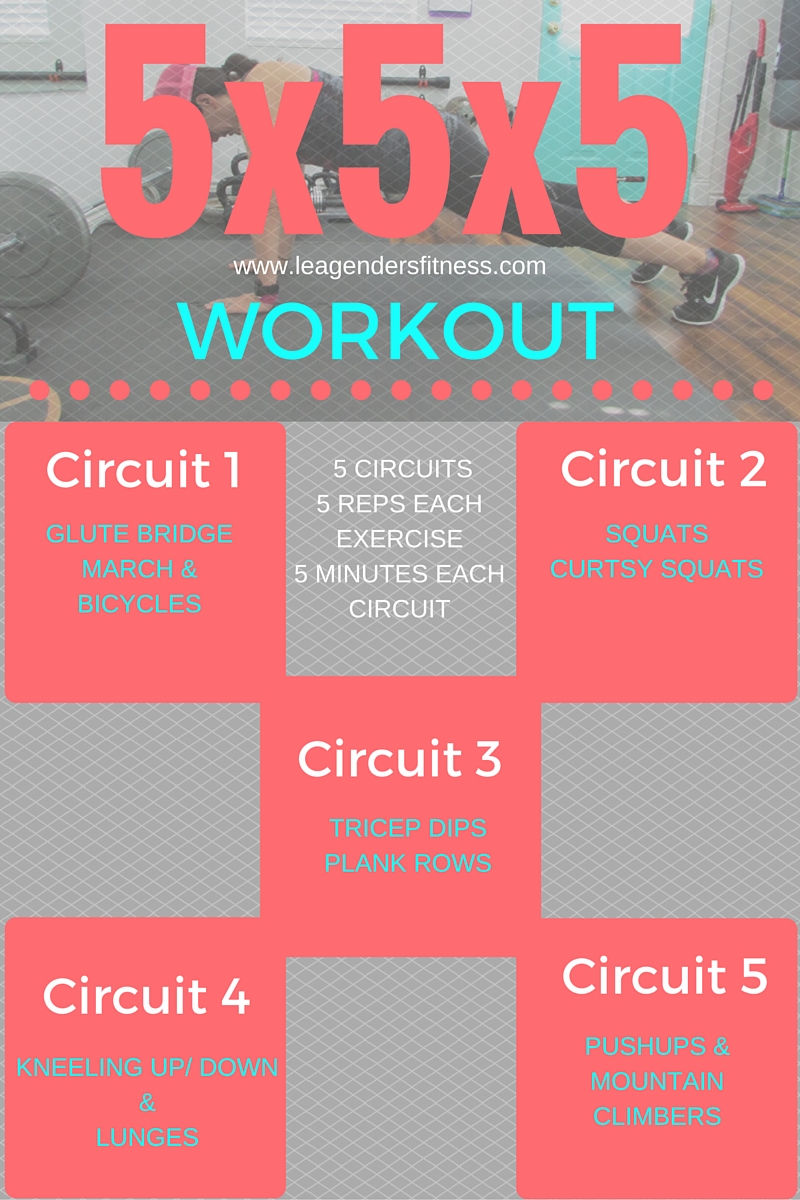
5 x 5 x 5 circuits

To complete the 5 x 5 x 5 workout you will perform five reps of each exercise in the circuit for five minutes. Repeat the exercises in the circuit until the five minutes are up. Take a one minute break between circuits. Complete all five circuits for a full body weight workout. 

Circuit 1

Glute Bridge March and Bicycles

Perform 5 reps of each exercise and repeat until the five minutes are up. 

Glute bridge march: Lie on your back with your knees bent and lift your hips off the floor while squeezing your glutes and abs. Bring your knees in towards your chest to march. March on the right leg then left leg equals one rep. Don't forget to breathe!

Bicycles: Lie flat on the floor with the lower back pressed into the ground. Place your hands on either side of your head, do not lock your fingers or pull the head up. Lift your knees to a 45 degree angle. Lift your head and shoulders off the floor and touch your right elbow to the left knee while pulling your knee up towards your head. At the same time, straighten your right leg, keeping it several inches off of the floor, similar to the motion you'd make while pedaling a bicycle. Repeat on other side.

Circuit 2

Squats and Curtsy Squats

Perform 5 reps of each exercise and repeat until the five minutes are up. 

Squat: Starting with your feet hip width apart push your hips back and lower until your thighs are parallel to the floor (like you are sitting back in a chair) or as low as your flexibility allows. In the low position, engage your core, squeeze your glutes and push up to standing in an explosive movement Take a deep breath in as your lower to the squat and breath out as you return up to standing.

Curtsy Squat: Stand with feet shoulder-width apart, hands on hips. Cross right leg behind body and to the left. Bend left knee 90 degrees, or as low your flexibility will allow, toes pointing forward, then return to starting position. Repeat on other side. This is one rep.

Circuit 3

Tricep Dips and Plank Rows

Perform 5 reps of each exercise and repeat until the five minutes are up. 

Plank rows: Start in a high straight arm plank position with your wrists directly under your shoulders with your legs wider than hip width for stability. Keep your body in a straight line from your shoulders to ankles while engaging your core. Do not allow your hips to hike up or sag down.

With your core tight and your glutes engaged lift your right elbow to the ceiling. Repeat with left arm. Row on right arm, then left arm equals one rep.

Circuit 4

Kneeling Up/Down and Lunges

Perform 5 reps on each leg of each exercise and repeat until the five minutes are up.  

Kneeling up/down: Start in a kneeling position on a mat. Leading with your right leg, push yourself up to standing position. While standing, leading with your left leg, lower yourself back down to kneeing position. Repeat on opposite leg, use your left leg to stand and right to return to kneeling.

Lunges: With your feet hip width apart and your toes pointed straight ahead, hold your core stable with your back straight and take one large step to lunge forward until your front knee is lined up over your ankle and your back knee is nearly touching the floor. Do not allow your knee to go past your toes. Push back up to standing and change legs. Lunge on right leg then left leg equals one rep.

Circuit 5

Pushups and Mountain Climbers

Perform 5 reps of each exercise and repeat until the five minutes are up. 

Pushups: Start in a high plank position with your hands placed directly under your shoulders. Keeping your body in a straight line, while engaging your core slowly lower your chest to the floor. Once in the low position, push back up to the starting position. If this is too challenging, drop to your knees. 

Mountain Climbers: Start in a straight arm plank position with shoulders directly over wrists. Step one foot up in line with hip, then step back to plank position. Repeat with opposite foot. This is one rep. Move as quickly as possible while keeping your core engaged and breathing normally. 


Warm up and cool down before and after every workout. It is important to remember that while I am a certified personal trainer, I am not your trainer. Please speak to a doctor or fitness professional that understands your unique fitness level and abilities before beginning any new exercise program. 

Try it out and let me know what you think!

Coach Lea