RUNNING

BAD RUNNING ADVICE YOU CAN SAFELY IGNORE

We live in a wonderful time when all the answers to our questions are at our fingertips. Who was that actor with the face in the movie with the car? You know, that guy. These days we don't have to know or remember much. We can look up anything we need to know in mere seconds. A far cry from the days when my parents had a 20-book encyclopedia set as our only source of information inside the house. Today, we don't even have to type, our BFF Siri has all the answers. I imagine in the future, we will be able to just ask our questions into the open air as we walk down the street and the answers will be delivered instantly to our brains. 

The problem with so much readily available information is that it is left up to us to determine what is valuable and what is garbage. We all know that there's a lot of bad information out there. Some of it is well-meaning but misguided, some it outdated and some of it outright lies designed to mislead us. I'm here to help you sort through some of the bad running advice. Here is my list of bad running advice that you safely ignore. 

bad running advice.png

GO HARD OR GO HOME

There seems to be a push lately for hard-core training. Go hard or go home. While hard-core determination or hard-core commitment is to be admired, don't confuse it with the intensity of your training. Your training program should be a mix of high intensity and low intensity workouts. In fact, a schedule of nothing but high intensity workouts will quickly lead to overtraining, burnout or worse, injury. Rest and recovery is as important in your training schedule as those high intensity days. In fact, most athletes will thrive on just one to two high intensity days per week. Be sure to schedule easier, enjoyable, lower intensity runs into your training cycle. A better piece of advice is to run hard on your hard days and run easy on your easy days. Runners often make the mistake of running too hard on easy days and not hard enough on hard days. 

PUSH PAST PAIN

Never ever (ever!) push through physical pain. Physical pain is your body's way of communicating to you that something is wrong. If something hurts, stop running before you make it worse. Sometimes we just need rest to heal, but if you keep pushing through physical pain, you can make it worse and put yourself out of commission for even longer. The important thing is to learn the difference between physical pain and discomfort. Better advice is to push through feeling tired, push through the burning sensation in your muscles, push through heavy breathing and mental discomfort, but never push through physical pain. I wrote a post on how to tell the difference between pain and discomfort. 

RUNNING IS BAD FOR YOUR KNEES

Ahh, my favorite piece of bad running advice. It often comes from well-meaning people who think they are trying to help. When Grandpa or a co-worker offers up this piece of bad advice, I assure them I am taking proper precautions to avoid any problems. The truth is a bad training plan can be bad for your knees. Runners who increase their mileage too quickly, run too fast for their abilities, don't rest enough and don't strength train may have knee (or other) problems. If you train responsibly, increase your mileage and intensity at the proper rate, include strength training and listen to your favorite running coach (that's me), then running is not bad for your knees. Bad training is bad for your knees.

PERFORM STATIC STRETCHING BEFORE RUNNING

Not long ago it was common practice to recommend static stretching (holding stretch for 30 seconds) before workouts. Today we know that stretching before you workout can actually hinder performance. A more effective use of time before your workout would be to perform a dynamic warm up to move the joints through the full range of motion. Here is a quick dynamic warm up to try before your next run. Better advice is to save the static stretches for after your runs. 

RUN FAST IN THE BEGINNING TO BANK TIME IN THE END WHEN YOU'RE TIRED

This doesn't work. It doesn't work on your long run and it certainly doesn't work on race day. Even if you feel great in the beginning and running faster than usual or planned, it is good idea to slow down in the first half of your run to a sustainable pace. If you feel great after the first half, feel free to pick up the pace and finish strong. It never works the other way around. You can't bank time in the beginning to finish strong. Better advice to always work towards achieving a negative split, this means you run the second half faster than the first. Trust me on this one. 

YOU HAVE TO RUN A CERTAIN PACE TO BE A REAL RUNNER

My personal pet peeve is when someone tells you that you have to run at least a (insert arbitrary pace here) mile in order to be considered a real runner. I call BS! If you strap on a pair of running shoes and hit the road, if you're out there, you're a runner. Period. If you take walk breaks, you're still a runner. The great thing about the running community is that they are largely supportive. I find the jerks and naysayers are often on the sidelines voicing their opinions while not even doing it themselves. Better advice:

“If you run, you are a runner. It doesn’t matter how fast or how far. It doesn’t matter if today is your first day or if you’ve been running for twenty years. There is no test to pass, no license to earn, no membership card to get. You just run.”
— John Bingham


YOU CAN EAT WHATEVER YOU WANT, YOU'LL JUST RUN IT OFF 

We don't train in a bubble. Everything matters. Your nutrition directly affects your running performance. If you consistently eat like crap, it will catch up with you. That's not to say there isn't room in your diet for treats and indulgences, but if you want to look, feel and perform your best, nutrition matters. The old adage is true, you can't out train a bad diet. Better advice is to eat to perform. I wrote a post about why sometimes you gain weight while marathon training and how to avoid it.

YOU SHOULD CARBO-LOAD BEFORE YOUR 5K

If you're looking for an excuse to eat four servings of pasta, I'm sorry to tell you that your upcoming 5K isn't it. Carbo-loading can be a an effective tool for long distance runners who need to increase their glycogen stores before an endurance race. Even then, a more effective strategy is to slowly increase carbs in the days leading up to race day. Better advice to fuel for a 5K is to eat proper portions of a mix of high quality carbohydrates, fats and protein most of the time to look, feel and perform your best. 

YOU CAN REST WHEN YOU'RE DEAD

Rest is as important in your training cycle as your workouts. You get stronger and faster during rest, not during the workout. If you never rest, you never allow your body the time it needs to repair, recover and build. You will eventually stall your progress if you don't rest. You'll risk overtraining, burnout and injury. Resting isn't laziness, it's an important part of the plan. Better advice is to schedule rest days into your training cycle. You can walk, stretch, foam roll or do other low-intensity activities on rest days, but don't neglect them. 

SAVE MONEY BY BUYING YOUR RUNNING SHOES ONLINE

When you're a new runner your local running store is a valuable resource available to help you start your running journey. The employees at these stores are knowledgeable runners and coaches that can help you choose the correct shoe for your individual needs. You shouldn't buy shoes because of their pretty colors, you need to buy the shoes that will support you in the unique way that you run. You can test out the shoes before you buy them and have access to a coach or knowledgeable associate to ask questions. Choosing the right shoe is an important decision. You will pay a little more at a local store than buying last year's model at a discount website, but by supporting your local running store you help support your community and the businesses and families within them. 

What's the worst running advice you've ever received?

Need help with training or nutrition? I am accepting new in-person clients in Fort Worth and online nutrition clients. Let's chat about your goals and how I can help you achieve them. 

Like this post? It helps me when you share!



Running Form Tips For The New Runner & a Lesson on Being a Beginner

When I tell people that I am a running coach, sometimes they are quick to inform me they hate to run. I'll be the first to recommend that you not to do any exercise you hate, because you'll never stick to it. The best exercise is one you will actually do. Find a way to move your body that you love. However, I believe that a lot of people never give running a fair chance.

In the beginning, running can really suck. It's hard. It takes some time for your body to adapt. If you can get through the beginning-sucky part you may just find that you love running after all. It is hard for everyone at first. Of course you suck in the beginning, everyone sucks in the beginning. You have to practice. You have to run consistently and after a couple of months things will start to get better. Running can be enjoyable and you can actually get good at it. 

Don't compare your start to someone else's middle.

Then I realized, damn, I need to take my own advice. Not about running, of course. You see, I recorded a quick video in the ShredShed this weekend. I always say I am a better writer than talker. I am just not very good on video. But why am I not very good on video? Because it is new to me. Because I don't do it often. Because I am not comfortable with it. Sound familiar new runners?

How do you get better at the things you suck at? You practice. You do them often. Just like that new runner that I coach to get out there and try again even when...especially when it doesn't feel good. 

So in an effort to practice what I preach, I am going to record more videos and share them. It's not about being perfect and polished. (Ha, that may never happen. Have you met me?) It's just about doing the best I can and getting better over time. I did this one on proper running form. It's not perfect, but the information in the video is still valuable. 

Watch my awkward reenactment of driving a car (yes, that is what that was supposed to be), my impression of an angry runner and my bad Phoebe Buffay running joke. Yes, I think i'm funny.

If you're anything like me and you still would rather read than watch a video, I'll cover my running form tips in writing too.

running form tips (1).png

RUNNING FOR TIPS FOR NEW RUNNERS

SHOULDERS BACK AND DOWN

In this day and age we are constantly rounding our shoulders forward; when we text, when we type and when we drive our cars. I don't know about you, but I do those things almost all day long. When you run pay attention to your shoulders. Stand up straight, roll your shoulders back and down. This will help with proper form and running efficency.

ELBOWS CLOSE TO THE BODY

Don't run like Phoebe Buffay. Keep your arms and your elbows close to your sides as you swing your arms, don't allow them to flare out to the side. Your arms should move forward and backwards only, do not allow them to cross over the front of your body.

HANDS RELAXED

Run with your hands relaxed. Do not clench your fists like an angry runner. A good tip is to place your thumb and pointer fingers together like you are holding a potato chip between them. Keep it light, easy and relaxed.

NECK NEUTRAL | EYES FORWARD

Don't look down at your feet. Look straight ahead at where you are going, not at where you are right now. Keep your neck neutral. 

Focus on one thing at a time. What can you improve today? Once you get these first four running form techniques mastered you will find that running is a little easier, that you are wasting less energy and running more efficiently.

Do you remember what it feels like to be a beginner at something? We all start somewhere. If we just strive to the best we can and keep moving forward (no matter how slowly), we will all be better for it. 

Lea signature.jpg

Coach Lea

Like this post? Yesterday was my birthday. I'll consider it a belated birthday gift if you share.


TRAIN SLOW TO RUN FAST: WHY SLOWING DOWN CAN HELP YOU SPEED UP ON RACE DAY

Train slow to run fast. Wait. What? That sounds counter-intuitive. 

A mistake a lot of runners make is that they run too often at a pace that is too hard. While fast-paced runs have their place in your training, if you run at a hard (tempo) pace every day, it could be holding you back from improving. If you add additional speed work on top of daily tempo runs, it's a recipe for a running disaster: injury. 

train slow to run fast (1).png

SLOW AND LOW THAT IS THE TEMPO

If you run your slow runs too fast your body will not be properly recovered and ready to do the speed work at your full potential. You'll end up limiting improvements by staying stuck in the middle with your slow runs too fast and your fast runs too slow.

Most coaches recommend aiming for about 80% slow runs and 20% fast runs in your training week. That means most of the time you should be running slow. I know we all want to post our speedy times on Instagram every day, but the slow runs strengthen your base so that you are ready and able to perform the fast runs at your full ability.

It takes a great deal of restraint to run slow. While you may worry that people are judging you for your snail-like pace on those slow run days, let me assure you that no one cares about your pace as much as you do. Most people are just impressed that you are out there at all.

Slow runs should be about one to two minutes slower than your race goal pace. Slow runs should be performed at a conversational pace, which means just what it sound like: You can hold a conversation with your running buddy without gasping for air between words and sentences. My running partner has four legs and he doesn't talk back, but you get the point. Get out there and actually enjoy your runs. You shouldn't be pushing yourself to the limit on every single run.

THE BENEFITS OF RUNNING SLOW

slow lane on road.jpg

Running slow may not make you an instagram star, but there are benefits that far outweigh a few new likes on your Strava image. Running slow helps build your tendons, ligaments and joints to adapt to the stresses of running. This helps you stay injury-free. Slow running builds your aerobic base and increases your glycogen (carbohydrates) stores which you will need if you want to run long(er) distances. Slow running allows you to put in more miles each week while avoiding burnout or injury from overtraining. 

VARY YOUR PACES

I am not advocating that you should always run slow. Remember the 80/20 rule. 80% slow but the 20% fast is important too. If you always run slow, your body will adapt and you will become really efficient at running slow. If you want to run faster, first build your aerobic base by running slow, then most athletes will thrive on just one or two speed sessions per week. It's about finding the balance between work and recovery. Everyone is a little bit different, you may have to experiment to find what works best for you. Listen to you body. 

RECOVER FROM SPEED WORK

Without proper recovery you can't keep improving. You get stronger and faster during rest, not during the workout. If you push your pace on every run and don't rest enough for recovery you will not allow your body to get stronger and faster. Resting and slow running are not signs of laziness, they are important components of a well-rounded training plan. Got it? Good. 

Next time you hit the road for a run, make a conscious effort to slow down. Go slower than you need. Sing the Beastie Boys in your head (or out loud for all I care) "Slow and low that is the tempo". Do the talk test. Can you hold a conversation without taking deep breaths for air? Enjoy your run. This is supposed to be fun. 

slow runners make fast runners look good.png

Like this post? I jump for joy when you share with your friends and followers.

Lea signature.jpg


LONG INTERVALS: SPEED WORKOUT FOR THE DISTANCE RUNNER

Welcome to the latest edition of workout Wednesday when each week I share a new running or strength training for runners workout. This week we are talking about speed for the distance runner. If you are a long distance runner training for a 10K, half or full marathon, then this is the workout that will help you progress.

Long intervals are speed intervals from 1/2 mile to two mile repeats with shorter periods of recovery. Long intervals are great for distance runners midway in their training cycle who want to improve their race times.

BENEFITS OF LONG INTERVALS FOR DISTANCE RUNNERS

  • Trains the cardiorespiratory system
  • Trains fast twitch muscle ability which means improved speed and power
  • Trains mental strength to endure longer intervals at an uncomfortable pace 
  • Increases strength and promotes an efficient running form
  • Helps increase the anaerobic threshold which means you can run faster with less effort
  • Helps prepare for faster paces during longer races

Convinced these are worth your time? Great. Now like any good running coach, let me warn you of the potential pitfalls. Intervals workouts should generally be introduced into your training plan after an aerobic base has been established.

When you begin your race training cycle, spend the first 4-6 weeks building mileage at a conversational pace. This period allows your body to adapt to running before increasing the intensity with intervals. You must train your muscles, tendons, joints and ligaments to adapt to the stresses of running before introducing high intensity runs. Speed work may sound fun and exciting (wait. what?!) but if you don't properly prepare for it by building a solid running base first you could end up sidelined with an injury.

It's also important to note that high intensity workouts should be followed by easy effort run days or rest days. Most athletes will thrive on just one or two high intensity runs per week. Work hard and then recover to enjoy the full benefits of the workout.

Coach rant over. 

This workout can be done on a track, a treadmill or a flat course if you have (affiliate link--->) a GPS watch to track your distances on the road. This is one I use, you can see it all over my Instagram feed.

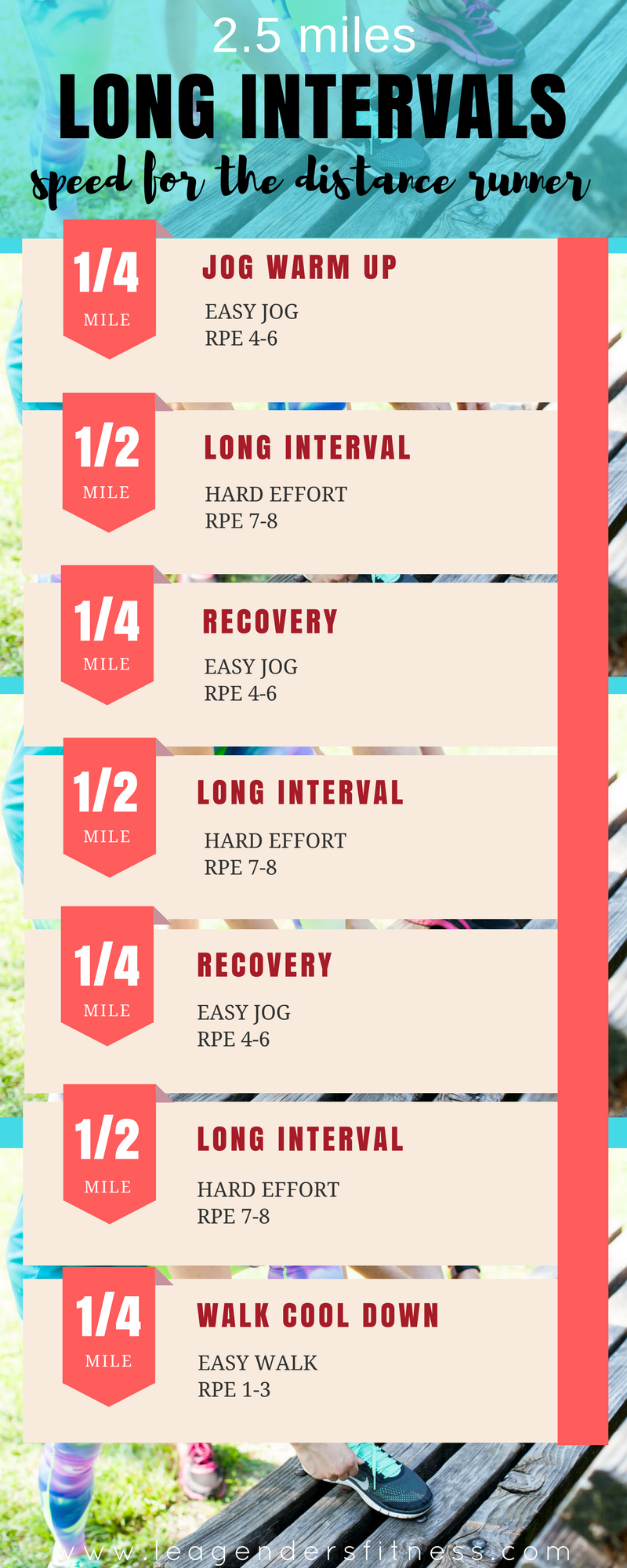
LONG INTERVAL SPEED FOR THE DISTANCE RUNNER WORKOUT (2).png

LONG INTERVALS WORKOUT

WARMUP

Always start your runs with a proper warmup. Check out this post with my dynamic warmup for runners. It's important y'all (insert my fake Texas accent here).

JOG FOR 1/4 MILE

Jog for the first 1/4 mile at an easy conversation pace at a RPE 4-6. Check out my RPE (rate of perceived exertion) chart to find out what the heck that means.

RUN FOR 1/2 MILE AT AN INCREASED PACE

This pace should feel comfortably hard, RPE 7-8. If you go out too fast you won't be able to sustain your pace for a half mile. You should be pushing yourself, it should feel hard, you shouldn't be able to talk much, but it shouldn't be so hard that you're gassed after one minute. Depending on your fitness it will likely take you 3.5 to 5 minutes to complete. It may take some experimenting to find what that pace is for you.

REPEAT TWO MORE TIMES

Repeat the interval/recovery periods two more times. If you are new to this, you may want to start out by just repeating once. Once you get stronger, as your body adapts, look for ways to continue to challenge yourself, either by running at faster paces, running longer intervals, decreasing rest periods or increasing sets. 

COOL DOWN

Walk the last quarter mile to cool down.

Are you training for a big race? Incorporate long intervals into your training cycle to enjoy faster race times. 

Like this post? You'll be my new BRF (best running friend) if you share with your friends and followers. 

Lea signature.jpg


THE RUNNER'S GUIDE TO GEAR UP FOR FALL RACES

Ah, the fall racing season is upon us. So whether that means you are signed up the local turkey trot and jingle bell 5K or training for a fall half or winter full marathon, it is undoubtedly the most wonderful time of year for runners. The cooler temperatures and crisp air gives us a burst of energy that seems to magically increase our speed and endurance after suffering through those long hot summer runs.

If you've been training this summer, it's about that time for some wardrobe changes to accommodate the dropping temperatures and the latest gear and technology to give us that edge (even it's all only in our heads).

This post contains affiliate links. That means if you click on a link in this post and make a purchase, I make a small percentage of the sale with no additional cost to you. No one is getting rich here, it just helps with the running (pun intended) of this blog. Thanks, as always, for your support. I only recommend products that I personally use and love. If I ever accept payment for promoting a product, I will clearly disclose it. In other words, If I hate it, I will always tell you. 

RUNNER'S GUIDE TO GEAR UP FOR FALL RACES.png

Running Shoes

I am a big proponent of shopping local. Buy those new shoes from your local running stores to help support the families and businesses in your community. Give back to the little guy. Comparison shop and read reviews online but go into your local store to get unmatched service and individual attention.

If you've been running in your shoes all summer, depending on your weekly mileage and your usual running surface, it may be time to replace. Everyone is different, but running shoes usually need to be replaced every 500 miles or so. If you look at the bottoms and the tread is worn down and inside the insoles are smashed in, it may be time for a new pair of kicks.

Remember to never wear anything new on race day, so if you do decided it's time for a new pair of running shoes, be sure to give yourself plenty of time to break them in before your big event. I love my New Balance shoes for distance running, but go into your local store so they can help fit you with the right shoe for your individual needs.

Compression Socks

Whether you wear compression socks during your race as a fashion statement, good luck charm (like me) or after your race to hug your calves as they are propped up on the couch for recovery, compression socks or sleeves are a staple in any runner's wardrobe. You can go wild with the patterns and colors, but the science is still out whether compressions socks offer any significant benefit, except when the runner believes it does. Go figure. ProCompression has consistently high-quality socks and sleeves with fun and funky colors.

Running Socks

Friends don't let friends wear cotton socks. Cotton absorbs water (aka sweat) which can cause damp feet, rubbing and blisters. It's the last thing you need while running a race. I was recently introduced to wool socks and I am hooked. They are not just for winter either, wool keeps you cool as well. Weird, I know.

Tops and Tights

The rule of thumb is to dress for 10-20 degrees warmer than the current temperature because once you start running, you will warm up considerably. Ideally you would dress in layers. Running tights, a long sleeve synthetic (aka not cotton) base layer, a warmer zip up on top and if it's really cold, a third layer. It's usually better to underdress than overdress, unless you are willing to leave a layer of clothing on the side of the road.

Running Belt

Unless your running tights have deep pockets, you're probably going to need some place to hold your belongings. You may need to take a selfie or call for a ride mid-run so having your phone and ID on you at all times is best. Once I tied my car key to my shoelaces and my shoe came untied on the trail. Ugh. That's a story for another blog. Now I'm much smarter and use a running belt to hold my belongings when I run. The FlipBelt is my BRF (Best running friend) and this color makes my emoji have hearts for eyes.

GPS Watch

While a GPS watch is not a necessity it is definitely a nice-to-have piece of running gear for the serious runner. These days the GPS on your phone running app is pretty reliable, but if you are obsessed..I mean, if you like to crunch the numbers of miles, paces, heart-rate, etc then a GPS watch is the way to go. This is the one I use, you can see it prominently displayed on my Instagram feed.

Are you ready for fall and the cooler running conditions? Are you geared up for all your fall races? What do you have on the schedule for the rest of this year? Did I miss any of your favorite gear?

Like this post? It helps me when you share with your friends and followers.

Lea signature.jpg