RUNNING

Running A-Z: I is for Injury Prevention for Runners

It's another week of Running A-Z, where I cover a running-related topic following the order of the alphabet. This week is the letter I. We will be talking about exercises for injury prevention. If you missed any of our past editions, you can catch up with letters A-H in the archives.
If you read this blog on a regular basis you know that I am a huge proponent of strength training for runners. In fact, I run my whole business on the notion that runners who strength train are stronger, faster and less prone to injury. But I get it. Runners generally don't enjoy the strength training aspect as much as they love to run. The good news is that you don't need to spend hours in the gym for basic injury prevention exercises. Runners generally need to work on strengthening their hips and abs. I challenge you as a runner to find 15 minutes three times a week to perform these exercises. Our goal is to strengthen those hip muscles to avoid injury.

You'll want to progress the exercises to make them more difficult over time, either by adding an extra set, a few reps, or adding resistance. Begin with two sets of ten reps for each exercise. After a week add an extra set. Once you are doing three sets, start adding additional reps each week until you're at three sets and 20 reps. Then make the exercises more challenging or add resistance. By continually progressing the exercises you will avoid adaptation and will get stronger over time. 

CLAMSHELLS
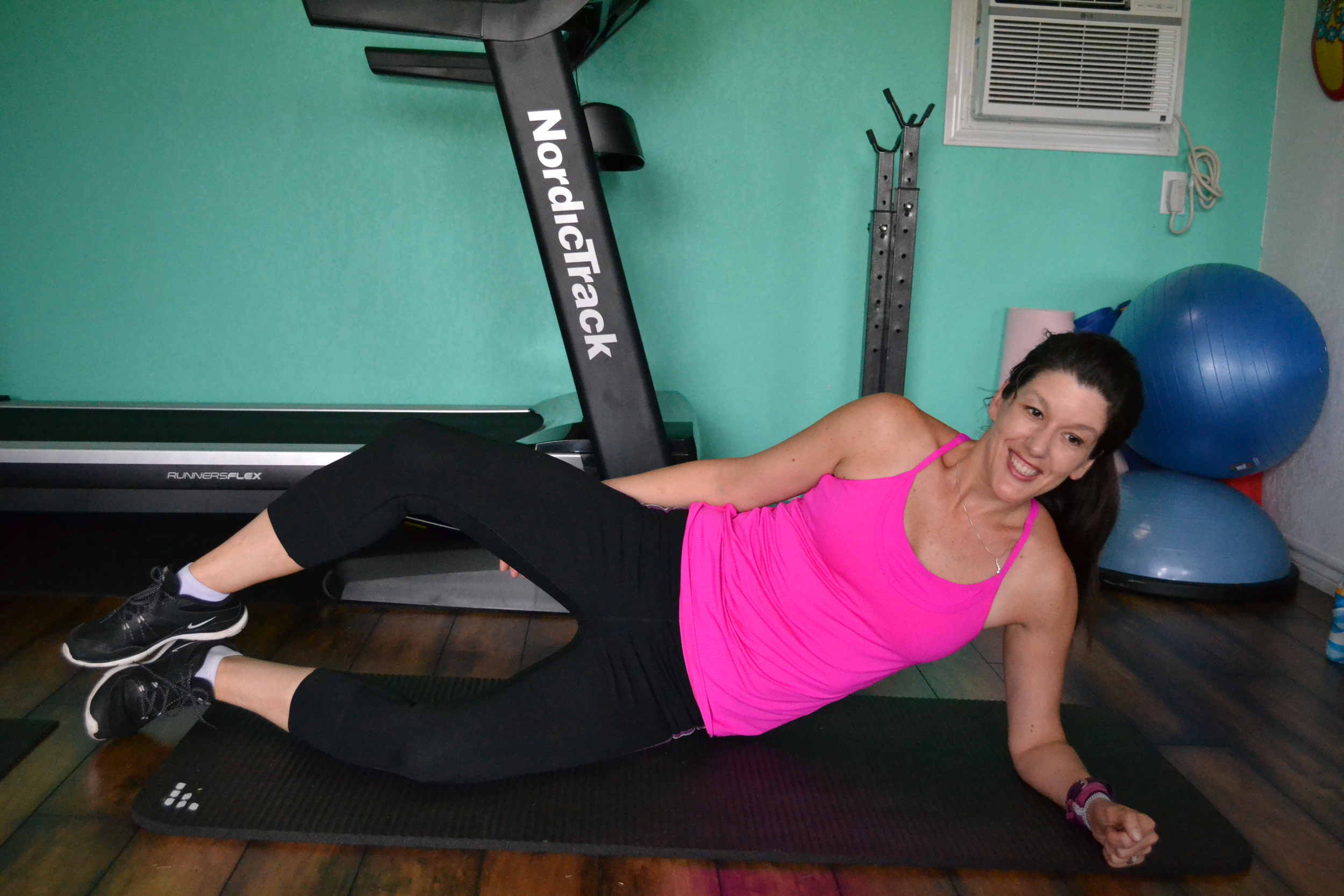
Lie on your side with your knees slightly bent with your legs and ankles together. You can prop yourself up on your forearm during the exercise. Open and close your knees like a clam by lifting your top knee up. Repeat on the opposite side.

Progress the exercise by adding a resistance band to your thighs.

BIRD DOG

On all fours with your wrists directly underneath your shoulders lift one arm off the floor to shoulder height while lifting the opposite leg in line with the hip. Switch arms/legs after 30 seconds. Squeeze your abs and glutes during the move while breathing normally.

Progress the exercise by extending the time in position.

HIP ABDUCTION

Lie on your side with your legs stacked on top of one another. Lift your top leg to about 45 degrees before lowering. Switch sides and repeat.

Progress the hip abduction when you're ready by advancing to the side plank hip abduction.

With a straight arm lift yourself up into a side plank position. Your shoulders should be directly over your wrists. Stack your feet and don't allow your hips to drop. Lift your top leg. Switch sides and repeat.

GLUTE BRIDGE

Lie on your back with your knees bent and lift your hips off the floor while engaging your glutes and abs. Your body should be in a straight line from your knees to your shoulders.  Lower your hips to the floor and repeat. 

Progress the exercise my lifting one leg, then alternating the leg. 

I encourage you to work these four exercises into your weekly routine to build hip strength. It is important to remember that while I am a personal trainer and running coach, I am not your personal trainer and running coach. Please get clearance from a medical professional before beginning any new exercise routine.

Any questions? 

Like this post? Please consider sharing.

Running A-Z: H is for Heart Rate (Interval Heart Rate Training)

Welcome to the latest edition of Running A-Z, a weekly blog post where I cover a running-related topic following the order of the alphabet. We are on letter H, you can catch up on letters A through G in the archives.

H is for Heart Rate

You bought a shiny new heart rate monitor, a new GPS watch with a HR monitor or a FitBit. You love being able to look at your wrist and seeing your heart rate at any given moment, but what does it mean? Just knowing your heart rate isn't enough, you need to know how to apply that knowledge to maximize your training. 

What are heart rate training zones? What is my max heart rate? What is my resting heart rate? How does this impact my training? I'm going to explain it all!

HR ZONES

HR STAGE % OF HR
STAGE 1 65-75%
STAGE 2 76-85%
STAGE 3 86-95%

We are going to establish your personalized training stages based on your max and resting heart rate using the HR reserve method. HRR is calculated using the Karvonen method formula:

((HRMAX - HR REST) X DESIRED INTENSITY) + HR REST

Having flashbacks of high school algebra? Don't worry, there are a ton of online calculators that will make this extremely easy. But before we start you need to know your resting heart rate and your max (or estimated) max heart rate. 

Estimating Max Heart Rate:

There is a formula that is widely used to calculate max heart rate but you should be aware that is an estimate and will probably need to be adjusted once you start your heart rate training. You may find when you start training that your heart rate will go higher than your calculated max rate, there is no need to worry, your heart is probably not exploding. You just need to adjust your calculations with your actual max heart rate. Don't worry if it doesn't make sense yet. Just keep reading.

To start take 220-your age to get an estimated max heart rate. 

I am 41, so using this formula (220-41) my max heart rate as 179. 

Determining your resting heart rate

A normal resting heart rate for adults is between 60-90 beats per minute. You should take your resting heart rate in the morning before you get out of bed (before your coffee!). Do it for a few days in row to get an idea of your average and make note of the lowest reading. FitBit shows your resting heart rate on the app. Generally speaking, a lower resting heart rate implies a healthier more efficient heart. 

According to my FitBit my resting heart rate is 55 BPM. 

Putting it all together with the Karvonen method formula

So now we have the numbers, let use the Karvonen method formula (or an online calculator) to calculate our target heart rates. 

((HRMAX - HR REST) X DESIRED INTENSITY) + HR REST

220-41 (AGE) = 179

179 - 55 (RESTING HEART RATE) = 124

124 X .65 (DESIRED INTENSITY - BASE TRAINING ZONE 65%) = 81 

81 + 55 (RESTING HEART RATE) = 136

136 is the low end of my target heart rate for my base training zone. Here are my heart rate zones based on my age, resting HR, and estimated max heart rate. 

HR STAGE HEART RATE
STAGE 1 136-148
STAGE 2 149-160
STAGE 3 161-173

How to apply HR stages to your training

Heart rate training

Heart rate training

Once you start plugging the numbers it will all makes sense. Trust me, because I am terrible at math and if I can do it, so can you. Let's get to the fun part, the training!

STAGE ONE

Stage 1 is your base training zone. This stage should be used for apparently healthy people that are new to exercise, people with a significant amount of weight to lose and for everyone in recovery periods or easy training days. (Yes, you should have easy training days built into your schedule.)

In stage one you should be working at conversational pace, which means you could hold a conversation for the entire duration of the workout without stopping between words or sentences to catch your breath.

People that are new to exercise should gradually build up to 30-60 continuous minutes in this stage before advancing to stage 2. Note you may start at just five minutes if you are new to exercise. The key is to progress slowly and gradually according to your own fitness levels. 

This stage is also sometimes referred to as the fat burning zone, but be careful not to fall for the myth of the fat burning zone. I wrote about it in detail in another post.

STAGE TWO

Stage two is the introduction of interval training. Interval training can be highly effective for fat loss, but be sure you have safely graduated out of stage one before moving to stage two to avoid injury, overtraining or burnout. 

During a Stage Two workout you would begin by warming up in zone one for 5-10 minutes. 

Increase your pace to bring your heart rate into zone 2 for one minute.

Return to zone one for 1-3 minutes or until your heart rate recovers. You will find as your heart gets more efficient over time, you will recover more quickly. 

Repeat the intervals into zone two for one minute and back into recovery for 3-5 times as long your heart recovers within those 3 minutes. It is important that your heart recovers back to stage one before attempting another interval. 

Cool down for 5-10 minutes in stage one. 

This is what a Stage two training day might look like for someone just starting in stage training. This is based on my personal heart rate zones, you will need to calculate your own to get your personalized stages. Need help?

HR STAGE HEART RATE MINUTES
STAGE 1 136-148 5-10
STAGE 2 149-160 1
STAGE 1 136-148 1-3
STAGE 2 149-160 1
STAGE 1 136-148 1-3
STAGE 2 149-160 1
STAGE 1 136-148 5-10

Alternate between stage one and stage two training days so that you never do interval training days back to back. Recovery it key to progress.

STAGE THREE

Stage three is for people with moderately high cardiorespiratory fitness level base. You should have been working in stage two for at least 3-6 weeks. Your heart rate recovery time in stage two should be about a minute between intervals before moving into stage three work. 

Warm up in zone one for 5-10 minutes

Increase the workload (pace or incline) every minute until reaching HR stage three. This should take about two minutes.

Once you reach stage three, stay there for one minute.

Reduce the effort to return to stage two. Once heart rate recovers at this stage (1-3 minutes) push back up into stage 3 for one minute.

Cycle between stage two and stage three before cooling down for 5-10 minutes in stage one. This is what a training day might look like for someone starting out in stage three training.

HR STAGE HEART RATE MINUTES
STAGE 1 136-148 5-10
STAGE 2 149-160 2
STAGE 3 161-173 1
STAGE 2 149-160 1-3
STAGE 3 161-173 1
STAGE 2 149-160 1-3
STAGE 3 161-173 1
STAGE 2 136-148 1-3
STAGE 1 136-148 5-10

Stage two and stage three workouts should not be performed on consecutive days. Effort sessions should be limited to 3 or 4 days a week. Always follow an effort session with an easy day to allow your body the proper time to recover. This helps avoids injury, burnout and overtraining. Remember that adaptation happens during rest, so those rest days are just as important as the workout days. 

It is important to remember that while I am a personal trainer and a running coach, I am not your personal trainer and running coach. Please get clearance from a medical professional before beginning any new workout regiment, especially one like this that taxes the heart. 

If you live in the Fort Worth area and need help setting up your heart rate zones, please visit my personal training services pages, I'd love to work with you!

Do you have a heart rate monitor? Do you train using heart rate zones or stages? Any questions? I'd love to hear how it is going for you.

Like this post? Please consider sharing.


Don't Make This Mistake on The Treadmill: The Myth of the Fat Burning Zone

Knowing your max heart rate, monitoring your heart rate during exercise and working in heart rate zones can be a great way to gauge intensity during your workouts. When you are trying to lose fat, it can be a little confusing to determine the correct heart rate zone to meet your goals. There is a lot of misinformation circulating and treadmill manufacturers add to this confusion.

We've all seen the chart on the treadmill at the gym. It says something like this:

Fat Burning Zone 60-70% of max heart rate

Cardio zone 70-80%  of max heart rate

Anaerobic zone 80-90% of max heart rate

Max 90-100% of max heart rate

It sounds great and easy. Want to lose fat? Work in the low intensity fat burning zone to burn more fat, right? Not so fast.

When you workout your body uses mostly fat or carbs (glycogen stores) as the energy source. While working at 70% of your max heart rate it's true that the overall percentage of fat utilized is higher in this low intensity heart rate zone. However you will burn a higher number of calories while working at a higher intensity.

What matters is the total amount of calories you burn, not the percentage that comes from fat. If you exercise at a lower intensity, a higher percentage of energy may come from fat, but this still will be a smaller number of overall calories.

If you increase your workout intensity, you will burn more total calories and therefore more fat calories.

Here's an example: At 60% max HR your calorie burn will be approx. 66% fat and 34% carbs. If you walk for 20 minutes at 60% max HR you may burn 100 total calories (rounded for easy math) and that would equal 66 fat calories. If you increase your workout intensity to 80% of your max HR, in the same 20 minutes you may burn 200 total calories, but the percentage that comes from fat drops to only 50%.

Max heart rate          Total Calories          %Fat         Fat Calories

60%                            100                         66%           66

80%                            200                        50%           100

You burned 100 fat calories at 80% max HR which is more than the 66 fat calories you burned at 70% max HR. You can see that at the higher intensity you burned a smaller percentage of fat, but still a larger amount of fat calories and overall calories. 

In the end it’s not about what type of fuel you burn while you workout, it’s about overall calorie expenditure to lose fat. 

The best method to lose fat is to increase your intensity to burn more overall calories. You can burn enough calories for fat loss at a lower intensity, you just need to do it for a much longer duration. A more efficient way to lose fat is to increase intensity. 

If you are unable to maintain a higher intensity workout, it is best to do low intensity while you build your fitness base. It's important to note that the low intensity heart rate zone has its place. 

Besides being great for active recovery in between hard workouts, It is the perfect heart rate zone for people new to exercising, returning after an extended break or people with significant amount of weight to lose to safely build a cardio base. Once you can safely maintain 30-45 minutes of low intensity work 3-4 times a week, you will likely be ready to graduate to higher intensity exercise.

It is a mistake to work on the treadmill at a lower intensity than your fitness level allows because you believe that this is going to burn more fat. Get that heart rate up to see incredible results!

Are you confused by the heart rate zones and how to calculate your own max heart rate? Check out this blog post to clear it all up for you in my Running A-Z series: H is for heart rate. 
 

Like this post? Please consider sharing.



Running A-Z: G is for Gear (What you Need and Don't Need to Get Started Running

Whoever said running is a free sport either isn't an active runner or isn't very good at math. Although it's true that the streets are free to run, you need a certain amount of gear to run safety and comfortably. Then when you start adding up the costs of things like GPS watches and races, running can get downright expensive. Let's break down the list of running gear and expenses and talk about what you need to get started, what you can live without and what is purely a luxury.

Shoes

Shoes are the one thing that you can't skimp on when it comes to running. You need to invest in at least one pair of running-specific shoes if you plan on running on a regular basis. These should be shoes that you wear only for running. You shouldn't wear your running shoes to Zumba class or to walk around the mall. Running shoes are for running only.

One reason is that running shoes provide support for motion in the sagittal plane only (that is front to back movement like in running). If you are moving laterally, like you might in a bootcamp class or in Zumba, then these shoes won't provide the support you need for those types of movements. Secondly, running shoes are generally more expensive than cross training shoes and typically last 300-500 miles no matter how you are putting on those miles. So if you are wearing your running shoes as your daily shoes, then you are literally burning money when you burn the rubber off those soles. Use your less expensive gym shoes for your daily comfortable walking-around shoe.

A good pair of running shoes will provide the support you need to run safety and help prevent injury. If you are putting in significant miles each week, like someone who is training for a marathon, I would recommend having two pair of running shoes and rotating the shoes every other run. 

Be sure to watch the tread on the bottom of the shoes and replace as needed, typically every 300-500 miles. 

Apparel

While you don't need to break the bank to buy running apparel, there are few things that you need to look for when purchasing running clothes. Look for clothing made with performance fabrics. Performance fabrics are generally man-made fabrics (polyester blends) that wick moisture away from the body. This means when you sweat, instead of the material absorbing the water and showing embarrassing sweat spots, it pulls the moisture away. This will help you stay cool, dry and comfortable. It doesn't need to be expensive, many discount brands and sporting good stores offer performance fabrics at a reasonable cost.

Avoid cotton shirts, shorts and especially socks. Read the garment's fabric content and choose items without cotton. Cotton socks will absorb your sweat and can cause nasty blisters. Polyester blend fabrics are your best choice for all your running clothing right down to your socks. 

Running Technology

Now that you have your running shoes and you're dressed in your non-cotton apparel, you're ready to run. Except some runners wouldn't dream of leaving the house without their GPS watch, heart rate monitor, MP3 player, wireless headphones, step tracker and cell phone.

There is a relatively new concept called running-naked and don't worry, it is not what it sounds like, I fully recommend that you wear clothes when you run so you avoid arrest. Running naked means running without technology.

GPS WATCH

It can be nice to have a GPS watch to track your mileage, pace and route, but sometimes, especially for new runners, it is best to run by how you feel, rather than trying to keep up with some arbitrary pace on your watch. Your daily pace can be affected by a lot of factors, like how well you slept, how stressed you feel, how well you ate and how recovered you are from your last run. It is not always the best thing to run according to the pace that you think you should be running. It can be better to run by how you feel.

With that being said, I often run with my GPS watch, but it purely an optional luxury. I leave it at home when I need to get out and just run for pleasure.

Heart-rate monitor

A heart-rate monitor can be very helpful to determine effort because your heart rate gives you an accurate indicator of how hard you're working. Most GPS watches these days come with a wrist-based heart-rate monitor (no chest strap needed) but because this is relatively new technology, it may not be as accurate as a chest strap. A heart-rate monitor is great for training, but running according to your breath (talk test) and RPE (rate of perceived exertion) can be all you need. 


MP3 player

I avoid listening to music and wearing headphones when running on the street for safety reasons. It is important that you can hear the cars and are aware of your surroundings. I wear my headphones when I run at the track or on the treadmill. Music can be a great motivator for running. Sometimes an uptempo song can help increase your pace because you naturally speed up to match the beat of the song. Just be aware when on a long run or when trying to pace yourself, music can sometimes cause you to speed up when you should be keeping a particular pace. Music is great, just be aware how it is affecting your pace. 


Cell Phone

You already own a cell-phone. I recommend you carry it on every run outdoors in case of emergency or burning desire to order a pizza on your long run.

Running Accessories

The list of possible running accessories goes on and on. I like to carry a running belt for my keys and cell phone when I run on the street or at a race. They are relatively inexpensive and eases the hassle of carrying your small personal items items with you when you run. 

Once you have the basics of shoes and clothes covered, you're be all set to start running. But I have a feeling once you've been bitten by the running bug, you will rationalize spending every free dollar on running gear, accessories and races. 

What are your running gear essentials? Did I miss anything?

Like this post? Please consider sharing.