Why I Don't Eat Clean

I don't eat clean. That may sound like an unusual statement from a nutrition coach so allow me to explain. I strive to prioritize whole foods from nature for about 80-85% of my intake, but I don't call it eating clean. Why not? 

why i dont eat clean (1).png

WHAT DOES "EAT CLEAN" EVEN MEAN?

The issue I have with using the term "eating clean" is that it means different things to different people. Some people define eating clean as consuming whole foods from nature. Others say it must be organic to be considered clean. While some claim it can't include grains, dairy or sugar if it is to be considered clean. Vegetarians eat clean by eliminating animal products. There is no one clear definition.

Of course we are all free to define it anyway that we would like, and eat (or don't eat) whatever works best for our lifestyles and preferences, I prefer not to label the way I eat at all. It's not a diet. I strive to eat food that makes me look, feel and perform my best, while also satisfying my hunger and cravings, whether I eat alone or enjoy meals with friends and family. Food is for fuel and for enjoyment, bonding and celebration. 

TOO MUCH OF A GOOD THING CAN BE TOO MUCH

Eating clean sounds like a good thing and of course, consuming whole foods from nature is always a great choice. But sometimes too much of a good thing is...well, too much. What starts out as good intentions to improve our health can actually make us less healthy. How can eating healthy be bad? When you obsess over only eating healthy foods or your choices start to interfere with everyday life or social situations (i.e. you stay home from a party because you don't know if they will have clean food) there might be a potential problem. Orthorexia is a type of eating disorder that is defined as an obsession with healthy eating. 

I'd rather separate myself from the hard-core clean eating crowd because for me personally, it almost has a negative connotation. It can be a potential red flag for an unhealthy obsession when our identity is tied to the way we eat.

ALL-OR-NOTHING

Been there done that and it sucks. I've struggled with overcoming an all-or-nothing mindset for better part of a decade. I was either on my diet or off. I was either training for a marathon or watching one (or three) on NetFlix. For me, for a long time, there was no middle ground and my weight reflected the inconsistency. It was only something that I was able to get a handle on when I learned to practice moderation, not just in theory, but apply it in real life.

It wasn't all-or-nothing, it was a little bit of everything that worked for me. You take the good, you take the bad, you take them both and there you have....moderation (or the facts of life, whatever Tootie). Once I learned to make choices on a continuum, everything changed for me. I learned to ask myself, How can I make this a little bit better? What's the best choice I can make in this situation? What's the best I can do with I have right now? Striving for perfection never worked for me. The black or white, good or bad, clean or dirty thinking is what got me in trouble in the first place. Of course, everyone is different, but for me, labeling foods led me down the wrong path. 

WHAT TO DO INSTEAD

I try to stay away from labels. I strive for a balanced approach. I aim to do the best I can with what I have in front of me. Sometimes that means a salad and sometimes it means a cheeseburger with a whole wheat bun and just one (or three) of hubby's fries. I try to make healthy choices most of the time, while enjoying indulgence foods as my brain and soul need them. I have to work on balance because it is something that does not come easily to me. 

I am probably overly-sensitive to the term clean eating because I know there can be a dark side to it (insert your own Star Wars joke here). I know a lot of level-headed people may ask, Who cares what you call it as long as you eat healthy? And I agree. Call it what you want. Define it the way you want. Have labels. Don't have labels. Do what works best for you. I am not here to try to convince you of anything other than a balanced approach. It doesn't matter what I think or what some health food guru thinks. If you evaluate your diet and can honestly say that the food you eat helps you look, feel and perform at your best, then you are doing the best you can and that is all anyone can do. No matter what you call it. 

I personally don't eat clean. I just eat. 

Like this post? It helps me when you share with your friends and followers.

Lea signature.jpg


4 STRENGTH EXERCISES 4 WORKOUTS FOR RUNNERS

Welcome to the latest edition of workout Wednesday! If you've been hanging around here at the strength and running blog, you know that I am a huge proponent of strength training for runners. As a long-time runner myself I understand that runners sometimes have a bit of resistance (pun-intended) to strength training. It's not that they don't know that it's important or understand that it helps make them faster, stronger and less prone to injury, it's just that they don't enjoy the time in the gym like they do on streets, trails or track. I get it. They don't want to spend a bunch of time in a gym taking away from the their time on the road. After all, there are only so many hours in the day and it's hard enough to find the time to get out and run, how are they supposed to find additional time to strength train? 

I have good news for you. You don't need to spend hours in the gym pumping iron. You can spend 12-25 minutes three to four days a week, either immediately before an easy run, at a different time of the day or on an off day from running. 

The exercises in these circuits are compound exercises which means we are working multiple joints and muscles at once for the most effective and efficient workout. This full body workout can be structured a few different ways using some basic strength exercises that are great for runners. 

This post contains affiliate links which means that if you click on a link in this post and make a purchase I make a small percentage of the sale with no additional cost to you. No one is getting rich here, it just helps with the running (pun-intended) of this blog. Thanks, as always, for your support.

EQUIPMENT USED IN THIS WORKOUT

Medicine ball
Resistance bands
Interval timer

download a free printable PDF of this four exercises for runners workout

download a free printable PDF of this four exercises for runners workout

THE STRENGTH EXERCISES FOR RUNNERS

SINGLE LEG DEADLIFT 

Standing on one leg, keep your knee soft (slightly bent) and perform a deadlift by bending at your hip while keeping your back straight and neck neutral. Extend your free leg behind you in line with your body. Lower until your back is parallel to the floor. With your back straight return to the upright position.

SQUAT WITH SHOULDER PRESS

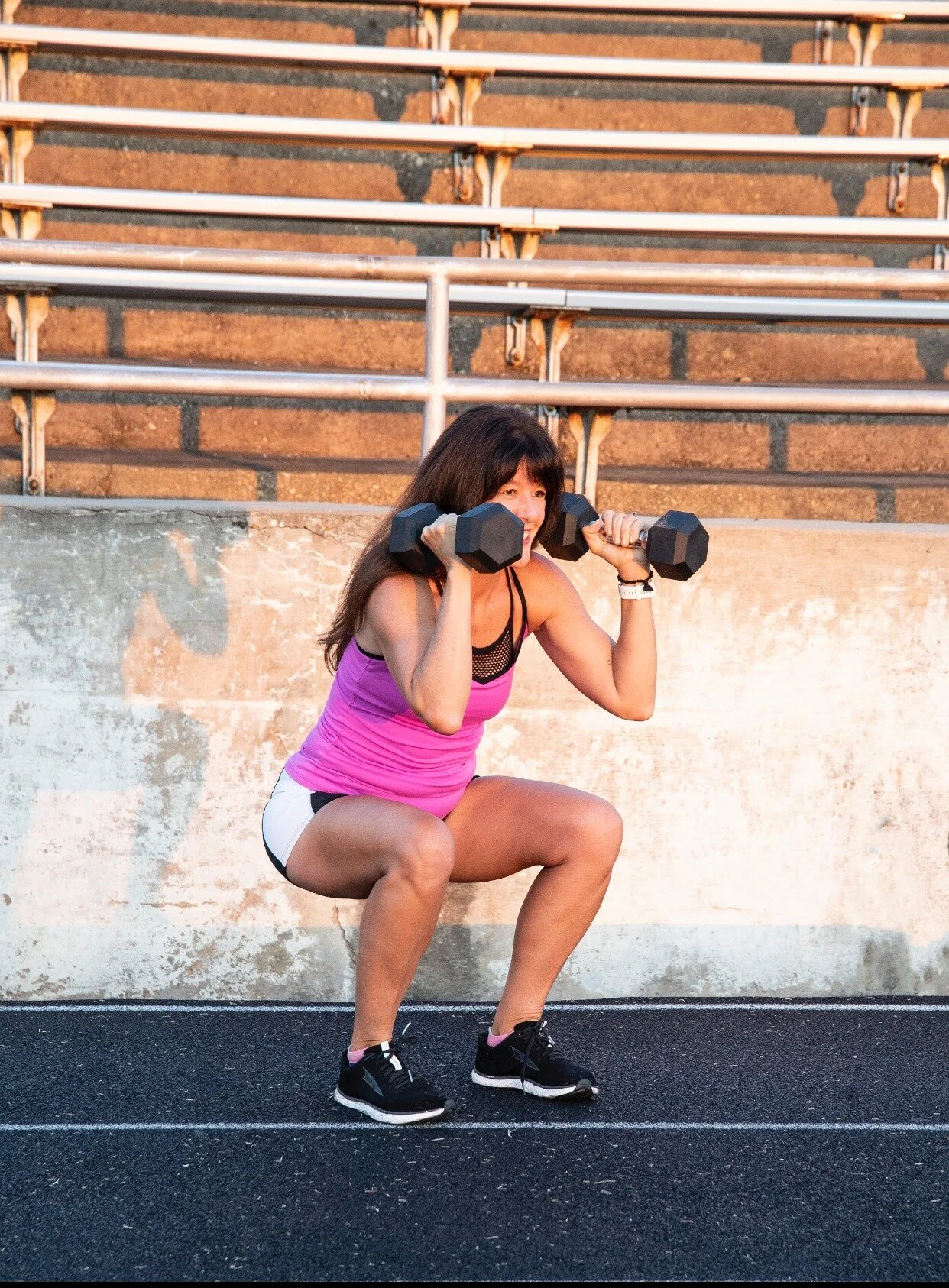
With your feet hip width apart push your hips back, brace your core and lower until your thighs are parallel to the floor (like you are sitting back in a chair) or as low as your flexibility allows. While holding a medicine ball, touch your elbows to your knees in the low position. Push up to standing while pressing the medicine ball above your head into a shoulder press.

CURTSY SQUAT WITH CHEST PRESS 

Holding a medicine ball or weight to your chest, stand with your feet hip apart. Cross your right leg behind the body and to the left. Bend left knee 90 degrees, or as low your flexibility will allow, toes pointing forward. In the low position straighten your arms to press the ball out from your chest. Bring the weight back to your check and return to starting position. Alternate sides.

BACK LUNGE WITH RESISTANCE BAND ROW 

With your feet hip width apart and your toes pointing straight ahead, take a large step backward with your right leg, so your right knee almost touches the floor and your left leg lunges at a 90 degree angle. While static in the low position, use a resistance band to row your right arm back keeping your shoulders down and elbow close to your side. Push back up to starting position. Always row on the same side as the leg that steps back.

lea genders fitness med ball.JPG

4 WAYS TO STRUCTURE YOUR WORKOUT

13 MINUTES: TABATA-STYLE

Using a Tabata timer app or an interval timer, perform the below exercises as indicated:

TABATA ONE:
SINGLE LEG DEADLIFT RIGHT SIDE- 20 SECONDS
REST 10 SECONDS
SINGLE LEG DEADLIFT LEFT SIDE - 20 SECONDS
REST 10 SECONDS
REPEAT FOR FOUR MINUTES
REST 30 SECONDS BEFORE MOVING ON TO NEXT CIRCUIT

TABATA TWO:
SQUAT WITH SHOULDER PRESS - 20 SECONDS
REST 10 SECONDS
ALTERNATING CURTSY SQUAT WITH CHEST PRESS - 20 SECONDS
REST 10 SECONDS
REPEAT FOR FOUR MINUTES
REST 30 SECONDS BEFORE MOVING ON TO THE NEXT CIRCUIT

TABATA THREE:
BACK LUNGE WITH ROW RIGHT SIDE - 20 SECONDS
REST 10 SECONDS
BACK LUNGE WITH ROW LEFT SIDE - 20 SECONDS
REST 10 SECONDS
REPEAT FOR FOUR MINUTES

12 MINUTES: 30 SECONDS EACH EXERCISE

Set the timer for 30 seconds x 6 and complete the circuit below.

SINGLE LEG DEADLIFT RIGHT SIDE - 30 SECONDS
SINGLE LEG DEADLIFT LEFT SIDE - 30 SECONDS
SQUAT WITH SHOULDER PRESS - 30 SECONDS
ALTERNATING CURTSY SQUAT WITH CHEST PRESS - 30 SECONDS
BACK LUNGE WITH ROW RIGHT SIDE - 30 SECONDS
BACK LUNGE WITH ROW LEFT SIDE - 30 SECONDS
REST ONE MINUTE
PERFORM THREE TIMES

20 MINUTES: AS MANY ROUNDS AS POSSIBLE

Set the timer for 20 minutes and perform the below circuit as many times as you can in the time frame. Move through the exercises quickly but with controlled movement. No sloppy reps!

SINGLE LEG DEADLIFT RIGHT SIDE - 8 REPS
SINGLE LEG DEADLIFT LEFT SIDE - 8 REPS
SQUAT WITH SHOULDER PRESS - 12 REPS
CURTSY SQUAT RIGHT SIDE WITH CHEST PRESS - 8 REPS
CURTSY SQUAT LEFT SIDE WITH CHEST PRESS - 8 REPS
BACK LUNGE WITH ROW RIGHT SIDE - 8 REPS
BACK LUNGE WITH ROW LEFT SIDE - 8 REPS
 

THE REP PYRAMID

The first time through the circuit perform each exercise for 6 reps.
Rest for one minute
Repeat the circuit but this time perform 8 reps for each exercise
Rest for one minute
The third time through perform 12 reps for each exercise
Rest for one minute
8 reps for each exercise
Rest for one minute
6 reps for each exercise
 

SINGLE LEG DEADLIFT RIGHT SIDE
SINGLE LEG DEADLIFT LEFT SIDE
SQUAT WITH SHOULDER PRESS
CURTSY SQUAT RIGHT SIDE WITH CHEST PRESS
CURTSY SQUAT LEFT SIDE WITH CHEST PRESS
BACK LUNGE WITH ROW RIGHT SIDE
BACK LUNGE WITH ROW LEFT SIDE

Do you find the time for strength training? 

Like this post? It helps me when you share with your friends and followers.

Lea signature.jpg

5 SMALL HABITS FOR BIG CHANGES IN FAT LOSS

Welcome to the latest edition of 52 healthy habits, where each week we tackle a new healthy habit in order to improve our lives. When we make the decision to live a healthier lifestyle, we often make the mistake of trying to change everything at once. We decide to eat "clean," workout six days a week, give up wine (gasp!) and then inevitably get overwhelmed and go back to our old ways. A more sane and sustainable approach is to tackle one habit and build on it slowly over time. It's not a quick fix but it is an effective long-term solution to a healthy lifestyle. When healthy behaviors become habits, then no willpower or iron-clad motivation is needed. 

But where do you start? There a million things you could do and as we discussed, doing too much at once is usually not an effective solution. We want to tackle the things that will make the biggest impact when working to achieve our goals. Here are the first five habits I recommend when prioritizing fat loss. These five small habits will yield big results over time. Take one at a time, cultivate it until mastered, then build on the next one. 

healthy habits 5 small habits for big changes in fat loss.png

PRIORITIZE PROTEIN/VEGGIES AT EACH MEAL

Fat loss starts in the kitchen. Make sure every meal has a serving of protein and veggies. Protein helps you maintain muscle, which is very important to ensure that you are losing fat and not muscle when you lose weight. Protein and the fiber from veggies help you feel full. 

When you want a snack, look for a high protein snack, like cottage cheese, Greek yogurt, protein shake or a tuna packet. Focus on what you can add to your meals to make them healthier, rather than what you have to take away.  Learn more about adding protein and veggies in these blog posts.

Health089.jpg

When I'm in an environment where I am not in control of the food being served: at a restaurant, at a dinner party or a work function, I always fill my plate with the protein and veggies first. It's a smart strategy to make the best decisions possible in any circumstance. We can never be perfect, but we can always strive to make the best choices possible. 

EAT SLOW

When you gobble down your food in five minutes flat you don't give your stomach enough time to send the signal to your brain that it's full. I am as guilty of this as anyone. A great fat loss strategy is to eat your meals slowly. Set a timer for 20 minutes and stretch it out. Chew your food slowly (20-30 times!), put your fork down between bites, take a drink of water between bites, talk with your family. Slow it down. Pay attention to fullness signals and stop eating when full. You'll digest your food better and likely eat less, which is ideal for fat loss. You can learn more about mindful eating in this blog post.

WALK FAST

A great habit to cultivate for fat loss is a power walking routine. No, I didn't say you have to join CrossFit or sign up to run a marathon. Those things can be great (if they align with your goals and preferences), but if you are just starting out take 15-20 minutes every day and walk a mile as fast as you can. Walk with purpose, like you're late for the start of Game of Thrones. Take your dog. Don't have a dog? Borrow a dog. They'll love you for it. Do it twice a day if you can. Little changes can make a big difference. Here is more on how to make exercise a daily habit.

SLEEP

Sleep is so important for fat loss that I would say if you could only do one thing on this list that you choose to prioritize sleep. It's the most overlooked activity in our modern environment but the most important. Create a sleep routine and aim for 7-8 hours of sleep a night. Yes, it matters for fat loss. Before you think about taking supplements or trying the next "fat loss secret" make sure you have the basics covered. I go into more depth on creating a sleep ritual in this blog post. 

REPLACE ALL DRINKS WITH WATER

If you replace all soda, juice, energy drinks and sugar-filled drinks with water (or seltzer water) you'll cut hundreds of empty calories a day. In order to lose fat you need to create a calorie-deficit, which means you consume less calories than you burn in a day. An easy way to do this without depriving yourself is to cut out those empty calories from sugar-filled drinks. Water can help you feel fuller and more energized. Dehydration causes all kinds of problems like fatigue, lack of energy and headaches. This is easy to fix with regular intake of H20. I cover some strategies to increase water intake here.

Need help with your healthy habits? Join my online nutrition habits program!

Lea signature.jpg

Fat Loss for Runners: Why You Gain Weight During Marathon Training

When Alanis Morissette wrote that song in the 90s about irony, I feel like there should have been a verse in there about gaining weight while training for a marathon. Sing along with me...

It's like training for your marathon day
But the more you ran the more you weighed
It wasn't supposed to be this way
And isn't it ironic, don't you think?
 

But just like the rest of the song, it's actually not ironic at all. When you are training for a marathon there is no guarantee of weight loss. Isn't that a jagged little pill to swallow? (You see what I did there?) In fact, it is quite common for runners to gain weight during marathon training. Runners of all shapes and sizes are kicking-ass across finish lines all over the world. So what gives? Running obviously burns a lot of calories, shouldn't we all be losing weight when training to run 26.2 miles?

The first thing to consider is that there is a difference between running for performance and running for weight loss. When training for a marathon you are running for performance. You are training your body to have the capacity to run 26.2 miles and that is a pretty amazing feat (but you "earn" less amazing-looking feet.) To lose weight you have to be in a calorie deficit, taking in less calories than you burn, but that is not ideal for running performance and recovery.

gain weight marathon training (1).png

WHY YOU GAIN WEIGHT DURING MARATHON TRAINING (IT'S NOT ALWAYS NEGATIVE)

YOU GAIN MUSCLE

One reason the scale may seem to be moving in the wrong direction is a positive thing. You are building muscle mass that wasn't there before. Muscle is more dense than fat, so when you lose fat and gain muscle your body fat percentage goes down (yay!) while your weight goes up or stays the same. The number on the scale may have gone up but you improved your body composition. 

YOU INCREASED CARBOHYDRATES (GLYCOGEN) STORES

When you run long distances you are training your body to increase carbohydrate (glycogen) storage in your muscles and liver, which also increases water storage. This is a necessity when you are training to run a marathon. The more glycogen you store the farther you can run without hitting "the wall", but it can add numbers to the scale. It's important to note that this is not fat gain.

YOUR BODY ADAPTS TO THE STRESSES YOU PLACE UPON IT

This is the whole point of marathon training. You train your body to be able to run long distances. You are able to run longer and farther month after month during training. Your body becomes more efficient over time. That means it feels easier to run and you are not expending as much energy. When you first start running your body is less efficient at running, so it burns more calories. Over time your body adapts, becomes more efficient and you burn less calories during the same activity. For marathon training this is a good thing. For weight loss, a double edge sword. 

YOU EAT MORE BEFORE YOU RUN

We've all heard of carb-loading before a big race, but when it's used as an excuse to eat junk foods in large quantities, it can be a factor in weight gain. Fueling for your long runs should include a slow increase of calories from carbohydrates from a variety of mostly whole foods. It doesn't mean three servings of pasta and four servings of garlic bread the night before your long run. Dangit, I wish it meant that. 

YOU EAT MORE DURING YOUR RUN

On average we burn about 100 calories per mile, obviously this varies from runner to runner. After about 90 minutes of running we usually start needing to fuel during our runs. It's necessary, but another reason that weight loss and creating a calorie deficit while marathon training can be so challenging. 

YOU EAT MORE AFTER YOU RUN

Are you seeing a trend here? You just ran 10 miles and your are hungry (or hangry, amiright?). You gulp down a protein shake, take a shower, then meet some friends to treat yourself to an indulgence meal. You can easily put down 1000 calories of burgers, fries and beer. While there is nothing wrong with an indulgence meal, try not to get into the habit of rewarding your hard work with junk food. After all, during marathon training you will be running a lot. If you reward every run with indulgence foods, you can easily out-eat your calorie expenditure. 

YOU MOVE LESS THE REST OF THE DAY

After running 14 miles you crash on the couch with your compression socks snuggling your calves while watching a NetFlix marathon. When hubby asks if you want to go to the mall, you grunt out a no-way Jose (even though his name is Russell). The house isn't getting cleaned, the dog isn't getting walked (by you) and you're not moving until you hear the doorbell ring with your dinner delivery.

The calories you burn while walking around doing everyday activities add up. So while you increased your calorie expenditure during your run, you decreased it the rest of the day. With the added food intake, the decreased activity outside of running, you can easily put yourself into a calorie surplus, which can cause weight gain.

FAT LOSS FOR RUNNERS: WHAT YOU CAN DO ABOUT IT

It can be counter-intuitive to have marathon goals and weight loss goals at the same time, but if you want to keep the weight off while marathon training I recommend always focusing on fat loss, not weight loss. Our goal should be to build or maintain muscle while losing fat.

VARY INTENSITY

Your long runs should be long and slow, but after a month or two of building your milage base you can play with the intensity of at least one other run in the week to help with fat loss. Long interval runs (1/2 mile or 1 mile intervals of hard effort repeats) can help with fat loss while improving your marathon pace. Here is a post I wrote about different types of interval runs. For injury prevention be careful never to increase intensity and mileage in the same week. That means if you are adding miles to your long run, don't also add in a new interval workout or increase the intensity/pace of an existing workout. Only introduce new intensity on weeks you aren't adding mileage. This is important. Got it? Good.

FUEL RESPONSIBLY

Yes, when you are marathon training you need to fuel, which means that you will probably need to eat more than usual. However, don't use marathon training as an excuse to binge eat. Increase calories with a variety of nutrient-dense foods from nature and save the treats for occasional indulgences in moderation. I wrote more about nutrition for athletes (yes, that's you) over in this blog post.

STRENGTH TRAIN

Runners who strength train are stronger, faster and less prone to injury. When you are marathon training, running should absolutely be your first priority, but don't neglect strength training. Short and focused runner-specific strength training sessions just twice a week can help you meet your running and fat loss goals. Muscle tissue uses more energy at rest than fat, so when you build lean muscle you burn more calories during your daily activities, like recovering on the couch. 

Running a marathon is a fantastic goal. I recommend training and fueling for your marathon with performance as your main focus, even if your personal definition of performance is crossing the finish line without dying. Once you achieve that goal, you can adjust your training and nutrition to focus on fat loss for a period of time before you inevitability start your marathon training all over again. 

Any questions about fat loss or weight gain during marathon training? I'd love to help

Like this post? It helps me when you share with your friends and followers. 


Run, Rock and Reps Workout

Welcome to the latest edition of Workout Wednesday when each week I share a new running or runner-specific strength training workout. This week I am combining the best of both worlds with a running workout that includes strength training. Runners always tell me they don't have time for strength training, but if you combine some strength moves with your running intervals you can fit it all in with a quick and efficient workout. 

In this run, rock and reps workout, the rock refers to an isometric hold. Isometric training is holding a position without movement. Isometrics build strength by holding the muscle under tension against the resistance of our own bodyweight.

Reps refers to the number of repetitions of each exercise. 

Download a free printable PDF of the Run, Rock and Reps workout.

Download a free printable PDF of the Run, Rock and Reps workout.

This post contains affiliate links. That means if you click on a link in this post and make a purchase, I make a small percentage of the sale at no additional cost to you. No one is getting rich here, it just helps with the costs associated with running (pun intended) of this blog. Thank you, as always, for your support. 

RUN 1/4 MILE

After warming up you start the workout by running 1/4 mile at a hard effort pace (see RPE chart for effort levels). This pace should feel challenging, but not an all-out-sprint. You should be able to hold the pace for the duration of the run. This workout is great for the track or treadmill where it is easy to measure out 1/4 mile. You could also use your GPS watch (<- this is what I have) or just use a timer and run for two or three minutes.

SQUAT HOLD

With your toes pointing straight ahead and your feet about hip width apart, push your hips back keeping your back straight and your chest up, lower into a squat position until your thighs are parallel to the floor (or as low as your flexibility will allow). Hold the low position for 30 seconds while breathing normally. Take breaks if you need to (feel the burn) but work up to holding for 30 continuous seconds. You can also do this exercise with your back flat against a wall. 

SQUAT REPS

After you complete the squat isometric hold follow with 15 repetitions of a squat. In the low position, engage your core, squeeze your glutes and push up to standing. Take a deep breath in as your lower to the squat and breath out as you return up to standing.

STRAIGHT ARM PLANK HOLD

Start in a straight arm plank position with your wrists directly under your shoulders with your legs slightly wider than hip width for stability. Keep your body in a straight line from your shoulders to ankles while engaging your core. Do not allow your hips to hike up (get that bum out of the air!) or sag down. Hold for 30 seconds. 

PUSH UP

After holding the straight arm plank you are in the perfect position for 15 reps of pushups. Keep your body in a straight line with your core engaged, bend your elbows to slowly lower your chest to the floor. Once in the low position, push back up to the starting position. If this is too challenging place your hands on an elevated surface like a weight bench or a counter top. As you get stronger, reduce the elevation until you are on the floor. 

BRIDGE HOLD

Lie on your back with your knees bent and your feet flat on the floor. Raise your hips off the floor so that your body forms a straight line from your shoulders to your knees. Engage your core and squeeze your glutes as you hold the position for 30 seconds. For an added challenge, while keeping your knees together, straighten one leg off the ground for 15 seconds, then switch legs.

BRIDGE REPS

To perform 15 reps lower your hips back to the floor before quickly pushing back up to the bridge position. Take a breath in as you lower and breathe out as your raise back up into position.

Perform this circuit a total of four times to run one mile and complete four sets of each of these exercises. 

Like this post? It helps me when you share with your friends and followers.