Fit to Run Strength Camp for Runners Workout

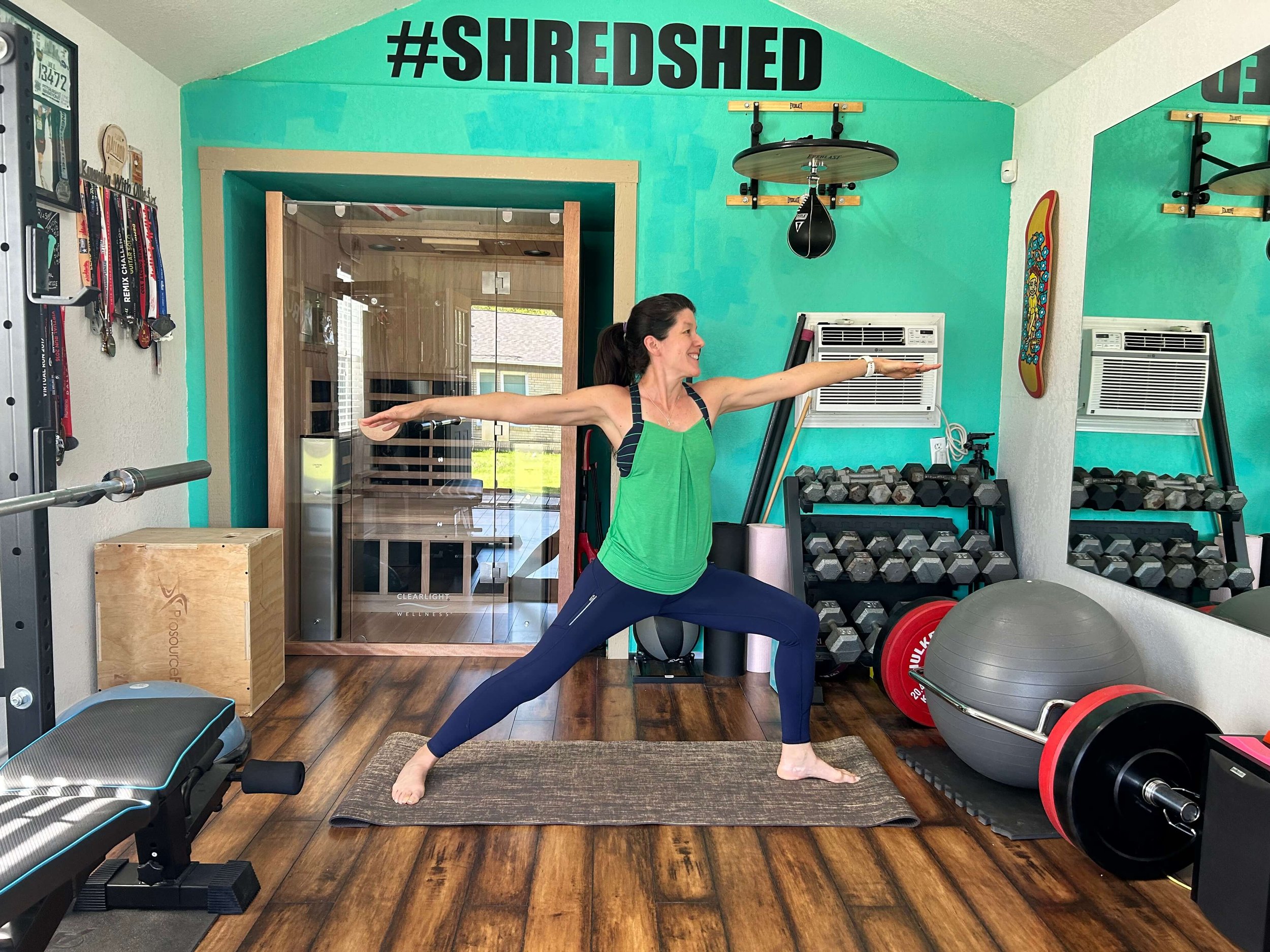
Welcome to the latest edition of workout Wednesday. I don't know about you, but I love working out outside. Whether it is running on the streets or an outdoor bootcamp, I just prefer it over the gym (even though I have a great gym at home called the Shredshed). 

I know the weather doesn't always cooperate this time of year, but if we are having a nice day or even if it is cold, I'll move it outdoors for a welcome change. Working out in the dark or cold helps build mental strength, endurance and resilience. Build a tough mind while you are building that tough body. Just be sure to stay safe and bundle up!

This week I am sharing a no-equipment strength workout that can be done indoors or out that is great for building strength for runners. This is a sample of the types of workouts you will see in my Strength Camp for Runners sessions starting in January 2017.

Warm up before you begin the workout. Perform the exercises in circuit style, do not rest in between the exercises. Once you finish the circuit, rest for one minute (or as long as needed) and repeat two more times. 

SINGLE LEG DEADLIFT

Standing on one leg, keep your knee slightly bent and perform a deadlift by bending at your hip while keeping your back straight and neck neutral. Extend your free leg behind you in line with your body. Lower until your back is parallel to the floor. With your back straight return to the upright position. Perform 12 reps and repeat on other leg. 

Runners benefit from unilateral (one leg at a time) leg strength work. As your balance improves, add a weight to progress the exercise.

PUSHUP

Start in a high plank position with your hands placed a little wider than your shoulders. Keeping your body in a straight line, while engaging your core slowly lower your chest to the floor by ending your elbows. Once in the low position, push back up to the starting position. If this is too challenging, drop to your knees. Perform 12 reps.

The pushup is great for runners because it is an exercise that works your entire core in addition to the chest and shoulders using just your own body weight. 

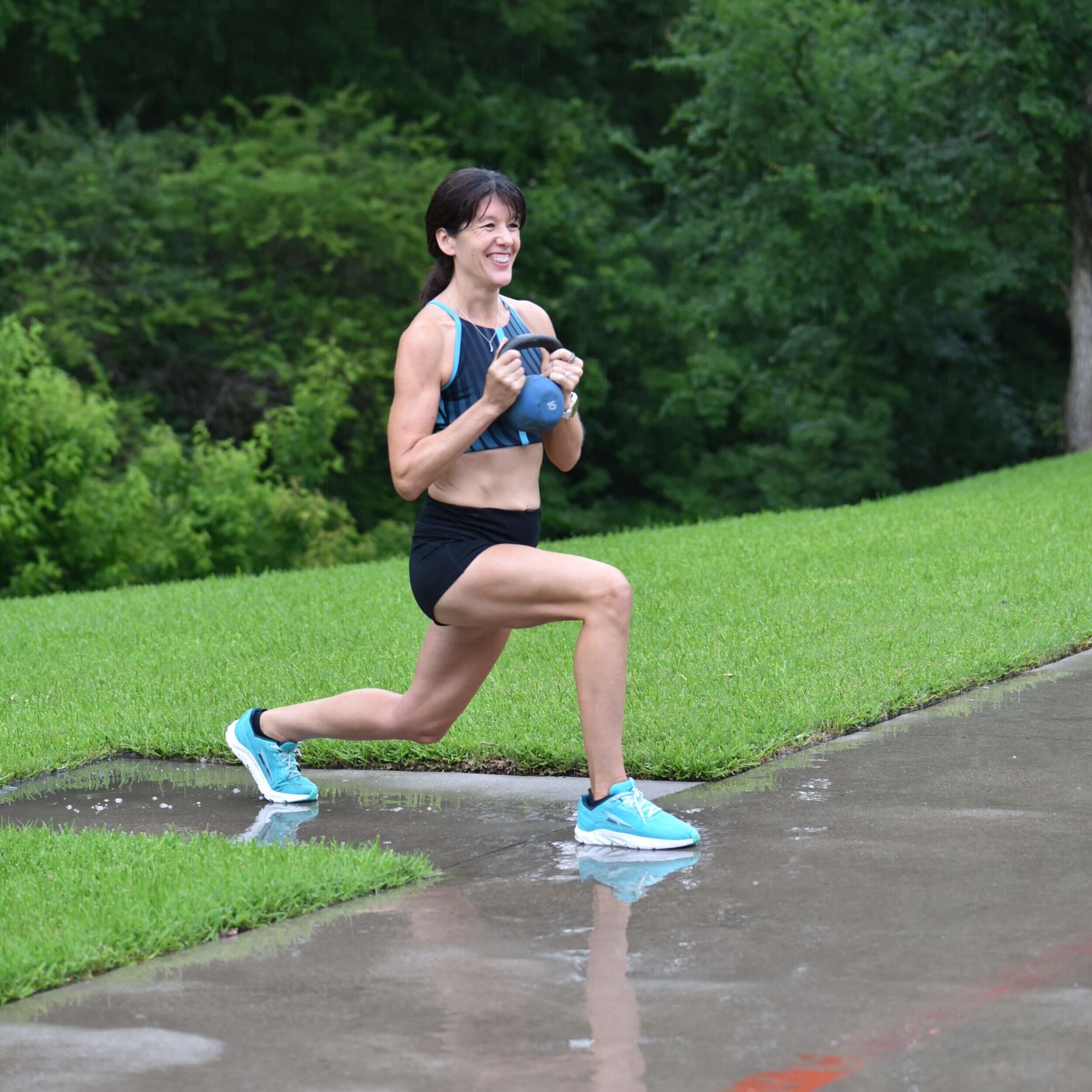
LUNGE WITH TWIST

With your feet hip width apart and your toes pointed straight ahead, hold your core stable with your back straight and take one large step with your right leg to lunge forward until your front knee is lined up over your ankle, your right thigh is parallel to the floor and your back knee is nearly touching the floor. Twist your torso in the direction of your forward leg. Push up to standing and repeat on other leg. Perform 12 reps on each leg.

The lunge with twist is another great unilateral exercise. When we run, we only move forward so we need lateral and twisting moves to stay strong and balanced in all planes of motion.

TRICEP DIP

Position your hands shoulder width apart behind you on a bench or ledge. Slide your butt off the front of the bench with your legs extended out in front of you. Bend your elbows to lower your body toward the floor until your elbows are at about a 90-degree angle while keeping your back close to the bench. From the low position, straighten your elbows to return to the starting position. Keep your shoulders down and your elbows close to your body as you lower and raise your body. If this is too challenging you can bend your legs to modify the exercise. Perform 12 reps.

Upper body strength is important for runners too. Our legs may be doing most of the work but our arms power our stride. Don't neglect the upper body

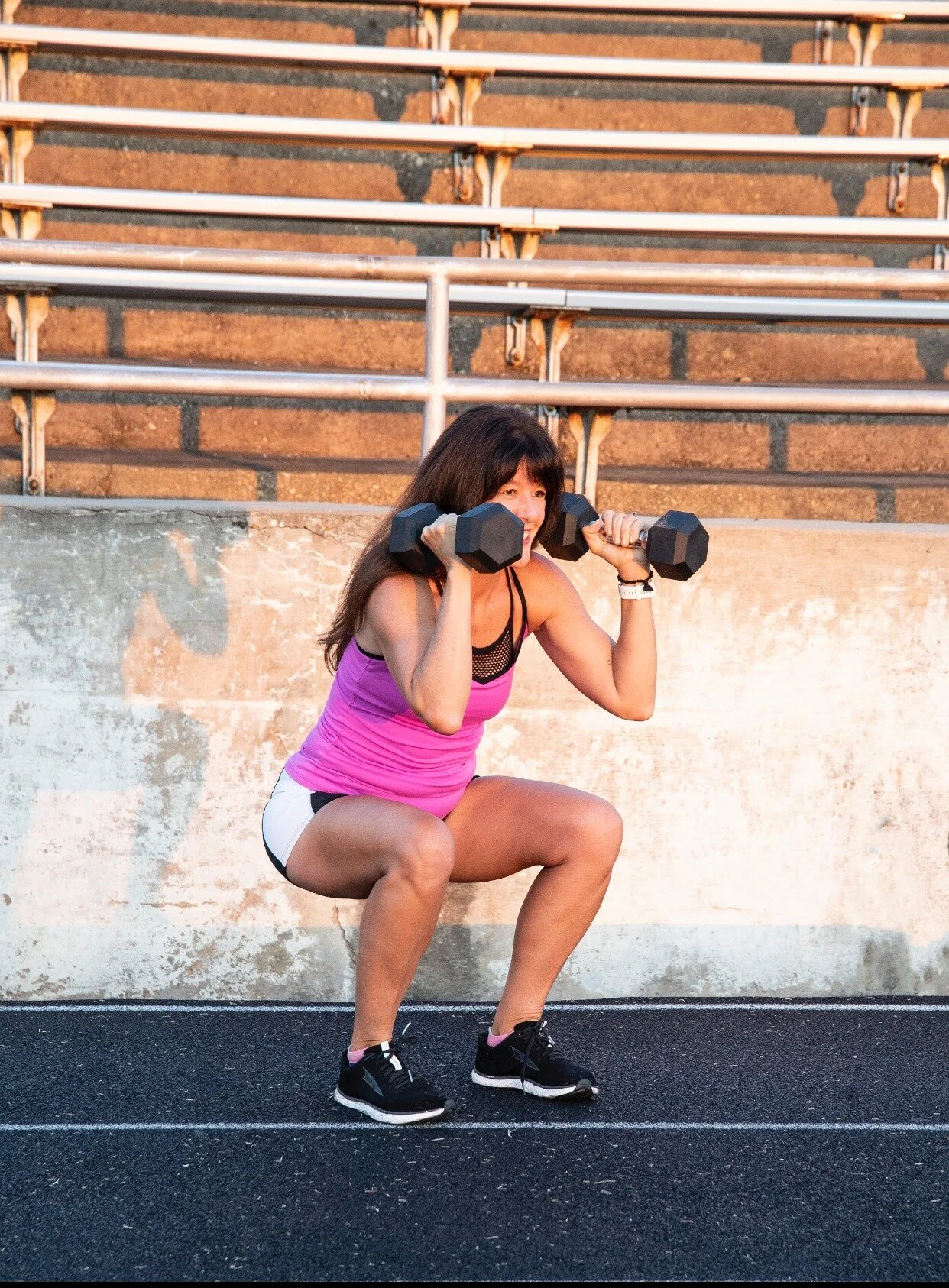
SQUAT

Starting with your feet hip width apart push your hips back and lower until your thighs are parallel to the floor (like you are sitting back in a chair) or as low as your flexibility will allow. In the low position, engage your core, squeeze your glutes and push up to standing. Perform 12 reps.

Running builds muscular endurance, but not necessarily muscular strength. Squats help us build the strength we need to run faster on the flats and get us up those steep hills.

BURPEES

Stand with your feet hip width apart, squat down by bending your knees until your hands are flat on the floor next to your feet. Jump your legs backwards into a high plank position. Jump both feet forward so you back in the starting position.. Jump up and raise both hands over your head. If this is too challenging, step back and forward from plank position instead of jumping. Perform 8 reps then rest for one minute (or as long as needed) before repeating the circuit.

Burpees are everyone's favorite exercise to hate. Progress this exercise by increasing the reps when you're ready! Burpees are extremely effective for conditioning and endurance. 

Give it a try outdoors or indoors and let me know how it goes! 

Want to join me in-person for Fit to Run Strength Camp for Runners in Fort Worth (Haltom City)? Learn more about Strength Camp for Runners!

Like this post? It helps me when you share.

Coach Lea

I am a NASM personal trainer and RRCA adult distance running coach that specializes in strength training for runners. I offer in-person training in the Shredshed, online training and Fit to Run bootcamps. If you are interested in a more in-depth running or strength training plan, please contact me. Have questions? I'd love to help. 

While I am a certified personal trainer, I am not your personal trainer. Since I don't know your exercise abilities, injury background or medical history, please see your doctor before beginning any new exercise program. This is an opinion blog. No information in this blog is intended to be taken as medical advice or prescription. Please see your doctor and/or registered dietitian for any health concerns.

7 Things You Should Never Say to a Runner

Hi, Friends! Back in 2005 I had a cousin visit me in Dallas from out of town. He was in town for a work conference and reached out to me through my parents to see if I wanted to get together. He was someone that that I knew growing up, but he was several years older than me and we were never that close. I probably hadn't seen or talked to him in ten years prior to that dinner. 

He walked into the restaurant wearing a Titleist hat. I knew it had something vaguely to do with golf, but a golf enthusiast I am not. In an awkward attempt to make conversation with this person who was family, but virtually a stranger I asked him, pointing to his hat, "Are you a Titleist?" 

It was admittedly a really stupid question. As if they just give hats to the winners of golf tournaments. Congratulations on winning, here is your hat to show the world you now hold a golf title. He (righfully) looked at me like I had two heads and informed me that Titleist was a golf ball brand. Ah, OK. Makes sense. 

I don't know golf and I asked a stupid question. People do it to runners all the time. You can't fault them, really. Most of the time they are just trying to take an interest. You don't know what you don't know. I certainly can't expect all my non-running friends to brush up on all things running just so they know the proper questions to ask me, but there are silly things that people say to runners over and over again.

If you want to be informed here is a short list of things you should never say to a runner. 


ISN'T RUNNING BAD FOR YOUR KNEES?

Why is everyone so worried about my knees? Running is good for your health and body. Sure, running is a high-impact activity, but as long as a runner progresses properly (building milage and speed slowly over time) and participates in some sort of strength training activities, their knees will probably be fine. There is some risk in any physical activity, but it is always less risky than being a couch potato. 

DID YOU WIN YOUR RACE? 

We don't run races to win them. Well, most of us. We run races to challenge ourselves, to join in with a community of runners, for fun and mostly just to finish. No, I didn't win. I didn't take the podium. That was never the point. Unless they volunteer the information, you probably shouldn't ask them their finishing time either. A better question to ask would be "Did you have fun?"

I RAN A 5K MARATHON ONCE.

I know the distances can be confusing and a lot of people associate any organized race with a marathon. A 5K is 3.1 miles and a marathon is 26.2 miles. It is an accomplishment to run and finish any race distance, but a 5K is not the same as a marathon. 

RUN, FORREST, RUN.

This stopped being funny in 1995 and it was never funny while being yelled out the window of a car while passing a runner. 20+ years later there should be newer ways to insult runners by now. 

I ONLY RUN IF SOMEONE IS CHASING ME.

I know you're trying to be funny and kudos for the effort, but this is what every "funny guy" says to runners. See also: I only go for beer runs. If you say this to a runner they are groaning on the inside because they have heard it a million times. We politely laugh but you may need to work on your material. 

I TRIED RUNNING ONCE AND I HATED IT.

Everyone hates running the first time they try it. Probably the first 20 times. If you tried running on the treadmill I don't even want to talk to you until you hit the streets or trails. Running is one of those activities that you have to give it a little time in order to adapt. It gets better, it gets easier. I promise. 

That being said, I don't expect everyone to love running. If it is not your thing, then that's fine. I encourage you to try different forms of exercise to find the thing that you do love. The form of exercise that you choose is not as important as just choosing an exercise. Anything. So whether it is running, biking, walking, Crossfit, bootcamp, weight lifting or trampoline jumping, find what you love and go out and actually do it. 

DON'T YOU GET BORED?

Running is a form of mediation for me. It is my quiet time away from technology (and people). It my time to unravel the thoughts, struggles and stresses that get tangled up during the day. It is how I manage stress. It is how I stay healthy. So, no. I don't get bored. 

If you don't know what to say to a runner, just say I am proud of you or congratulations on finishing your race. In the meantime I'll Google "Things to Never Say to a Golfer" so that next time that cousin is in town, I can ask intelligent questions. As long as we can agree that a marathon is 26.2 miles. Every. Single. Time. 

Runners, Did I miss anything?

Like this post? Please consider sharing. 

Coach Lea

I am a NASM personal trainer and RRCA adult distance running coach that specializes in strength training for runners. I offer in-person training in the Shredshed, online training and Fit to Run bootcamps. If you are interested in a more in-depth running or strength training plan, please contact me. Have questions? I'd love to help. 

While I am a certified personal trainer, I am not your personal trainer. Since I don't know your exercise abilities, injury background or medical history, please see your doctor before beginning any new exercise program. This is an opinion blog. No information in this blog is intended to be taken as medical advice or prescription. Please see your doctor and/or registered dietitian for any health concerns.


Fitness Voices of Reason: Who I Trust in This Industry

These days there is no shortage of information. Want to learn about fitness, working out or running? There are millions of articles, books, websites and blogs packed full of the all the information you could ever want to know. Herein lies the problem. Information overload. What is the best way to learn new information? The water can get a little muddy between information that is outdated or obsolete and information that is intentionally misleading to sell you something. How do you know what and who to trust? 

Before I became a personal trainer and a running coach, I honestly thought I pretty much knew everything about fitness and nutrition. After all, I had been a fitness enthusiast for over a decade, I read a ton of blogs, books and magazine articles. What more was there? Turns out, a whole lot. You just don't know what you don't know. Until I started the process of getting the education needed to become a fitness professional, I did what most people do, I skimmed the surface of the information available, I took what was valuable, meaningful and made sense to me and threw out the rest. I figured I was pretty equipped to see through the crap. Lose 20 lbs with this miracle shake? Fruit makes you fat? Get in the best shape of your life on 15 minutes a day? BS detector activated! These things were obvious. 

But there is so much more that seems to make sense on the surface, but when you dig a little deeper you realize you're just another layer deep in sales tactics and misinformation. I realized that I had a lot of learn. I am always still growing and evolving. I read a lot, continue to work on certifications, listen to podcasts and talk to people smarter than me to stay up to date on the current trends in health and fitness. 

In the fitness world full of celebrities like Dr. Oz, Food Babe and Tracy Anderson, if you're not careful, it can be pretty easy to be led down the wrong path of misinformation. 

Over the last couple years a few voices have emerged to me as voices of reason. These were the people that I could look to for clarity of information. I know they aren't trying to sell me the latest fitness gimmick or fad. They have established themselves as experts and leaders in their field. These are the people that have proven to me time and time again that I could trust them in a fitness world that can't always be trusted. They are as a whole, committed to moderation in fitness (not extremes), body-positive messages and seeking/spreading the truth. 

ON NUTRITION

JOHN BERARDI - PRECISION NUTRITION

John Berardi is a writer, coach, professor, researcher, speaker and athlete behind Precision Nutrition. I am currently working on my Precision Nutrition Level 1 certification, but I have been following John and the Precision Nutrition blog for about a year. The precision nutrition blog is full of great information on coaching and nutrition that is backed by science and research. No woo or scare tactics to be found, which is all too common in the field of nutrition.

ON STRENGTH TRAINING

TOM VENUTO - BURN THE FAT, FEED THE MUSCLE

I first bought Burn the Fat, Feed the Muscle over 10 years ago as a printable e-book. After I used an entire ink cartridge printing out hundreds of pages, I remember thinking that I was going to cancel all my fitness magazine subscriptions. After everything I learned in this literal encyclopedia of health and fitness I felt like there wasn't anything a fitness magazine could write about that wasn't already covered more accurately in this monster book. Tom has been around for a long time teaching people the basics of strength training, cardio and nutrition. His book led me in the right direction shortly after I kicked off my healthy lifestyle all those years ago and lucky for you, that old ebook is available in hardcover now so you can save your ink cartridge. I love his message that everyone's path to fitness looks a little different and you have to learn what works for you and your body by tracking and experimenting. It was a game changer for me in my fitness journey. 

CORI LEFKOWITH - REDEFINING STRENGTH

When I first stumbled upon Redefining Strength I was hooked immediately by Cori's message of strength and empowerment. She is strong, kind and funny. She offers tons of free workouts on her site and Facebook page and I love The Fitness Hacks Podcast. As a trainer and a gym owner she freely shares her wealth of knowledge about training and business. I've only been following for a short time but Cori made a big impression and I have learned a lot from her already. 

ON THE MENTAL GAME

LEIGH PEELE 

Leigh is a writer, researcher and personal trainer. I love her You Need to Hear This Podcast. While she is extremely knowledgable on weight lifting and nutrition, she talks a lot about the psychological side of health and fitness on her Podcast. I'm always interested in hearing her opinions on hot topics because he responses are always based on science and research. I can count on her to be rational and sensible, something that Is not always easy to find in this industry. 

AMBER ROGERS - GO KALEO

Amber shares a message of inclusion, body-acceptance and moderation. She was probably that first voice I heard many years ago teaching that moderation was something to strive for in this fitness world of extremes. She taught me to look at the fitness industry a little more critically. She also seems to be a voice for people struggling with eating disorders. Lately she has taken to a message of overcoming emotional abuse, which honestly has lost me a little since this isn't something that I personally dealt with, but still is a positive message for the people who need to hear it. 

JAMES FELL - BODY FOR WIFE

I am not sure "on the mental game" is the right category for James Fell. I am not sure he fits into any category. Maybe with James, I use the words "voice of reason" a little loosely. I like him because he is hilarious and he has seemed to have made a career out of calling out the bull shit in this industry. If you are offended by strong language or don't appreciate an in-your-face approach to fitness truth, he may not be the guy for you. On the other hand, if you like to laugh and need a little help wading through the misinformation, he may be your new best friend. He tells the hard truth about all the hot topics (and makes some people very angry along the way, he is worth to follow just for the comments). 

Over the years I learned to tune out the many confusing voices of fitness and tune into a few key people that that have proven to operate on knowledge, science, compassion and truth. While I can't say they aren't selling anything, because they all make their living in the fitness industry selling courses, books, training, memberships, etc. I can trust that they aren't selling lies or misinformation.

Who are your fitness voices of reason? Did I miss anyone? 

Like this post? Please consider sharing.


Coach Lea

I am a NASM personal trainer and RRCA adult distance running coach that specializes in strength training for runners. I offer in-person training in the Shredshed, online training and Fit to Run bootcamps. If you are interested in a more in-depth running or strength training plan, please contact me. Have questions? I'd love to help. 

While I am a certified personal trainer, I am not your personal trainer. Since I don't know your exercise abilities, injury background or medical history, please see your doctor before beginning any new exercise program. This is an opinion blog. No information in this blog is intended to be taken as medical advice or prescription. Please see your doctor and/or registered dietitian for any health concerns.


How to Transition from Running/Walking Intervals to Running

Welcome the latest edition of Workout Wednesday! This week we are talking about how to transition from running/walking intervals to running without walk breaks.

When you first start running it is very common to use run/walk intervals in order to adapt to running. There is absolutely no shame in walking. A lot of people are very successful running full and half marathons on a run/walk program with very impressive finishing times. If you are happy with your run/walk plan and you're continuing to progress, there is no reason to change your program. However if you're interested in transiting from run/walk intervals to running without walk breaks, I may be able to help you with the plan that worked for me when I first started running.

Most people start in the same place, it is very common be short of breath when you first start running. You have to stick with it through that hard beginning part in order to become a stronger runner. It does get easier, I promise. 

Once you have been performing run/walk intervals for a few months, you may be ready to train to run without walk breaks. I suggest that you have a solid running base before starting this program. You should be running (with walk breaks) several days a week for at least four weeks. Follow the below plan two to three days a week with full rest days in between training days to allow for proper recovery.

HOW TO TRANSITION FROM RUNNING/WALKING INTERVALS TO RUNNING WITHOUT WALK BREAKS

The key to train to run without walk breaks is to first start by taking walk breaks. Hear me out. If you stick with the program you will progress to running without walk breaks.

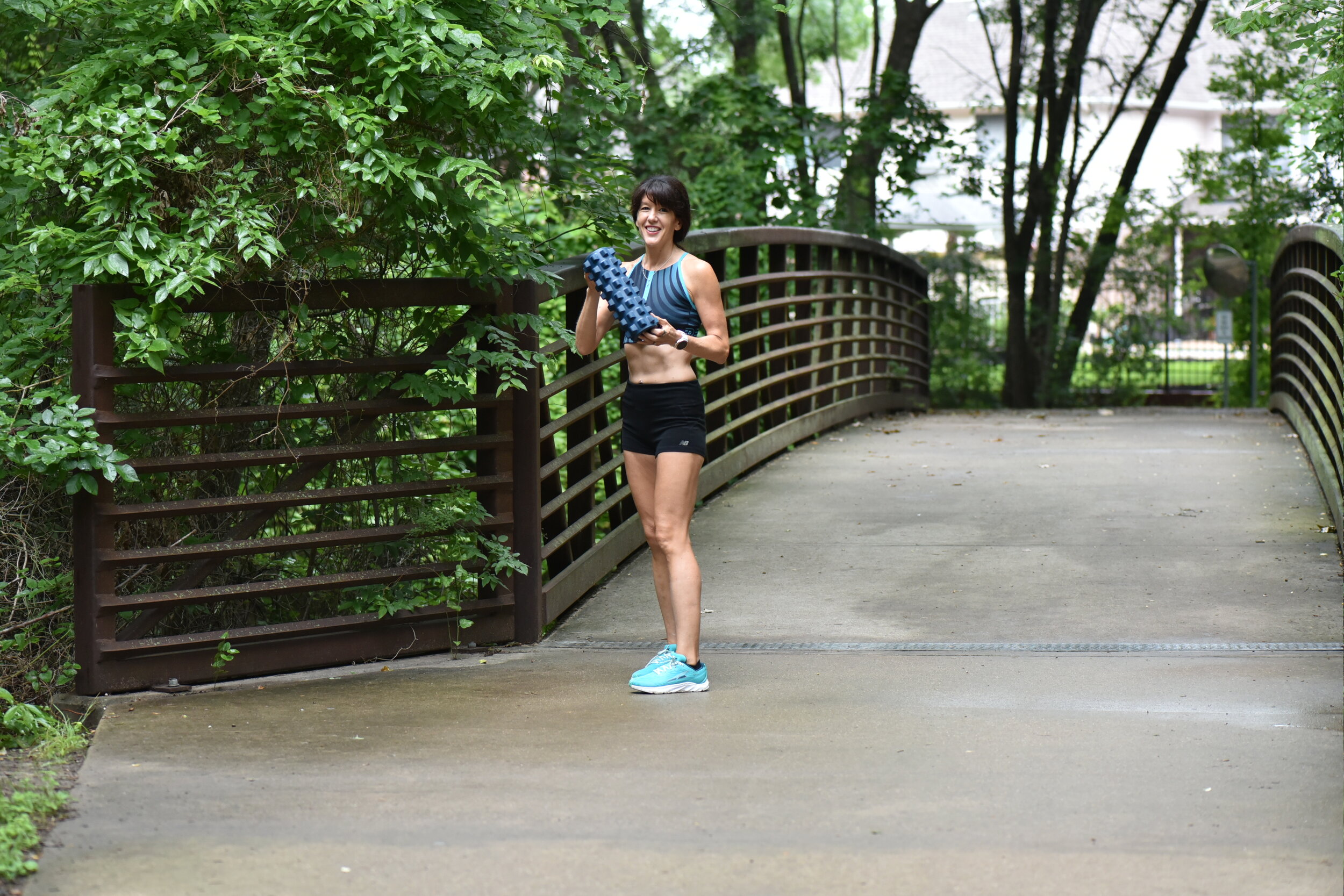
Walk for a few minutes to warm up. Try some dynamic stretching and/or foaming rolling to warm up before you get started.

Start running at a very slow pace. Go even slower than you think you can maintain. It's better to go too slow than too fast at this point. We can work on speed later, for now we are working on endurance. A slow pace is key.

Run until you feel like you just can't run for one more second, then try to count out 50 more steps. This may help you push past any mental barriers. When your mind says no more, see if your body has 50 more steps. It is important to be sure that you are listening to your body and not your mind. Is your mind telling you can't go on? Or is it your body? Sometimes your mind will tell you to stop, but think about it first. Can I breathe? Are my legs OK? How do I feel physically? If it is just your mind, keep going. Your thoughts can lie, especially when you are trying new things.

Once you are sure it is your body and not your mind slow to a brisk walk. Now here's the key to the whole plan: Only walk as long as you need to in order to recover your breath. It is really important to be honest with yourself and start running again as soon as you are able. When your breathing returns to almost normal It is time to start running again, don't walk for one second longer than necessary.  

Repeat the running cycle. Run as long as you can. When you think you need to stop, try to count out 50 more steps. You are probably feeling uncomfortable, but as long as you aren't feeling any physical pain, push yourself to keep running for just a little bit longer. When you are sure it is your body and not your mind, it is time to walk briskly again to recover.

Start the run cycle again. 

The idea is that you run for as long as you physically can, then walk only as much as necessary. If you continue this cycle, while being completely honest with yourself, over time your run intervals will become longer and your walk intervals will become shorter, until there are no walk intervals at all.

This process can take between four to ten weeks depending on your starting fitness level and dedication to the program. Remember that no matter what you are trying to achieve, consistency with your training is the single best path to success.

I can clearly remember the great feeling the first time I realized that I didn't need to stop for a walk interval, that I could keep running. Don't listen to your mind, listen to your body.

This same technique can be used to improve your running pace. Just replace the walk intervals with slower run internals. Run fast, then run slower to recover until you don't have to run slower anymore at all.

When you set out to run these intervals run according to time and not distance. For example, make a plan to run for 30 minutes, not three miles. You'll find that over time you will be able to cover the distance in less time. 

Give it a try and let me know how it goes.

Like this post? Please consider sharing!

5 Reasons to Hire a Personal Trainer to Reach Your Fitness Goals

You may think I am a little biased on the subject, after all I am a personal trainer, but everyone can benefit from the knowledge, experience and coaching that comes with hiring a personal trainer. Even trainers can benefit from hiring a trainer because most of the time it is not simply about knowing what to do.


5 REASONS TO HIRE A PERSONAL TRAINER

THE DIFFERENCE BETWEEN KNOWLEDGE/APPLICATION

Most people already generally know what to do to get results, but they still don't have the results they desire. Why is that? Because there is a big difference between knowledge and application. A personal trainer has experience in taking that knowledge and applying it in a way that produces results. If you know what to do, but don't follow through, you'll never reach your goals. A trainer can help you bridge the gap between knowledge and application. 

WORKOUTS VS. PROGRAMMING

You can do a simple internet search and find millions of free workouts every day. There are sites dedicated to every kind of fitness imaginable. You can even find free workouts here in my archives. But there is a big difference between workouts and programming. You can do random workouts and see some results, but a trainer can help you do the most effective, efficient workouts to meet your individual goals.

Is your goal to run faster? To get stronger? Bigger muscles? Lose weight? Your goal will determine your workout program. A trainer can get you on the most efficient path to meet your individual goal so you don't waste your time with workouts that aren't designed with your goal in mind. A good trainer knows how to tweak the variables of your workout to maximize your results.

There are many ways to fitness, individualized programming will get you there by progressing in the proper timeframe (not too fast, not too slow). A trainer can help you take the guess work out of your workouts by looking at the big picture and building a progressive plan to safely meet your goals over an established time period. 

MOTIVATION & COACHING

Even if you can build your own progressive program, you still have to follow through with it to see results. A trainer/coach can provide the motivation and accountability needed to stick with a program. Having a trainer to check in with you in-between sessions, answer questions and provide feedback can be the difference between success and failure.

REAL-TIME FEEDBACK

Speaking of feedback, this is one of the most important roles of a trainer. Anyone can find a program on the internet and start following it exactly as written and hope to see results. The problem is that everyone is different and what works for one person may not work for the next. A coach can give you feedback on your performance and make changes/updates to your program as needed. You may need to progress faster or more slowly than written. Real life obstacles like family emergencies, work travel and injuries can result in getting off track unless you have a trainer to help you adjust on the fly and work through these challenges. 

PERSONAL BIASES

It is human nature to want to work on our strengths and ignore our weaknesses, sometimes we do it on a subconscious level. A trainer can help make sure you are balancing your fitness. Not just by working on correcting muscle imbalances and making sure you build strength in all planes of motion, but also ensuring you are working on your weaknesses and refining your strengths. Our personal biases can make it hard to make objective decisions and can inadvertently lead to unbalanced fitness and possibly injuries.

Convinced? Contact me.

Like this post? Please consider sharing.


Coach Lea

I am a NASM personal trainer and RRCA adult distance running coach that specializes in strength training for runners. I offer in-person training in the Shredshed, online training and Fit to Run bootcamps. If you are interested in a more in-depth running or strength training plan, please contact me. Have questions? I'd love to help. 

While I am a certified personal trainer, I am not your personal trainer. Since I don't know your exercise abilities, injury background or medical history, please see your doctor before beginning any new exercise program. This is an opinion blog. No information in this blog is intended to be taken as medical advice or prescription. Please see your doctor and/or registered dietitian for any health concerns.