NUTRITION

52 Healthy Habits: How to Self-Assess Your Food Journal

Welcome to the latest edition of 52 healthy habits, where we tackle a new habit each week in order to make incremental improvements to our lifestyle, week after week. You can follow along with my habits or do your own, the most important thing is that you are evaluating ways to improve your habits for an overall healthy lifestyle.

It's not about changing everything all at once, we already know that doesn't work. Choose one small thing and spend a week (or two) working on that new habit. After 52 weeks you won't believe the massive improvements to your life. 

If you've already tried the 'eat, workout and live perfectly' approach and that didn't work (hint: it hardly ever does) try the 'small habit' approach instead. It is a sustainable and healthy way to improve your healthy lifestyle. The truth is no matter how well you live there is always room for small improvements. What habit can you tackle next? This week we are talking about food journals. It's not enough to just keep a food journal, for the best results you need to learn how to self-assess your food journal. 

KEEP A FOOD JOURNAL

I recently wrote about how you don't need to count calories (if you don't want to). There are other ways to monitor intake that are just as effective and less hair-pull-out-y (that's a word, right?).

I do believe that keeping a temporary food journal can be very helpful in evaluating ways to improve your eating habits. If you write down everything you eat for three days you can get a pretty good idea of your regular eating habits. I would recommend Thursday through Saturday to start depending on your work or school schedule. Then do it once a month to monitor your progress.

This isn't about counting calories. In fact, you don't even need to record the calories (if you don't want to). Record what you eat and how much of each food (bonus points for how you were feeling when you ate). You could fill out a written journal, use Myfitnesspal (or other app) or, if you're a nerd like me, type it into a spreadsheet. The method or recording the data isn't as important as the evaluation of it. 

Just keeping track isn't enough. You want to keep track, then evaluate your journal for ways to make incremental improvements. This isn't about a whole diet overhaul. Choose one small thing and work to improve it. Practice your new habit for a week or two, then choose something else to improve. It's a slower process than you're probably used to, but it much more effective. How many times have you started a strict diet but eventually fell off the wagon after a few weeks or even days? I know I have. I just doesn't work. Even when it does work it's usually not sustainable, you eventually go back to your old habits and the weight comes back. 

Just for fun. Hah. Good thing is that you don't have to choose. Everthing in moderation, my friends.

Just for fun. Hah. Good thing is that you don't have to choose. Everthing in moderation, my friends.

Play the long game for long term results.

HOW TO SELF-ASSESS YOUR FOOD JOURNAL

One of the benefits of keeping a food journal is that you can review your eating habits and see what patterns emerge. If you determine that the pattern is not a healthy one, you can start to work to change it. Be as honest as you can be when keeping your journal. Don't try to eat "better" than usual on your journal days. It's not about judgement, it is just gathering data. Be sure to record everything, especially those hidden calories, like the sugar or cream in your coffee, that handful of chocolate from your co-worker's desk, any drinks or snacks. We often forget about these things, but at the end of the day or the end of the week, they can add up. 

Once you have your three day journal complete, it's time to evaluate it and look for ways to improve. 

LOOK FOR THE LOW HANGING FRUIT

Look for the low hanging fruit in your journal. These are the things that would be very easy for you to change. Sometimes we have habits that we aren't that attached to, they are just mindless habits. Maybe you eat pretzels with your lunch everyday, but you don't really enjoy them or even care. It would be easy to just stop eating the pretzels and eat an apple instead. You added a nutrient-dense food and removed a serving of processed carbs in one change.

Look for the easy changes, the easy wins. Some things may be harder to change and you can tackle those things when you're ready, start with the easy stuff. 

EVALUATE YOUR MACRONUTRIENTS

The macronutrients in foods are the protein, fats and carbohydrates. Most people need a balance of all three in order to eat a healthy sustainable diet. Look at each meal in your journal to make sure you have maximized your macro intake.

PROTEIN

Make sure you have a serving of protein at each meal. Protein can help you feel satiated and less hungry between meals. It is essential to build and maintain muscle. Look for ways to add lean proteins to each meal and snack. Check out this article I wrote on protein for some ideas.

CARBOHYDRATES

Carbs may have gotten a bad rap in the fitness industry, but the truth is carbs don't make your fat. Repeat after me: carbs don't make you fat. Evaluate if the carbs in your food journal are whole food choices in proper portions.

Evaluate your food journal for ways to improve your carb intake. Don't be afraid to add whole food or minimally-processed carbs, especially if you workout. Most people get enough carbs, that's not usually the problem. Work on improving the quality and portion sizes of your carbs. I wrote an article called How to cut carbs without cutting your sanity for more ideas. 

HEALTHY FATS

Carbs (and sugar) may be the villain these days, but when I was growing up fat was the bad guy. Fat makes you fat. Makes sense, right? Except it is not true. Consuming dietary fat does not increase body fat directly. Sometimes these beliefs are ingrained because that is what we were taught growing up. Look in your food journal and see where you can add proper portions of healthy fats like avocados, nuts, olive oil, dairy and fish or fish oils.

CONSIDER HOW YOU CAN MAKE HEALTHY SWAPS

Review your food journal for ways to make healthy swaps. Maybe you can add cinnamon to your coffee instead of sugar, maybe swap a processed snack for nuts, cheese or fruit. Evaluate your food journal for ways to improve the quality of the foods you eat by making healthy swaps..

  • Replace processed carbs with natural carbs
  • Replace processed fats with healthy fats
  • Replace processed sugars with natural sugars

CONSIDER WHAT YOU CAN ADD 

People often look at their food journals and stress about what they have to remove in order to be healthier. I advise my clients to focus on what they can add in order to be healthier. If you love your morning waffles, then take a tip from one of my nutrition clients, she adds protein powder to the waffle mix. She still gets her morning waffles, which she loves, but she added protein powder to improve the macronutrient intake of the meal. Is it the most perfect thing to eat? Probably not. Is it a big improvement to the meal to add protein? Absolutely. We are not striving for perfect, we are striving for better than before. 

Don't focus on what to take away. Look for ways to add protein to each meal. Look for ways to add colorful vegetables and/or fruit to each meal. Look for ways to add healthy fats. Take it slow and sometimes the less-than-healthy stuff falls away naturally because you are filling up on the good stuff. 

ASK YOURSELF, HOW CAN I MAKE THIS A LITTLE BIT BETTER?

It's not about perfection. Look at the foods you eat and ask yourself, how can I make this meal a little bit better? Maybe you are at a burger restaurant with friends. How can you make it a little bit better? Ask for a whole wheat bun? Remove the bun all together? Share the fries with a friend? Order a side salad instead of fries? Order water instead of soda. Your aim isn't perfection, just to be a little bit better. Every meal offers an opportunity to evaluate. Maybe it's replacing your soda with iced tea. Or your diet coke with water. Maybe it's eating plain yogurt with berries instead of flavored yogurt with a lot of added sugar. Make it a game with every meal. What can I do to make this just a little bit better? Not perfect. Not even a lot better. Just a little bit better.

DON'T BE TOO CRITICAL OF YOURSELF

The food journal is not intended to be about self-criticism or judgement. You should never feel bad about your journal, only use it as a tool to improve. 

My client likes to eat ice cream at night. I mean Loves with a capital L. Not willing to give up. You know what? That's ok. You know why? Because if you are not ready to change, you won't change. We start with eating the icecream s-l-o-w-l-y. Then we reduce the portion of ice cream. Then reduce the numbers of days eaten each week. Slowly over time. We focus on other ways to improve his diet throughout the day. I know someday he will be ready to swap that ice cream for a healthier option (how about cottage cheese with fruit and berries?) but today is not that day. We'll get there. We are taking a long term approach and it takes time. Do what you can do today. You'll experience a mental shift over time and what seemed impossible or too uncomfortable to change last week, maybe be something you are ready to tackle next week. 

Ready to get started? Download my three day food journal. Remember, it's not about changing everything all at once. Choose one thing to improve upon and work on it for a week or two. Then choose something else. Rinse and repeat. Over time you'll be a nutritional rock star. 

downloadfreefoodjournal

If you are already subscribed, adding your email in order to download the 3 day food journal will not add you to the list twice. 

Unicorn Protein Shake

Starbucks took over my social media feed the last couple of weeks with their Unicorn Frappuccino. 

I'll be the first to advise you that it's perfectly ok to eat (or drink) everything in moderation. If you really want that high-sugar limited-edition drink then I don't see a problem with it as an one-time treat. Yes, I know it has 79 grams of sugar. It's a lot. You probably shouldn't drink 79 grams sugar in one sitting every day, but every once in awhile a unicorn comes along and you may want to enjoy the treat with friends. 

The recommendation for health is to keep your added sugars to 25 grams a day or less. If you follow this guideline most of the time, then breaking the rule occasionally won't break your overall health. 

I don't see a problem as long as you go into it with your eyes wide open. You know what you are consuming is less-than-healthy. You know it's just an occasional treat. You enjoy it. You pay attention to how it makes you feel. You stop when you feel full. (You don't have to drink every last drop just because you bought it.) You move on to your next healthy meal. Consider it your indulgence for the week and move on with your life. 

Except it's too late. The unicorn has already come and gone. (Don't worry, given the success of the unicorn, I'm sure there is another magical mystical character drink waiting in the shadows.)

I personally wasn't drawn to the sugary drink. When you don't consume a lot of added sugar, then things like fruits and berries taste very sweet and delicious. I set out to make my own healthy version of the unicorn drink. 

When you are trying to live a healthy lifestyle, you don't have to give up all that tastes good. Sometimes you can make healthy swaps and find that same joy in a healthy version. I combined fruit, berries and protein powder for a delicious, filling...and pretty treat.

This post contains affiliate links, which means if you click on a link in this post and make a purchase, I make a small percentage of the sale with no additional cost to you. No one is getting rich here, it just helps with the running (pun intended) of this blog. 

Unicorn Protein Shake


Frozen raspberries
Frozen blueberries
Frozen pineapples
Small banana
1 scoop of vanilla protein powder

I made my shake in layers.
To start I mixed the frozen raspberries, 1/3 of the protein powder scoop and water in my Nutribullet.
I poured into a separate glass and placed in the freezer to set.

I rinsed the cup and made my second layer.
Frozen pineapples, small banana, 1/3 protein powder scoop and water to mix.

I rinsed the cup and made my third layer.
Frozen blueberries, 1/3 protein powder scoop and water to mix.

I let it all sit in the freezer for about 20 minutes, then I combined the layers and gently stirred them up with a straw.

Like this post? It helps me when you share!


Coach Lea


Are You Confused About Calories? Join the Club

Calories in, calories out. Right? 

Well, sort of.

It's more than a math problem. Despite the popular adage, fueling our bodies is not exactly like filling a gas tank. It's a little more complicated than that. 

When you take in more calories/energy than you expend you gain weight and when you take in fewer calories/energy than you expend, you lose weight. This is the law of thermodynamics. We just don't always know exactly how much we are taking in and how much we are burning.

Are calories important? Yes. If you have never tracked your calories before, it can be helpful to track for a few days to get an estimate of what you are taking in. It's a good starting point. Do most people need to track every morsel they consume for the rest of their lives? I say no. 

Why not? 

First of all, it is all a guessing game. Well, a guess-timate game. 

HOW MANY CALORIES DO I NEED?

How many calories should you eat to lose weight? Again, it depends. There are formulas and online calculators that can help you get in the ballpark. This is a great weight loss calorie calculator from Precision Nutrition. It considers all the important factors like current weight, age, height, sex, activity level. It is still an estimate. 

And if you tell the calculator you want to lose 40 pounds in 2 months it will probably give you some unrealistic number of calories to consume, because it is an internet calculator and not a real coach. An online calculator doesn't know what a realistic, sustainable weight loss goal looks like, it just calculates the numbers. Numbers in, numbers out. 

Let's assume you have a realistic, sustainable weight loss goal to lose two pounds a week over the next 15 weeks. You want to lose 30-40 pounds over the next four to five months. You plug in your numbers and get a calorie goal for each day. Great, you're on the right track. 

DO I NEED TO WEIGH AND MEASURE FOOD?

You open up a MyFitnessPal account and start entering in the foods you eat. There is another issue. Are you weighing everything? Are you measuring out the serving sizes? Was that banana a small banana or a medium banana? How many ounces of chicken was in that salad? Was it cooked in oil or butter? How much? Did you enter that coffee creamer? What were the ingredients in that 1/2 cupcake you ate at your co-worker's party?

Now, you can get close if you weigh and measure, which I think is a fine solution for a short-term. Is it sustainable to weigh and measure everything you eat for the rest of your life? Probably not. You might just drive yourself crazy first. 

Once you weigh and measure for a few days you might start to get an idea what a 1/2 cup looks like, what 4 oz of chicken is and what a tablespoon of peanut butter look like (Wait? It's not a heaping oversized spoon? Darn it.). This is great. You are starting to educate yourself on what proper portions look like and it can be a long term tool that will serve you for years to come.

AM I CALCULATING AN EXACT CALORIE COUNT?

Unfortunately, still no. The calories listed on packages can legally be up to 20% inaccurate. So even if the package says 100 calories, it may be 120. Why is that? Well it is hard for food producers and restaurants to know the exact calorie count in foods. There are so many factors that can affect it: soil and growing conditions, ripeness at time of harvest, animals' diets and storage length. Different batches of of both natural and processed foods can vary in their exact contents. One test can't accurately predict all future lots. Calories for natural foods listed in databases are averages. 

So, in short, it's complicated. But wait...there's more.

DO I ABSORB ALL THE CALORIES I EAT?

We don't necessarily absorb all the calories we consume. Preparation and cooking time can change the nutrient content and individuals absorb calories uniquely and not necessarily the same each time. 

And the metabolism is adaptive. Your body adapts and your calorie needs change. 

We haven't even talked about calories out. Again, a giant guessing game. That calories burned number on your treadmill or your FitBit? Even when heart-rate is factored in it is a big fat guess that may be over-estimated. 

So calories in, calories out as a long term sustainable game plan may be an exercise in futility. 

DO I NEED TO TRACK CALORIES?

Am I telling you all of this to frustrate you? Should you throw your MyFitnessPal against the wall? We often want to try to control something that is simply out of our control. You can drive yourself crazy and still not get the results you want. The good news is that we don't have enter every calorie consumed into an app for the rest of our lives. 

Calorie counting, weighing and measuring at the beginning of your journey or when you want to get back on track can be a tool to give you an estimate of where you are starting. That can be beneficial.

Some people like tracking because it gives them accountability. They know that if they eat something they have to enter it in a food journal or app, so it helps them stop and consider what they are eating. Great. A food log can be a good thing when used properly, as a journal to review your daily food choices and how they make you feel.

Other people get obsessive about tracking and it takes over their lives (raises hand). Not great. Find the middle ground that works for you. 

If counting calories is not the solution, what is? How can I be mindful of what I eat? How can I make sure I am in a calorie deficit when trying to lose weight? Or get enough calories when I am trying to put on muscle?

PORTION SIZES

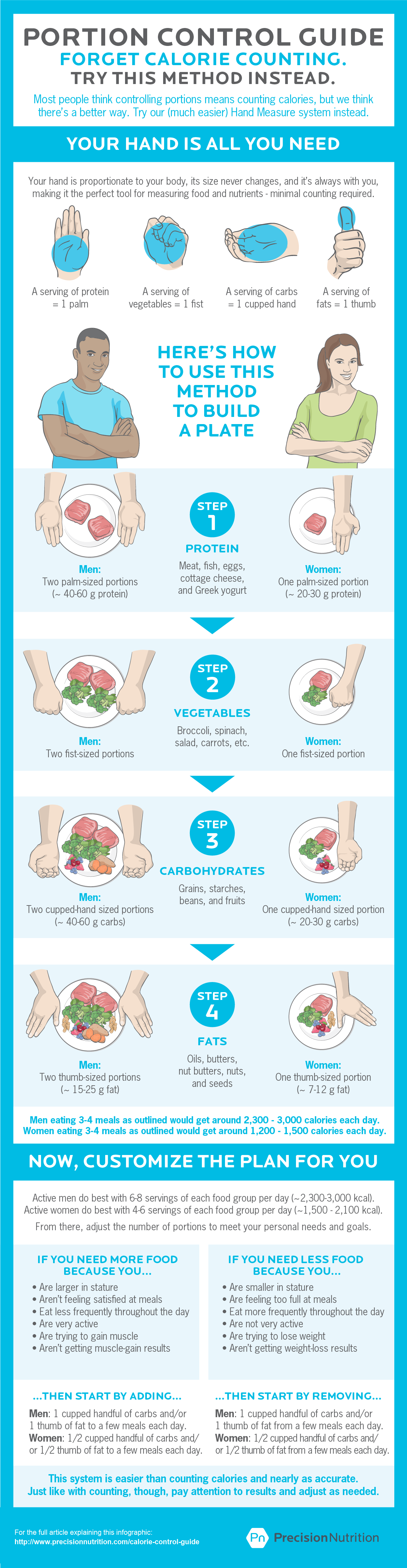
I like Precision Nutrition's method for determining portion sizes

FOR MEN

  • 2 palms of protein dense foods with each meal
  • 2 fists of vegetables with each meal
  • 2 cupped hands of carb dense foods with most meals
  • 2 entire thumbs of fat dense foods with most meals

FOR WOMEN

  • 1 palm of protein dense foods with each meal
  • 1 fist of vegetables with each meal;
  • 1 cupped hand of carb dense foods with most meals
  • 1 entire thumb of fat dense foods with most meals

It's a great starting point, but It's just that, a starting point. If you start to incorporate the hand method of portion sizes, you may need to adjust. If you find that you are very hungry 30 minutes after eating or if you are extremely active, you may need a little more. If you feel stuffed and haven't been as active, maybe a little less. Your needs will always be individual. Pay attention to results and adjust as needed. It's a common sense system that works and doesn't feel like punishment.

When you eat a casserole, obviously, the hand method doesn't work. You can easily eat a thumb-size portion of avocado or almonds (fats), but how do you eat two thumbs of eggs? Does bacon count as a protein or a fat? All good questions. Just remember that it is not meant to be another strict rule to follow, but a general guideline to give you an idea of where to start. You adjust in a way that makes sense to you, then monitor results. If you are lost, consider hiring a nutrition coach to help you on your path. 

GETTING STARTED

Eat slowly and pay attention to your your body's hunger and fullness cues. I wrote a post on mindful eating that may be helpful. (Spoiler alert: for one, put away your cell phone at the dinner table.) Keep a food journal if it helps you better evaluate what you are eating and how certain foods make you feel. 

We sometimes over complicate things. As a starting point, let's work to eat mostly whole, minimally processed foods from nature, while maintaining proper portions. Over time, once this becomes part of your daily habits, along with regular exercise and movement, your weight will most likely reflect your healthy lifestyle. 

I don't mean to oversimplify things either. Our bodies are complicated and each of us is different. We all have individual needs, preferences and lifestyles. Aim to find that sweet spot of sanity and sustainability. What habits can you sustain for the rest of your life? You can start by keeping paying attention to food quality, portion sizes and hunger cues and adjust as needed.

If you love counting calories and it works for you and your lifestyle, then great. I would not advise you to stop doing anything that benefits you as an individual.

It's just that if you are pulling out your hair counting calories, and you're not seeing the results you desire, just know it doesn't have to be that way. You can live a healthy, balanced life and never count a calorie again. 

Need help with your nutrition strategy? Tired of dieting? Want help developing healthy habits while staying sane and balanced? My nutrition and lifestyle coaching program begins in June, get on the list for a big pre-sale discount. 

Like this post? It helps me when you share. 

 

Lea

Coach Lea


The Problem with Cheat Meals and What to Do Instead

I know I've been writing a lot about nutrition lately. It's because I recently finished my Precision Nutrition Sports and Exercise certification. I am discovering that I have this passion to help people with their nutrition. 

THE PROBLEM WITH CHEAT MEALS AND WHAT YOU SHOULD DO INSTEAD

I don't have a problem with adding calorie surplus days, or even indulgence days, I just don't like to call them cheat days. 

Cheat implies it isn't part of the plan. You cheat on your diet. Diets are flawed. You can't cheat on your lifestyle. You may say it's just semantics whether we call it a cheat day or an indulgence day but getting into the right mindset is paramount to success. Psychology is a big part of what is holding people back from reaching their goals. 

When you make a commitment to long term permanent lifestyle changes then there is no more cheating. I prefer indulgence meals or calorie surplus days. 

The reason that calorie surplus days are recommended is if you spend a lot of time in a calorie deficit (consuming less calories than your body needs for maintenance in order to lose weight) your body may down-regulate your metabolism in order to compensate. Your body is smart. When it realizes that that you are consistently taking in less food, it assumes that there is less food available and it adjusts so it doesn't need as much food to live. 

Adding an occasional higher calorie day that meets or exceeds your daily calorie requirements sends the signal to your body that you are not starving and it's ok to keep that metabolism revving. There's no rule that that these higher calorie days have to be junk food days, it's totally possible to get a calorie surplus on healthy food...but what's the fun in that? Hah. 

Indulgence meals are great for the mental aspect too. If you are usually very calculated about what you eat then it can be a mental and emotional break. I am all about balance, if you decide that you will never eat an unhealthy food again, you are setting yourself up to fail. There is always room for indulgences in your otherwise healthy lifestyle. 


5 TIPS FOR HAVING an indulgent meal while maintaining a healthy balance. 

1. No Guilt. 

Savor it. Enjoy it. No guilt.

2. Plan ahead.

When trying your best to live a healthy lifestyle there will always be occasions when sticking to a healthy meal is not reasonable or sustainable. Do you want to tell your Italian Grandma that you can't have her garlic bread, spaghetti and homemade cannoli? Do you want to bring tupperware of chicken and broccoli to your best friend's wedding reception? I didn't think so.

Food is just as much about connection and joy as it is about nutrition. There will always be holidays, special occasions, celebrations and parties. If we miss out on the social and cultural connections over food, then we are missing out on a big part of health and happiness. Plan your indulgence meals around those celebrations and special occasions so you can have the best of both worlds.  


3. Portion control. 

An indulgence meal should not be a license to binge. Think about proper portions and eat slowly until you are 80% full. You will find that you are satisfied on less food, while still enjoying your indulgence. 

I try to make choices on a continuum. Even if I am at a burger restaurant, I think to myself, how can I make this a little bit healthier? Maybe I'll enjoy that burger with a whole wheat bun instead of white. Maybe I'll skip the fries and order a salad on the side or maybe I'll order the fries, but get a veggie burger or salad. I find that I enjoy it just as much and a little indulgence is all I need. 

If you have red flag foods that you know cause you to overindulge, then choose those foods sparingly or not at all. If you can't open a family size bag of chips without polishing it off, then the right choice for you may be to not open that bag. It's up to you. If you struggle with binging, I recommend working with a Registered Dietitian. 

4. The 80/20 Rule.

I'm not good at math, but I try to make healthy choices 80% of the time and indulgent choices 20%. It's not a hard and fast calculation, but generally speaking it is 1-2 indulgence meals a week with maybe a treat thrown in..

Some people eat a strict healthy diet all week and then let loose on the weekends. I'd just ask you to consider if you are having an indulgence meal, an indulgence day or a whole indulgence weekend, every single weekend. If you decide to have indulgence weekends, that's 2.5 days, 35% of your week. I don't think there should be strict rules about when you and can not have indulgences, but if it is all weekend every weekend from Friday night through Sunday night of junk food, then you might consider how that could affect your goals. 

5. Move on.  

Don't allow an indulgence meal to be a trigger for more poor choices.  Do it, love every second of it, and move on to your next healthy meal. This also means that you shouldn't attempt to exercise twice as long or hard the next day to compensate. 

I always say what you do daily matters more than what you do occasionally. It goes both ways, if you eat healthy foods all week, one indulgent meal will not have a big impact on your results and if you eat junk food all the time, then one salad is not going to make a difference either. 

When you find the balance of healthy foods and indulgent foods that you enjoy you really can have the best of both worlds. Eat foods that make you feel good, that taste good and you enjoy. 

DO YOU EAT CLEAN OR DIRTY?

Do you eat clean? It's impossible to say. It means different things to different people. What I do know is that things go south when we moralize our food choices. You're not bad or dirty if you eat a less-than-healthy food and you're not a perfect angel because you made a healthy choice. In fact, orthorexia is a disorder associated with having an obsession with healthy eating. 

We should aim to eat healthy foods from nature most of the time, but we are not bad people for choosing to eat things occasionally simply because they taste good. 

I believe that there are no inherently good or bad foods. Some foods are good for your health, some foods are good for your soul (like Grandma's cannoli), and that's ok in moderation. 

I've personally struggled with balance and yo-yo weight in my 30s. It wasn't until I let go of labels, rules, diets and guilt that I learned the art of balance. Once I went off diets and adopted health as a long term goal, the weight loss (and more importantly, maintenance) was a natural side effect. 

What's your favorite indulgence meal? Mine is sushi and pizza (not together, silly)

What's your favorite healthy meal? I love spaghetti squash and eggs (Again, not together. Although that may be #strangebutgood)

Need help with your nutrition strategy? Tired of dieting? Want help developing healthy habits while staying sane and balanced? Join my nutrition and lifestyle coaching program today.

Like this post? If you agree, I'd love it if you would share.


52 Healthy Habits: A Rant on Sugar, Cocaine and Artificial Sweeteners

One thing I love about writing a blog is it that it gives me a chance to air my grievances (even when it isn't Festivus!) to no one in particular and everyone on the internet all at the same time. 

When things bother me, I usually tell my husband, but when I start to notice his eyes glaze over I know it's time to get it out in writing. He even told me once, "You need to blog about that because I stopped listening 10 minutes ago." Hah. At least he's honest. 

I am not usually someone who rants. I usually keep things that bother me bottled up inside until it explodes...like a normal person. Just kidding. 

Last Friday we had a health fair at my corporate marketing job. It was a half day event when speakers came in to educate us with seminars and they served a delicious healthy lunch. It's a great benefit and I usually look forward to hearing speakers on various topics. It gets me out from my cubicle for a few hours and immersed in the world I love, heath and fitness. 

scenes from our healthy lunch - colorful mini peppers.

scenes from our healthy lunch - colorful mini peppers.

One of the speakers was a doctor. When you have some letters behind your name and a book under your belt you command a certain amount of respect and authority. Everything started out great. He showed us a sugar cube that equaled four grams of sugar. He taped plastic baggies of these sugar cubes to popular food products that are often marketed as healthy options. That box of organic bran cereal? Six cubes (24 grams of sugar) per serving...and watch out, that serving size is only 3/4 cup. So-called healthy yogurt? As many sugar cubes as a can of Coke. It can be eye-opening for someone who never really thought about hidden added sugars in their diet.

It was a great visual representation of the amount of sugar in processed foods and how, if we don't pay attention, the sugar adds up quickly and can hurt our health and body composition. It is a an important message that most people need to hear, but this is where things went south, in my opinion. 

He then recommended to replace the sugar in our diet with artificial sweeteners (he said he preferred to call them sugar substitutes) and not to eat any foods with more than 2 grams of sugar per serving, and this is where he really lost me....not even fruit.

He suggested that when you are in the produce section of the grocery store to think of bananas and grapes (and sometimes apples) as bad and berries as good. My takeaway from his message was that all sugar is bad and artificial sweeteners are the solution to the sugar problem because they do not spike blood sugar or raise insulin levels. 

He said sugar causes the same reaction in the brain as cocaine. Message received doc, Cocaine bad = Fruit bad. 

Look, I'm no doctor. This guy is clearly educated. He went to medical school and treated cancer patients. I respect that level of commitment and service. I went to a community college and have some personal training and nutrition certs. He obviously is far ahead on the education front. But I have something he has seemed to miss: Common sense, or at least context. 

It is irresponsible to tell the general population that fruit is bad and artificial sweeteners are the solution to the sugar problem. Yes, bananas are high in natural sugars but they are also nutrient-rich and have benefits. Are there better things you could eat? Maybe. But is it the worst choice? Absolutely not. Is natural sugar as bad as cocaine? Let's not be ridiculous. (To be fair, he didn't say that directly.) No matter what your health and fitness goals are, a banana, a cupped handful of grapes or an apple is generally a good, healthy choice for most people.

I like to look at all foods on a continuum. What food choice would be a little bit better? What food choice would be worse? If we are always inching towards making healthier, better choices, we are on the right track. We have to get away from all the all-or-nothing, it's either good or it's bad mentality. 

NUTRITION INFO

One small-to-medium sized banana (100g) contains about 89 calories, 1.10g protein, 0.33g of fat, 22.84g of carbohydrates, 2.60g of fiber, and 12.23g of sugar.

Bananas are rich in potassium, vitamin C, and manganese.


We can get into a discussion about high level athletes or physique stage competitors with body composition goals and how eliminating certain foods (temporarily!) can help them meet these aesthetic goals. However, in the context of our health fair, we are talking to office workers who are sedentary for at least eight hours a day looking to improve their lifestyle and eating habits. For general health and weight loss, moderate amounts of fruit is A-ok.

Most people eat a poor diet and a piece of fruit would be an improvement on a daily snack. Herein lies the problem: If you label fruit as bad, and you already know that a Snickers bar is bad, maybe you would just choose the snickers bar because it tastes better. After all, they are both bad, right? Um. No. 

When people start to label food as good or bad it causes all kinds of problems. It can lead to nutrient deficiencies and maybe worse, disordered eating or thinking. Especially when things get labeled as bad that are, in fact, nutritionally beneficial. For health (body and mind) we should aim to eat a wide variety of whole, minimally processed foods that we enjoy, in proper portions.

We are not talking about the nuisances of food intolerances, diabetes or other outliers. My problem is telling a room full of office workers that fruit is a generally a bad choice for them.

Nutrition isn't as hard as the industry would have us believe. It's just that there are so many mixed messages, that people start to get confused. Most people don't need to worry about the possible downside of eating a piece of fruit because they are still drinking soda, eating processed foods or restaurant meals on a regular basis and sleeping five hours a night. Let's work on improving the basics before we start talking about advanced diet strategies. 

On the subject of artificial sweeteners, I don't mind artificial sweeteners...wait for it...in moderation. Like anything else, what you do every day is more important than what you do occasionally. I happen to like the taste of Diet Coke, probably because I drank it most of my adult life. These days, I don't drink it often, but when I am craving a Coke, I go for the diet option. If I preferred the taste of regular Coke I would go that route. It is an occasional indulgence, not an everyday activity. For me, it's no problem.

I don't, however, recommend artificial sweeteners as a solution to your sugar problem. They are probably fine for most people in moderation, but we should be aiming to move towards whole natural foods whenever possible. If the problem is too much sugar, let's fix the problem by reducing added sugar intake (mostly by reducing processed foods), not just band-aid it by replacing all of our sugar intake with artificial sweeteners. 

I am all about balance, finding that sweet spot of sanity and sustainability. What healthy foods do you enjoy eating? Eat more of those. What not-so healthy foods make you feel like crap later? Eat less of those. Learn to tune in to your body's natural signals. If a less-than-healthy (notice I didn't say 'bad') food brings you joy, then definitely enjoy it in moderation without guilt. It sounds overly simplistic, but when nutrition is so far off track, it's exactly what we need: simplicity. 

I'm no smarty pants doctor but if you like bananas, go ahead and eat them. 

For my 52 Healthy habits this week, I encourage you to eat a piece of healthy, natural fruit every day this week, limit added sugars and artificial sweeteners and oh yeah, don't use cocaine. How's that for health advice? Who wants to hire me to speak at their health fair? My presentation will be called 'A Rant on Sugar, Cocaine and Artificial Sweeteners' Hah. 

Seriously. Need help with your nutrition strategy? Tired of dieting? Want help making healthy choices part of your lifestyle while staying sane and balanced? My nutrition and lifestyle coaching program begins in June, get on the list for a big pre-sale discount. 

Do you agree? I'd love it if you would share.